- The paper presents a cryptographically sealed delegation mechanism that mitigates power imbalances and prevents herding effects in liquid democracy.
- It employs timed-release encryption combined with ranked multi-delegation and fallback ballots to ensure auditability and robust resilience against delegate failures.
- Empirical evaluations on participatory budgeting and U.S. electorate data confirm enhanced outcome accuracy and structural integrity even under targeted attacks.
Secure Delegation Networks for Resilient Liquid Democracy: Summary and Implications
Introduction
This paper proposes a novel approach to liquid democracy, addressing two well-documented systemic vulnerabilities: (i) the concentration of power and herding effects that stem from transparent delegation networks, and (ii) fragility in the presence of delegate failures. The authors introduce a cryptographically secure delegation mechanism that utilizes timed-release encryption to seal delegation relationships during formation, combined with ranked multi-delegation and fallback ballots to enhance resilience. The theoretical, cryptographic, and empirical analysis delineates the precise structural and representational impacts of this mechanism, establishing a new benchmark for both practical deployments and future theoretical developments in democratic decision systems.
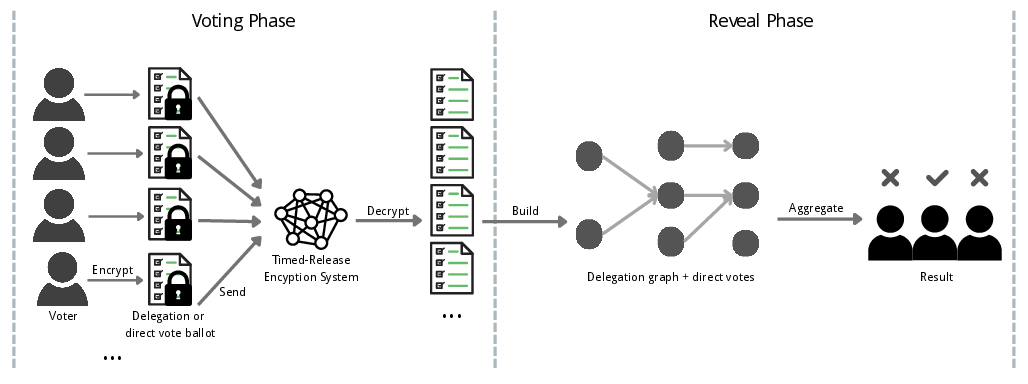
Figure 1: System workflow of the proposed sealed liquid democracy mechanism. In the voting phase, voters encrypt and submit their policy tuples to the ledger; in the reveal phase, all encrypted ballots are decrypted and the system computes the final outcome.
Cryptographically Sealed Delegation: Mechanism Overview
The proposed system leverages decentralized timed-release encryption (TRE) to ensure that all delegation relationships and ballots submitted during the formation phase remain cryptographically hidden until a designated reveal time. This removes all contemporaneous popularity signals, thereby suppressing herding and bribery predicated on observable support. The core process involves:
- Voters encrypting policy tuples—including an ordered list of delegates and an optional fallback direct ballot—using TRE with an enforced reveal time.
- Submissions posted to a public, append-only ledger; only the latest valid submission per voter is admissible.
- After the reveal time, decryption is enabled via a decentralized committee, restoring transparency and public auditability for the tally phase.
- Vote resolution is deterministic, with delegation chains followed in order of ranking, explicit cycle-breaking rules, and robust handling through fallback ballots.
The system satisfies post-reveal auditability, deterministic resolution, and robustness to single-point delegate failures, with formal proofs for both pre-reveal secrecy and receipt-freeness under standard cryptographic assumptions.
Structural and Representational Effects
The empirical evaluation utilizes real-world participatory budgeting and U.S. electorate datasets, examining the behavioral and structural properties of the proposed system under both sealed and transparent regimes.
Delegation and Representational Accuracy
Delegation improves outcome accuracy only when abstention is both sizable and unrepresentative, a finding captured by the "recoverable-gap" law. Specifically, delegation is beneficial solely in settings where a large, systematically skewed abstaining group can be reintroduced via trusted delegates. Otherwise, delegation is neutral or actively deleterious—especially when delegating to an elite on the basis of objective competence when abstention is demographically balanced. Representative-style delegation (where delegates aggregate constituency views) is empirically safer than naïve expert delegation.
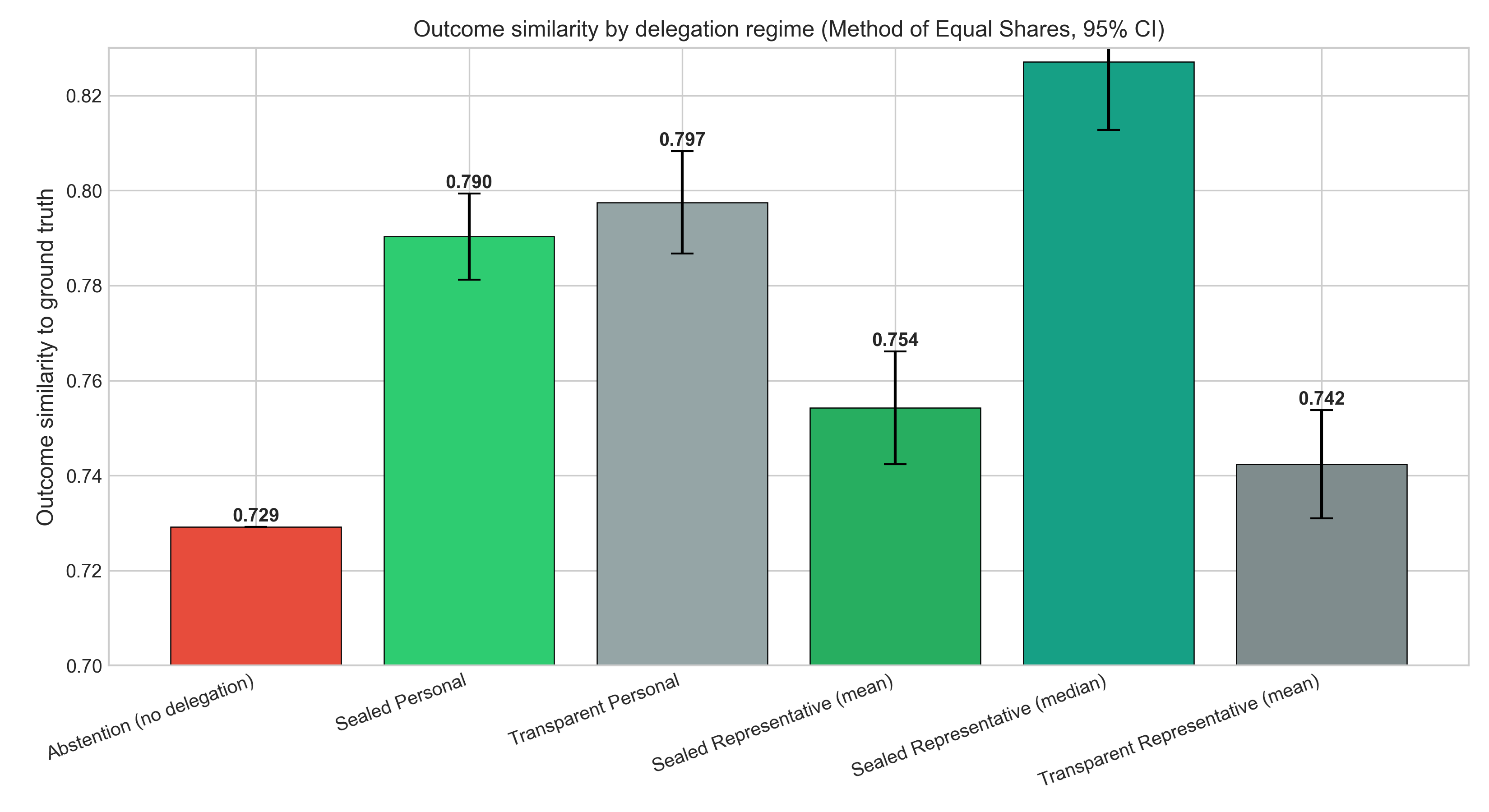
Figure 2: Outcome accuracy (agreement with the 1704-voter ground truth) by delegation regime; all regimes improve upon the abstention baseline, but sealed and transparent personal regimes yield statistically comparable results, while median representative delegation is strongest.
Moreover, the empirical generalization across 20 participatory budgeting elections and a 60,000-voter U.S. survey confirms this conditionality; large-scale gains appear only when a sharp divergence exists between abstainers and the full electorate.
Timing and Conditional Effects of Delegation
The benefit of delegation scales strictly with the "recoverable gap"—the outcome difference caused by abstention—which is controlled by the size and representativity of abstainers. When this gap is absent or minimal, expert delegation can misalign the outcome rather than recover it.
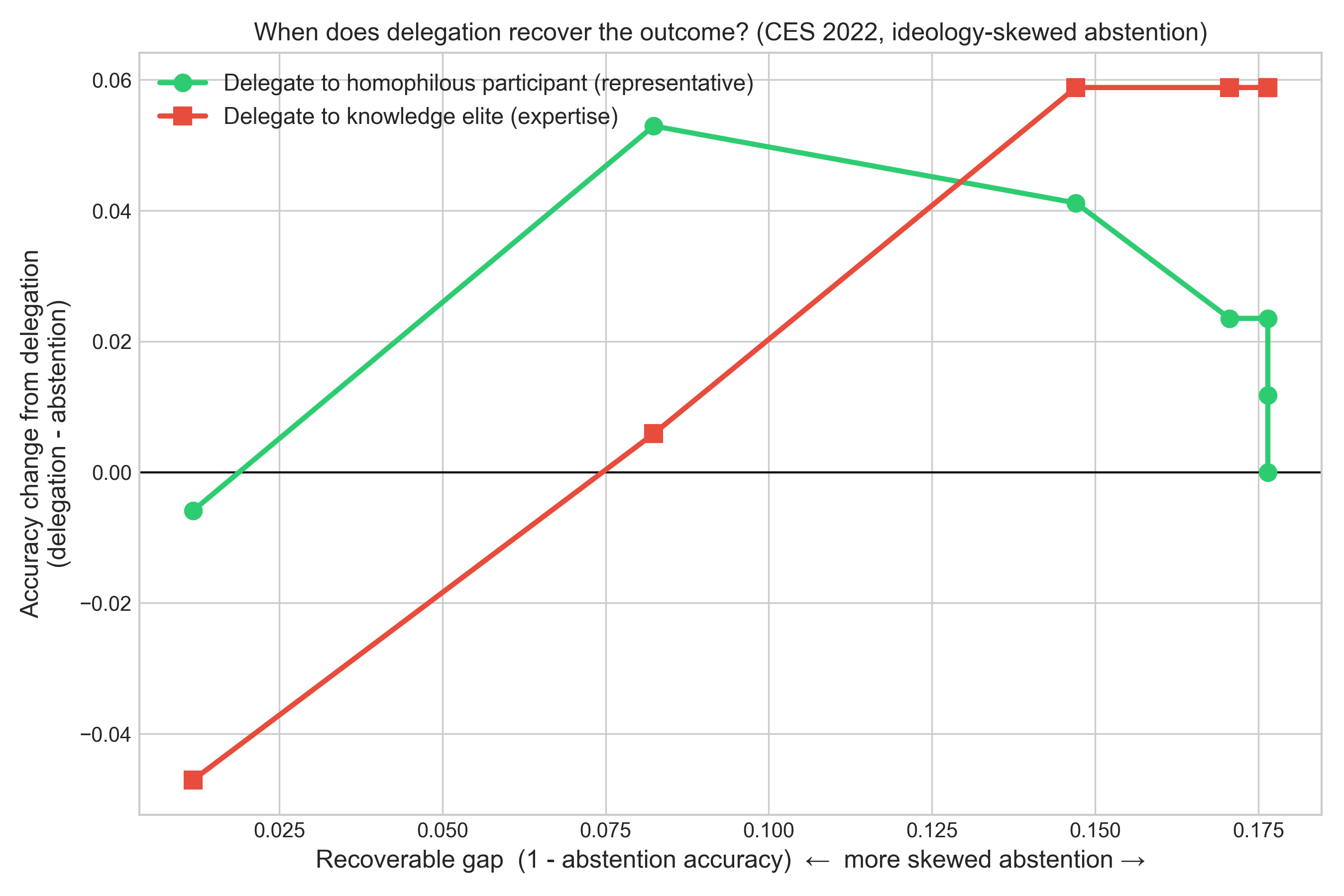
Figure 3: When delegation recovers the outcome, as a function of the recoverable gap γ=1− (abstention accuracy); representative delegation is advantageous at low gap, expertise-based delegation dominates only under extreme abstention skew.
Crucially, the visibility regime (sealed versus transparent) makes only a negligible difference in outcome accuracy in non-transitive, two-level settings. The primary empirical impact of sealing is structural.
Structural Robustness: Herding and Power Concentration
The sealed regime fundamentally alters the evolution of delegation networks by eliminating contemporaneous popularity cues. In transitive delegation models, this difference is profound:
- Transparent regimes inevitably collapse into extreme oligarchies—one or few super-delegates absorbing most voting power—via rich-get-richer dynamics.
- Sealed regimes prevent such runaway centralization, maintaining distributed power across many local delegates and thus preserving robustness against targeted manipulation or malfeasance.
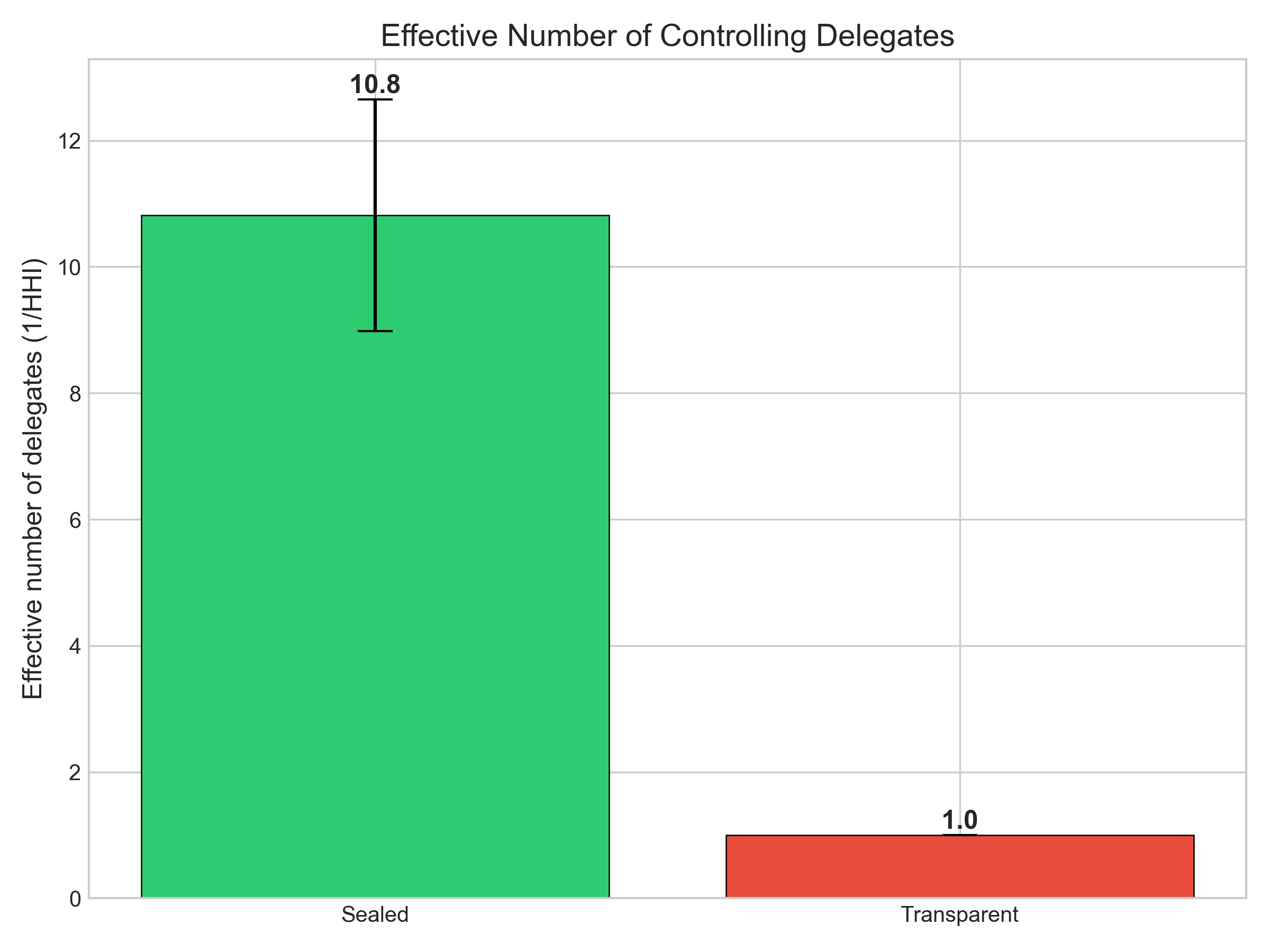
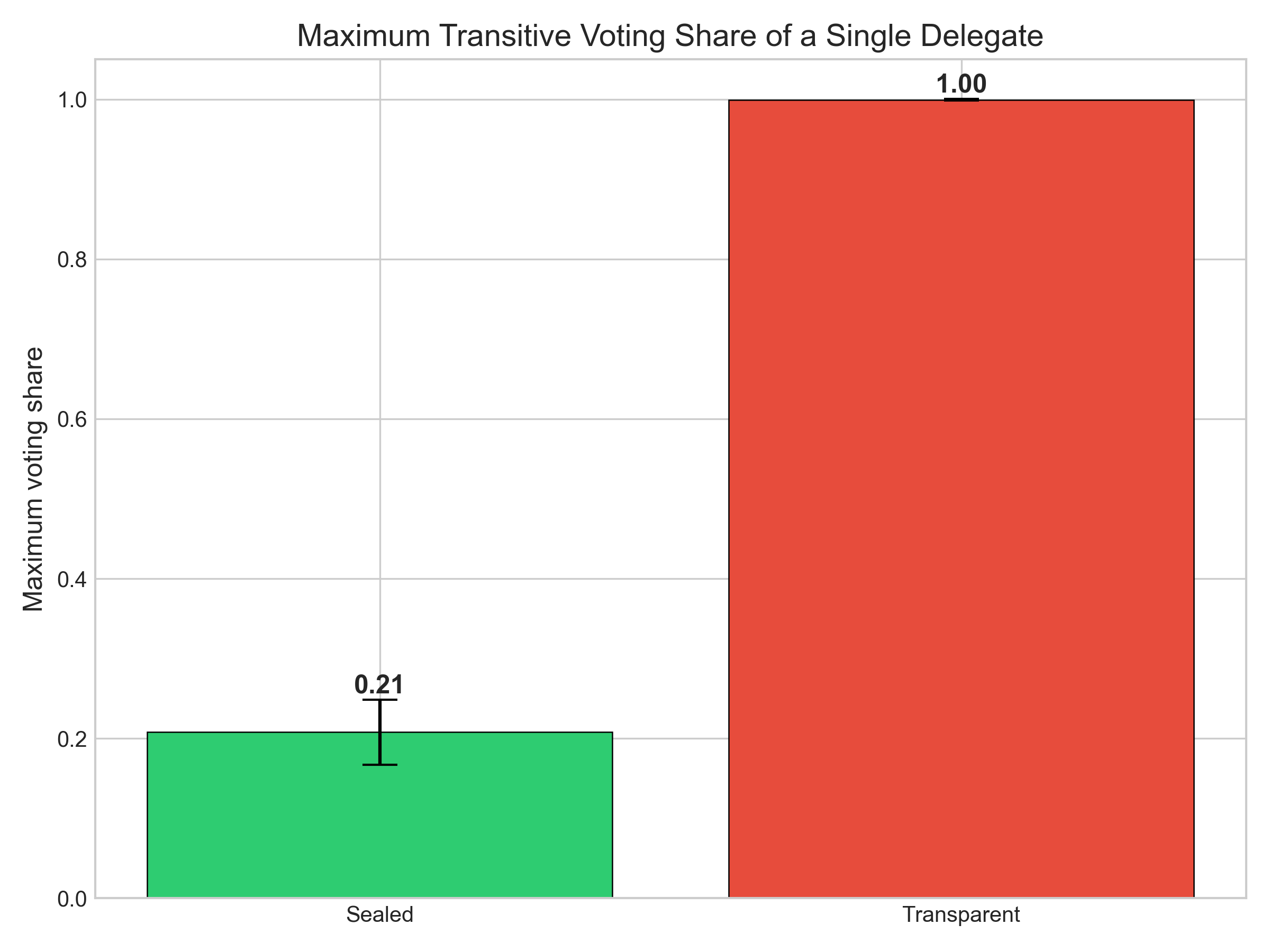
Figure 4: Voting power concentration under sealed versus transparent delegation in the transitive delegation model; transparency results in a single controlling delegate with ~100% power, while sealing distributes power (effective number of delegates ≈ 11).
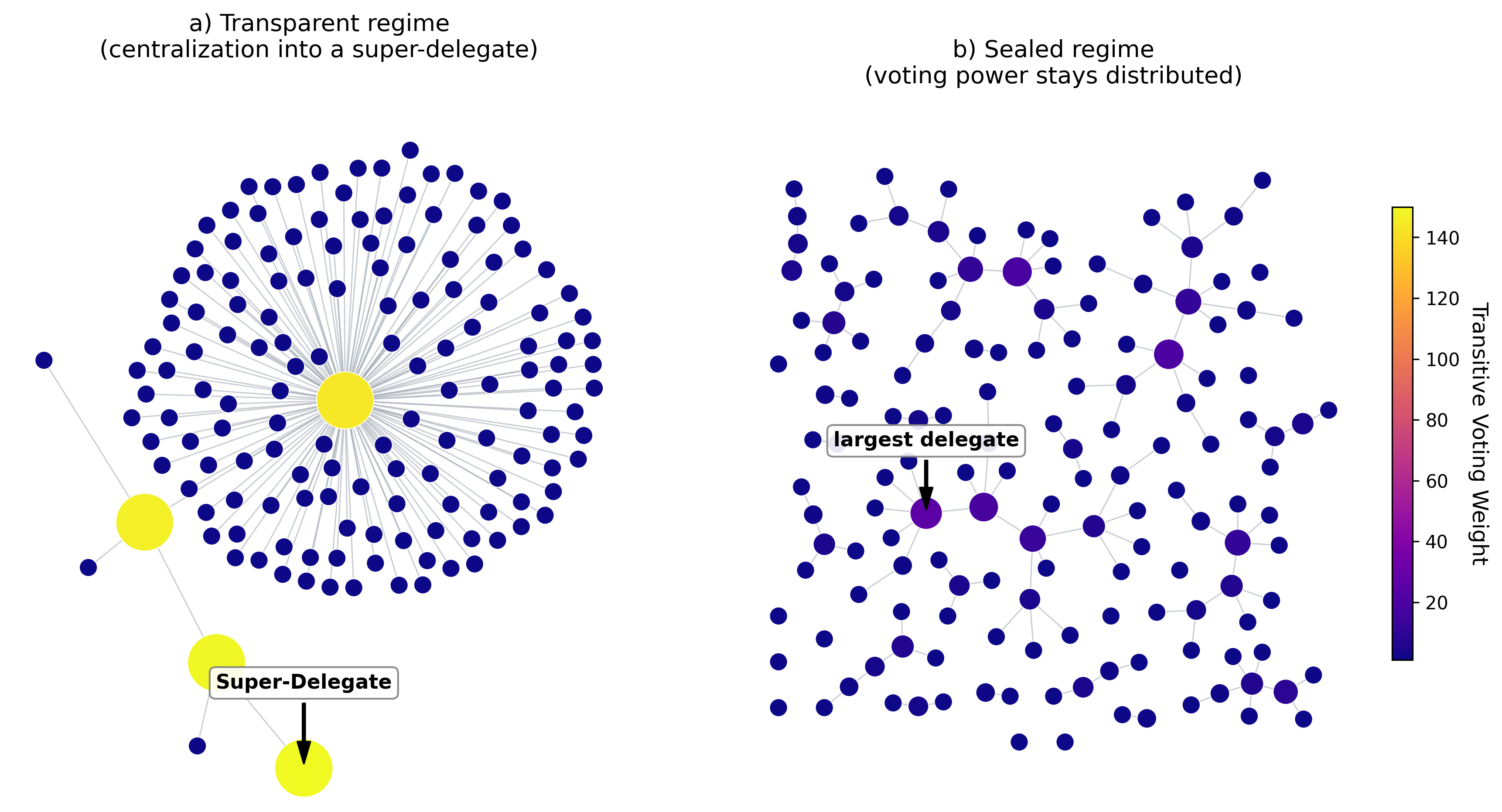
Figure 5: Delegation graphs in the transitive model; transparent regime yields a highly centralized super-delegate (left), while the sealed regime retains distributed voting weight (right).
Robustness to Delegate Failure
A key technical innovation is the integration of ranked multi-delegation and personal fallback ballots. This structure converts the delegation network from a brittle, single-point-of-failure system to a maximally resilient routing mechanism. The empirical findings are strong and consistent:
- Under targeted attacks removing up to 30% of top delegates, a single-delegate design can lose up to 26–30% of voter influence.
- Ranked delegation with fallback ballots reduces this vote loss to approximately 3%, a result that replicates across all tested elections and failure modes.
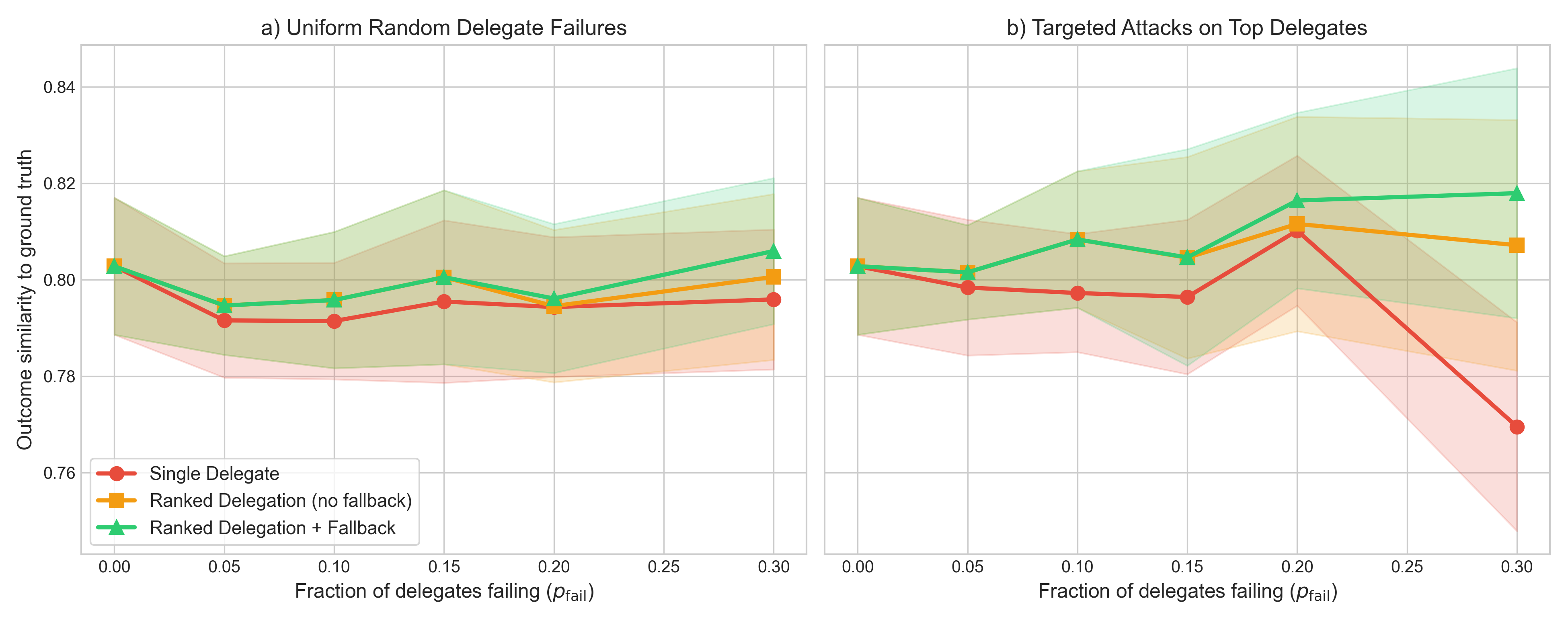
Figure 6: Outcome accuracy degrades sharply for single-delegate designs under targeted attacks, whereas ranked delegation with fallback ballots is robust.
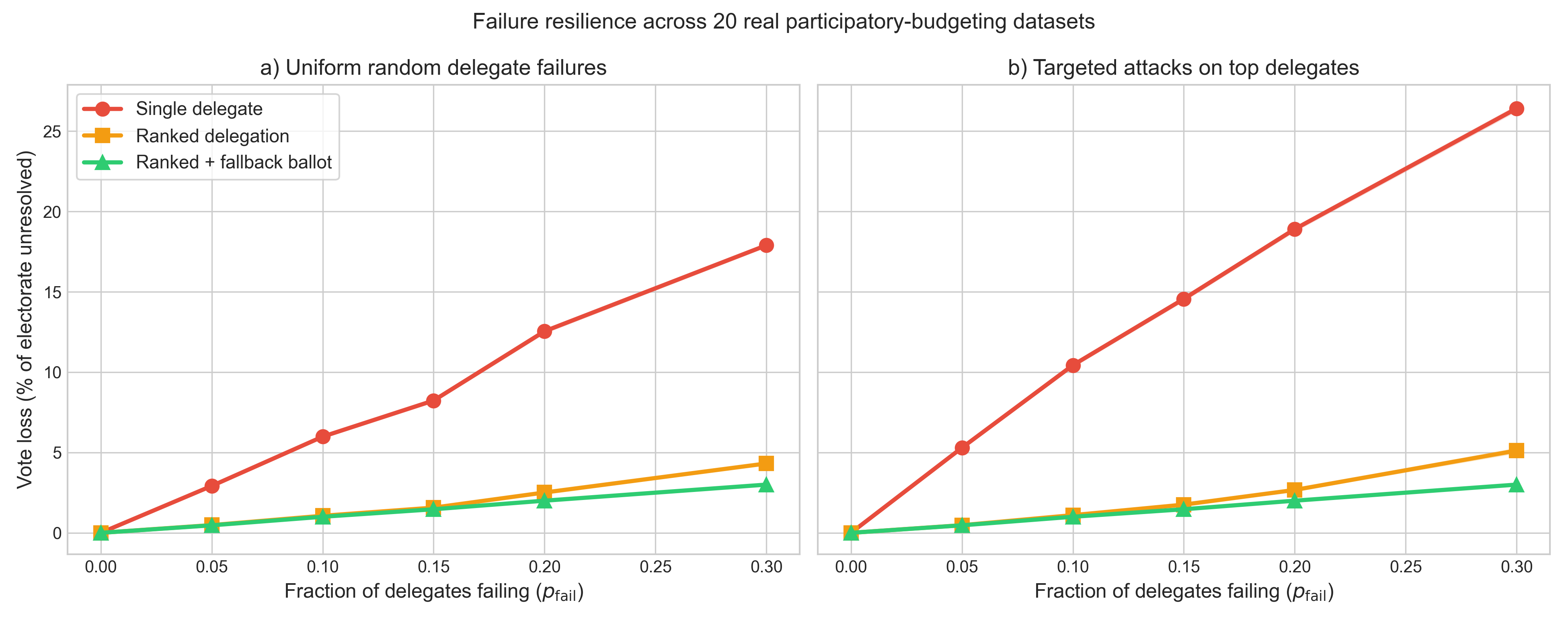
Figure 7: Vote loss under delegate failures across 20 participatory-budgeting datasets; ranked delegation with fallback remains below 3% loss even for 30% targeted delegate failures, vastly outperforming single-delegate approaches.
Sensitivity and Parametric Robustness
The core findings persist across a wide range of homophily and herding parameters; outcome accuracy is insensitive to the choice of demographic affinity weights, while herding exponent variations corroborate the link between visibility, popularity reinforcement, and concentration.
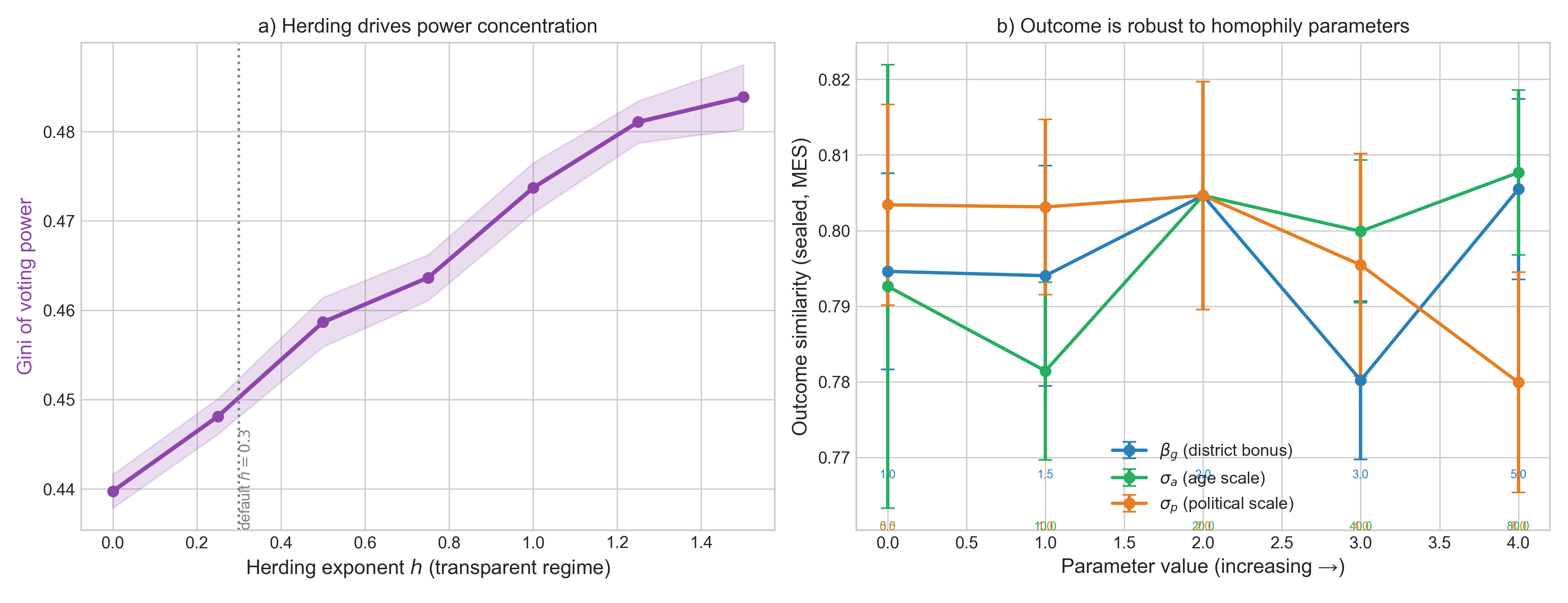
Figure 8: Sensitivity analysis demonstrates that power concentration in the transparent regime rises with herding exponent, while accuracy for sealed regimes is stable across homophily parameters.
Theoretical Implications and Future Directions
The paper’s security analysis formally establishes the protocol’s pre-reveal secrecy and receipt-freeness under reasonable adversary models. The decentralized time-based cryptographic primitive enables sealed formation without sacrificing ex post public verifiability, a design that is compatible with both civic and decentralized (blockchain-based) governance systems. Conceptually, this proposal articulates a new transparency timing principle: secrecy during formation to preserve independent judgment and prevent manipulation, followed by immediate public auditability after commitment.
Practical implications include:
- Deployments of robust, manipulation-resistant liquid democracy in large civic platforms and blockchain DAOs.
- Design of privacy-preserving DAOs and e-governance tools that are resilient to social attacks and coercion, while supporting flexible fallback and rerouting under failures.
- Field experiments to validate behavioral effects of sealed delegation, further empirical analysis of multi-level delegation networks, and integration with scalable ZK-rollup implementations for efficiency.
Conclusion
This research isolates and resolves the core vulnerabilities of liquid democracy as deployed in both civic and decentralized digital institutions. The sealed formation protocol, underpinned by timed-release cryptography and robust ranking/fallback mechanisms, sharply reduces power concentration, eliminates herding incentives, and guarantees resilience to delegate failures—without sacrificing auditability or representational accuracy in legitimate settings. The findings demarcate the precise conditions under which delegation is beneficial and establish resilient, auditable, and manipulation-resistant delegation as a practically deployable standard for the next generation of democratic and decentralized decision platforms.

