- The paper presents WM-SAR, a spectral repair algorithm that identifies minimal causal subgraphs to minimize error amplification in agent rollouts.
- It leverages GEAF, node-edge coupling, and spectral relief to construct repair regions that efficiently reduce the spectral radius and enhance stability.
- Empirical results show WM-SAR achieving near full-graph spectral-radius reduction with significantly lower context cost, outperforming traditional patching methods.
Stable Correction of Amplifying Failures in Agent World Models via Spectral Region Selection
The paper "Repair the Amplifier, Not the Symptom: Stable World-Model Correction for Agent Rollouts" (2607.01767) rigorously addresses the challenge of stabilizing failed rollouts in LLM-driven agent systems that maintain large, executable world models as planning graphs. With increasing adoption of graph-structured world models and long-horizon automated agents, failures are increasingly hard to localize: observed errors often do not indicate causal defects, and naive remediation can leave underlying amplification channels intact, leading to recurring instability across rollouts.
The study formulates world-model correction as selecting a minimal, connected subgraph within a failed planning graph such that its repair stabilizes subsequent rollouts. Unlike standard engineering correctors which prioritize immediately visible node errors via pointwise heuristics, the proposed approach targets the spectral characteristics responsible for error amplification through the graph structure itself.
The Spectral Theory of Rollout Error
Central to the paper is a rigorous spectral analysis of error propagation in graph world models (GWMs). The theoretical framework decomposes rollout error growth into two factors: one-step local error and structural amplification characterized by the spectral radius of the error propagation operator.
The key result establishes that the spectral radius ρ(B) of a coupled node-edge error operator B determines whether rollout errors decay or amplify. If this quantity is not minimized by repair, future rollouts remain susceptible to compounding failures, irrespective of local corrections to high-error nodes. The theory formally links ρ(B) to an upper bound on planning regret, demonstrating that repair should focus on subgraphs whose modification most decreases this spectral radius, thus maximizing stabilization.
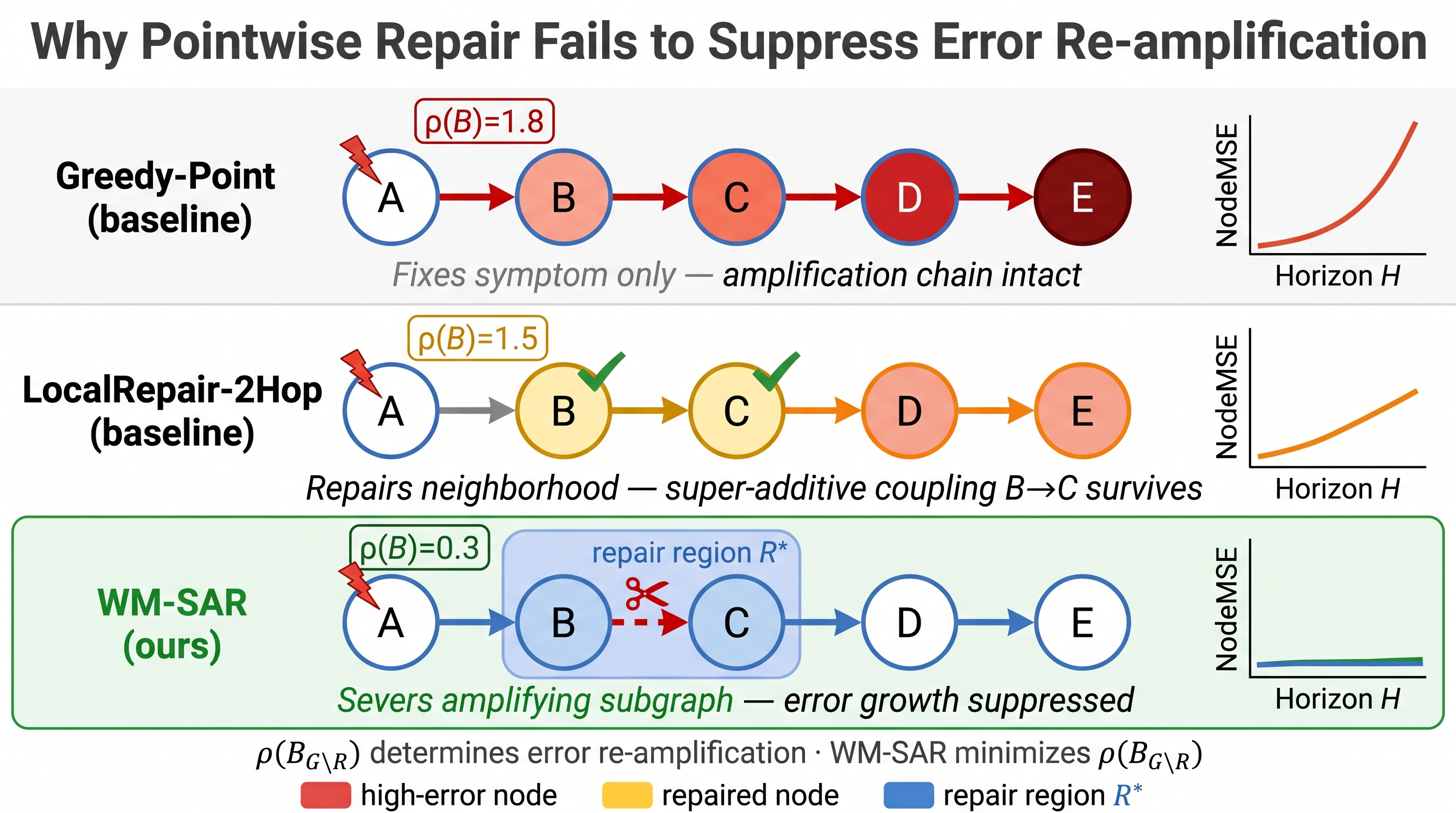
Figure 1: Targeting the amplifier rather than the symptom—WM-SAR identifies and repairs the minimal causal path, suppressing long-horizon error amplification.
The WM-SAR Algorithm
Graph-Theoretic Region Selection
The paper introduces WM-SAR (World-Model Subgraph Amplification Repair), a spectral-repair algorithm that operationalizes the theory above. Rather than relying on visible node errors, WM-SAR synthesizes three quantities for each node:
- GEAF (Graph Error Amplification Field): Local estimation of how much a node and its neighborhood amplify error, quantified via the local spectral radius.
- Node-Edge Coupling (κv): Encodes to what extent a node is critical in propagating error across message-passing and structural channels.
- Spectral Relief: The marginal reduction in residual spectral radius from including the node in the repair region.
The algorithm seeds region candidates with high GEAF×coupling scores, then greedily grows a connected region to maximize spectral relief per budgeted node, prunes redundant nodes, and finally serializes this subgraph for downstream LLM repair.
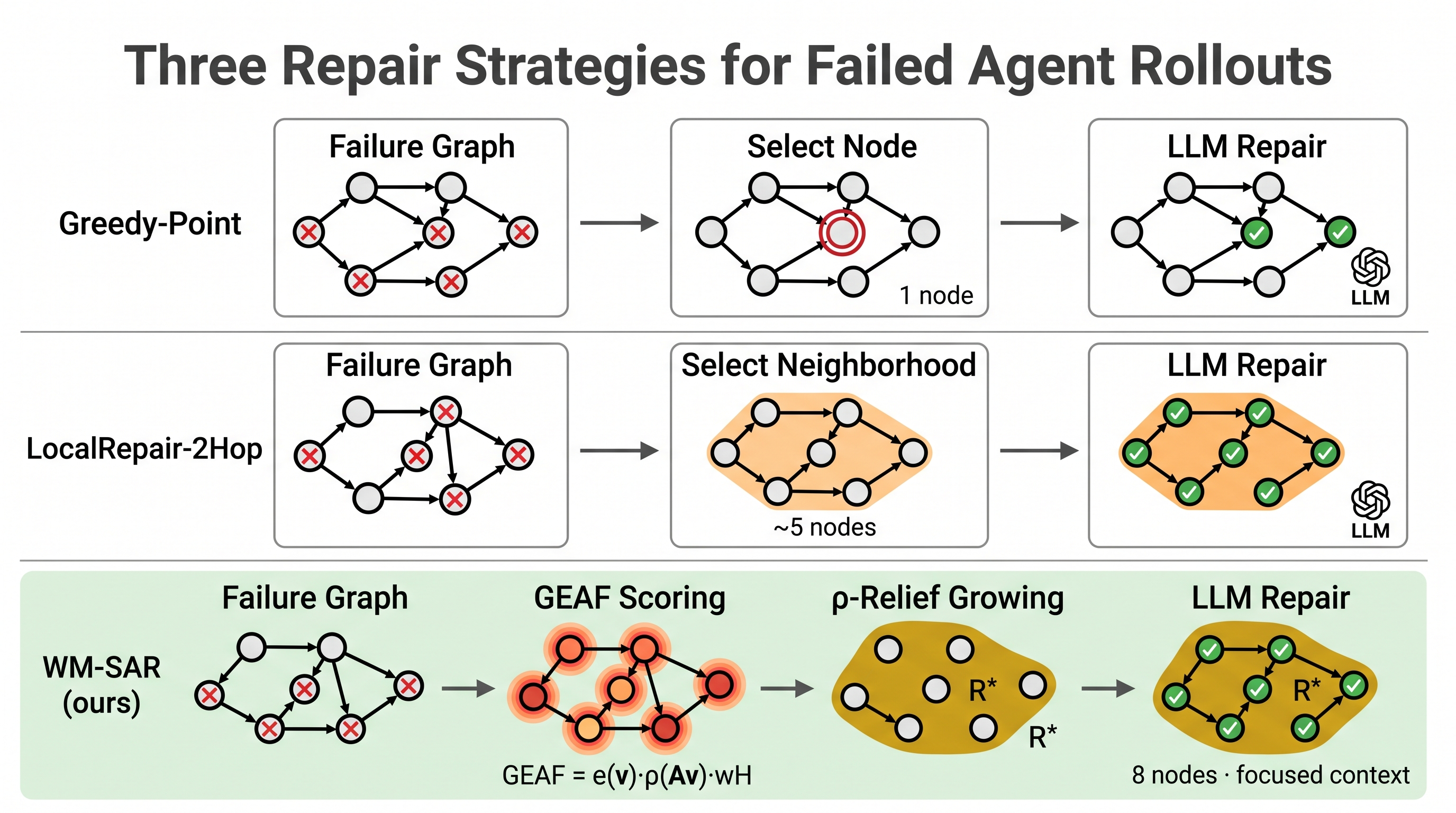
Figure 2: WM-SAR's workflow, combining geometric scores and spectral relief to select compact, causal repair regions.
Downstream LLM Repair
After region selection, only the WM-SAR-minimized causal fragment is provided to the LLM, narrowing the repair context to the highest-signal subgraph. This contrasts with whole-graph prompting or sliding-window engineering baselines, which either overflow context or dilute signal with irrelevant details.
Empirical Evaluation and Results
Synthetic and Benchmark-Inspired Rollout Graphs
Experiments on synthetic calling-tree graphs and benchmark-inspired topologies (e.g., SWE-bench, WebArena, AgentBench-OS) consistently demonstrate that engineering correctors, which patch top-K error nodes, scan temporal windows, or expand local neighborhoods, repeatedly fail to reliably suppress error amplification. In contrast, WM-SAR with an average repair region of 8.3 nodes achieves:
- Normalized spectral-radius reduction near that of whole-graph repair (Δρ≈1.95) with a fraction of the context cost,
- Flat long-horizon NodeMSE trajectories, indicating elimination of compounded error growth through the repaired region,
- Highest exact root-cause recovery by LLMs under tight token budgets, surpassing all engineering baselines and matching full-graph repair with less than half the token usage.
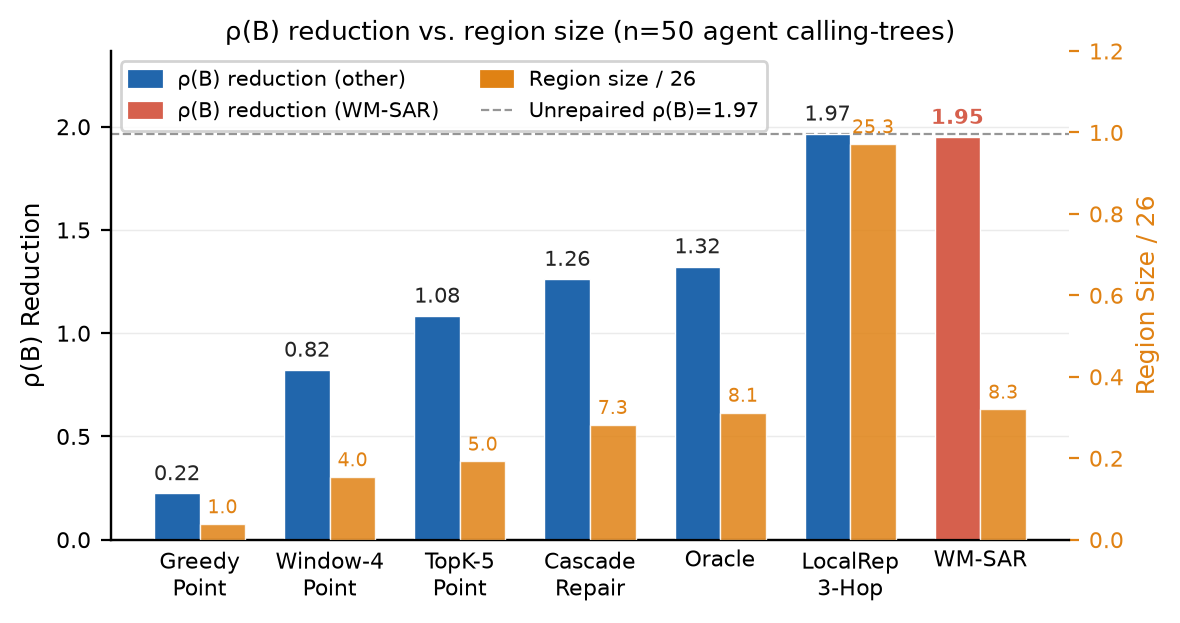
Figure 3: WM-SAR achieves maximal spectral relief with compact regions, while engineering baselines expend repair budget on symptoms with minimal impact.
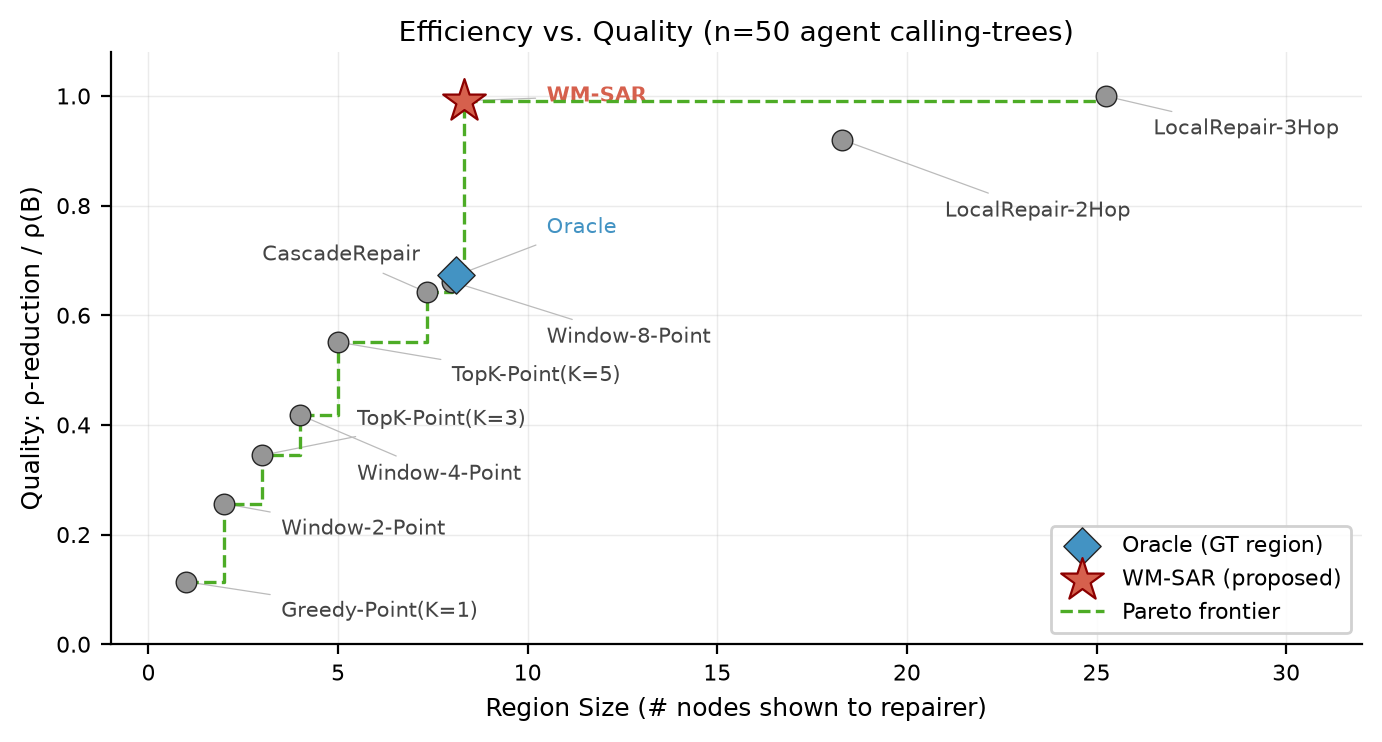
Figure 4: WM-SAR consistently lies on the region-size vs. repair-quality Pareto frontier, omitting irrelevant nodes.
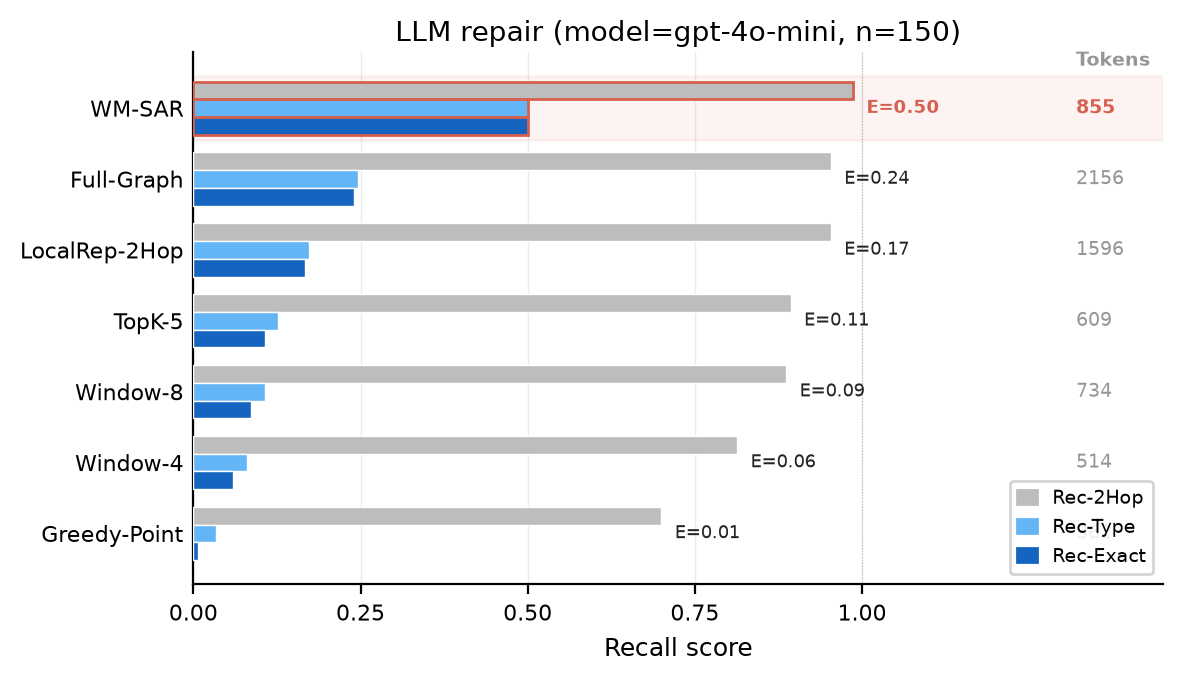
Figure 5: On GPT-4o-mini, WM-SAR maximizes exact root-cause recovery using only an 855-token region.
Cross-Model and Robustness Studies
Cross-model LLM repair (GPT-4o-mini, GPT-4o, Gemini-2.5-Flash) confirms that WM-SAR's advantage derives from structurally principled context selection and is not a quirk of any singular API.
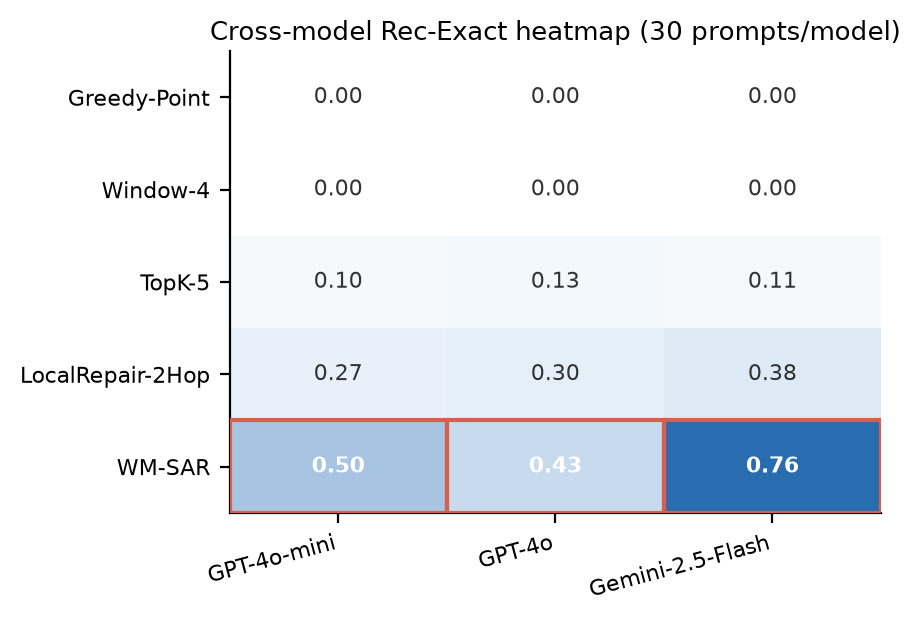
Figure 6: Across all LLMs, WM-SAR yields the highest root-cause recall.
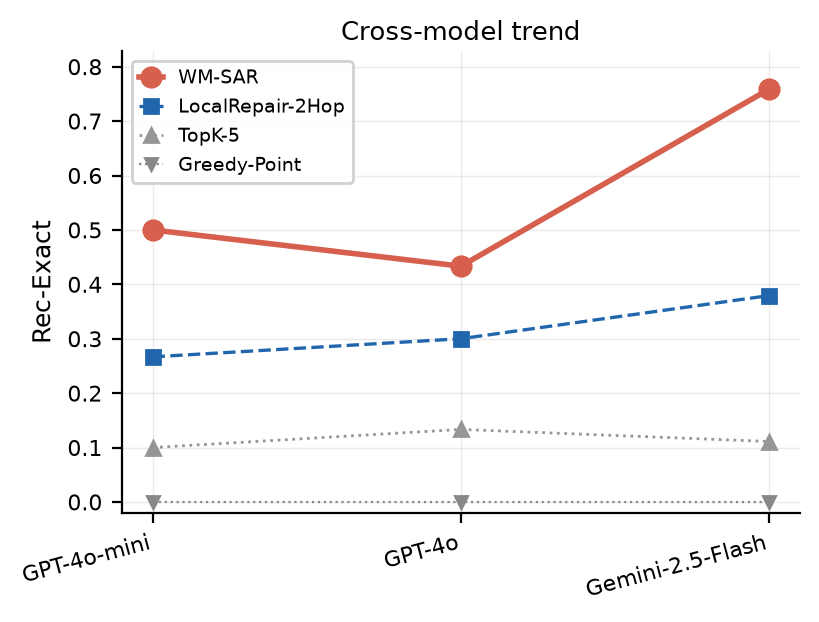
Figure 7: Context selection advantage of WM-SAR persists across diverse LLM APIs.
Additional studies show WM-SAR's efficiency under explicit region-size budgets (Figure 8), robust performance across increasing cascade gain (Figures 9, 10), and strong generalizability to realistic agent graph structures.
Limitations and Applicability
The method's scope is currently limited by reliance on per-node intermediate error magnitudes and evaluation on synthetic datasets. In blackbox attribution settings where only terminal outcomes are available (e.g., the Who{content}When benchmark), WM-SAR's structural advantage effectively disappears.
The repair operator implemented (zeroing node errors) is a surrogate for re-invocation or targeted tool correction, and extensions to edge-structure correction or real-world, human-attributed traces remain as future work.
Implications and Future Directions
This work establishes spectral repair—specifically, actively minimizing the error-propagating modes of the residual world model—as the objective for stabilizing agent rollouts, in contrast to symptom-driven correction. The implications are theoretical (a new, operator-theoretic approach to repair in large, structured agent systems) and practical (enabling compact, compute-efficient correction plans in the face of ever-growing world-models and context lengths).
As agents become more persistent and their underlying world models increase in expressivity and scale, future systems will need to integrate spectral region selection, potentially with end-to-end learned spectral predictors, for robust, token-efficient repair. There is an open avenue for integrating parametric GWM estimates, uncertainty-aware correction, and live deployment against real agent trace logs.
Conclusion
The paper delivers compelling theoretical and empirical evidence that stabilizing agent rollouts in large planning graphs requires targeting the amplification subgraph—the minimal causal region governing future error propagation. The proposed WM-SAR method achieves this via spectral analysis and region-growing, providing robust, token-efficient correction that outperforms both traditional engineering correctors and large-context LLM repair. These findings chart a path toward operator-theoretic maintenance of long-horizon world models in autonomous agents, with direct consequences for reliability and efficiency in complex, scalable AI deployments.