- The paper demonstrates how native defects in CaO affect optical and electronic properties by quantifying formation energies and migration barriers via SCAN and HSE functionals.
- The study employs large supercells and the cNEB method to accurately model defect kinetics and reveal stable complexes under varying stoichiometric conditions.
- The analysis directly maps defect energetics to experimental absorption/emission peaks, providing insights into defect-induced optical transitions in CaO.
Density Functional Theory Investigation of Native Point Defects in CaO
Introduction
The structural, electronic, and optical properties of native point defects in calcium oxide (CaO) have significant implications for the material's potential applications as a gate oxide in semiconductor devices and as a host for solid-state quantum defects. This paper provides a comprehensive first-principles density functional theory (DFT) study of the relative stability, migration kinetics, and optical activity of native point defects and defect complexes in CaO, with a particular emphasis on their role under varied stoichiometric conditions and implications for quantum coherence.
Methodology
DFT calculations were performed using the SCAN meta-GGA functional, which improves upon standard GGA in both structural and energetic predictions. Defect energetics were computed in large supercells to minimize spurious interactions. For accurate optical transition energies, hybrid functional calculations (HSE) were employed in a one-shot fashion, using geometries and charge states identified by SCAN. Migration barriers were calculated via the climbing-image nudged elastic band (cNEB) method, enabling direct estimation of the thermal activation conditions for defect mobility.
Bulk Properties of CaO
The computed lattice constant (a=4.80 Å) and formation enthalpy (ΔHf=−6.50 eV) agree closely with experimental values, affirming the reliability of the simulation framework. The SCAN band gap (Eg=4.15 eV) underestimates the experimental value (7.09 eV) but offers a quantitatively improved picture over conventional GGA-based calculations.
A systematic investigation of vacancies, interstitials, and antisite-like defects was conducted. Defect formation energies as a function of the Fermi level and chemical potential bounds (O-poor/Ca-rich, Ca-poor/O-rich, and intermediate) were analyzed.
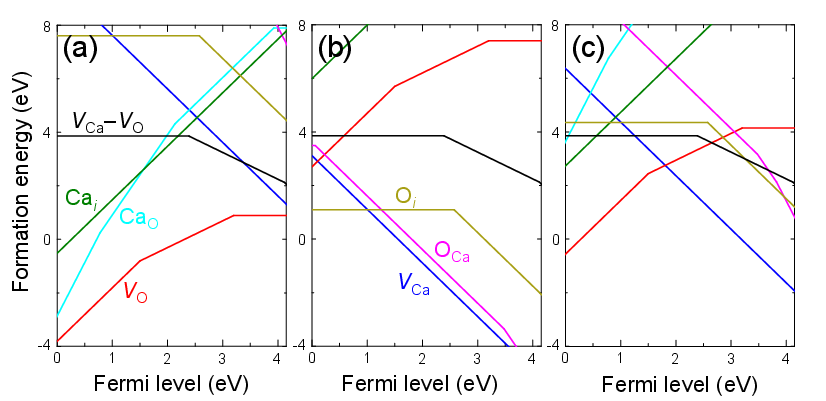
Figure 1: Formation energies of native point defects in CaO as a function of Fermi level under O-poor, Ca-poor, and intermediate chemical potential conditions.
Under O-poor conditions, oxygen vacancies (VO) dominate across the bandgap, whereas calcium vacancies (VCa) and O-on-Ca antisites (OCa) predominate under O-rich/Ca-poor growth. Experimental growth conditions are typically intermediate and thus both types of vacancies are expected to be thermodynamically accessible.
Atomic Structure and Electronic Signatures of Defects
Oxygen Vacancies
Oxygen vacancies exhibit deep donor behavior, introducing (+/0) and (2+/+) charge-state transition levels at 0.95 eV and 2.65 eV below the CBM, respectively. Local relaxations indicate outward displacements of neighboring Ca atoms, with the extent increasing for higher positive charge states.
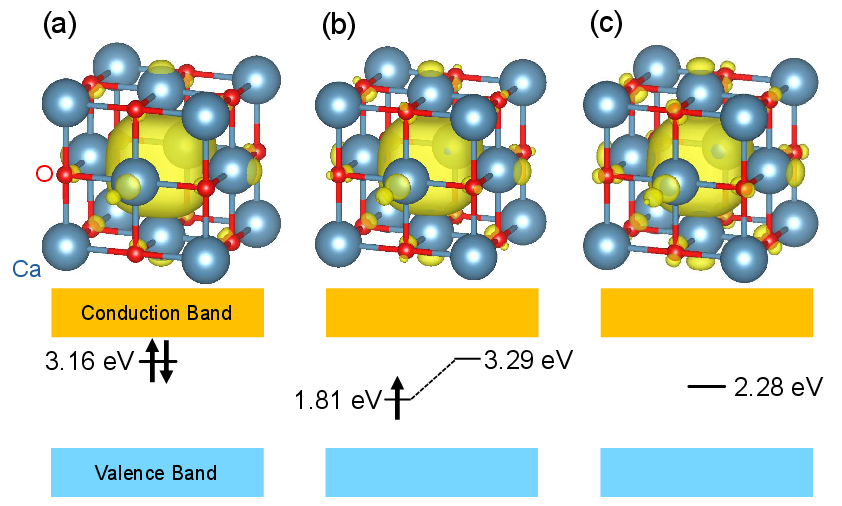
Figure 2: Local atomic structures and in-gap charge densities for VO in different charge states.
Kohn-Sham in-gap states are present with VO0 and VO+ (the latter being spin-1/2), which could contribute to magnetic decoherence in quantum applications. Migration barriers of VO2+ and ΔHf=−6.500 are 1.88 eV (677 K) and 3.16 eV (1138 K) respectively, suggesting immobility at ambient conditions.
Calcium Vacancies
ΔHf=−6.501 is stable only in the 2– charge state across the gap under all conditions, with no in-gap electronic states. The nearest O neighbors relax outward by 0.19 Å. Its migration barrier is high (ΔHf=−6.502 eV, ΔHf=−6.503 K), mirroring the kinetic stability of O vacancies.
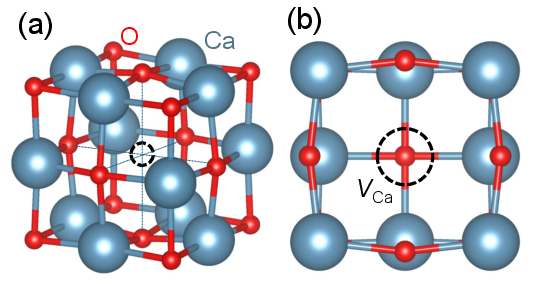
Figure 3: Atomic structure of ΔHf=−6.504, highlighting outward relaxation of surrounding O atoms.
Interstitials
Both O and Ca interstitials are highly mobile due to low migration barriers (0.13 eV for OΔHf=−6.505, 0.56 eV for OΔHf=−6.506, 0.62 eV for CaΔHf=−6.507), and thus unlikely to persist as isolated defects. OΔHf=−6.508 forms either split-interstitial or off-center configurations depending on charge state.
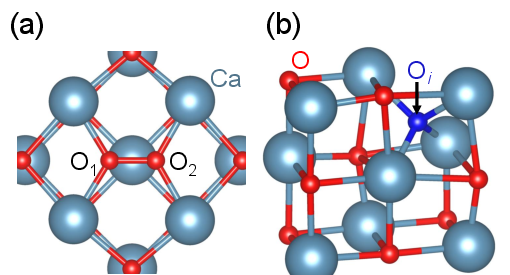
Figure 4: Structures of O interstitials in neutral and double negative charge states.
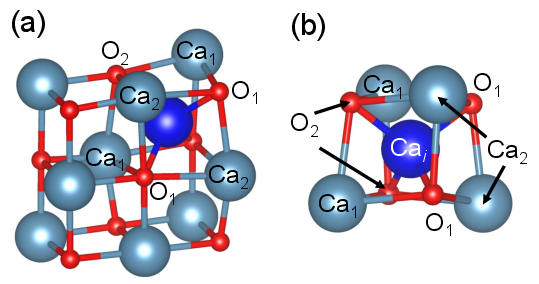
Figure 5: Structure of Ca interstitial in ΔHf=−6.509 charge state.
Antisite-like and Vacancy Complexes
Antisite defects Eg=4.150 and Eg=4.151 are structurally better described as strongly off-centered interstitial-vacancy complexes. Their formation is not particularly favored under typical growth regimes, and binding energies are modest, suggesting complexes may mainly form via annealing rather than during growth.
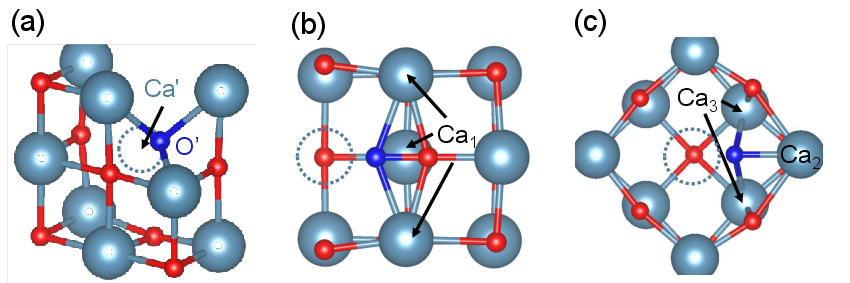
Figure 6: Atomic structures of Eg=4.152 in various charge states, showing substantial off-center displacement and local coordination shifts.
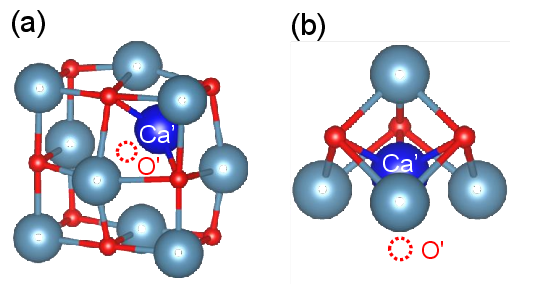
Figure 7: Local structure of Eg=4.153 in the neutral state, resembling a displaced Ca interstitial-vacancy pair.
The Eg=4.154 and Eg=4.155 have binding energies of 1.95 eV and 1.07 eV, resulting in high annealing temperatures (1379 K and 1138 K), indicating thermodynamic stability of these complexes at elevated temperature.
Dependence on Exchange-Correlation Functional
Comparison with HSE hybrid functional calculations reveals a significant dependence of charge-state predictions on the fraction of exact exchange. While the SCAN functional provides typical acceptor-like behavior for Ca vacancies, the bandgap-tuned HSE (α=0.504) predicts stable neutral and even positively charged Ca vacancies, inconsistent with expected physics and sensitive to alignment issues. Thus, relying solely on bandgap matching is not sufficient for predictive defect calculations in wide-gap oxides.
Optical Properties and Assignment of Experimental Peaks
Experimental optical absorption and emission peaks at 340 nm, 400 nm (absorption), and 370 nm, 605 nm (emission) in CaO have been historically assigned to Eg=4.156 and Eg=4.157 centers. The present calculations, using a combination of structural/electronic results from SCAN and vertical transition energies from HSE, provide a deeply quantitative mapping of defect energy levels onto optical spectra.
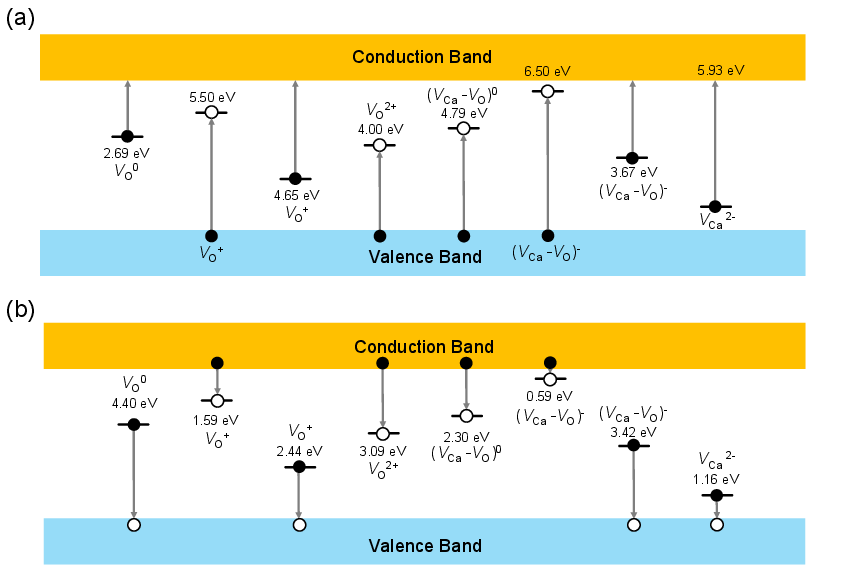
Figure 8: Computed optical absorption and emission energies, indicating correspondence of theoretical transitions to experimental peaks.
Key assignments:
- The Eg=4.158 transition yields 3.67 eV, matching the 340 nm absorption peak.
- An absorption band at 260 nm (4.77 eV) is attributed to Eg=4.159 transitions (computed 4.79 eV), resolving earlier ambiguity in experimental assignment.
- VO0-mediated absorption gives higher energies (4.65–5.50 eV), not matching low-energy experimental peaks as previously thought.
- The 605 nm (2.05 eV) emission is best explained by VO1, with calculated 2.30 eV.
- VO2 and other isolated O-vacancy related emissions do not explain these peaks.
- The temperature dependence of VO3-center emissions is rationalized as arising from hydrogenic donor-like states associated with VO4, in agreement with small experimental activation energies.
These results indicate that complex vacancies, rather than isolated O vacancies, are primarily responsible for the optical activity observed experimentally in CaO.
Implications and Future Outlook
This study provides a detailed atomic-level understanding of the defect landscape in CaO, with broad implications:
- Materials Reliability: The dominance and kinetic stability of vacancy types under different stoichiometries inform processes to engineer low-defect-density CaO for high-k dielectric applications.
- Quantum Defect Engineering: The identification of stable paramagnetic (spin-1/2) defect complexes, and their computed coherence-relevant properties, positions CaO as a promising host for spin qubits. However, magnetic noise associated with VO5 and VO6 will set limits on quantum coherence.
- Defect Spectroscopy: Direct, quantitative assignment of optical signals to specific complexes refines the interpretation of existing experiments and guides the search for new identifiable quantum defects.
- Theoretical Methodology: The sensitivity of defect charge-state predictions to exchange-correlation functional tuning highlights the requirement for band-edge alignment beyond bandgap correction in hybrid functional studies of wide-gap oxides.
Conclusion
This comprehensive DFT study delineates the formation, migration, and optical properties of native point defects in CaO. Both O and Ca vacancies are stabilized under experimental conditions, but defect complexes, particularly VO7 in various charge states, are thermodynamically and kinetically favored at elevated temperatures and are the most likely sources of optical and magnetic signatures. The findings have direct implications for the control of charge and spin defects in CaO for both traditional electronic and emerging quantum applications. Theoretical insights provided here offer a rigorous platform for future computational and experimental defect engineering initiatives in wide-gap oxides.