- The paper systematically reviews Koopman operator theory, emphasizing its capability to linearize nonlinear systems for advanced control design.
- It details EDMD and kernel methods for numerical approximation, highlighting trade-offs between subspace invariance and predictive error.
- The study integrates control strategies with modern machine learning, enhancing the robustness and scalability of model predictive control.
Koopman Operator Theory: Foundations, Control, and Applications
Koopman operator theory has rapidly evolved into a central paradigm for data-driven analysis and control of nonlinear dynamical systems. By facilitating a global linearization in an (often infinite-dimensional) space of observables, the Koopman framework enables the direct leverage of linear systems theory—both for analysis (e.g., spectral, stability) and for advanced controller synthesis, including Model Predictive Control (MPC) with strong theoretical guarantees. This paper provides a systematic and comprehensive review of modern Koopman operator theory, its numerical realization via Extended Dynamic Mode Decomposition (EDMD) and kernel EDMD, extensions to controlled systems, and intersections with machine learning.
Koopman Operator Theory: Mathematical Structure and Invariance
The Koopman operator K, defined as Kg=g∘F, acts linearly on possibly infinite-dimensional spaces of observables, even when the underlying dynamical system x+=F(x) is nonlinear. This operator admits spectral analysis analogous to that for finite-dimensional matrices, but with richer features such as continuous spectrum, making the theory suitable for both stability and prediction analysis.
Eigenfunctions of the Koopman operator, associated with eigenvalues, reveal coherent structures and invariant sets, and these structures facilitate the construction of Lyapunov functions for global stability analysis. The focus on Koopman-invariant subspaces is fundamental since invariance determines if finite-dimensional linear models preserve the original nonlinear dynamics when restricted to the span of selected observables.
Data-driven Approximation: Extended Dynamic Mode Decomposition (EDMD)
EDMD provides a finite-dimensional, data-driven surrogate for the Koopman operator by formulating a least-squares problem over observed data and a chosen dictionary (basis) of observables. The choice of dictionary is critical for balancing expressivity and invariance: larger dictionaries improve function approximation but can degrade invariance, leading to enlarged projection errors and loss of predictive quality, especially in multi-step rollouts.
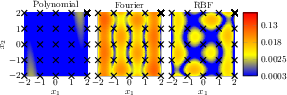
Figure 2: One-step prediction errors for different dictionaries demonstrate significant spatial variation based on the tuning of the observable basis.
EDMD can be further extended to kernel methods (kEDMD), where the RKHS induced by the kernel encodes the dictionary implicitly and allows for sophisticated regularization and expressiveness controls. The analysis of prediction errors for EDMD reveals a fundamental trade-off between invariance (dictated by the subspace) and approximation (empirical risk) error.

Figure 4: Training and prediction errors grow with polynomial degree for non-invariant polynomial dictionaries, highlighting the criticality of subspace invariance.
Spectral Approximation and Kernel Methods
Beyond prediction, EDMD enables numerical computation of Koopman eigenvalues, eigenfunctions, and modes—quantities of direct interest for analyzing system behaviors. Leading eigenfunctions, as exemplified in the approximation of the Duffing oscillator, map onto basins of attraction and segregate dynamical regions of interest.
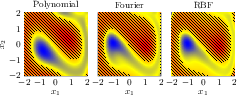
Figure 1: Approximate eigenfunctions for different dictionaries illustrate how leading eigenfunctions correspond to regions of attraction and inform model reduction.
In kEDMD, kernel choices (Matérn, Wendland, squared exponential) impact the function space regularity, invariance properties, and approximation error rates. The study of fill distances and error bounds in RKHS frameworks allows for rigorous uniform error guarantees, even in the context of stochastic or controlled systems.
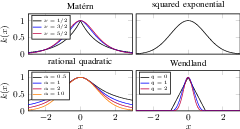
Figure 7: Various kernel functions k(⋅,0) illustrating how smoothness and lengthscale parameters affect functional regularity and model capacity.
For control systems, three major approaches are synthesized:
- Exact LTI embeddings: Only a restrictive class of nonlinear systems (control-affine preserved structure, existence of lifting functions) admits exact finite-dimensional linear representations. For general systems, only approximate embeddings are attainable.
- Koopman Control Family (KCF): This formalism extends Koopman theory to a family {Ku} parameterized by input u, leading to the input-state separable modeling paradigm.
- Product Hilbert Spaces and GeKo Models: By forming tensor product spaces of state and input observables, the generalized Koopman (GeKo) operator yields exact infinite-dimensional bilinear models whose finite truncations correspond to previously employed bilinear or linear surrogate models.
These representations motivate direct, data-driven identification (via extended EDMD) of lifted models for control design.
Empirical and Numerical Results for Control Applications
The authors provide thorough empirical evaluation and numerical comparison of various EDMDc (EDMD for control systems) variants, benchmarking their performance on highly nonlinear systems like the Duffing oscillator and a nonlinear-input DC motor.
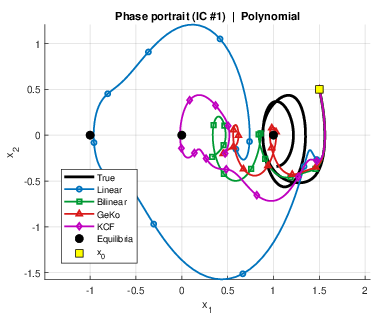
Figure 3: Phase trajectory rollouts for the forced Duffing oscillator under different lifted model predictive control schemes.
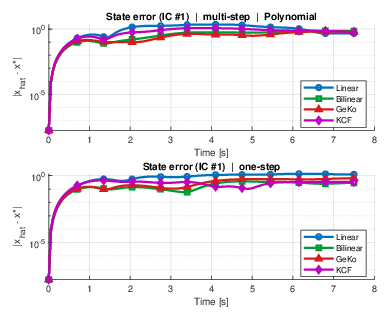
Figure 5: State error rollouts highlight the accumulation of prediction error and the sensitivity to dictionary choice and invariance.
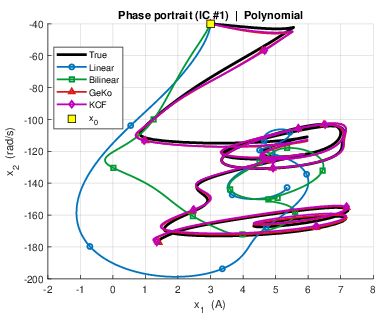
Figure 6: Phase trajectory plots for the DC motor, illustrating the challenge for control-affine models on systems with nonlinear input interactions.
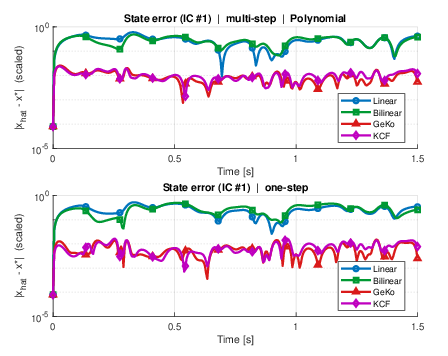
Figure 8: Rollouts of state error for the DC motor demonstrate the superior error containment of input-lifted architectures (GeKo/KCF) on non-affine input dynamics.
Notably, input-lifted models (GeKo and KCF) robustly approximate highly nonlinear input interactions, drastically reducing worst-case tracking errors compared to purely bilinear or linear lifted models—which fail when structural assumptions (e.g., control-affineness) are violated.
Koopman-Based Model Predictive Control (MPC)
Koopman-MPC schemes allow for scalable optimal control with strong closed-loop theoretical guarantees. Both stability (Lyapunov decrease) and performance (suboptimality bounds) can be rigorously certified under proportional model error bounds derived from kernel-based (and bilinear) learning methods.
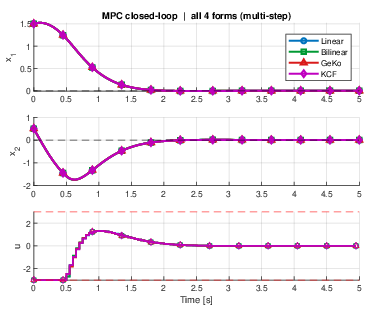
Figure 9: Closed-loop Koopman-MPC performance for the Duffing oscillator, illustrating effective set-point regulation by all four lifted model classes.
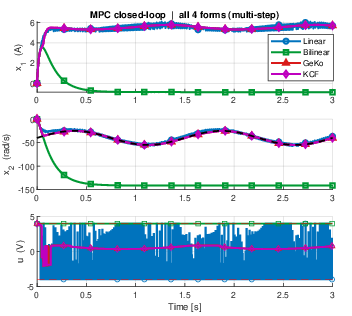
Figure 10: Closed-loop tracking for the DC motor. Only input-lifted (GeKo and KCF) architectures achieve low tracking error, highlighting their necessity for genuine input-nonlinear plants.
The necessity of input-lifting becomes acute for control of systems with pronounced nonlinear input effects—conventional bilinear lifting fails, but model classes based on tensor products or KCF substantially outperform when combined with properly designed dictionary learning and kernel methods.
Koopman Operator Learning and Machine Learning Synergy
Recent advances explicitly unify Koopman operator theory with statistical and deep learning. Key advances include:
- Statistical Learning Theory: Quantified generalization error and empirical risk convergence for regularized EDMD.
- Bayesian Kernel Methods: Gaussian process viewpoints provide uncertainty quantification, scalable training via variational approximation, and structured hyperparameter optimization.
- Deep Koopman Architectures: Encoders and decoders parameterized by neural networks, optimized for multi-step linearity in latent space, yield models directly analogous to modern world model architectures.
- Koopman in Contemporary AI: Incorporation in generative modeling (diffusion/flow-matching), neural network pruning (operator-theoretic significance of weight dynamics), and reinforcement learning (Bellman operators as Koopman objects; spectral data augmentation for offline RL).
These connections highlight the role of Koopman-theoretic viewpoints in both enhancing the theoretical foundations and practical performance of machine learning models for dynamical data.
Implications and Future Directions
The survey delineates a clear research frontier: integrating theoretically grounded Koopman operator learning with scalable, uncertainty-aware, and model-structured representations for complex nonlinear controlled systems. Open challenges are multifold: developing systematic subspace pruning with invariance guarantees, unifying continuous and discrete-time settings for hybrid dynamics, enhancing deep Koopman network theory, and further infusing operator-theoretic structure into foundational AI architectures for planning and control tasks.
Conclusion
Koopman operator theory, through an overview of rigorous mathematical analysis, advanced numerical learning methods, and integration with modern machine learning, demarcates a powerful and generalizable route for the data-driven analysis and control of nonlinear dynamical systems. This framework not only bridges long-standing gaps between nonlinear system theory and linear systems analysis but also sets the stage for the next generation of robust, scalable, and interpretable learning-based controllers with broad applicability in scientific and engineering domains.