- The paper introduces a significance-aware 1-bit binarization framework that enhances LVLM performance while reducing memory and latency costs.
- It employs Hessian-based sensitivity and modality-guided integration to differentiate important unimodal and cross-modal weights for optimized quantization.
- Experimental results show up to 14-point improvements over binary baselines, maintaining critical multimodal capabilities on diverse benchmarks.
Significance-Aware Binarization for Large Vision-LLMs: SAB-LVLM
Introduction
Large vision-LLMs (LVLMs) have established strong multimodal capabilities but their immense parameter scale and associated cross-modal computation result in prohibitive memory and latency costs, severely impeding deployment on resource-constrained devices. While post-training quantization (PTQ) methods offer substantial compression, existing binary PTQ approaches suffer pronounced performance degradation due to their disregard for the heterogeneous and modality-specific significance of weights, particularly within the LVLM architecture. The paper "SAB-LVLM: Significance-Aware Binarization for Large Vision-LLMs" (2607.01876) systematically addresses this deficit by introducing a binarization framework that explicitly models and exploits the modality- and layer-wise variations in parameter importance.
Methodological Framework
The SAB-LVLM framework introduces a set of algorithmic contributions designed to enable effective 1-bit quantization for LVLMs without compromising task-relevant performance. These contributions include:
- Spatial Significance Map Construction: The approach utilizes Hessian-based sensitivity calculations for visual and textual modalities using calibration data. Analyses of the resulting gradients yield a spatial significance map (Γ) that quantifies the degree to which individual weights are activated by unimodal or cross-modal inputs, discriminating between weights critical for unimodal versus multimodal operation.
- Modality-Guided Significance Integration (MGSI): A modality integration score (r) is adaptively estimated for each layer, capturing the preference distribution of task relevance across modalities and fusing local and global significance information into a final binarization map (Λ). The result is an error reweighting scheme that upregulates quantization fidelity on functionally critical subspaces.
- Alternating Significance-Weighted Update: Building on the error-weighted objective, SAB-LVLM deploys a multi-stage alternating update procedure—akin to ARB-LLM strategies but modulated by per-weight significance estimations—allowing prioritized fitting of binary parameters subject to their contextual importance.
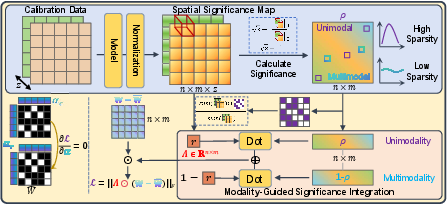
Figure 1: Architectural pipeline of SAB-LVLM, highlighting spatial significance calculation, modality-guided integration, and the alternating significance-weighted update.
The theoretical justification is anchored in an error allocation result (Theorem 1) that asserts, under a relaxed budget constraint, the optimal quantization error is inversely proportional to the local significance defined in Λ. This formalizes the intuition that task-relevant weights (those with high Λij) are better preserved during binarization.
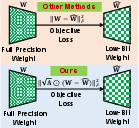
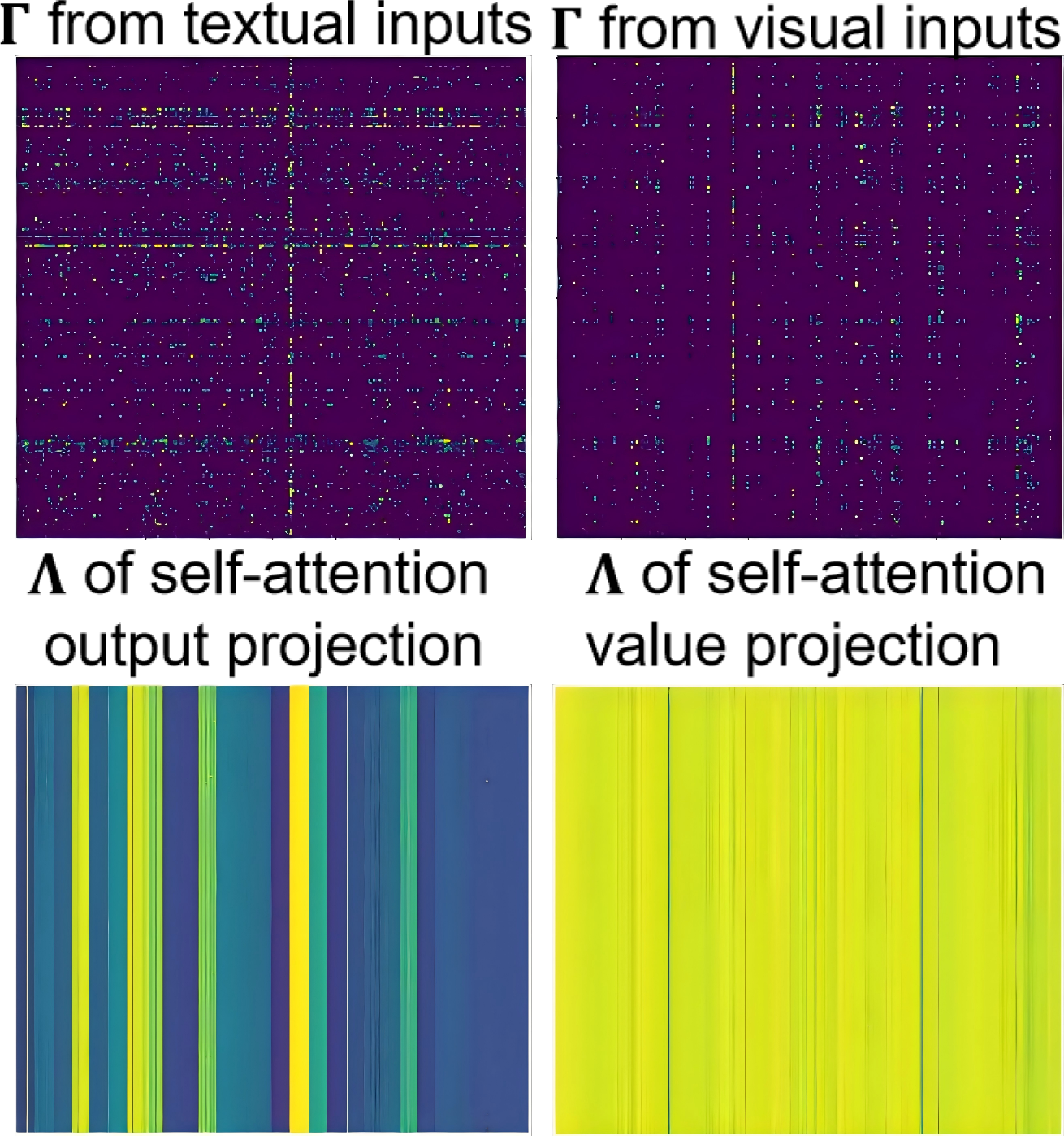
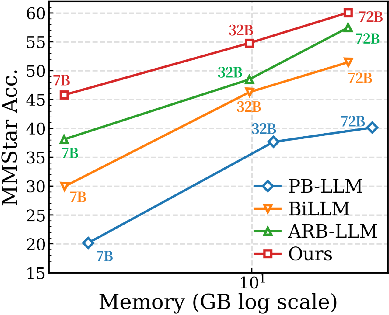
Figure 2: (a) SAB-LVLM compared to prior PTQ and binarization baselines; (b) visualization of the spatial significance map for visual and textual activations; (c) performance-memory tradeoff on the MMStar benchmark.
Experimental Analysis
Benchmarks and Model Variants
Comprehensive evaluation was conducted on Qwen2.5-VL and InternVL3.5 families (7B to 72B parameters), across canonical multimodal tasks (MMStar, DocVQA, TextVQA, Video-MME, VSI-Bench). Results are compared with state-of-the-art PTQ baselines including GPTQ (3-bit), PB-LLM, BiLLM, and ARB-LLM (1-bit).
Quantitative Results
SAB-LVLM consistently establishes new Pareto frontiers under ∼1-bit constraints, yielding large improvements over existing binarization. On Qwen2.5-VL-7B/32B/72B, it achieves absolute gains of 7–14 points on MMStar over the strongest binary baselines and markedly narrows the gap to 16-bit full-precision. Similar trends are observed on InternVL3.5 variants.
Ablation studies confirm:
- The effectiveness of the joint spatial significance and MGSI, especially the necessity of using modality-adaptive scoring rather than fixed or unimodal-only metrics.
- The optimal binarization performance is highly sensitive to the thresholding in the spatial significance map, supporting the importance of precise partitioning between single-mode and cross-modal weights.
Strong performance is retained across all major capability axes, with coarse and fine-grained perception, logical reasoning, and visual spatial intelligence tasks all exhibiting significant robustness to 1-bit quantization when using SAB-LVLM. Qualitative analyses confirm improved answer consistency over prior approaches in highly multimodal queries.

Figure 3: Qualitative performance analyses on MMStar with Qwen2.5-VL-7B-Instruct, highlighting complex perception, counting, and reasoning questions.
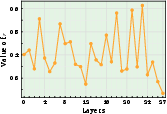
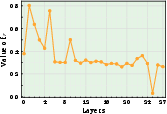
Figure 4: Visualization of the dynamic, layer-wise modality integration score r among self-attention and MLP down-projection layers, confirming distributional variability.
Theoretical and Practical Implications
SAB-LVLM sets an explicit curriculum for future LVLM binarization: quantization performance is decisively improved by embedding high-granularity, modality- and layer-aware weight significance modeling directly into the error objective and the fitting process. The explicit modeling of cross-modal weight contributions addresses a central limitation in previous generic PTQ methods, enabling the robust application of binarization at scale to multimodal architectures.
Practically, this advances the deployability of high-performing LVLMs on constrained hardware by an order of magnitude relative to naive binarization, substantially reducing parameter storage and inference latency while largely retaining critical perceptual and reasoning capacities.
Prospects and Future Directions
Given the generality of the significance-aware binarization paradigm, several future research directions are immediately evident:
- Extension to broader LVLM architectures (including those with complex cross-modal adapters, attention routing, or multi-stage integration).
- Application to settings requiring rigorous temporal/contextual reasoning, such as long-context video understanding or embodied multimodal interaction.
- Exploration of significance-driven quantization beyond binarization, such as adaptive-mixed precision, which could further optimize the efficiency-accuracy frontier.
Conclusion
The SAB-LVLM framework introduces a principled, highly effective approach for 1-bit quantization in large vision-LLMs, driven by explicit modeling of modality- and layer-specific weight significance. Its integration of Hessian-based sensitivity analysis, adaptive modulation by cross-modal importance, and an alternating optimization scheme sets a new standard in binary PTQ for LVLMs. The resulting compression gains and retention of downstream performance open new avenues for energy- and memory-efficient deployment of advanced multimodal AI.