Zeus: Towards Tuning-Free Foundation Model for Time Series Analysis
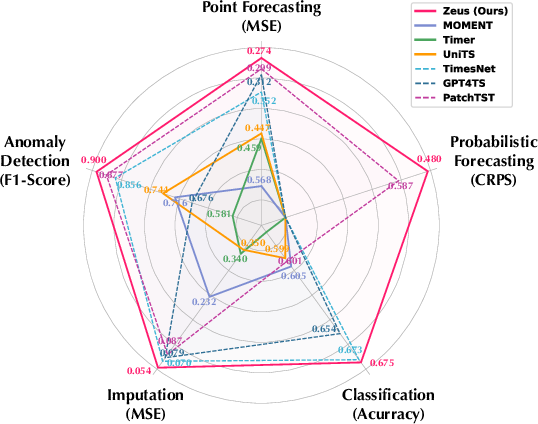
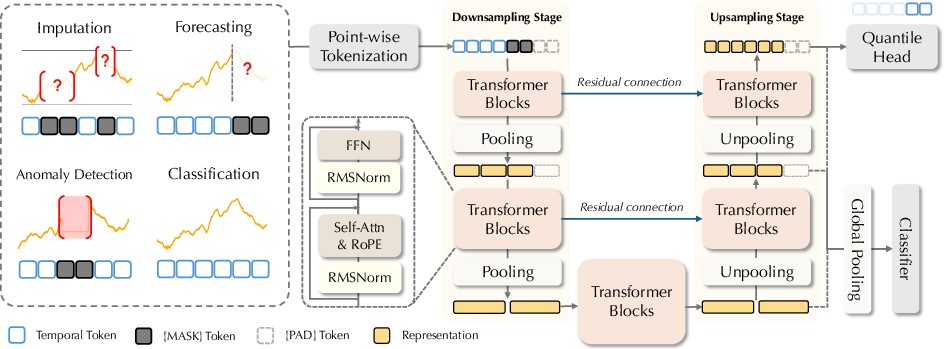
Abstract: We present Zeus, a unified tuning-free Time Series Foundation Model (TSFM) that delivers superior performance across diverse analysis tasks without any task-specific fine-tuning. Unlike prior studies that primarily focus on zero-shot forecasting but require task-specific tuning for other tasks, Zeus bridges this gap by addressing two fundamental challenges in multi-task generalization. First, to reconcile point-level granularity with long-sequence scalability, Zeus incorporates a multi-scale Transformer featuring point-wise tokenization and a U-shaped hierarchy, effectively balancing fine-grained fidelity with computational efficiency. Second, to accommodate varying inductive biases across different tasks, Zeus introduces Multi-Objective Temporal Masking (MOTM), a unified strategy that supports heterogeneous tasks (e.g., extrapolation, interpolation, and global abstraction) within a single framework. Extensive experiments across five representative tasks demonstrate that Zeus consistently achieves competitive results in tuning-free settings, underscoring its potential as a general-purpose TSFM.
Paper Prompts
Sign up for free to create and run prompts on this paper using GPT-5.
Top Community Prompts
Explain it Like I'm 14
What is this paper about?
This paper introduces Zeus, a single “foundation model” for time series data that works well on many different tasks right out of the box. Time series are numbers tracked over time, like weather every hour, heart rate every second, or energy use every day. Unlike many previous models that need extra tuning for each new task, Zeus aims to be tuning-free: you can use it directly for forecasting, filling in missing values, spotting unusual behavior, and classifying patterns without retraining.
What questions were the researchers trying to answer?
The authors focus on two big problems that have held back general-purpose time series models:
- How can a model keep tiny, point-by-point details while still handling very long sequences efficiently?
- How can one model learn the different “skills” needed for different tasks, like predicting the future (extrapolation), filling gaps (interpolation), and understanding the overall pattern (global abstraction), without special training for each task?
How does Zeus work?
To tackle these problems, Zeus mixes a smart model design with a smart training strategy.
Point-wise “tokens” instead of “patches”
- Think of a time series like a long sentence of numbers. Some models group numbers into chunks (“patches”) before reading them. That’s fast, but you lose fine details.
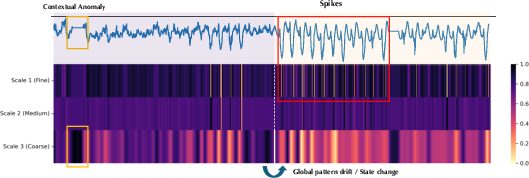
- Zeus treats each time step as its own token (like reading every single letter), so it keeps details. This helps with tasks like filling in single missing points or detecting short, sudden spikes.
A U-shaped, multi-scale Transformer
- Imagine looking at a long timeline by first zooming out to see the big picture, then zooming back in to refine the details. That’s Zeus’s idea.
- The model compresses the sequence to coarser scales to capture long-range patterns efficiently, then expands it back to fine resolution to preserve point-level detail. This U-shape balances detail and speed.
- Light, fast layers work on fine details; deeper, stronger layers work on the coarse, zoomed-out view.
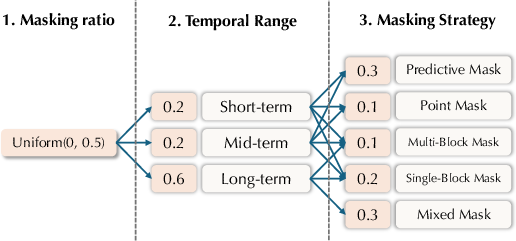
Multi-Objective Temporal Masking (MOTM)
- “Masking” means hiding parts of the data during training and asking the model to guess them. It’s like covering parts of a story and asking what’s missing.
- Different masks teach different skills:
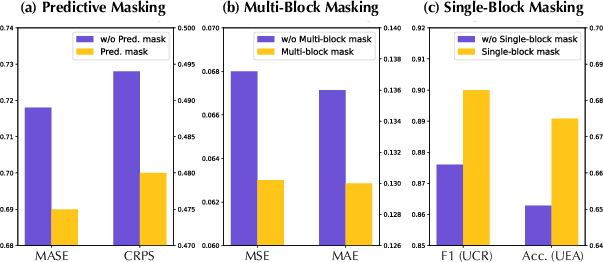
- Predictive mask: hide the end of the series so the model learns to predict the future (extrapolation).
- Point mask: hide random single points to teach filling tiny gaps (interpolation).
- Multi-block mask: hide several short chunks to handle real-world missing spans.
- Single-block mask: hide one long chunk to teach the model to keep the whole story consistent (good for classification and contextual anomaly detection).
- Mixed mask: combine masks to make training tougher and more realistic.
- Training with all of these at once helps Zeus become good at many tasks without extra tuning.
Probabilistic outputs (quantile head)
- Instead of giving just one guess, Zeus can give a range of likely values (like a weather forecast saying there’s a 10%, 50%, and 90% chance the temperature will be under certain levels). This better reflects uncertainty in real life.
Big and varied training data
- Zeus is trained on a huge mix of real and synthetic time series (about 300 billion observations), covering many domains and patterns. Synthetic data adds rare or sharp patterns that might be missing from real datasets.
What did the researchers find?
Across five major tasks, Zeus performed strongly without any task-specific fine-tuning:
- Point forecasting: Accurately predicts future values and beats or matches leading models designed just for forecasting.
- Probabilistic forecasting: Ranks at the top on a large benchmark (GIFT-Eval), meaning its uncertainty estimates are high quality.
- Imputation (filling gaps): Handles both random missing points and missing blocks better than many specialized models, thanks to point-wise detail and masking strategies.
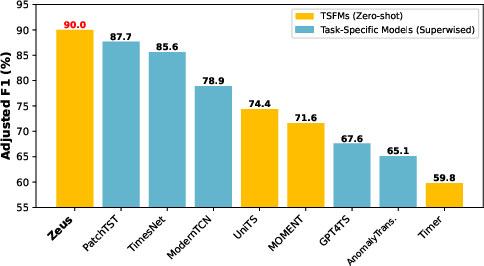
- Anomaly detection: Finds unusual patterns very well, outperforming other general time series foundation models and even some tuned task-specific models.
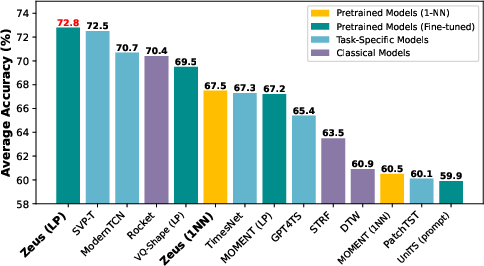
- Classification: Recognizes pattern types (like activity types from sensor data) with competitive or best-in-class results, even when using simple evaluation methods.
It’s also efficient for its design:
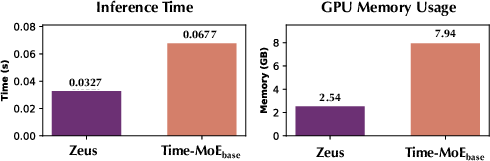
- By doing most heavy computation at coarser scales, Zeus is faster and uses less memory than typical point-by-point Transformers on long sequences.
Why is this important?
- One model, many jobs: Zeus reduces the need to train and tweak a new model for each task. This saves time and makes deployment easier in real settings like hospitals, factories, energy grids, and weather services.
- Handles real-world messiness: It deals well with missing data, sudden spikes, and long sequences, which are very common outside the lab.
- Better uncertainty: Probabilistic outputs help users plan for best and worst cases, not just the “average” future.
- Scalable and practical: The multi-scale design keeps fine details without getting too slow or memory-heavy.
In short, Zeus moves time series AI closer to “plug-and-play” foundation models: one powerful model that can be used across many problems without extra tuning. The authors suggest future work on handling many channels together (multivariate signals) and expanding to even more task types.
Knowledge Gaps
Knowledge gaps, limitations, and open questions
Below is a concise, actionable list of what remains missing, uncertain, or unexplored based on the paper.
- Multivariate dependency modeling is deferred: pretraining is univariate with channel-independent handling at inference, leaving cross-variable temporal dependencies, inter-channel causality, and variable-varying interactions unmodeled. Investigate joint multivariate pretraining (e.g., cross-channel attention, variable set transformers, graph/time-varying relational structures) that scales to many channels and supports variable cardinality.
- Exogenous and static covariates are not incorporated: the framework does not explicitly support known-future covariates, static metadata, holidays/calendars, or hierarchical group structures common in forecasting. Add token types and masking schemes for covariates and evaluate on benchmarks that require them.
- Irregular/asynchronous sampling is unaddressed: all experiments assume regularly sampled grids. Extend to irregular time stamps, asynchronous multivariate streams, and missing time stamps using continuous-time positional encoding, neural ODE/SDE layers, or point-process encoders, and benchmark on irregular datasets.
- Causality and potential look-ahead leakage are not clarified: the encoder-only architecture with bidirectional self-attention is trained via masked reconstruction. Explicitly specify and test causal attention masks for forecasting, quantify leakage risk, and report performance under strict causal constraints.
- Robustness to distribution shift and concept drift is not studied: evaluate zero-shot performance under domain shifts (seasonality changes, regime switches, new sensors), conduct controlled shift benchmarks, and explore test-time/online adaptation compatible with the “tuning-free” goal.
- Probabilistic calibration is not evaluated: beyond CRPS/MASE, assess calibration (PIT histograms, coverage vs. nominal, reliability diagrams), sharpness vs. calibration trade-offs, and propose calibration mechanisms (e.g., monotonic quantile heads, isotonic regression, conformal prediction).
- Quantile crossing and limited distributional expressivity remain open: nine fixed quantiles can cross and may not capture multimodality/heavy tails. Enforce monotonicity and explore richer distributions (flows, diffusion, mixtures) and coherence across quantiles/horizons.
- Cross-horizon temporal coherence is unexamined: suffix forecasting via [MASK] tokens may yield temporally inconsistent trajectories. Introduce and evaluate coherence constraints or sequence-level probabilistic models that preserve path consistency.
- Missingness mechanisms are simplified: only random and short-block masks are tested. Evaluate MNAR patterns, long outages, and structured operational gaps (e.g., maintenance windows), and stress-test MOTM under extreme/clustered missingness.
- Anomaly detection protocol is rudimentary: detection relies on reconstruction error with tuned window sizes. Compare to state-of-the-art unsupervised detectors, define a tuning-free thresholding strategy, measure online detection latency, and evaluate robustness to contamination and rare-event prevalence.
- Instance normalization may remove amplitude information critical for anomalies: ablate normalization choices (instance vs. reversible vs. learnable per-channel) and study impacts on scale-sensitive tasks (e.g., point anomalies and extreme events).
- Hyperparameter-free claim is weakened by inference-time searches: context length (forecasting), window size (anomalies), and PCA whitening (classification) are tuned per dataset. Provide a default, fixed recipe and quantify performance sensitivity to eliminate per-dataset selecting.
- Efficiency and scalability at extreme lengths are not demonstrated: experiments use L≈4096. Assess throughput/memory/latency for L≫104, streaming/online inference, CPU/edge deployment, and energy footprint, and compare with linear/sparse/state-space alternatives.
- Multi-scale design is static: scale counts, pooling ratios, and per-scale depth/width are fixed. Explore dynamic/adaptive scaling (learned downsampling ratios, cross-scale routing/moe), and measure gains vs. complexity.
- MOTM masking policy lacks principled design: mask type/fraction distributions are heuristic. Learn mask policies (e.g., reinforcement learning, curriculum), explore task-conditional masking, and evaluate generalization gains across tasks/domains.
- Alternative self-supervision is unexplored: combine MOTM with frequency-domain masking, contrastive/InfoNCE objectives, season-trend disentanglement, or temporal order prediction and quantify additive benefits.
- Pretraining data transparency and bias analysis are limited: provide a detailed manifest of sources, licenses, domain/task coverage, temporal spans, and deduplication safeguards; audit domain biases; and release hashes/splits to verify no leakage (especially for GIFT/Chronos overlaps).
- Synthetic dataset (Aegis-Syn) validity is not rigorously validated: quantify realism/coverage (e.g., TS-FID/precision-recall for time series), ablate synthetic-to-real ratios, and test for generator-induced artifacts or negative transfer.
- Generalization beyond the five tasks is not evaluated: assess segmentation, change-point detection, early classification, clustering/similarity search, causal discovery/Granger analysis, and counterfactual inference to test the “foundation” claim.
- Classification relies on 1-NN or linear probes with optional PCA: study truly tuning-free classification without preprocessing, compare retrieval heads vs. class tokens, and evaluate on large-scale, long-sequence and imbalanced/multilabel settings.
- Handling multi-frequency and ragged-panel data is unaddressed: design tokenization/positional schemes for mixed sampling rates, panel datasets with variable series lengths, and variable availability across time.
- Forecasting with hierarchies and groups is not covered: add hierarchical reconciliation and group-sharing mechanisms, and evaluate on hierarchical forecasting benchmarks.
- Interpretability is limited to feature-norm visualizations: develop scale-aware attributions, shapelet/periodicity explanations, and per-task failure analyses; measure alignment between explanations and domain knowledge.
- Safety, privacy, and fairness concerns are not assessed: analyze demographic/sector biases in pretraining, privacy risks (reconstruction leakage), and downstream decision risks; propose mitigation (differential privacy, bias audits).
- Reproducibility and compute reporting can be expanded: detail pretraining compute budget, hardware, mixed precision, optimizer schedules, seeds, and checkpoint release; provide Aegis-Syn generator/code and sampling seeds for replication.
- Attention to recent baselines varies across tasks: ensure inclusion of strongest 2024–2025 SOTA baselines in each task under matched zero-shot protocols and report ablations under identical preprocessing.
- Causal consistency and interventions are open: evaluate whether representations support causal discovery/intervention effects; add objectives or inductive biases that capture causal structure (e.g., invariance across environments).
- Multimodal extensions are not discussed: explore unified tokenization for event/text/image/context streams paired with time series, and test cross-modal transfer benefits.
Practical Applications
Immediate Applications
The paper introduces Zeus, a tuning-free, multi-scale Transformer for time series that supports forecasting (point and probabilistic), imputation, anomaly detection, and classification out of the box. Because no task-specific fine-tuning is needed, many practical deployments can start immediately by wrapping Zeus as a service or embedding it into existing data/analytics pipelines.
- Energy and utilities (power, gas, water)
- Use cases: short/long-term load forecasting with uncertainty intervals (resource planning, bidding), missing meter data imputation, anomaly detection for outages/fraud, asset-health monitoring from SCADA/historian data.
- Tools/workflows: deploy a “Forecast + Intervals” API using the quantile head; an “Impute-then-Forecast” preprocessing module for TSDBs (TimescaleDB/InfluxDB); anomaly scoring service using reconstruction/prediction errors for outage/fraud alerts; integration with EMS/SCADA dashboards.
- Assumptions/dependencies: sufficient coverage of domain patterns by Zeus’s pretraining; GPU/accelerated inference for long horizons; channel-independent inference may miss cross-sensor correlations (mitigated by per-channel inference plus post-hoc aggregation).
- Retail and supply chain
- Use cases: probabilistic demand forecasting, stockout/returns anomaly detection, POS data imputation, promotion/regime-shift classification for planning.
- Tools/workflows: plug-in for ERP/BI tools (e.g., Power BI) to show forecast bands; ETL component to fill missing POS/supplier feeds; anomaly monitoring on inventory and lead-time signals.
- Assumptions/dependencies: zero-shot efficacy depends on similarity to pretraining domains; heavy seasonality and shocks are supported but calibration should be validated locally.
- Finance and fintech
- Use cases: risk-aware volume/cashflow forecasting with quantiles; anomaly scoring in transaction time series (fraud/operational incidents); backtest data gap filling; market regime classification.
- Tools/workflows: forecasting microservice exposing MASE/CRPS; anomaly detectors embedded in monitoring (e.g., Grafana); research pipelines using Zeus embeddings with 1-NN/linear probes for labeling regimes.
- Assumptions/dependencies: strict compliance and explainability requirements; domain shift in high-frequency data may require conservative thresholds; privacy/security controls for sensitive streams.
- Manufacturing and industrial IoT
- Use cases: sensor anomaly detection for predictive maintenance, imputation for intermittent telemetry, probabilistic forecasts of throughput/quality KPIs.
- Tools/workflows: edge/near-edge inference for long-context monitoring; Kafka/Flink streaming integration performing rolling “mask-and-reconstruct” checks; historian connectors for batch scoring.
- Assumptions/dependencies: compute/memory availability at the edge; multivariate dependencies across sensors are handled channel-independently (may limit complex cross-sensor patterns).
- Healthcare and digital health
- Use cases: anomaly detection in vitals/wearables, imputation of missing EHR or home-monitoring signals, activity/condition classification from time series representations.
- Tools/workflows: on-prem inference for PHI; clinician dashboards showing forecast bands and anomaly scores; use Zeus features with simple classifiers for quick prototyping.
- Assumptions/dependencies: regulatory approval and clinical validation; bias/fairness checks; robustness to device artifacts and missingness patterns.
- Weather, climate, and environmental monitoring
- Use cases: station-level forecasting with prediction intervals, gap-filling for sensor networks, anomaly detection for environmental events.
- Tools/workflows: Zeus service in data assimilation/QA pipelines; uncertainty-aware forecasts for operations and public dashboards.
- Assumptions/dependencies: long contexts may require GPU; ensure standardized normalization/inversion in ETL.
- Cybersecurity/IT operations
- Use cases: anomaly detection in service metrics (latency, error rates), forecasting capacity trends, imputation for missing telemetry/logs.
- Tools/workflows: drop-in detectors with thresholding on reconstruction error; capacity planning dashboards using quantile forecasts; integration with APM/observability stacks.
- Assumptions/dependencies: concept drift and incident-driven distribution shifts; careful alert calibration to manage false positives.
- Academia and R&D
- Use cases: off-the-shelf baseline for five tasks; feature extractor for 1-NN/linear probing in classification studies; adoption of Multi-Objective Temporal Masking (MOTM) to pretrain in-house TS models; use of Aegis-Syn-like synthetic generation for broader coverage.
- Tools/workflows: reproducible benchmarking across tasks; ablation studies on masking strategies; teaching labs demonstrating zero-shot TS applications.
- Assumptions/dependencies: adherence to the repo/weights license; compute for long-sequence experiments; data leakage controls.
- Public sector and policy operations
- Use cases: early warning dashboards for grid stress, water usage, epidemiological anomalies; gap-filling in open sensor data; scenario planning with forecast bands.
- Tools/workflows: API-driven services embedded in public analytics portals; uncertainty communication using quantiles; transparent evaluation with MASE/CRPS.
- Assumptions/dependencies: governance over alerts and interventions; open-data quality variability; procurement and security reviews.
- Daily life and consumer apps
- Use cases: smart thermostat scheduling with predicted intervals; personal finance cashflow forecasting; wearable anomaly alerts; home energy usage prediction.
- Tools/workflows: lightweight client-server setups; periodic batch scoring; user-facing uncertainty bands to improve trust.
- Assumptions/dependencies: privacy and data consent; limited on-device compute—server-side inference recommended.
Long-Term Applications
Beyond immediate deployments, Zeus’s architectural and training innovations suggest new products and research pathways that require additional development, scaling, or validation.
- Multivariate and cross-channel modeling
- Vision: extend from channel-independent inference to models that natively capture inter-variable dependencies (e.g., multi-sensor fusion in healthcare/manufacturing).
- Dependencies: multivariate pretraining objectives; memory-efficient cross-channel attention; new benchmarks and validations.
- Real-time, closed-loop decision systems
- Vision: use probabilistic forecasts and anomaly scores to drive control policies (grid load shedding, HVAC optimization, trading safeguards).
- Dependencies: robust calibration in feedback loops; safety constraints and causal assessments; streaming inference and latency budgets.
- Digital twins and robotics
- Vision: apply multi-scale representations to state estimation, fault detection, and control in digital twins or robot telemetry.
- Dependencies: domain-specific pretraining; integration with simulators; certification for safety-critical contexts.
- Privacy-preserving and federated TSFMs
- Vision: federated deployment across hospitals, banks, or critical infrastructure with differential privacy/secure aggregation.
- Dependencies: algorithmic advances for federated masked reconstruction; privacy/utility trade-off studies; legal frameworks.
- Lightweight, edge-ready variants
- Vision: distill/quantize Zeus for embedded or mobile devices (wearables, gateways), maintaining calibration of quantiles.
- Dependencies: model compression and distillation strategies; efficient attention approximations; on-device memory/compute constraints.
- Adaptive and streaming learning
- Vision: incorporate continual/online adaptation to concept drift while maintaining tuning-free core capabilities for new tasks.
- Dependencies: safe adaptation modules (e.g., adapters) with drift detectors; catastrophic forgetting safeguards; governance for model updates.
- AutoML for time series with MOTM
- Vision: automated pipeline builders that leverage MOTM-style pretraining for new domains, selecting masking mixes and scales automatically.
- Dependencies: search strategies over masking/scale configurations; meta-learning of objectives; cost-aware training orchestration.
- Sector-specific validated bundles
- Vision: pre-validated Zeus variants with domain calibration (e.g., grid operations, clinical monitoring), packaged with standard connectors and dashboards.
- Dependencies: domain partnerships, ground-truth curation, regulatory audits, and post-deployment monitoring.
- Standardization and evaluation ecosystems
- Vision: unified benchmarks, metrics, and best practices for tuning-free TSFMs across many tasks, building on Zeus’s five-task evaluation.
- Dependencies: community datasets and leaderboards; shared protocols for uncertainty and anomaly evaluation; reproducibility frameworks.
Cross-cutting assumptions and dependencies
- Domain coverage: zero-shot performance depends on similarity between deployment data and Zeus’s pretraining corpus; out-of-domain cases may need calibration or light adaptation.
- Compute: long-sequence contexts benefit from GPUs/accelerators; FlashAttention-enabled environments improve efficiency; production costs should be assessed.
- Data handling: correct instance normalization and de-normalization in pipelines is critical; masking setups in deployment should align with MOTM assumptions for best performance.
- Risk, compliance, and ethics: sectors like healthcare and finance require explainability, audit logs, and careful thresholding to manage false positives/negatives; privacy safeguards for sensitive time series.
- Licensing and support: confirm model code/weights license and long-term maintenance plans for production systems.
Glossary
- 1-nearest neighbor (1-NN): A simple non-parametric classifier that labels a sample by the class of its closest training example. "a non-parametric 1-nearest neighbor (1-NN) classifier"
- Adjusted F1-score: A variant of the F1 score tailored for time-series anomaly detection evaluation. "We use adjusted F1-score as the evaluation metric"
- Aegis-Syn: A synthetic time-series dataset created to enrich pattern diversity beyond real-world records. "we additionally construct Aegis-Syn, a synthetic dataset that extends KernelSynth"
- Autoregressive generation: A modeling approach that predicts the next value conditioned on past outputs in sequence. "GPT-style autoregressive generation"
- BERT-style masked reconstruction: A self-supervised objective where parts of the input are masked and the model learns to reconstruct them. "BERT-style masked reconstruction"
- Channel-independent strategy: Processing each variable (channel) of a multivariate time series independently during modeling. "employ the channel-independent strategy to handle multivariate time series"
- Contextual anomalies: Anomalies defined relative to a broader temporal context rather than isolated point deviations. "contextual anomalies necessitate modeling global consistency"
- Continuous Ranked Probability Score (CRPS): A proper scoring rule for evaluating probabilistic forecasts over continuous outcomes. "we report MASE and CRPS as evaluation metrics."
- Downsampling stage: Part of a hierarchical architecture that reduces temporal resolution to capture high-level semantics efficiently. "a downsampling stage to compress fine-grained information into high-level semantics"
- Encoder-only Transformer: A Transformer architecture composed solely of encoder blocks, typically for bidirectional contextual modeling. "Zeus\ is a multi-scale encoder-only Transformer architecture"
- FlashAttention v2: An optimized attention algorithm for memory-efficient and fast Transformer training on long sequences. "All attention modules are implemented with FlashAttention v2 \cite{dao2024flashattention2}"
- Gated embedding layer: An embedding mechanism that uses gating to increase representational capacity of token embeddings. "via a gated embedding layer:"
- Gated feed-forward networks: Feed-forward layers augmented with gating mechanisms to control information flow. "together with gated feed-forward networks \cite{shazeer2020gluvariants}"
- Gaussian process–based generators: Synthetic data generators based on Gaussian processes to model smooth stochastic functions. "Gaussian processâbased generators."
- Geometry distribution: A (misspelled) reference to the geometric distribution used to sample lengths of missing blocks. "block masking, where the lengths of contiguous missing segments are sampled from a Geometry distribution with ."
- Global abstraction: Learning high-level, sequence-wide representations needed for tasks like classification. "classification requires global abstraction."
- Global pooling: Aggregating token-level representations into a single sequence-level vector for classification. "for classification tasks, global pooling is applied to obtain sequence-level representations."
- Inductive biases: Built-in assumptions in the model or training objective that favor certain patterns or structures in data. "the distinct inductive biases required by different objectives."
- Instance normalization: Normalization applied per-sample to remove scale variations in time series. "we first apply instance normalization \cite{kim2021reversible} to remove scale variations."
- Linear probing: Evaluating learned representations by training a simple linear classifier atop frozen features. "we also report linear probing results"
- MASE (Mean Absolute Scaled Error): A scale-free error metric for forecasting performance, normalized by a naive baseline. "we report MASE and CRPS as evaluation metrics."
- Masked reconstruction: Training objective where masked inputs are reconstructed, encouraging contextual understanding. "trained in a masked reconstruction manner with the quantile loss."
- Mixed masking: Combining multiple masking strategies in training to increase task difficulty and robustness. "We further employ a mixed masking scheme"
- Multi-Objective Temporal Masking (MOTM): A unified masking strategy to instill extrapolation, interpolation, and global abstraction capabilities. "Multi-Objective Temporal Masking (MOTM)"
- Multi-block masking: Masking several contiguous segments to simulate structured missingness in time series. "we introduce a multi-block masking strategy."
- Multi-head self-attention: An attention mechanism with multiple heads that capture diverse dependency patterns. "Each Transformer block employs multi-head self-attention"
- Multi-scale Transformer: A Transformer that processes sequences at multiple temporal resolutions to balance detail and efficiency. "a multi-scale Transformer featuring point-wise tokenization and a U-shaped hierarchy"
- PCA whitening: Transforming features to be uncorrelated and normalized, often used before non-parametric classification. "with optional PCA whitening applied for feature normalization."
- Point anomalies: Isolated anomalous deviations at specific time steps. "point anomalies require sensitivity to local variations"
- Point mask: A masking scheme that randomly hides individual time steps to train interpolation capability. "simpler masks (multi-block and point mask) are paired with harder ones"
- Point-wise tokenization: Treating each time step as an individual token to preserve fine-grained temporal details. "point-wise tokenization \cite{ansari2024chronos, shi2025timemoe} preserves fine-grained structure"
- Poisson distribution: A statistical distribution previously used for span lengths in language-model masking; contrasted here with uniform. "instead of adopting the Poisson distribution commonly used in language modeling"
- Predictive mask: Masking the suffix of a sequence to train extrapolation for forecasting. "removing the predictive mask leads to a clear performance drop"
- Pre-LN scheme: Applying layer normalization before the attention/MLP sublayers in each Transformer block for stability. "we adopt RMSNorm \cite{zhang2019root} and a pre-LN scheme \cite{xiong2020layer}"
- Probabilistic forecasting: Forecasting that produces predictive distributions (e.g., quantiles) rather than point estimates. "we evaluate our model on the GIFT-Eval benchmark \cite{aksugift} for probabilistic forecasting"
- Quantile head: An output module that predicts multiple quantiles per time step for probabilistic outputs. "Zeus\ employs a quantile head that provides quantile values for each time step"
- Quantile loss: A loss function for training quantile predictions, asymmetric around the target. "trained in a masked reconstruction manner with the quantile loss."
- Residual skip connections: Shortcut connections that add features from earlier layers/scales to later ones to preserve information. "via residual skip connections"
- RMSNorm: A normalization technique using root-mean-square statistics instead of mean and variance. "we adopt RMSNorm \cite{zhang2019root}"
- Rotary positional embeddings: Position encoding technique that injects relative positional information via rotations in attention. "with rotary positional embeddings \cite{su2024roformer}"
- Single-block masking: Masking one long contiguous segment to encourage modeling of global consistency. "we introduce a single-block masking strategy"
- Span-based corruption: Masking contiguous spans of tokens during pretraining, borrowed from language modeling. "Inspired by span-based corruption used in language modeling"
- Tuning-free: Inference without any additional parameter tuning or retraining for downstream tasks. "a unified tuning-free Time Series Foundation Model (TSFM)"
- U-shaped hierarchy: A symmetric downsampling–upsampling architecture that aggregates and refines representations across scales. "a U-shaped multi-scale hierarchy"
- Unpooling: The inverse of pooling used to expand representations back to higher temporal resolution. "employs unpooling to progressively restore local details."
- Upsampling stage: The phase that increases temporal resolution and refines fine-grained details after compression. "a symmetric upsampling stage, which employs unpooling"
- Zero-shot: Evaluating a model on tasks without any task-specific fine-tuning or training. "primarily demonstrated zero-shot capability only in forecasting tasks"
Collections
Sign up for free to add this paper to one or more collections.