- The paper extends primary scalar hair concepts from black holes to neutron stars in DHOST gravity via modified TOV equations.
- It quantifies the interplay of the scalar charge, length scale, and EOS, revealing non-monotonic pressure and density profiles.
- Parameter space analysis shows critical bounds where excess scalar hair induces singular or negative ADM mass configurations.
Neutron Stars with Primary Scalar Hair in DHOST Gravity
DHOST Framework and Primary Scalar Hair
This paper presents a detailed study of neutron stars with primary scalar hair in a sub-class of Degenerate Higher-Order Scalar-Tensor (DHOST) gravity, where the Lagrangian exhibits shift and parity symmetry. These models propagate a single scalar degree of freedom via carefully engineered degeneracy relations that eliminate Ostrogradsky ghosts, encompassing Beyond Horndeski as a special case. Crucially, static spherically symmetric (SSS) solutions can feature nontrivial primary scalar hair—an independent integration constant associated with a time-dependent scalar profile in the presence of a global shift symmetry.
This work builds directly on previous black hole solutions exhibiting primary scalar hair in this DHOST sector, extending their construction to compact stars. The focus is on a DHOST model with an explicit kinetic term dependent on a power of the gradient squared X=−21∂μϕ∂μϕ, where—for analytic and phenomenological clarity—the primary example considered is the p=2 case.
Modified Stellar Structure Equations
The authors derive the modified Tolman-Oppenheimer-Volkoff (TOV) system governing static equilibrium configurations. The effect of the scalar hair (quantified by a star-dependent parameter ξ2) and a theory-defined length scale λ is encoded as a radially varying effective energy-momentum tensor resembling a perfect fluid with Peff=−ρeff. For each EOS and central density, the stellar structure is thus determined by ξ2, λ, and the chosen EOS.
A nontrivial result is that, unlike in GR or many Horndeski theories, the scalar profile inside the star couples non-universally to matter, leading to strong backreaction effects even when matter couplings are purely metric. The scalar field and metric components can exhibit unconventional radial behavior—pressure and density may rise outward in the core, and the A metric component may display non-monotonicity.
Structure and Parameter Space Constraints
Parameter Bounds
Systematic numerical integration reveals strong upper limits in the (ξ2,ρc) parameter plane: for each λ, increasing p=20 or the central density produces a singularity (divergence in the equations) beyond a critical curve. The criticality arises from the kinetic structure of the modified TOV equations—most notably from factors involving the effective sound speed and the nontrivial scalar backreaction on the pressure gradient, which can reverse sign and give rise to pathological configurations. The domain of allowed solutions is thus sharply delimited.
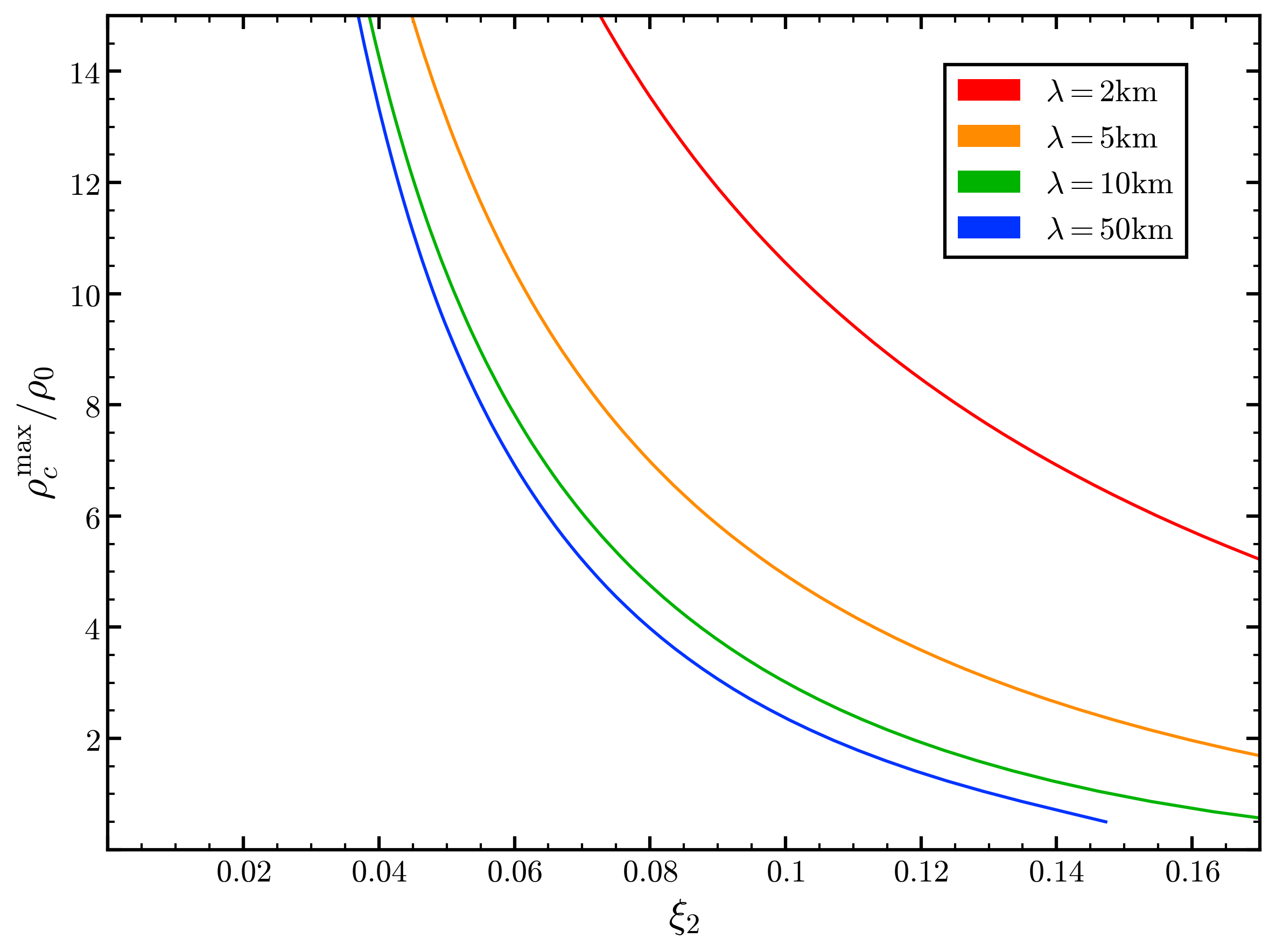
Figure 1: Upper bounds in the parameter space p=21, defined by the maximal central density p=22 allowed for each value of scalar charge and length scale.
Radial Profiles
The radial profiles of the metric functions, matter pressure, energy density, and the effective energy density are extensively studied for both polytropic and realistic (SLy, BSk21, BSk22) EOSs. Key findings include:
- For large positive p=23 or small p=24, pressure can peak non-centrally and decrease only near the surface—a major qualitative departure from GR.
- Metric components p=25, p=26 can both deviate substantially from GR—interpreted as enhanced or suppressed central compactness.
- The effective energy density p=27 is generically positive in the core and can become negative in the outer layers, leading to modifications in observable mass profiles and the local versus ADM mass.
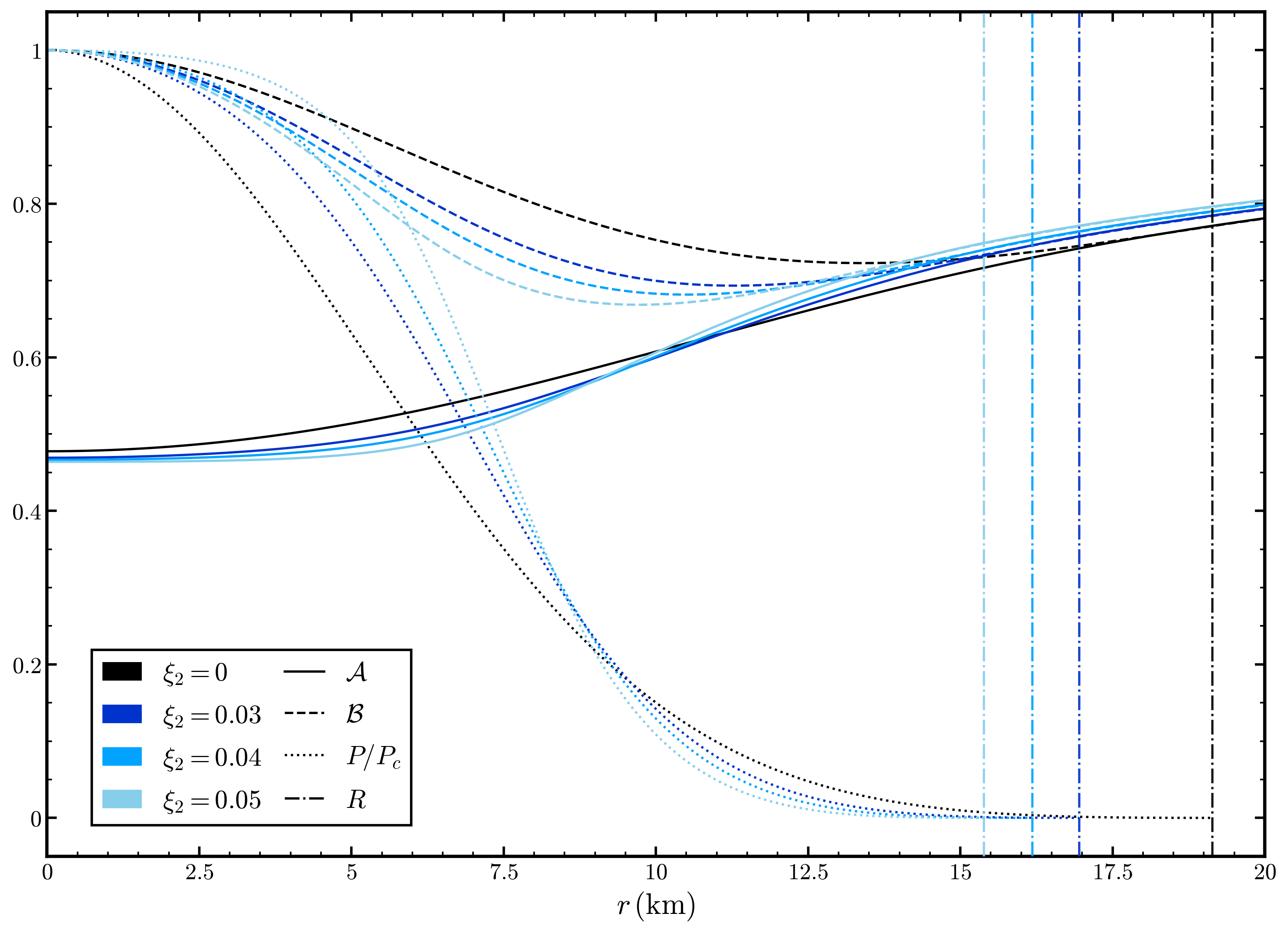
Figure 2: Radial profiles of p=28, p=29, and ξ20 for varying ξ21, with ξ22 and a polytropic EoS; deviations from GR become pronounced as ξ23 increases.
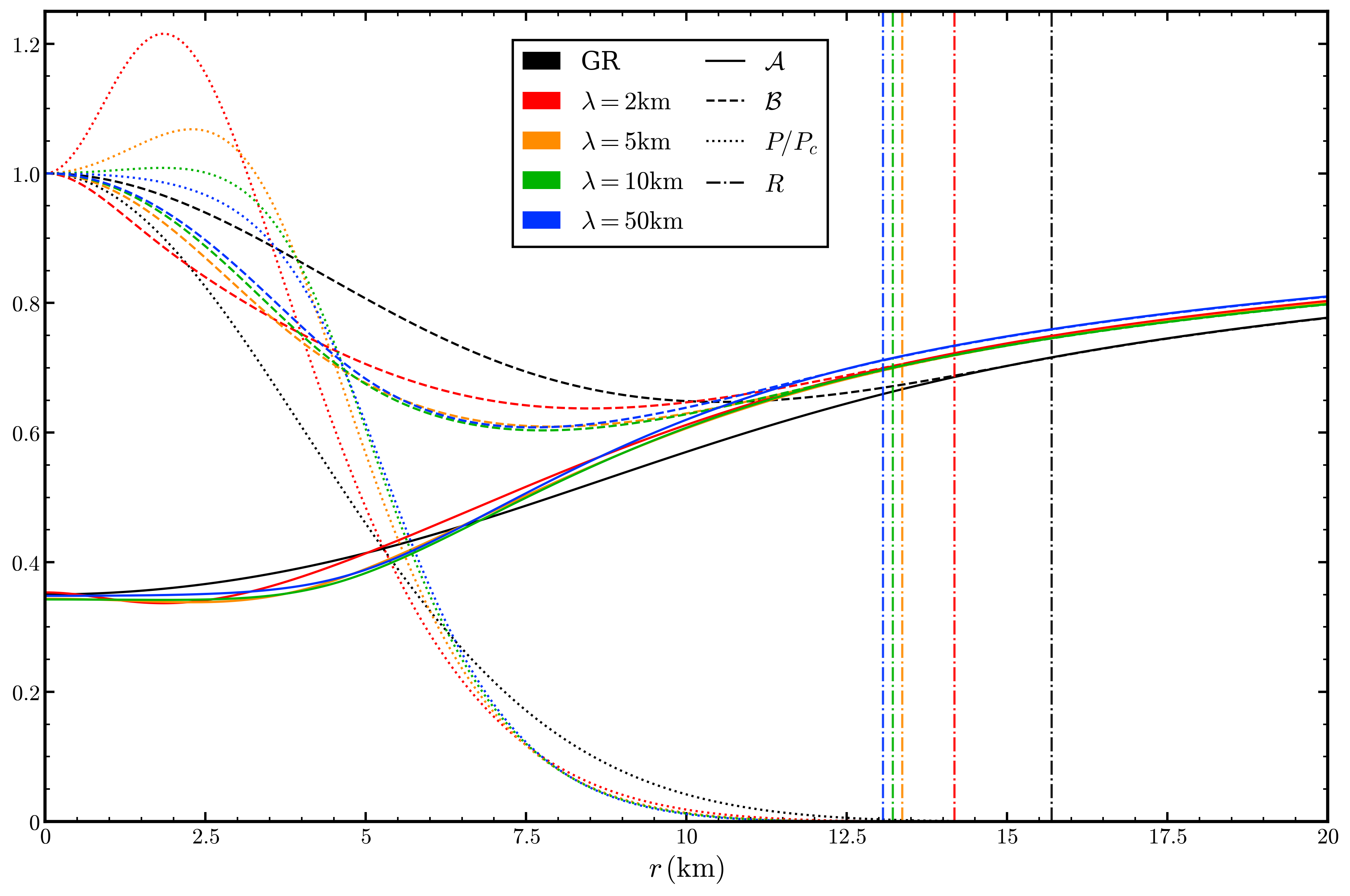
Figure 3: Radial profiles of ξ24, ξ25, and ξ26 under variation of ξ27, fixing ξ28 and ξ29; decreasing λ0 sharpens non-monotonic effects in pressure and density.
Nontrivial Scalar Gradient Dynamics
In the SLy EOS case, for certain parameter choices and high central density, the scalar kinetic density λ1 can flip sign in the interior (implying a change from timelike to spacelike scalar profile over finite radius), only to revert in the outer region. This is permitted at the level of the background solution, although the associated stability and physical acceptability remain uncertain. The system remains mathematically regular as λ2 crosses zero.
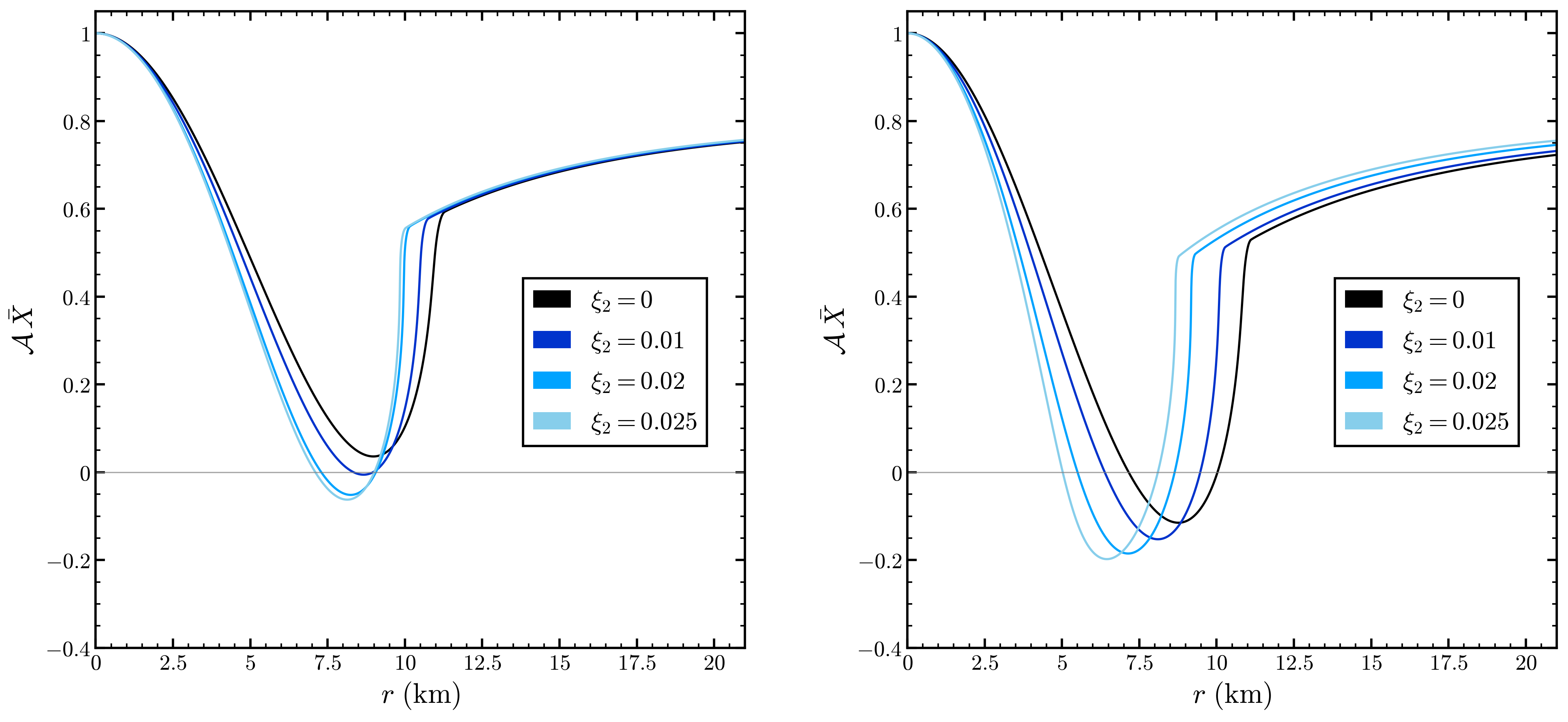
Figure 4: Radial profile of λ3 showing regions where the scalar density λ4 changes sign, for select SLy models.
Mass-Radius Relations and Negative-Energy Configurations
The mass-radius (M–R) relation is mapped for each EOS and parameter set, exhibiting clear systematic shifts under variation of the theory-fixed (λ5) and star-dependent (λ6) parameters:
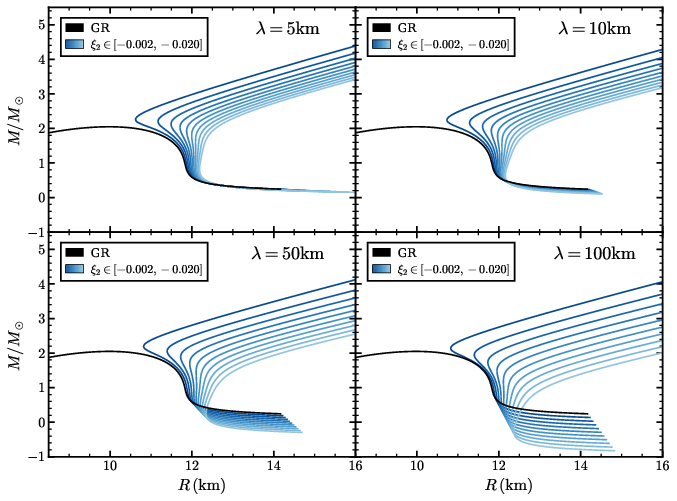
- At fixed λ7, increasing λ8 enhances mass for given radius; for sufficiently large λ9, the ADM mass scales additively as Peff=−ρeff0 in the small-Peff=−ρeff1 limit.
- The Peff=−ρeff2 curve terminates suddenly at the leftmost point, reflecting the onset of singular configurations at maximal central density.
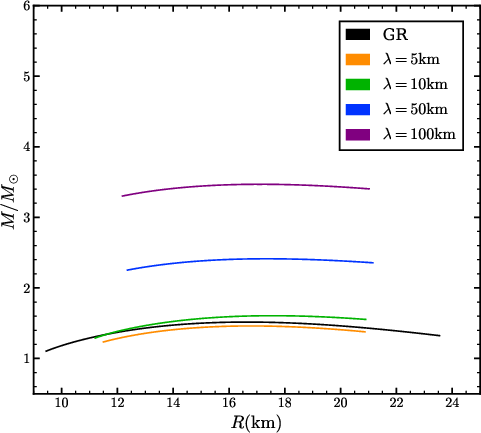
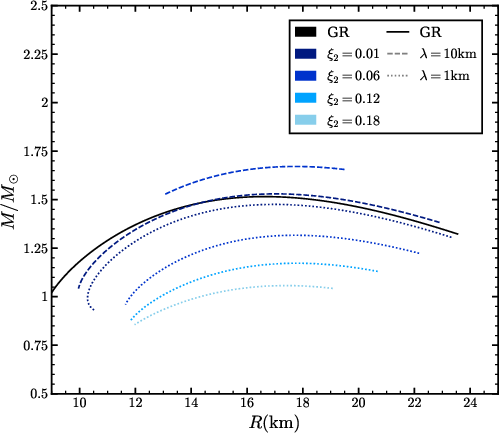
Figure 5: Mass-radius relation Peff=−ρeff3 for polytropic EOS; left: effect of Peff=−ρeff4; right: effect of Peff=−ρeff5.
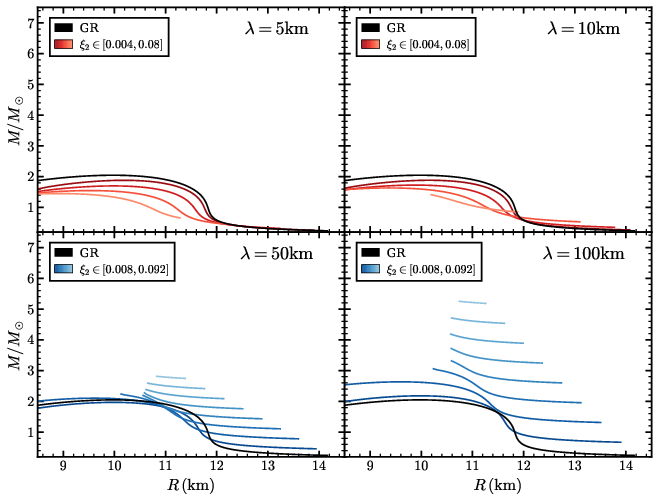
Figure 6: Mass-radius relation Peff=−ρeff6 for the SLy EOS; dependence on both Peff=−ρeff7 and Peff=−ρeff8 is evident, especially at large Peff=−ρeff9.
Moreover, negative scalar charge (ξ20) yields striking and potentially problematic regimes:
Implications and Perspectives
This research demonstrates that neutron stars in shift-symmetric Beyond Horndeski DHOST gravity can circumvent classic no-hair theorems and support configurations with primary scalar hair, parameterized independently of mass or equation of state. Observational signatures—such as systematic deviations in M–R relations, maximum mass constraints, and local versus ADM mass shifts—offer concrete targets for gravitational wave and X-ray observations. The presence of singularities at high compactness and the possibility of non-monotonic matter profiles serve as strong theoretical constraints on the allowed DHOST parameter space.
Potentially observable effects include:
- Modifications to the maximum allowable neutron star mass, impacting interpretation of LIGO/Virgo events in the mass gap regime.
- Differences between locally measured mass and ADM mass at large distances, arising from the scalar field profile and its scale ξ25.
- Non-monotonic pressure and density distributions and associated effects on stability and potential instabilities observable via oscillation modes or in the GW inspiral regime.
The possibility that ξ26 may become spacelike inside the star, together with the occurrence of negative mass configurations for negative scalar charge, raises nontrivial interpretational and stability challenges. The paper suggests that future work should prioritize a full perturbative stability analysis (including both radial and nonradial modes), as well as explore further the observational constraints from current and future multimessenger astrophysics.
Conclusion
By constructing neutron star equilibrium solutions with primary scalar hair in DHOST gravity, the paper provides a comprehensive model that generalizes and extends scalar-tensor predictions beyond GR. The existence of strong upper parameter-space bounds, pronounced modification of mass-radius relations, and the appearance of new instabilities have direct implications for both the theoretical landscape of modified gravity models and their possible astrophysical realization or exclusion. This study highlights the importance of incorporating both theoretical self-consistency and observational signatures in the program of testing gravity with compact objects (2607.01937).