- The paper demonstrates that long-horizon, action-faithful rollouts enable reliable policy evaluation using learned world models.
- It introduces the WMBench benchmark with metrics like Subject Consistency and Perspectivity (up to ρ=0.88) to ensure evaluator alignment.
- The system uses a scalable VLM-based pipeline with explicit action control and memory modules to mitigate error accumulation in rollouts.
GigaWorld-1: A Systematic Roadmap for World Models in Robot Policy Evaluation
Introduction and Motivation
Robotic policy evaluation fundamentally diverges from the paradigms established by large language or vision models. While LLMs are evaluated on efficient digital benchmarks, embodied robot policies require repeated real-world rollouts, incurring high overhead and limiting the rate and scale of evaluation. This bottleneck has intensified with the rise of large-scale multi-modal robot foundation models, motivating the exploration of learned world models as surrogate policy evaluators. However, the specific properties that ensure a world model's reliability for policy assessment were largely unresolved. "GigaWorld-1: A Roadmap to Build World Models for Robot Policy Evaluation" (2607.02642) addresses this gap through a rigorous empirical and methodological analysis, culminating in a scalable, open-source framework—GigaWorld-1—for evaluator-centric world model design.
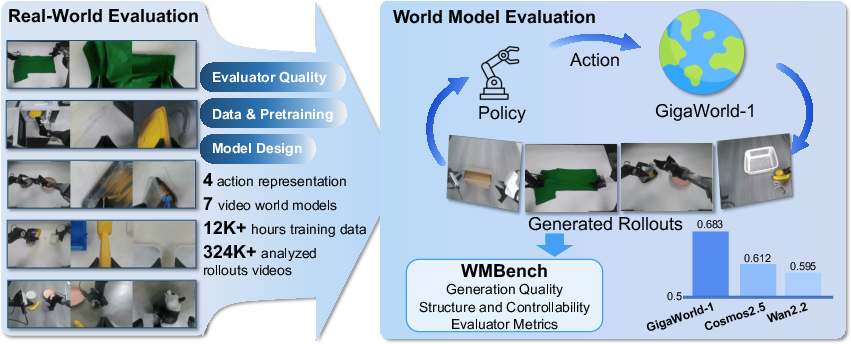
Figure 1: Large-scale comparative analysis of world-model-simulated rollouts, video world models, and action representation paradigms in GigaWorld-1.
Framing World Models as Evaluators
The core contribution of the paper is treating world model policy evaluation as a first-class research objective, independent of standard video generation or simulation fidelity. The system is formalized as a recurrent closed-loop between the robotic policy and the learned world model: the policy produces an action conditioned on observations, and the world model predicts future observations based on this action, iteratively producing a rollout trajectory.
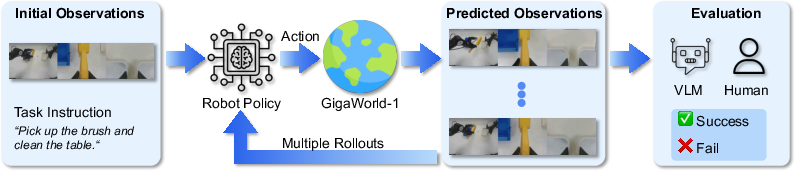
Figure 2: Conceptualization of a world model serving as a policy evaluator—requiring fidelity in both visual quality and accurate, action-faithful rollouts.
Critically, reliable evaluation hinges not on short-horizon video realism, but on the preservation of action-faithful causality over long-horizon rollouts and calibration with real-world policy outcomes. The primary alignment metric is the correlation of empirical success rates between world-model-generated and real-world rollouts, emphasizing agreement in policy-level conclusions across conditions.
WMBench: Benchmarking the Policy Evaluation Task
To systematically evaluate evaluator fidelity, WMBench is introduced—constructed from extensive real-robot teleoperation and policy rollout data, with rigorous data cleaning and annotation, supporting multi-view and multi-task robotic manipulation.
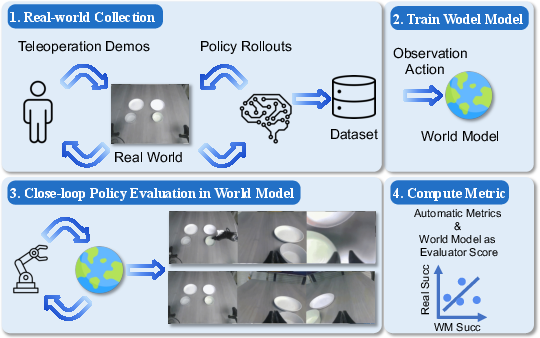
Figure 3: WMBench's evaluation protocol: from real-world policy collection to world model training, closed-loop rollout, and comprehensive alignment assessment.
The benchmark features a four-level ordinal World Model Evaluator Score (WMES) aligned with both outcome faithfulness and visual/motional fidelity, and is complemented by a taxonomy of automatic metrics spanning frame quality, geometry, semantics, interaction, and long-horizon stability.
Empirical Insights: Metric Predictivity and Design
Large-scale evaluation on 324,000 annotated rollouts yields several key findings:
- Visual and geometric fidelity metrics—such as Subject Consistency, Perspectivity, and Instruction Following—are the most reliable predictors of evaluator alignment, with group-level correlations up to ρ=0.88. Semantic labels alone are insufficient for robust evaluation.
- Metrics emphasizing appearance stability (e.g., Background Consistency, Photometric Consistency) can be misleading, as trivial static rollouts can score highly despite being action-ignorant.
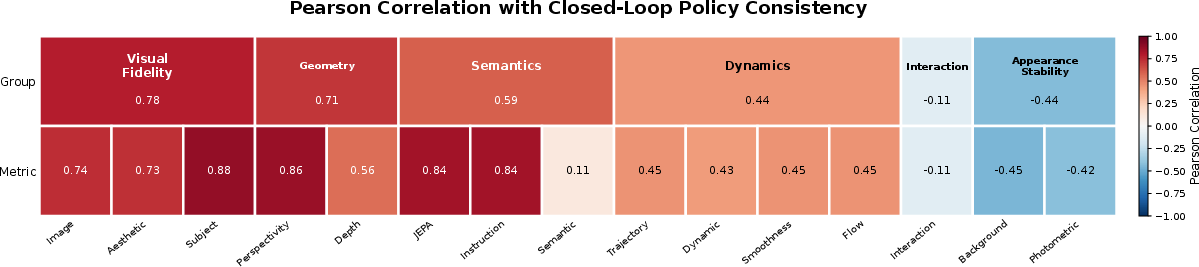
Figure 4: Metric group correlations illustrating the dominance of visual fidelity and geometry in outcome prediction.
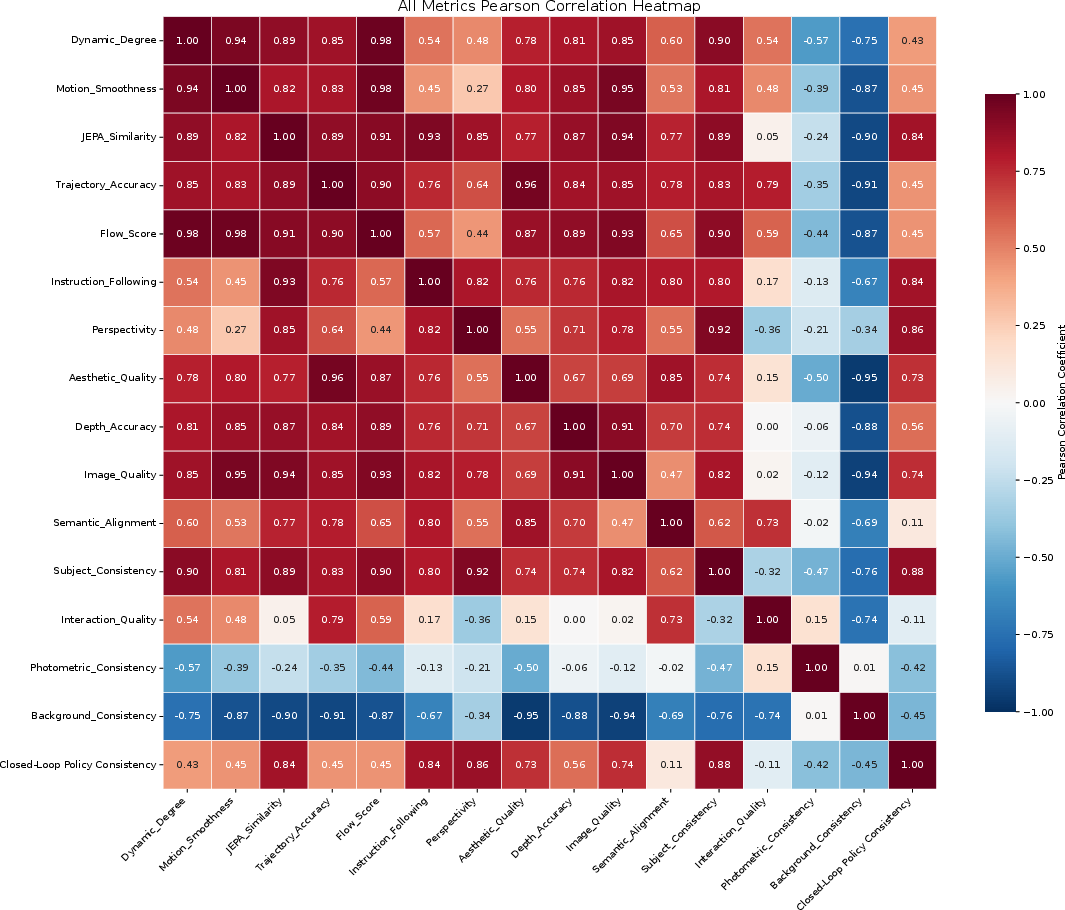
Figure 5: Pearson correlation heatmap—subject consistency, geometric, and semantic fidelity most strongly predict WMES, while appearance stability is unreliable.
- Evaluator quality must be assessed over long-horizon autoregressive rollouts, as models with plausible short-horizon outputs degrade under iterative feedback, leading to compounding drift and misalignment.
VLM-Based Evaluation Pipeline
A scalable, VLM-assisted evaluator (LoRA-tuned Qwen3-VL) is deployed to predict WMES and provide structured rationale, achieving over 87% exact agreement and 99% adjacent agreement with human judges, enabling cost-effective scaling of policy evaluation without sacrificing reliability.
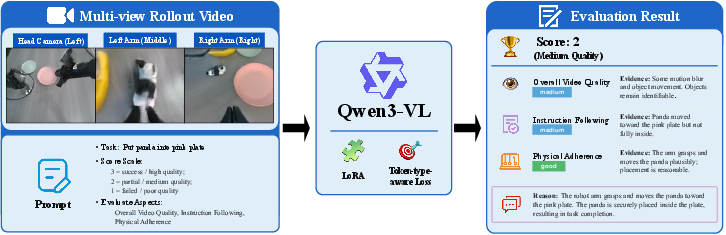
Figure 6: Qwen3-VL-based rollout evaluator: structured aspect-level and outcome score predictions from multi-view video rollouts.
Impact of Pretraining, Data Composition, and Architecture
Pretraining and Data Ablation
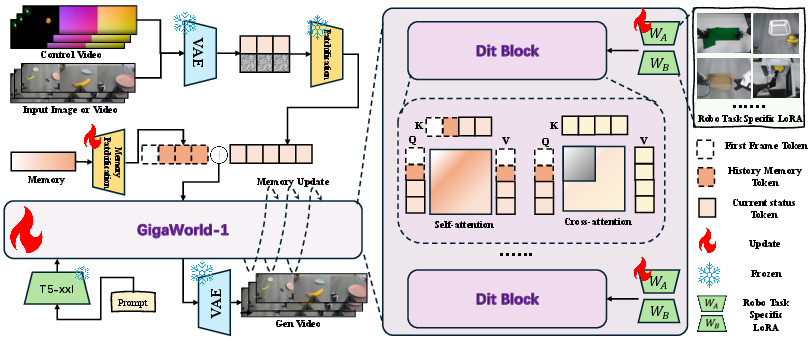
Architecture: Action Control and Memory
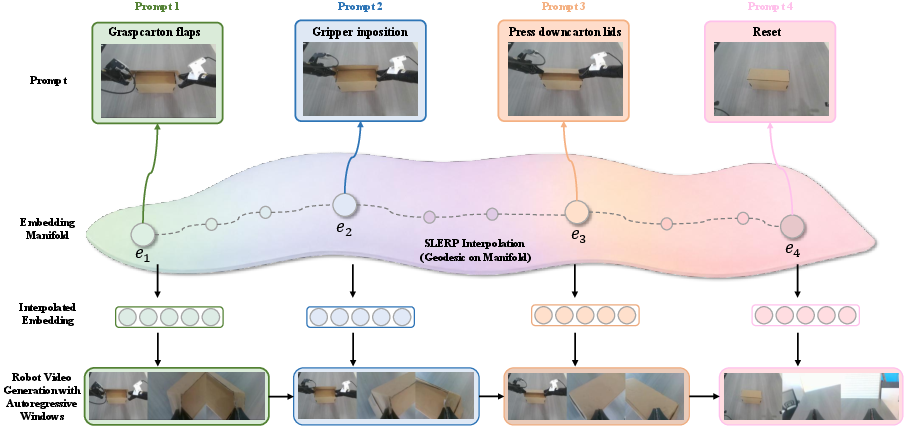
Spherical Linear Prompt Interpolation
Training and System Optimization
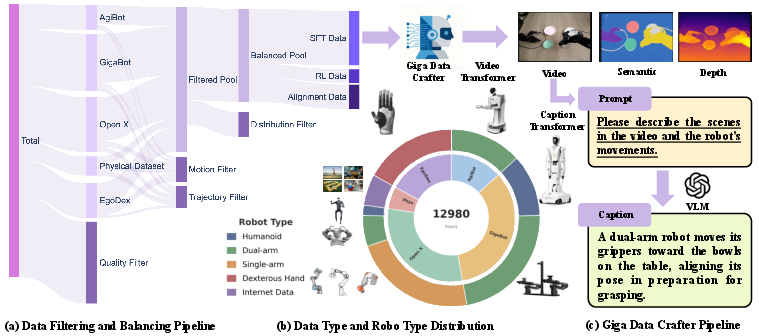
A progressive curriculum covers robot-domain pretraining, autoregressive rollout learning, optional scene adaptation, and few-step DMD2 distillation—enabling practical few-step inference with negligible compromise to generation fidelity. System-level optimizations (SageAttention, custom Triton kernels, memory/parallelism techniques) yield up to 36× speedup in inference throughput, crucial for scaling policy evaluation pipelines.

Figure 10: Multi-stage training pipeline from foundation pretraining to distillation, with modular, pluggable adaptation and optimization stages.
Quantitative Results and Empirical Validation
GigaWorld-1-Plus and GigaWorld-1-Nano achieve the highest scores on all relevant evaluator metrics in head-to-head comparison with established open-source backbones. Compared to the strongest robot/auto and generic baselines, GigaWorld-1-Plus improves core evaluator-alignment metrics by 11.6%–14.9%. Gains are concentrated in JEPA Similarity, Semantic Alignment, and Trajectory Accuracy—metrics tightly coupled to action-faithful policy evaluation.
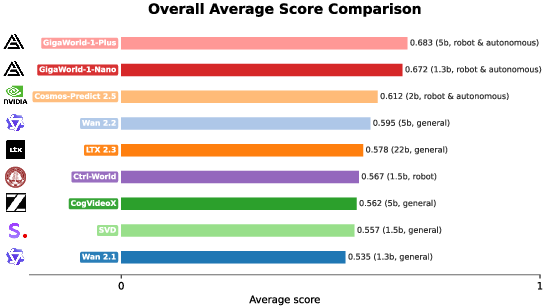
Figure 11: Per-metric model architecture comparison—GigaWorld-1 variants score highest on evaluator-alignment, semantic, and trajectory metrics.
Long-horizon rollout experiments demonstrate GigaWorld-1's superior resistance to error accumulation and visual/semantic drift, outperforming baselines across PSNR, FID, and FVD over 40-second rollouts.
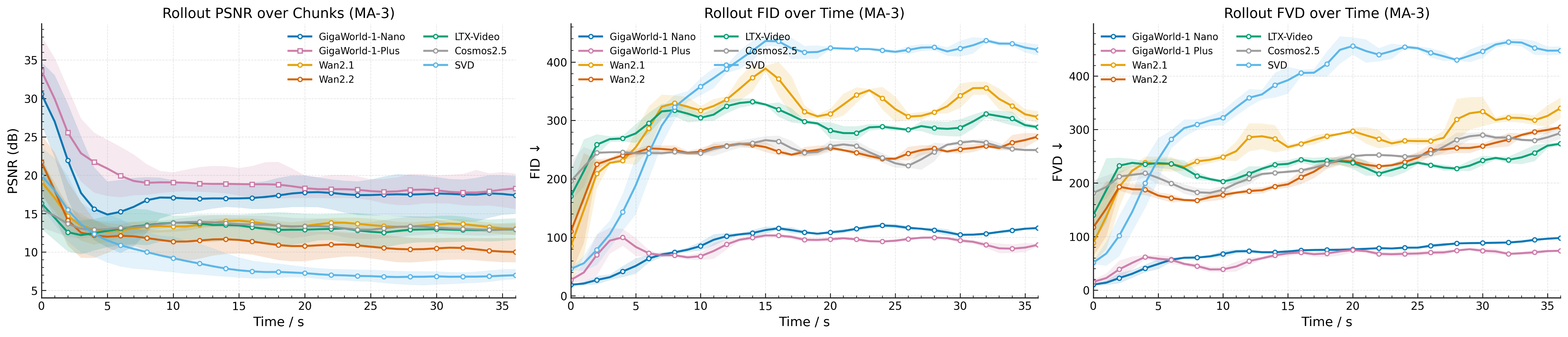
Figure 12: Long-horizon rollout fidelity dynamics—GigaWorld-1 sustains higher PSNR, lower FID/FVD over extended sequences.
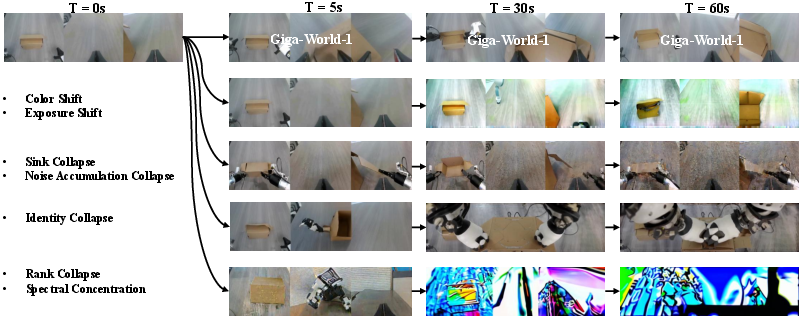
Figure 13: Comparative visual rollout—GigaWorld-1 maintains consistent identity and physics, avoiding collapse observed in generic models.
Ablations confirm the ablation impact of explicit memory and interpolated prompts on scene stability and semantic transition smoothness.
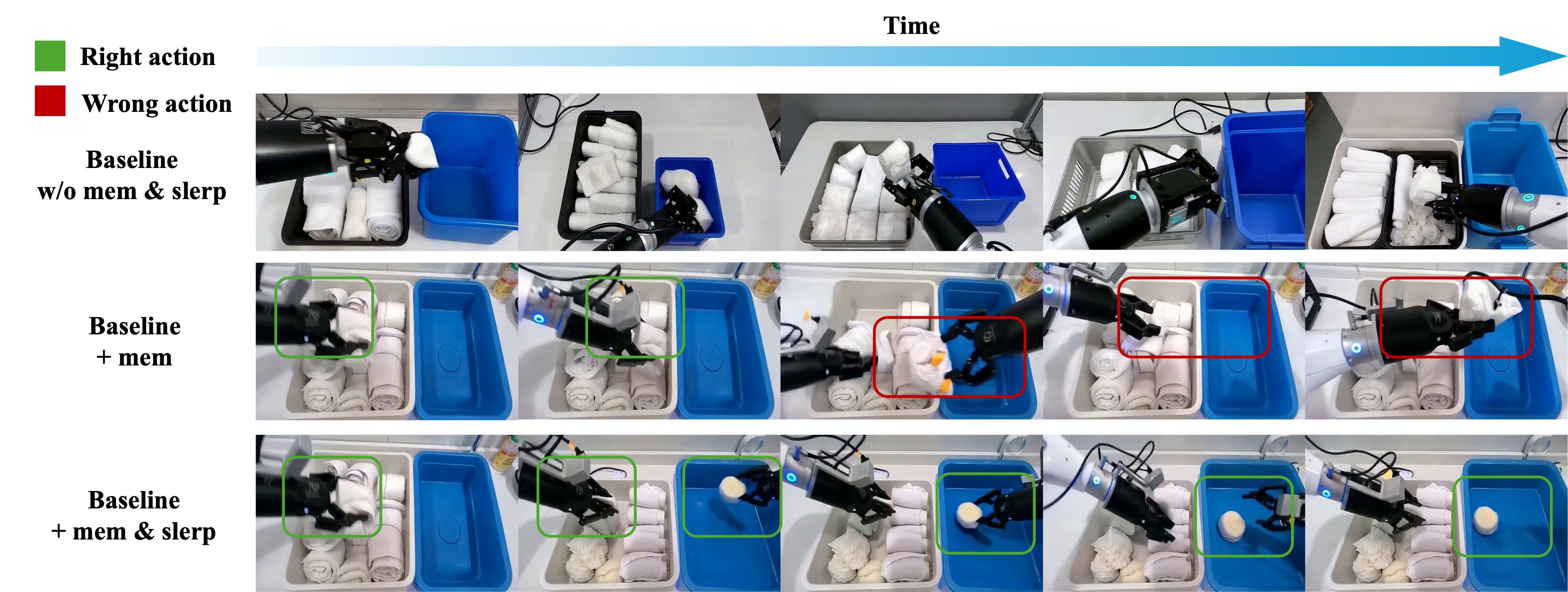
Figure 14: Memory and prompt interpolation ablation—combination yields optimal semantic and geometric consistency.
Policy-Consistent Evaluation: Closed-Loop and OOD Robustness
GigaWorld-1 demonstrates strong OOD generalization, accurately simulating physical outcomes under object, background, and action distribution shifts. Most significantly, in closed-loop policy evaluation, success rates under world-model rollouts closely match real-robot executions, markedly outperforming challenge baselines (reduced optimistic/overconfidence bias).
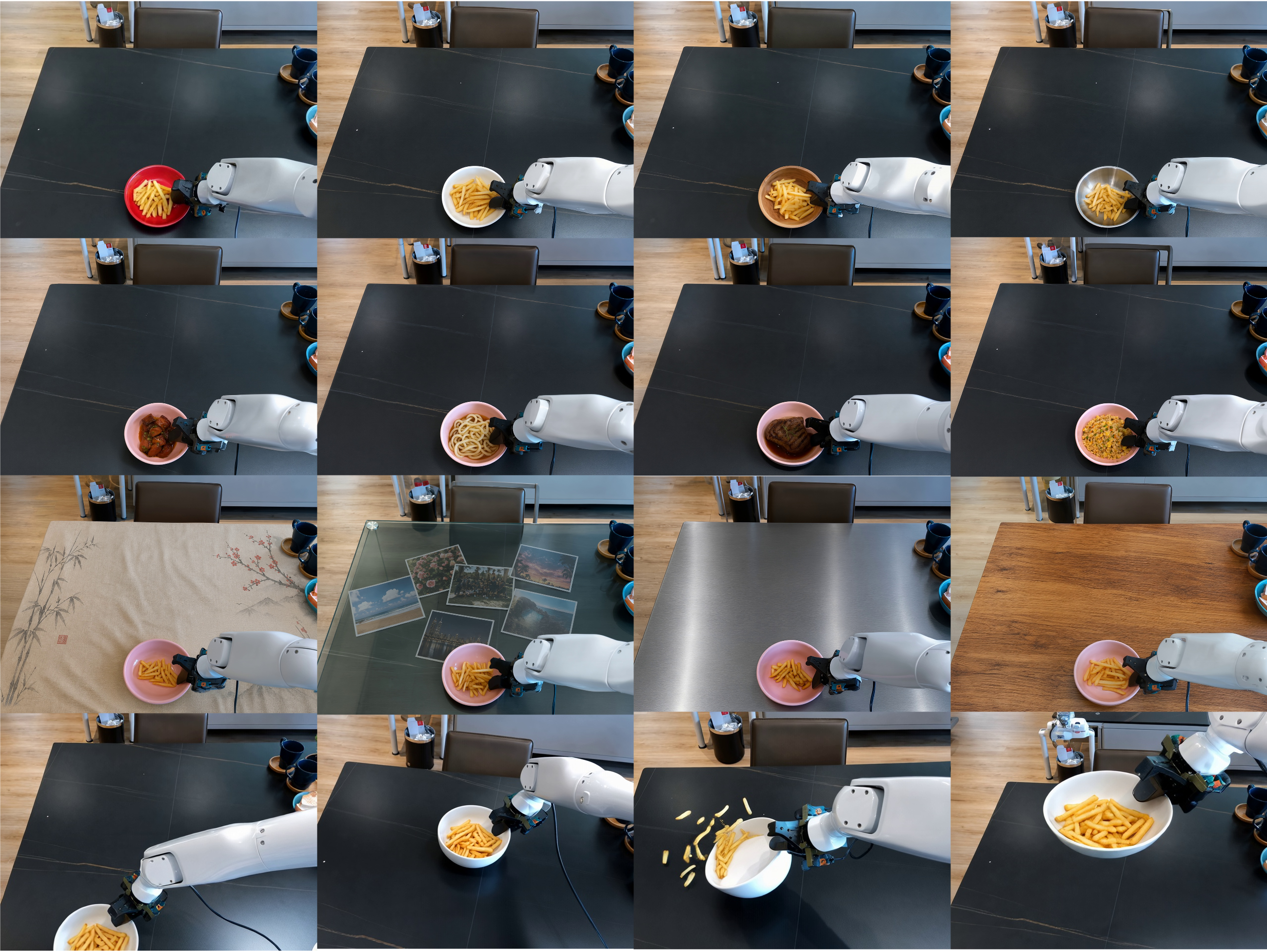
Figure 15: OOD generalization—robust preservation of causal physical dynamics and outcome under diverse shifts.
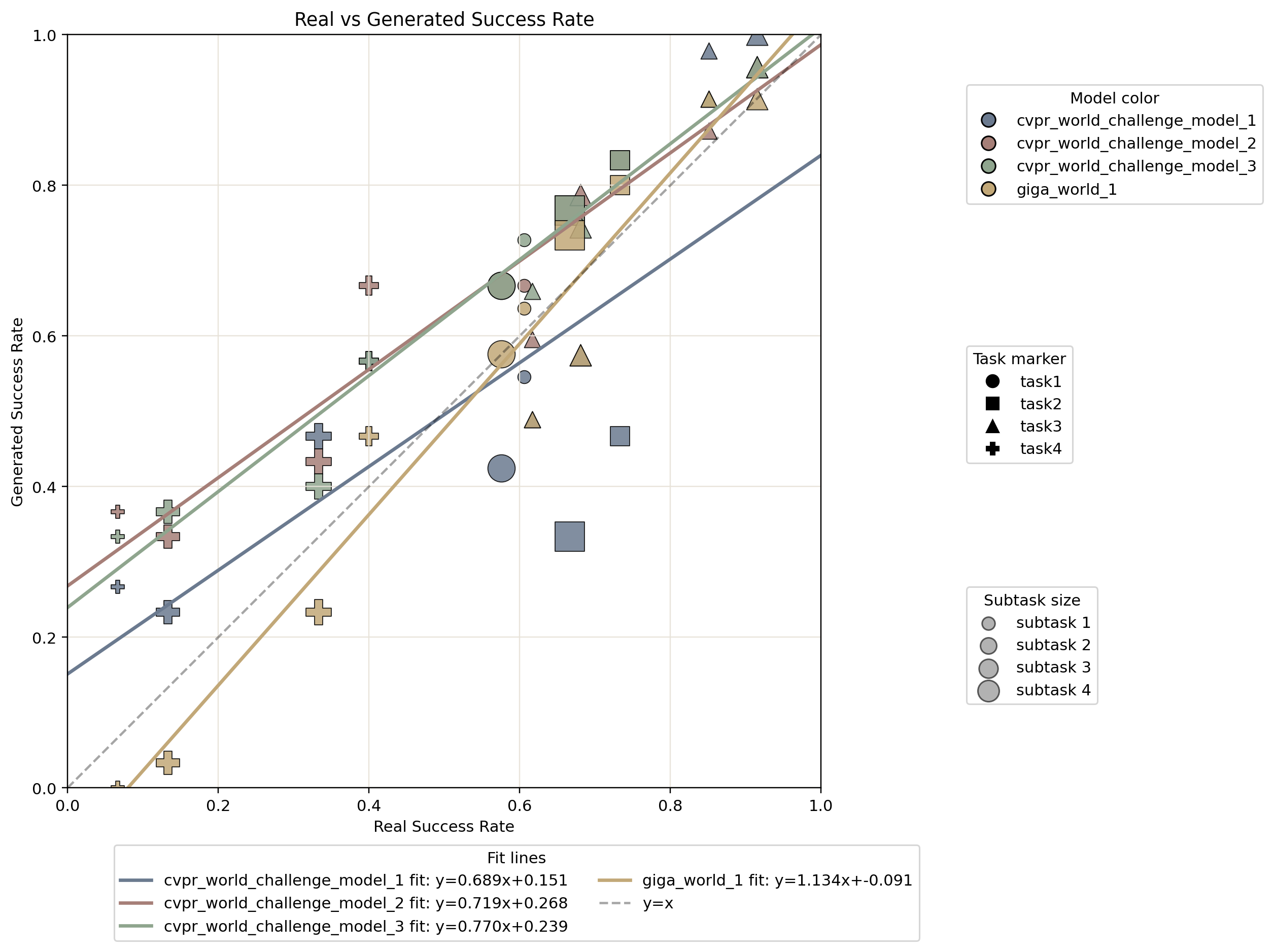
Figure 16: Task-level success-rate alignment—GigaWorld-1 closely tracks the real-world diagonal; baselines frequently overestimate.
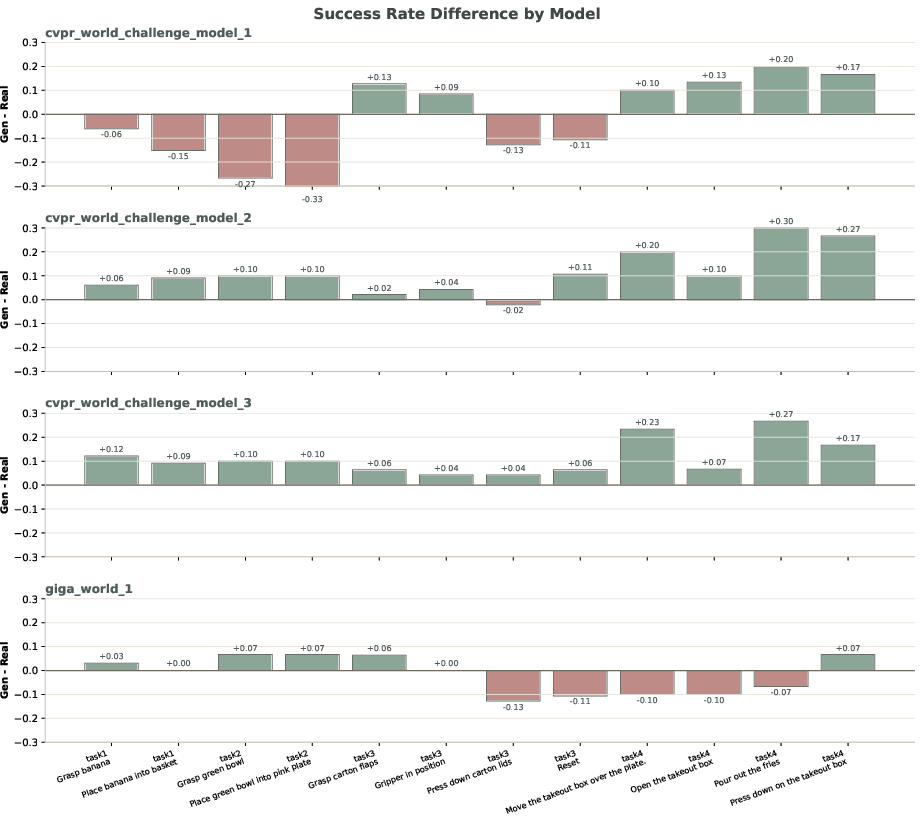
Figure 17: Subtask-level success-rate bias: GigaWorld-1 achieves closer agreement and lower error than competitors.
Theoretical and Practical Implications
- The study reorients the definition of world model fidelity from visual realism to policy-level outcome alignment under long-horizon, action-conditioned rollouts.
- Evaluator-centric design must balance broad world knowledge, robot-specific controllability, and persistent causal grounding.
- Relying on misleading metrics or static video generation for evaluator selection can result in severe mis-calibration and failure to recognize poor policies.
- The public release of code, trained models, and benchmark tools establishes WMBench and GigaWorld-1 as critical infrastructure for scalable, community-driven robot policy evaluation.
- The paper's insights inform both simulator design (e.g., new benchmarks beyond WMBench, 3D/physically-grounded world models) and future research directions in uncertainty estimation, richer reward modeling, and omnimodal embodied world models.
Conclusion
GigaWorld-1 sets a new standard for world-model-based robotic policy evaluation by unifying empirical rigor, scalable benchmarking, architectural design, and system efficiency. Its open-source release catalyzes follow-up work in embodied foundation model evaluation and simulator research. The paper’s findings underscore that long-horizon, action-faithful consistency—not superficial visual metrics or model scale—is central to reliable surrogate policy evaluation. Building on these insights, future advances may integrate richer modalities, certified uncertainty, and even counterfactual evaluation, bringing embodied AI foundation models closer to rapid, trustworthy, and scalable iteration.