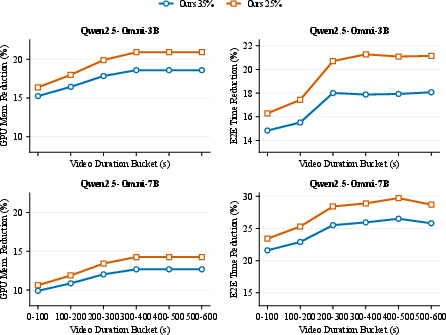
- The paper introduces a training-free, query-guided token compression framework for omni-modal LLMs, achieving robust cross-modal alignment.
- It employs adaptive chunk-wise drop ratio allocation and dual-score token selection to optimize token retention based on query relevance.
- At 25% token retention, it maintains high accuracy and improves GPU efficiency, advancing scalable and efficient multimodal reasoning.
Query-Guided Modality-Balanced Token Compression for Omni-Modal LLMs
Overview and Motivation
Omni-modal LLMs (OmniLLMs) have demonstrated compelling capabilities for unified audio-visual reasoning across domains such as everyday perception, video QA, and empathetic understanding. Yet, the token explosion—especially under long-form audio-visual inputs—poses fundamental inference and memory bottlenecks, limiting practical deployment. Previous audio-visual token compression strategies, particularly unimodal-guided methods, either prioritize audio or visual events based on a single modality attention signal, leading to modality bias and poor cross-modal alignment (Figure 1). These approaches fail to address the temporal locality and modality-specific density of query-relevant evidence, often degrading performance when both modalities are jointly required.
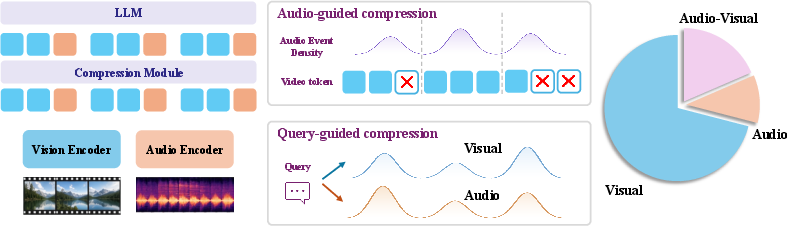
Figure 1: Unimodal-guided compression preserves audio-centric performance but degrades visual/joint-task accuracy, motivating modality-balanced query-guided compression.
Methodology: OmniFocus Architecture
OmniFocus introduces a training-free, query-aware, modality-symmetric token compression framework that operates before the LLM backbone, requiring no parameter updates. The system is composed of three sequential modules (Figure 2):
- Query-Aware Chunk Importance Scoring: Given a textual query, audio and video tokens are mapped into temporal chunks. Separate max-similarity scores (cosine in input space) quantify the query relevance for each modality and chunk, capturing localized evidence via sparse activations.
- Adaptive Chunk-Wise Drop Ratio Allocation: Relevance scores are transformed (via softmax) into local drop ratios for each modality, calibrated under global modality-specific budgets through binary search, with standard local bounds [0.35,0.75]. This allocation preserves the token budget constraint while concentrating retention on query-relevant regions.
- Dual-Score Token Selection: For each chunk and modality, tokens are selected by balancing inter-modal association (cross-modal cosine similarity to mean features in the paired modality) and intra-modal peak scores (distinctiveness within modality). An equal split preserves both cross-modal correspondence and modality-internal evidence. Tokens are masked out pre-LLM, maximizing inference efficiency.
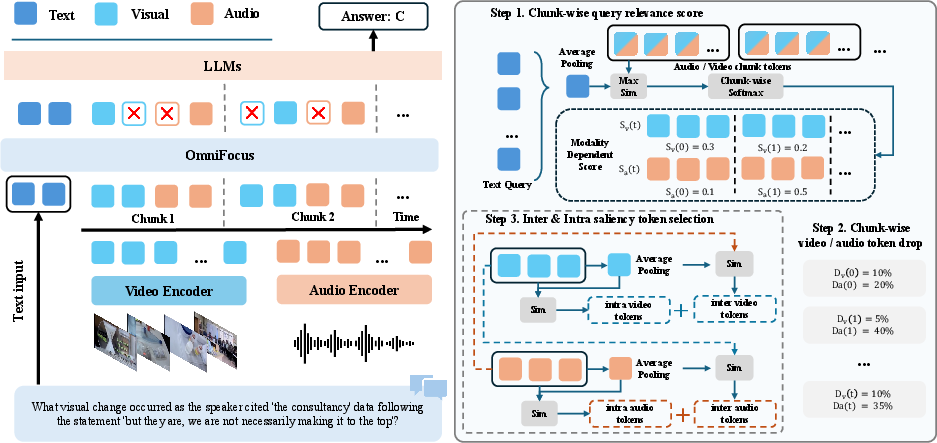
Figure 2: OmniFocus workflow, with query-guided modality-specific chunk relevance, adaptive drop ratios, and dual-score token retention.
OmniFocus is validated on Qwen2.5-Omni-3B and 7B across DailyOmni, WorldSense, OmniVideoBench, and VideoMME. Baselines include unimodal-guided OmniZip, vision-language compression DyCoke, and random sampling. Key findings include:
Ablation and Analysis
Detailed ablation studies isolate the contributions of scoring, allocation, and token selection schemes:
- Chunk Relevance Scoring: Max-similarity outperforms average pooling in query-token aggregation, underlining the importance of sparse evidence localization.
- Drop Ratio Allocation: Adaptive score-based allocation yields consistent improvement over random or uniform variants.
- Inter/Intra Token Selection: Hybrid selection is optimal; intra-modal peak retention provides discriminative advantage for modalities with modality-specific evidence (Figure 4, Figure 5).
- Modality-Balanced Guidance: Joint audio-video chunk scoring surpasses single-modality guides, minimizing bias and robustly capturing the evidence distribution.
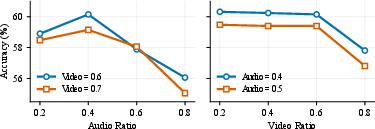
Figure 4: OmniFocus is resilient to moderate modality-specific budget settings; aggressive compression of any modality degrades performance.
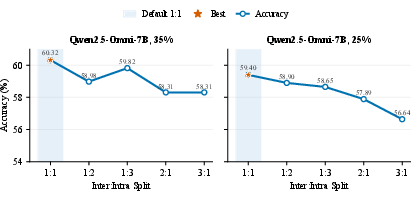
Figure 5: Token selection accuracy is sensitive to inter/intra split; balanced retention is optimal across benchmarks.
Practical and Theoretical Implications
OmniFocus fundamentally shifts modality compression for OmniLLMs to a query-driven, symmetric, evidence-preserving approach that can be deployed in a training-free manner on diverse model backbones. Its efficiency improvements without retraining—crucial for long-form and real-time multimodal reasoning—enable scalability of unified perception systems in resource-limited environments. The method also reveals how attention to modality-specific query evidence and chunk alignment enhances the capacity for cross-modal reasoning, potentially extending to even more modalities (e.g., text, sensor).
Theoretically, the work undermines the premise of unimodal-guided compression as universally optimal for cross-modal LLMs, highlighting the need to combine local query relevance, adaptive token budgeting, and inter-modal association to exploit the full expressiveness of fused multimodal representations.
Future Directions
- Instance-Adaptive Budget Allocation: Moving from benchmark-level calibration to per-example adaptive retention could further optimize accuracy-efficiency trade-off, especially for queries with variable modality requirements.
- Robustness to Challenging Conditions: Extension to noisy, occluded, or temporally misaligned data would test the generality of modality-balanced compression.
- Integration with Internal LLM Attention: Augmenting compression with lightweight adaptation or explicit feedback from downstream LLM attention maps may further boost query-driven selection.
Conclusion
OmniFocus provides an efficient, training-free token compression mechanism for omni-modal LLMs, overcoming modality bias and maintaining cross-modal alignment under extreme compression. The empirical results substantiate its accuracy-efficiency gains in long-form audio-visual reasoning, with robust ablations supporting modality-symmetric design choices. The approach has direct implications for scalable deployment of unified multimodal systems and advances methodological understanding of evidence-driven cross-modal compression (2607.03050).