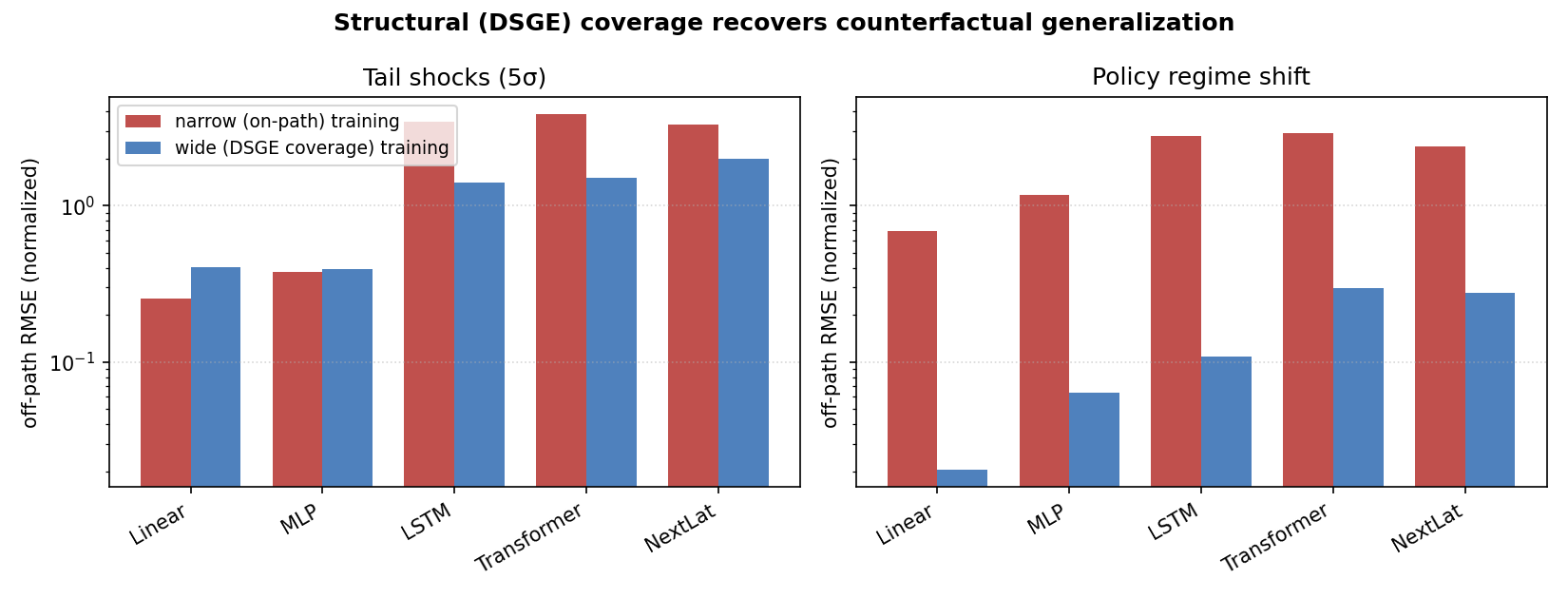
- The paper establishes DSGE models as belief states that generate synthetic coverage for robust counterfactual predictions in economic settings.
- It introduces DSGE-Gym, a benchmark across eight economic environments that reveals significant error reduction in tail and regime shifts.
- The study emphasizes that only training on structural DSGE coverage enables reliable off-path generalization, bridging economic theory and machine learning.
DSGE as a Structured World Model: Benchmarking Counterfactual Generalization
Motivation and Conceptual Framing
The work recasts the Dynamic Stochastic General Equilibrium (DSGE) model as a structured world model, providing a rigorous bridge to latent world models in machine learning such as Dreamer and transformer-based architectures (e.g., IRIS, Genie, NextLat). The central thesis is that the DSGE state variable fulfills the role of a belief state—a sufficient statistic of history for predicting the future—that recurrent/self-predictive world models are explicitly trained to learn. This formal identification positions DSGE models not just as solvers of policy functions, but as generative mechanisms that impose causal structure and hard constraints across the entirety of the state space, including regions inaccessible from historical data.
In machine-learning settings, world models are fit to observed trajectories and are disciplined only within the regions covered by training data. This is problematic for planning, policy analysis, and risk assessment, as these often demand robust off-path generalization—counterfactual predictions about states not encountered during training. In economics, the off-path regime is particularly critical, underpinning a structural approach to policy counterfactuals and rare-event extrapolation.
(Figure 1)
Figure 1: Schematic contrasts of learned vs. structural world models; DSGE applies hard constraints universally and can generate tail/regime coverage unachievable by ML models trained on local data.
Benchmark Design: DSGE-Gym
To empirically examine counterfactual generalization, the paper introduces DSGE-Gym, a benchmark spanning eight DSGE environments (real, monetary, fiscal, open-economy, labor, climate, firm-dynamics), including the ECB New Area-Wide Model (NAWM) at production scale (230 variables, 21 shocks). The benchmark uniquely draws train and test sets from different regions (on-path versus off-path—including tail shocks and counterfactual regimes), with the off-path region synthesized by the structural model—a mechanism that cannot be realized from any single historical trajectory. Tasks include one-step world-model prediction, multi-step rollouts, and planning over policy actions.
Experimental Evidence: Collapse and Recovery
The results are sharp and robust across multiple environments and scales:
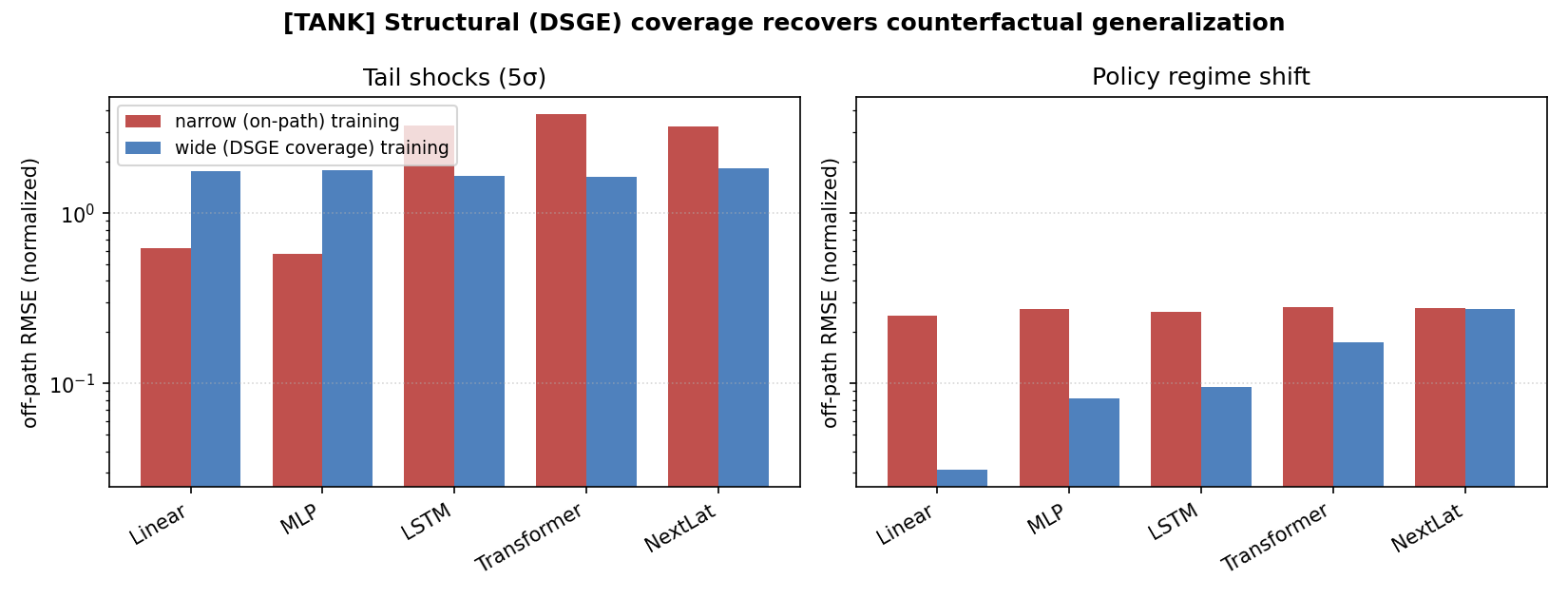
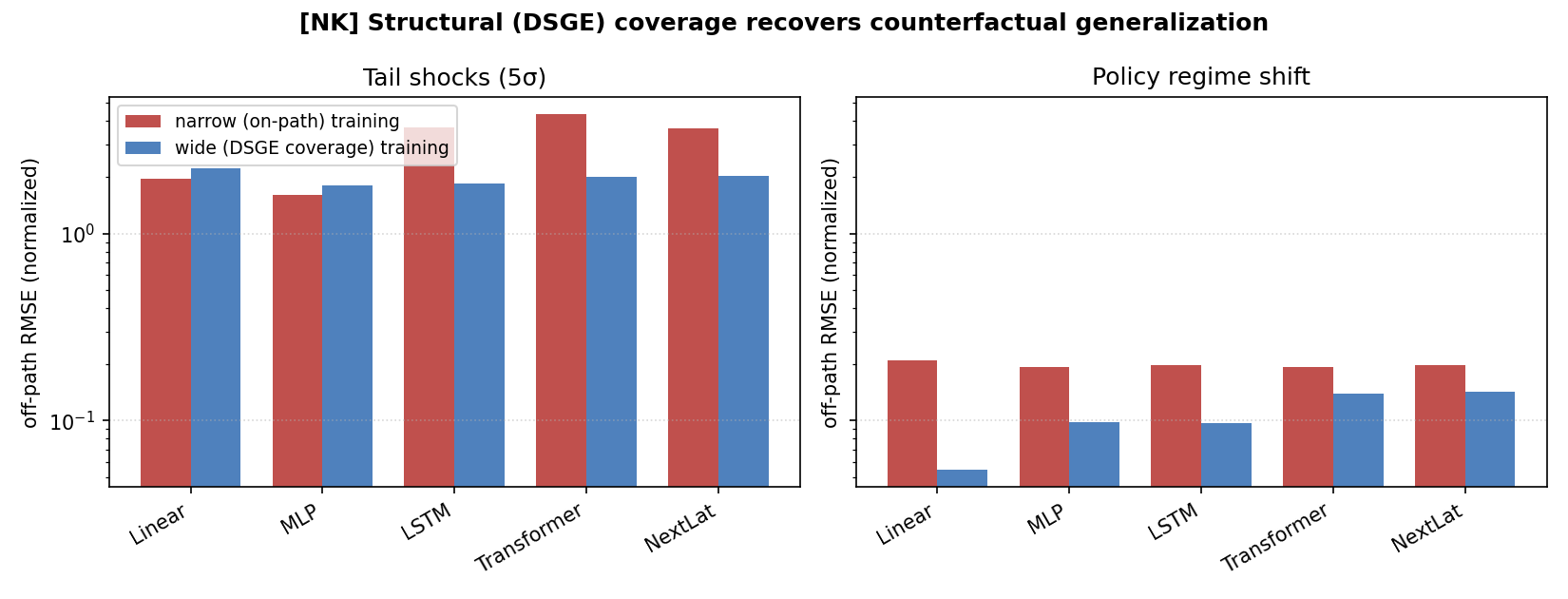
Figure 3: Coverage replication on NK and TANK; off-path gap collapses with DSGE-generated training coverage, even under monetary and fiscal actions.
- Replication Across Mechanisms and Scale: The H1 collapse and H2 coverage effects persist in NK (monetary), TANK (fiscal), TCM (open-economy), as well as DMP (search unemployment), E-NK (climate), and firm-entry models. The NAWM scale test further validates that tail collapse and coverage recovery persist at production scale, contingent on model capacity.
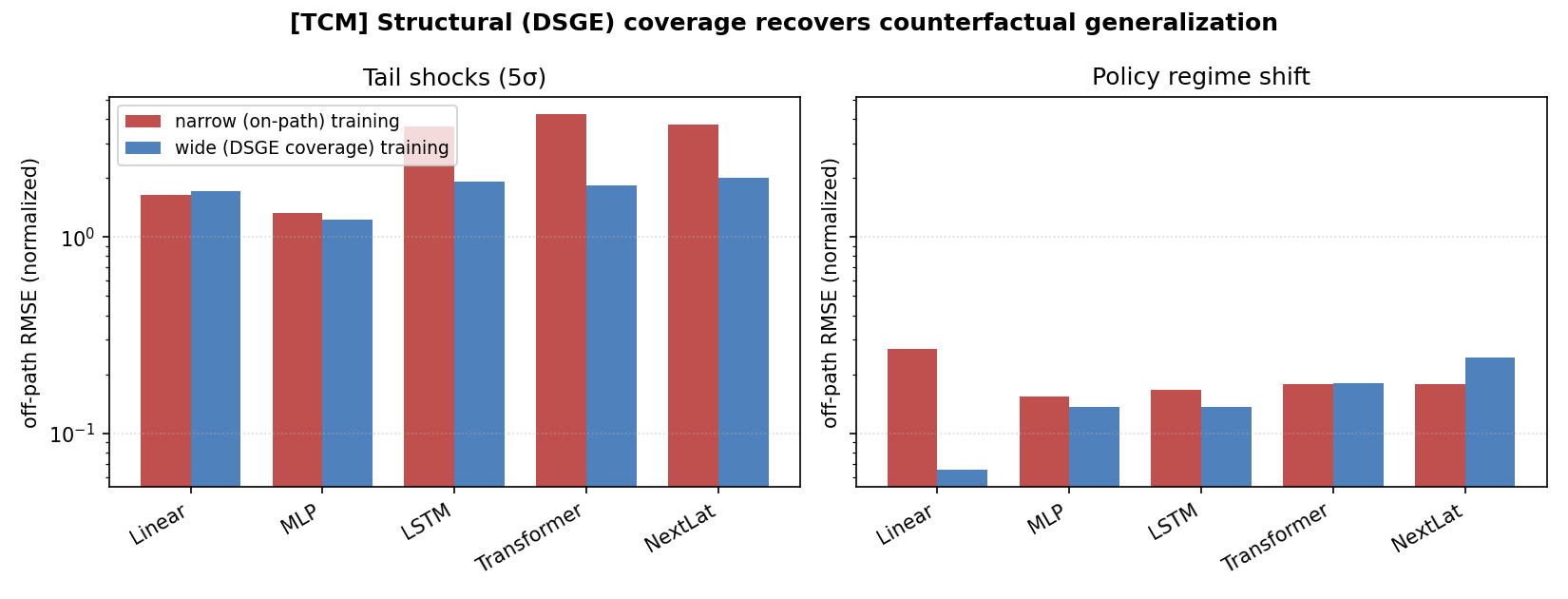
Figure 4: Open-economy replication; the H1 → H2 pattern holds with exchange-rate-leaning Taylor rules.
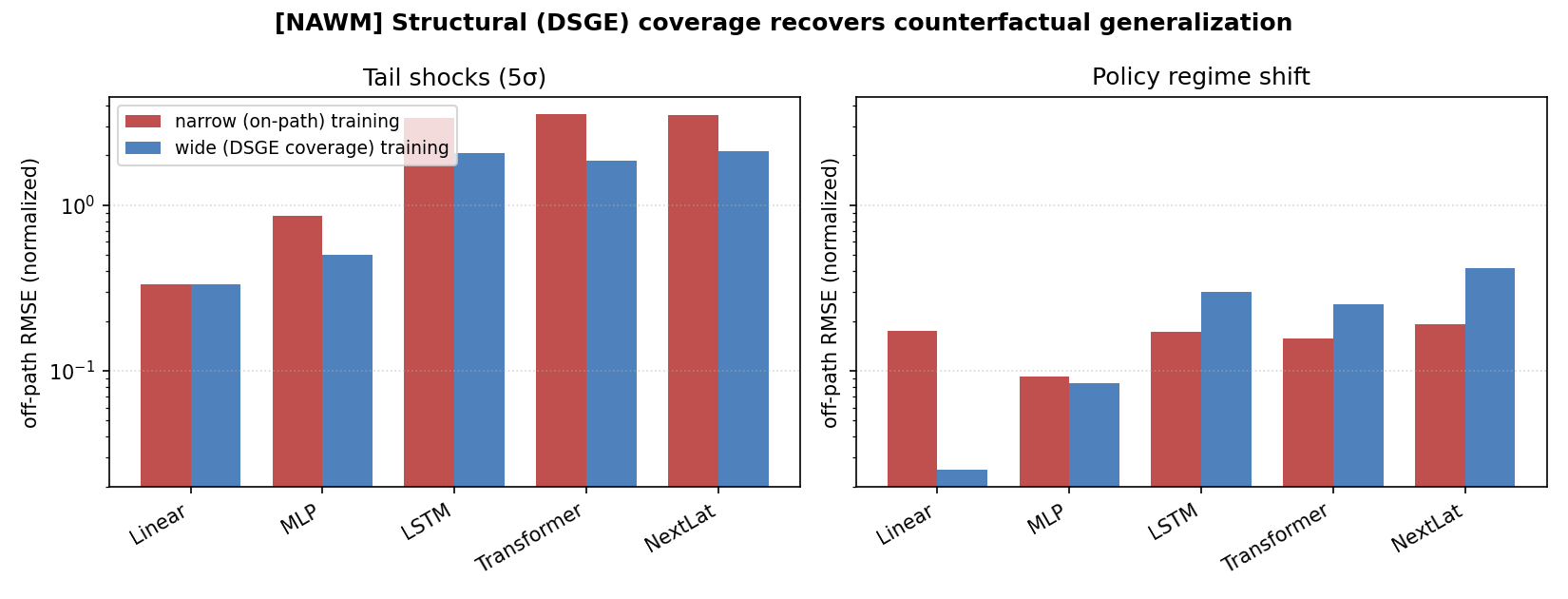
Figure 5: Coverage and tail recovery in the ECB NAWM; linear baselines are exact for first-order DGP, capacitated sequence models recover off-path error only with adequate wide coverage.
Implications, Limitations, and Future Directions
The work isolates coverage generation as the mechanism by which economic structure aids counterfactual generalization: a DSGE model acts as a generator rather than merely a constraint-imposing oracle. This reframes the value of mechanistic models (physics engines, simulators, economic theory) in world-model learning—not just as ground truth but as distribution shapers enabling synthetic coverage of decision-relevant states absent from real data.
Key theoretical implication: The identification of the DSGE state as a belief state solidifies the conceptual unity between economics and machine learning world models, suggesting mutual benefit from integrating deep structure and flexible data-fitting. Practically, the results underscore that planning, policy evaluation, and risk management require structural coverage to avoid catastrophic extrapolation failures.
Limitations include the lack of non-structural coverage controls (VAR, regime-perturbation augmentation), the challenge of scaling nonlinear solutions (third-order) to large models (NAWM), and the imposition (rather than learning) of structure in the current reference baselines. The negative result on imposed structure motivates developing learned structured world models (e.g., NextLat-style models regularized toward DSGE constraints), currently outlined for subsequent work.
Misspecification is also a risk: structural coverage is only as accurate as the model class used to generate it. This motivates a hybrid learning structure capable of adaptation and correction.
Conclusion
The paper establishes that DSGE models are structured world models whose state variable fulfills the belief-state property sought in modern ML world models. Learned world models, while powerful on-path, are incapable of off-path generalization without synthetic coverage generated by structural models. Structural coverage, not static constraint enforcement, is the operational mechanism to achieve counterfactual robustness. This reframing has broad implications for model-based AI, economics, and decision-making under uncertainty, motivating hybrid approaches where structural priors and machine-learned adaptivity are jointly optimized.
The DSGE-Gym benchmark and protocol provide a reproducible platform to measure, contest, and advance counterfactual generalization in complex economic environments, laying the groundwork for future learned structured world models and digital-twin research.