- The paper introduces a novel schedule algebra that repurposes pipeline bubbles to eliminate encoder stalls and improve MFU in MLLM training.
- It employs a 'transpose' mechanism to statically assign encoder computations, reducing runtime scheduling overhead across heterogeneous workloads.
- Empirical results on 512 and 8 NPU setups demonstrate up to 2.70× speedup, validating its efficiency and scalability in production and controlled settings.
HyperParallel-Mpipe: A Composable Algebra System for Optimizing MLLM Training over Supernode Clusters
Introduction
The proliferation of multimodal LLMs (MLLMs) has driven demand for increasingly sophisticated distributed training systems capable of handling heterogeneous workloads across massive accelerator clusters. Addressing the suboptimal Model FLOPs Utilization (MFU) observed in MLLM training, especially when compared to decoder-only LLMs, HyperParallel-Mpipe introduces a novel parallel scheduling approach grounded in composable algebra. The proposed system formalizes pipeline scheduling as algebraic constructs, enabling systematic derivation of runtime execution. Central to the method is the 'transpose' schedule, which remaps modality encoder computations onto otherwise idle pipeline warmup bubbles, mitigating pipeline stalls and inefficiencies.
Motivation: Heterogeneous Workloads and Pipeline Bottlenecks
Multimodal models incorporate modality encoders (e.g., ViT-style for vision), LLM backbones, and often modality generators, forming a fundamentally heterogeneous pipeline. Modal encoders, whose workloads fluctuate according to the input modality (resolution, length, etc.), typically sit at the pipeline's input stage and induce substantial variance in computational load and memory footprint. This variability translates to dynamic pipeline bubbles, as shown by significantly reduced MFU for MLLMs relative to traditional LLMs.
The separation of modality parsing and language reasoning introduces a major structural divergence from homogeneous Transformer stacks. Encoder workloads—particularly image and video processing—can dominate activation memory and introduce unpredictable stalls, posing challenges for existing pipeline, tensor, and data parallelism strategies.
Analysis of Existing Solutions
Prior approaches tackle pipeline heterogeneity and dynamic workloads through spatial partitioning (DistTrain), temporal bubble exploitation (Optimus), and runtime balancing (DIP), but all fundamentally couple the encoder inside the LLM backbone pipeline. This coupling results in per-iteration scheduling overhead, reliance on workload profiling, and reduced reproducibility, particularly at scale, when encoder variance grows.
Mpipe Design: Schedule Algebra and Transpose Mechanism
Mpipe introduces a formal schedule algebra, conceptualizing parallel schedules as lists of per-region skeletons (e.g., 1F1B, GPipe, transpose) and providing a derivation mapping cuts, schedules, and model structure to concrete runtime behavior—device placement, collective communication, and execution order.
The 'transpose' skeleton represents replication of the modality encoder across all pipeline ranks, execution within warmup bubbles, and gathering outputs into the first LLM stage. This static placement is uninfluenced by the modality mix and eliminates runtime scheduling overhead, yielding schedule-invariance both for frozen and trainable encoders.
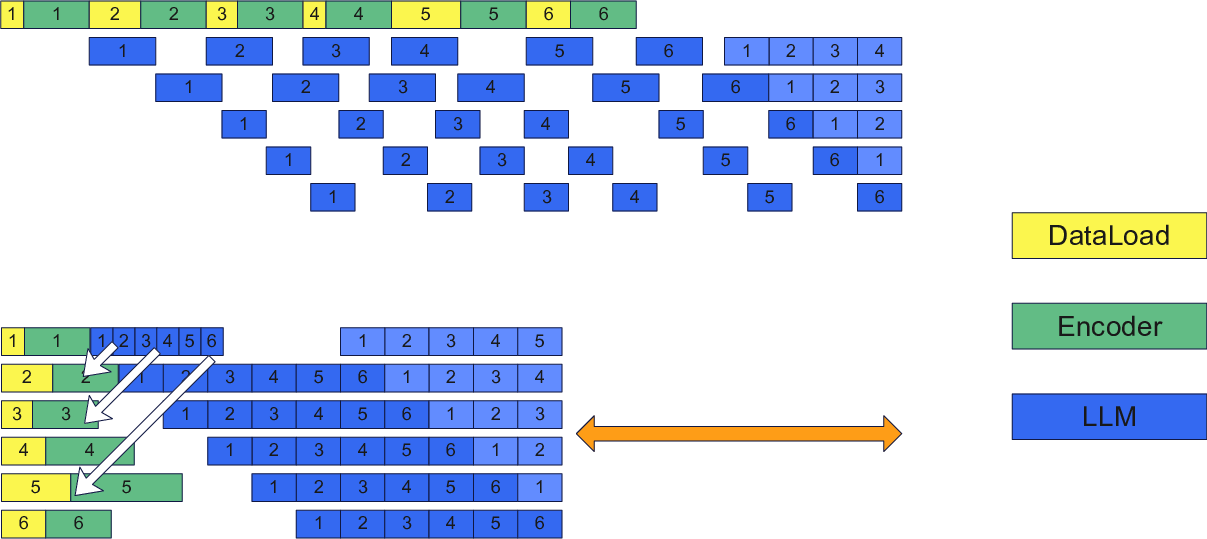
Figure 1: Mpipe transposes the modality encoder execution into warmup bubbles, repurposing otherwise idle pipeline slots and hiding variability from the critical path.
This algebraic formulation supports compositional reasoning on scheduling, enabling modular extension toward richer schedule families. Memory and cost are derived directly from placement/order; encoder activation is live throughout the LLM span but hidden within the pipeline bubble rather than allocated as a separate sharded stage.
Cost Model
Mpipe's cost model leverages the algebraic structure. Each event is weighted by duration, and step makespan is read as the longest path through the event graph. 'Transpose' quantitatively matches encoder work to warmup slack per rank, exposing only the overflow beyond available bubble time. The owner map for microbatch assignment greedily minimizes exposed spill, yielding significant speedup when encoder work is small relative to warmup slack.
Cost model homomorphism onto the (max,+) semiring enables compositional analysis, supporting prediction of schedule efficiency and bottleneck identification. The step makespan's computation directly supports empirical validation.
Empirical Results
HyperParallel-Mpipe is validated on production-scale (512 Ascend 910C NPUs) and smaller (8 NPUs) workloads:
- Production-scale (512 devices, ViT+DeepSeek backbone): Achieves 1.21x step time reduction over the DistTrain-like baseline.
- Small-scale (8 devices, Qwen3.5 MLLM): Achieves 2.70x step time reduction, outperforming Megatron-LM baseline.
The relative speedup correlates with the encoder's share of the pipeline step and the available warmup slack. The larger backbone in the production setup constrains potential gains, while controlled settings with relatively heavier encoder workloads show substantially larger speedups.
Implications and Theoretical Significance
By relocating encoder computation outside the critical path and into static pipeline bubbles, Mpipe delivers increased efficiency, reproducibility, and zero per-iteration scheduling overhead. Its algebraic schedule design provides a formal foundation and compositional flexibility, supporting extension to more complex, heterogeneous pipeline topologies. The corollary of schedule-invariance guarantees that encoder placement and backward footprint are unaffected by schedule choice, enhancing practical robustness.
The static nature of the schedule yields deterministic behavior, contrasts with runtime search and adaptation characteristic of systems like DIP and MegaScale-Omni. While Mpipe's effectiveness depends on the encoder-to-bubble ratio, its principled cost model enables precise prediction and tuning.
Practically, Mpipe enables scale-out training for multimodal models with controlled resource utilization, promising improved throughput in high-end datacenter and enterprise training scenarios. The method is particularly suited for deployments on supernode clusters with heterogeneous accelerator configurations.
Limitations and Future Directions
Mpipe's static scheduling is optimal when per-microbatch encoder workload is bounded by available warmup slack. When this is exceeded, residual spill into the critical path is inevitable, and loss-preserving metadata-guided microbatch reordering is a promising avenue for future work. The schedule algebra is instantiated on a two-region encoder/LLM split with 1F1B, but supports richer families (folds, event splits, bidirectional feeds), whose empirical evaluation is open.
Further research can explore dynamic matching algorithms for encoder microbatch assignment, hybrid static-dynamic scheduling, and integration with model architectures exhibiting deeper pipeline heterogeneity.
Conclusion
HyperParallel-Mpipe formalizes heterogeneous pipeline scheduling as a composable algebra, introducing the transpose schedule for efficient, loss-preserving, and static placement of modality encoder workloads. Empirical results demonstrate substantial reduction in end-to-end step time across scale regimes, affirming the value of algebraic schedule design in optimizing MLLM training. Future research should extend schedule algebra to broader heterogeneity and investigate dynamic strategies for residual bubble closure.

