- The paper introduces a systematic taxonomy and quantitative analysis of downstream adaptation, focusing on SKILL.md modifications and structural changes.
- It employs MSR methodologies and LLM-driven labeling to assess 1,126 validated adaptation instances from popular agent skill repositories.
- Findings highlight that interdependent modifications not only reshape workflow logic but also elevate security risks, urging enhanced audit mechanisms.
Empirical Characterization of Downstream Adaptation in Agent Skill Ecosystems
Motivation and Scope
The proliferation of LLM agent ecosystems has shifted the locus of reusable procedural knowledge to "agent skills": modular, package-based artifacts frequently stored and distributed as SKILL.md-centric directories. These skills encapsulate workflows, policies, tool integrations, and behavioral directives designed for plug-and-play consumption by downstream developers. Despite their intended universality, empirical evidence from over 1,100 instances in popular public repositories reveals a paradox: direct reuse is rare and substantial effort is spent on localized adaptation. This study provides the first systematic taxonomy and quantitative characterization of downstream adaptation in agent skills, dissecting its patterns, prevalence, interdependence, and associated security risks (2607.03238).
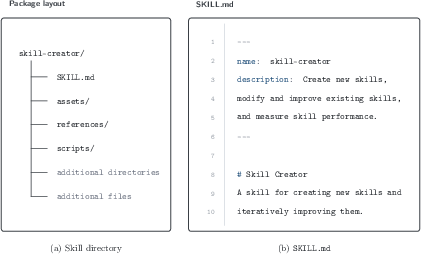
Figure 1: A skill is a package directory centered on a required SKILL.md file, which orchestrates agent behavior and bundles domain-specific resources.
Methodological Design
The study pipeline leverages Mining Software Repositories (MSR) methodologies, focusing on six highly forked skill repositories with over 67,000 public forks. Instance selection is stringent: only branch-level adaptations, unique per fork-owner, and confined to the modification of pre-existing skills are retained. Labeling employs inductive taxonomy formation via LLM annotation (Claude Opus), supported by two-level taxonomy definition, rigorous consensus auditing, and statistical agreement metrics (Cohen’s κ, Krippendorff’s α). The final corpus comprises 1,126 validated adaptation instances, spanning hundreds of distinct skills.
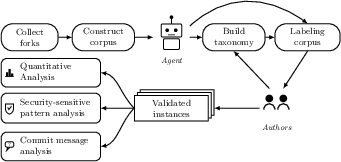
Figure 2: Overview of the study pipeline, including corpus construction, taxonomy building, LLM-driven labeling, human-audit validation, and quantitative analysis.
Taxonomy of Adaptation Patterns
A saturated taxonomy encompasses 46 adaptation patterns grouped into 13 families organized by target: SKILL.md instructional body and external components (resources, scripts, configuration). Dominant families include:
- Lifecycle: Packaging, metadata modification, translation, organizational structure.
- Procedure: Workflow step addition, reorder, branching, integration via external systems.
- Decision and Policy: Activation criteria, branching logic, constraint specification.
- Retarget: Technology stack, tool, API adjustments.
- Resource and Script: Addition and modification of local files, executable scripts.
- Fix, Polish, Guardrail, Personalize, Spec, Style: Functional correction, instruction clarity, safety, personalization, output specification, style guidance.
Quantitative analysis illustrates that SKILL.md is modified in 79.8% of adaptation instances, and lifecycle modifications account for 40.9% branch prevalence. Patterns such as metadata editing (notably description field for skill routing), procedure step augmentation, and hard constraint introduction dominate the adaptation landscape.
Interdependence and Adaptation Bundling
Adaptation is typically not an isolated operation. High-lift co-occurrences are observed for procedure+decision, procedure+policy, and decision+policy bundles, reflecting tightly coupled changes to workflow logic, branching, and behavioral constraints. Retargeting and lifecycle adaptations exhibit the widest skill coverage, indicating structural repackaging linked to environmental porting. The implication is that downstream modification often requires cross-family consistency and coordinated impact analysis for correctness.
Security Considerations in Adaptation
Up to 18.6% of adaptations inject content matching security-sensitive patterns, with a majority landing in SKILL.md or bundled documentation rather than scripts. Access to sensitive files (e.g., credentials, tokens) is the most prevalent flagged category, followed by network requests and global package installations. Instructions delivered as natural language in SKILL.md evade traditional code review pipelines, expanding the attack surface. The finding underscores the necessity for text-based security audit mechanisms in skill evolution workflows.
Commit Message Limitations
Commit messages provide incomplete and often non-discriminative rationale for adaptation: 84.5% indicate at least one patch pattern, but average recall for What is only 63.4%. Stated functional objectives dominate over explicit customization needs; only rare categories (necessity, requirement) correlate with concrete adaptation types. Reliance on commit narrative is insufficient for capturing the latent coupling and rationale of downstream skill modification.

Figure 3: Relationship between commit-message Why categories and adaptation family occurrence; functional objectives show no significant enrichment, while necessity and requirement show sparse but specific association.
Implications
For Skill Ecosystem Researchers
- Adaptation patterns provide granular variables for evaluating self-evolving skill frameworks, enabling fine-grained tracking of behavioral improvement trajectories.
- Customization needs should be inferred from the content of diffs rather than stated intent, given the unreliability of commit messages.
For Harness Engineers
- There is a systemic need for native support—extension points, modular abstractions, retarget-automation, and adaptation-aware diffing—for recurrent adaptation families.
- Security trade-offs require explicit surfacing and enforcement; automated privilege minimization and review mechanisms must account for instruction prose, not just code.
For Downstream Developers
- Adaptation is a coordinated, multi-family operation; the RADAR checklist is proposed for routing, behavioral adaptation, dependency declaration, security audit, and change recording.
For Skill System Design
- Skill formats, orchestration tools, and review pipelines must evolve to facilitate composable, context-adaptive, and auditable adaptation without reliance on narrative proxies or manual consistency checking.
Conclusion
Downstream adaptation is the rule, not the exception, in agent skill ecosystems. The predominant locus of change is SKILL.md—a natural-language instruction file that has superseded code scripts as the control plane for agent behavior. Adaptations are highly interdependent, frequently introduce latent security risk, and are insufficiently described by commit rationale. The findings challenge current assumptions about skill reusability and inform the future of skill-centric agent management, provenance, and secure orchestration (2607.03238).