- The paper introduces novel SPM-equivalence bounds and algorithms that reduce previous complexity from O(n^10) to O(n^(4+ε)) in the boundary-restricted case.
- The authors employ algebraic lower envelope techniques and event enumeration to efficiently compute decompositions across different source/target constraints.
- These advancements significantly impact geometric query problems, enabling faster two-point shortest path queries, geodesic diameter, and center computations.
Shortest Path Map Equivalence Decompositions and Applications
Introduction and Problem Statement
The paper "Shortest Path Map Equivalence Decompositions and Applications" (2607.03416) addresses the problem of computing and analyzing Shortest Path Map (SPM) equivalence decompositions in polygonal domains. Given a polygonal domain P with h holes and n vertices, the shortest path map S(s) decomposes P into cells based on the combinatorial structure of shortest paths from a fixed source s to all targets t. The core object of study, the SPM-equivalence decomposition, partitions the source domain so that for all s within the same cell, the shortest path map S(s) remains topologically equivalent.
This paper advances the understanding of the combinatorial complexity of SPM-equivalence decompositions under various source/target constraints—including both boundary-restricted and unrestricted cases—and devises algorithms that improve the efficiency of computing these decompositions. The authors leverage these results to obtain new asymptotic bounds and algorithmic frameworks for central geometric path-planning queries, notably two-point shortest path queries, geodesic diameter, and geodesic center computation in polygonal domains.
SPM-Equivalence Decomposition Variants: Definitions and Motivation
There are multiple variants of SPM-equivalence decompositions, differentiated by boundary restrictions on source s and target h0:
- General SPM-equivalence decomposition (h1): Both h2.
- Boundary-restricted decompositions: Source and/or target restricted to the boundary h3 of h4.
- h5-h6: h7
- h8-h9/n0-n1: one of n2 or n3 in n4, one in n5
These decompositions refine prior objects, such as the SPT-equivalence decomposition (based on shortest path tree structure) and have critical implications for preprocessing-based shortest path queries and higher-order facility location problems (diameter/center).
Combinatorial Analysis and Algorithmic Results
Complexity Bounds and Algorithmic Improvements
A fundamental contribution of the paper is tight upper bounds on the combinatorial complexity of the SPM-equivalence decompositions, improving over classical n6 bounds from prior work [Chiang & Mitchell].
Key results:
- n7-n8 case: New upper bound n9, reducing the previous S(s)0 and S(s)1 bounds for related decompositions, with an algorithm matching this complexity.
- S(s)2-S(s)3 case: S(s)4 combinatorial complexity, and an S(s)5 time algorithm.
- General case (S(s)6-S(s)7): No asymptotic improvement beyond S(s)8, but a new algorithm runs in S(s)9 time, output-sensitive in P0.
- P1-P2 case: Upper bound P3 and an algorithm with complexity P4.
The derivation of the improved upper bounds is achieved by reducing the enumeration of SPM-equivalence events to the complexity of lower envelopes of algebraic surface patches defined by path-length functions between boundary segments and obstacle vertices. Specifically, the analysis exploits structure in visibility polygons and overlays of shortest path maps from distinct vertices.
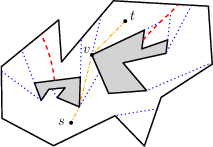
Figure 1: Illustrating a shortest path map P5, with extension segments (dotted blue) and bisector curves (dashed red), highlighting the cell structure induced by obstacles.
Event Structure and Combinatorial Changes
A critical technical component is the detailed analysis of event points where SPM equivalence classes change as the source moves—either boundary or interior events—corresponding to degenerate shortest path situations (e.g., triple or quadruple points). For example, as P6 moves along the boundary, a combinatorial change (event) occurs when the anchor structure in P7 changes due to contraction or expansion of bisector curves.

Figure 2: Illustration of a combinatorial change in P8 as P9 moves along the boundary.

Figure 3: Dynamics of bisector curves and event points in s0 as s1 moves, with contraction leading to multiple combinatorially distinct shortest s2-s3 paths.
Applications to Geometric Query Problems
Two-Point Shortest Path Queries
The decompositions provide a foundation for preprocessing-based data structures that answer two-point shortest path queries efficiently under various source/target constraints:
- s4-s5: s6 space and construction time, s7 query.
- s8-s9: t0 or t1 space/time, t2 or t3 query.
- t4-t5: Output-sensitive in t6, matching the best known randomized and deterministic bounds for large t7.
The approach leverages parameterized shortest path maps and persistent search structures, achieving more space-efficient representations and separating preprocessing from query cost.
Geodesic Diameter and Center Computation
The improved decompositional bounds propagate to substantial asymptotic improvements in algorithms for the geodesic diameter and center problems, especially in restricted cases:
- Diameter (t8-t9): s0 time (improving from s1).
- Diameter (s2-s3): s4.
- Center (s5-s6): s7 (from s8).
- Center (s9-S(s)0): S(s)1.
These algorithms are built on the properties that diametral/farthest pairs and farthest-point distances correspond to vertices or upper envelopes of the SPM-equivalence decomposition.
Algorithmic Techniques
The core algorithmic contributions are built from:
- Overlay computations of SPM segments and cells from obstacle vertices.
- Lower envelope construction for algebraic surfaces induced by combinatorial path length functions.
- Event enumeration via algebraic equation solving for multi-vertex path degeneracies (triple, quadruple, quintuple path events).
- Plane sweep and persistent data structures to store parameterized SPMs and answer queries efficiently.
A recurrent theme is the careful partitioning of the boundary/visibility intervals to localize combinatorial changes, enabling batched and amortized computation.
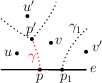
Figure 4: Triple point formation involving obstacle vertices S(s)2, S(s)3, S(s)4, and S(s)5, which underpins events that change the SPM structure.

Figure 5: Combinatorial change at a bisector curve endpoint event, as S(s)6 crosses S(s)7.

Figure 6: Local dynamics of bisector and anchor changes before and after crossing a combinatorial event point S(s)8.
Implications and Future Directions
This paper's results offer new structural and algorithmic insights for geometric path-planning, visibility, and location problems in polygonal domains. The new combinatorial bounds open avenues for further improvements in visibility-based facility location algorithms (center/diameter), path-planning in robotics, and fine-grained geometric data structures, especially for configurations with moderate numbers of holes and intricate combinatorial structure.
From a theoretical perspective, the decomposition paradigm advanced here motivates further study of the interplay between SPM combinatorics, algebraic envelope complexity, and preprocessing-query tradeoffs. Future research could target removing residual polylogarithmic factors, determining tight lower bounds for SPM-equivalence decompositions in various geometric regimes, and extending these methods to non-Euclidean metrics or higher-dimensional geometric complexes.
Conclusion
The paper establishes new asymptotic bounds and algorithmic frameworks for SPM-equivalence decompositions in polygonal domains, yielding improved algorithms for two-point shortest path queries, geodesic diameter, and geodesic center problems. By carefully analyzing the combinatorics of shortest path maps, leveraging algebraic envelope techniques, and optimizing the event enumeration, the authors close several longstanding gaps in the theoretical complexity of these fundamental geometric problems, with implications across computational geometry, robotics, and related algorithmic disciplines.