- The paper establishes a rigorous error decomposition that separates deterministic kernel bias from finite-particle Monte Carlo error.
- It employs Lyapunov drift and local minorization conditions to achieve geometric attenuation of errors in SMC samplers.
- Empirical evaluations on Gaussian mixtures underscore practical guidance for conditional diffusion sampling in score-based generative models.
Non-Asymptotic Error Bounds for SMC with Biased Proposals: Application to Conditional Diffusion Sampling
Overview and Motivation
This paper addresses the stability and error behavior of Sequential Monte Carlo (SMC) samplers when the transition (mutation) kernels are only approximate, as is common in modern applications where these kernels are learned or intractable. The authors present a comprehensive non-asymptotic analysis of SMC with biased proposals, introducing an error decomposition that distinguishes between deterministic kernel bias and finite-particle Monte Carlo (MC) error. The results are particularly motivated by conditional inference in score-based diffusion generative models (SGMs), where exact reverse kernels are unavailable and must be approximated through learned scores and time discretizations.
General Framework and Theoretical Contributions
The paper establishes a perturbation theory for biased Feynman–Kac particle systems. The core insight is a rigorous error decomposition:
- Kernel bias: The deterministic error arising from the discrepancy between the ideal and implemented kernels, inclusive of initialization, score approximation, and numerical discretization errors.
- Monte Carlo error: The stochastic error due to finite particle number, quantifiable in terms of concentration inequalities and local empirical fluctuations.
The authors employ Lyapunov drift criteria and local minorization (Doeblin-type) conditions to control these dynamics in unbounded state spaces. These stability conditions are transferred from the proposal kernels to the forward-smoothing kernels of the Feynman–Kac model, facilitating a precise quantitative analysis of how local kernel errors propagate forward in time. The main theorem gives a non-asymptotic, explicit bound on the total SMC error, factoring in both sources of error and rigorously tracing their contributions through the particle evolution mechanism.
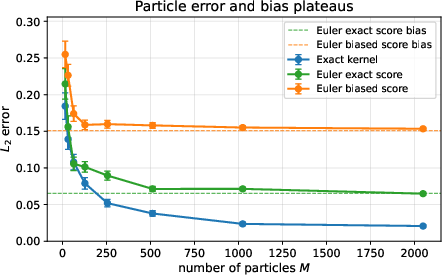
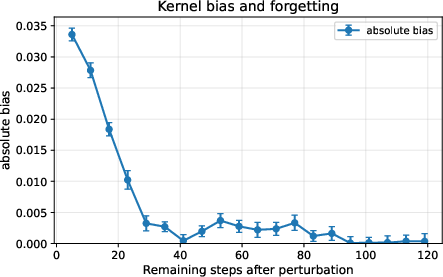
Figure 1: Illustration of the two terms in Theorem 1, showing empirical L2 error versus particle number (Monte Carlo decay and deterministic bias plateaus) and the decay of local kernel bias via forward-smoothing forgetting.
The structure of the bounds guarantees that, under forward-smoothing stability, both the kernel bias and MC error terms are discounted geometrically in reverse time, controlled by forgetting rates. In particular, the propagation of a localized kernel perturbation is exponentially suppressed as the perturbation is moved further from the terminal time, formalizing and quantifying the intuitive notion of “forgetting” in such stochastic flows.
Instantiation for Conditional Diffusion SMC and SGM Conditioning
The general theory is instantiated in the context of conditional sampling with diffusion-based generative models. Specifically, the authors analyze SMC-based post-hoc conditioning methods, where the Markov kernels arise from discretized learned (score-based) reverse SDEs. In this regime:
- Initialization error: Reflects deviation between the actual initial distribution and the (often unattainable) forward process terminal law.
- Score error: Measures the difference between the true reverse-time score and the surrogate score network used in practice.
- Discretization error: Encodes the effect of time discretization of the SDE.
The theory transparently incorporates each of these sources into the error bound, providing for the first time a uniform, non-asymptotic error estimate that applies jointly to all.
To ensure that the drift and minorization (stability) conditions are satisfied for the learned proposal kernels, the paper gives sufficient conditions directly on the score network parameters—specifically, a dissipativity condition and bounded growth. These requirements are mild and compatible with standard neural network architectures used in SGMs.
Empirical Illustration: Gaussian Mixture Benchmarks
The error decomposition and propagation results are validated on synthetic benchmarks (low- and high-dimensional Gaussian mixtures) for which exact solutions are available. The empirical results highlight two prominent error regimes:
- MC regime: With the ideal kernels, the error decays as M−1/2, where M is the number of particles, consistent with classical MC central limit rates.
- Bias regime: When using approximate kernels (Euler-discretized or learned-score-based), for large M the error plateaus at a value reflecting the deterministic kernel bias. This plateau is further decomposed into contributions from discretization and score mismatch.
Furthermore, the effect of a local kernel perturbation is demonstrated empirically to be strongly attenuated when occurring further back in the smoothing flow, supporting the theoretical forgetting factors furnished by the stability theory.
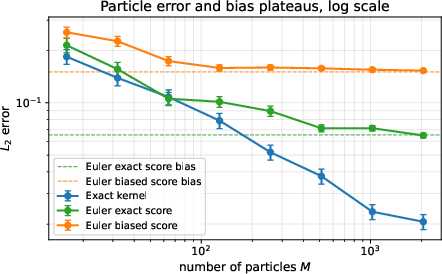
Figure 2: Log-scale empirical L2 error as a function of particle number, showing clear transition from MC error to kernel bias plateau, distinguishing the error sources.
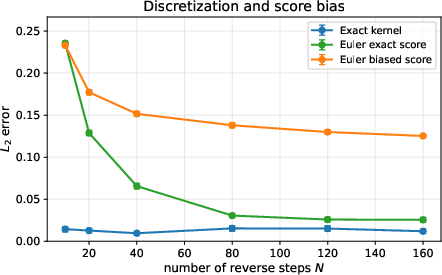
Figure 3: Error as a function of reverse steps N (for fixed M), highlighting the impact of discretization refinement on deterministic bias.
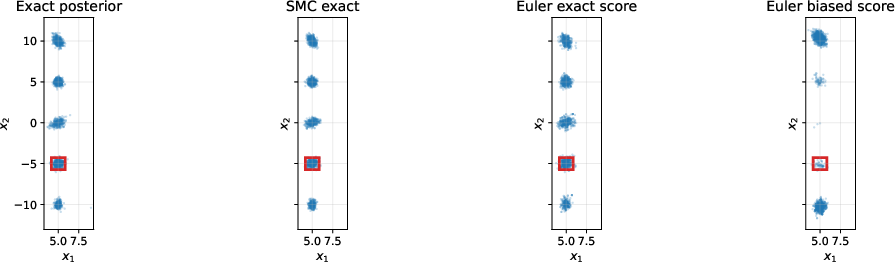
Figure 4: Conditional samples in a 50-dimensional Gaussian mixture (projections shown), comparing SMC outputs and illustrating mode capture with exact, discretized, and learned-score-based kernels.
Implications and Future Perspectives
Practically, these results provide a principled method for error budgeting in SMC-based conditional diffusion samplers. For practitioners, the explicit error bounds offer guidance for selecting grid resolutions, regularizing score networks, and determining adequate particle counts. Theoretically, the decomposition refines understanding of the interplay between stochastic and deterministic errors in Feynman–Kac flows under model and numerical approximations.
The framework is immediately relevant for the design of conditional sampling algorithms in high-dimensional SGM applications, such as inverse problems and data imputation, where exact kernels are intractable and error control is crucial.
Potential future directions include further refinements of contraction constants via problem-specific analysis, extension to adaptive SMC schemes where resampling and kernel bandwidths are dynamically tuned, and the analysis of robustness to heavy-tailed or non-Gaussian conditioning scenarios.
Conclusion
This work delivers a complete non-asymptotic theory of error propagation in SMC samplers with biased (approximate) kernels, crucially applicable in the post-hoc conditioning of score-based diffusion models. By decomposing errors into MC and bias components and showing their geometric attenuation via smoothing stability, the results provide both foundational advances in probability theory for SMC and directly impactful guidance for modern conditional generative modeling pipelines.
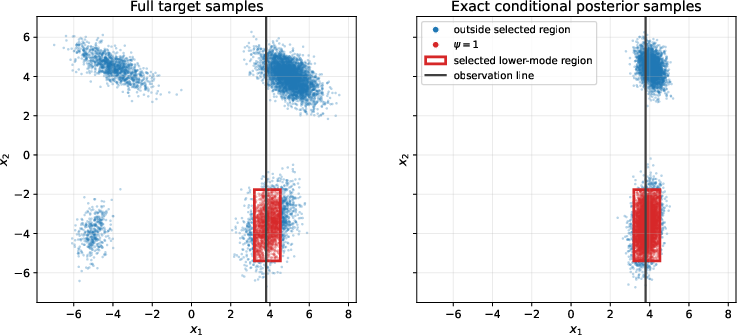
Figure 5: Two-dimensional Gaussian-mixture benchmark: event geometry and post-conditioning particle distributions visualized for selected region.
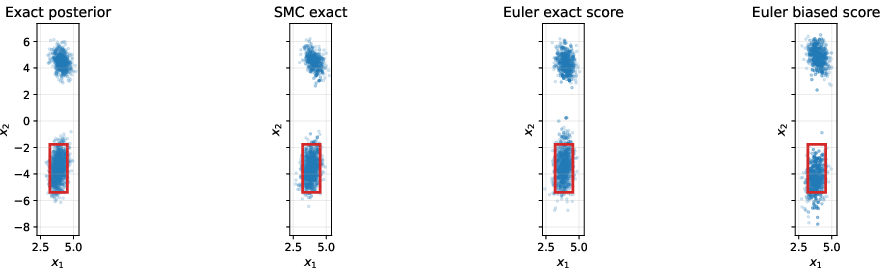
Figure 6: Conditional samples for the 2D benchmark using different kernel choices—note the effect of bias and discretization on sample location.
Figure 7: Particle error and kernel bias in the 50-dimensional Gaussian mixture, confirming scalability and the structural error split in high dimension.
Figure 8: Decay of a single local kernel perturbation effect (kernel bias and forgetting) as a function of its position along the sampling sequence, for the 50D benchmark.
References
- S. Strasman, G. V. Cardoso, S. Le Corff, V. Lemaire, and A. Ocello, "Non-Asymptotic Error Bounds for SMC with Biased Proposals: Application to Conditional Diffusion Sampling" (2607.04780).