CTA-Pipelining: A Latency-Oriented Spatial Scaling Method for Multi-GPU Systems
Abstract: The evolution of compute infrastructure has transformed multi-GPU systems into tightly integrated shared-memory structures. However, current software still mostly treats these coherent interconnects simply as high-speed networks. Simultaneously, the demand for serving LLMs under latency constraints has shifted GPU workload optimization from being throughput-driven to latency-bound, necessitating latency-oriented scaling methods beyond Tensor Parallelism (TP). Thus, we introduce CTA-pipelining, an execution paradigm designed to exploit shared-memory multi-GPU systems. As a latency-oriented spatial scaling technique, CTA-pipelining leverages dependencies at the Cooperative Thread Array level, enabling concurrent execution of dependent kernels across GPUs. We demonstrate its capability using CUTLASS, cuBLAS, and NCCL libraries on 8-GPU H200 and B200 systems. Results show on 2-layer GEMM, representing the MLP operation, CTA-pipelining reduces latency by up to 31.8% compared to micro-batching, and 29.6% compared to TP. It can also be combined with TP as an orthogonal scaling dimension to further push the latency boundary.
Paper Prompts
Sign up for free to create and run prompts on this paper using GPT-5.
Top Community Prompts
Explain it Like I'm 14
What this paper is about
This paper shows a new way to make big AI models (like chatbots) answer faster when they run across multiple GPUs. The authors introduce “CTA‑pipelining,” a technique that lets different GPUs start working on the next step of a task as soon as a small piece of the previous step is ready, instead of waiting for the whole step to finish. It’s designed for modern GPU machines where the GPUs are tightly connected and can share memory quickly.
What questions the paper asks
- How can we get single‑request responses (latency) to be faster on multi‑GPU systems, not just push more requests per second (throughput)?
- Is there a smarter way to split work across GPUs than the usual methods (micro‑batching and tensor parallelism) that avoids extra waiting and communication?
- Can we do this using today’s hardware and standard software libraries without rewriting everything?
How the method works (in simple terms)
Think of a group of kitchens (GPUs) connected by fast hallways (NVLink/NVSwitch). A big meal (an AI computation) has multiple stages: chop, cook, plate. Usually, the next kitchen waits until the entire previous stage is done for the whole meal. That’s slow.
CTA‑pipelining turns this into an assembly line at a finer scale:
- A CTA (Cooperative Thread Array) is like a team of cooks that handles one small tile or chunk of the job.
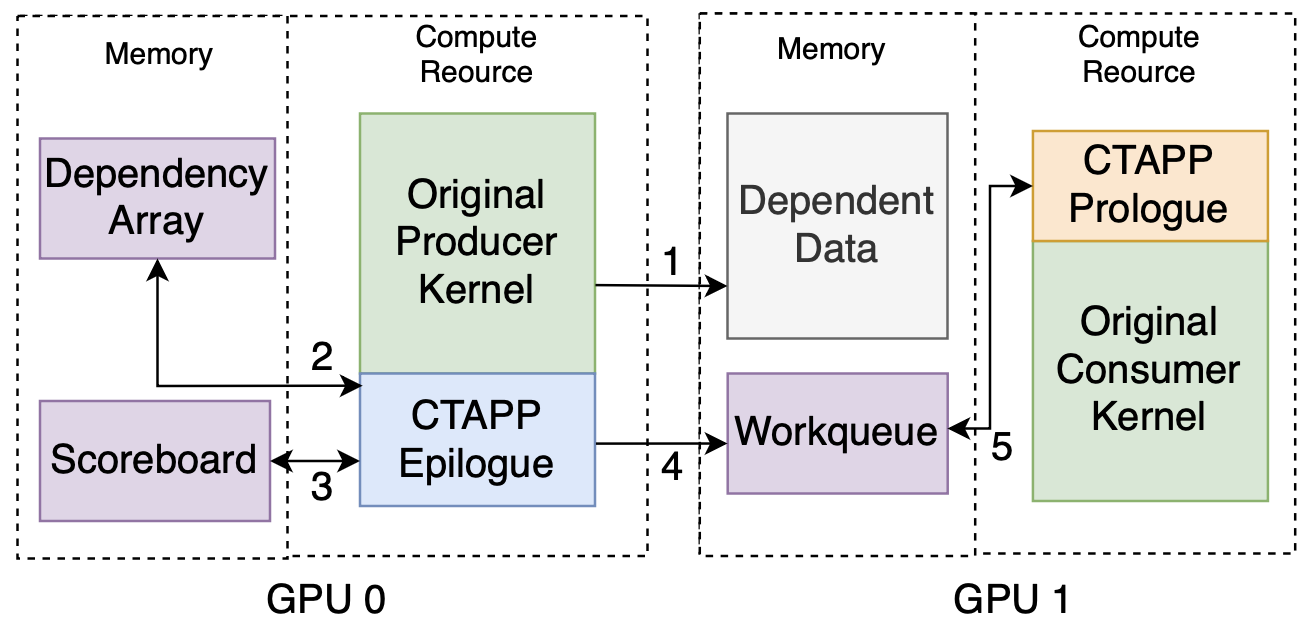
- As soon as a team finishes its small piece, it quickly tells the next kitchen’s team, “Your piece is ready!” via a shared to‑do list (a queue) and counters (a scoreboard).
- The next team starts on that piece right away, even if the rest isn’t done yet.
- This creates a “tile‑by‑tile” pipeline across GPUs, so the whole job flows continuously instead of in big, stop‑and‑go blocks.
Key ideas behind the scenes:
- Workqueue: a shared, circular to‑do list where finished tiles are posted for the next stage.
- Scoreboard: a set of counters so a team knows when all the pieces it depends on are ready.
- Prologue/Epilogue: tiny bits of code added at the start and end of existing GPU kernels to check the queue and update the scoreboard. The main math code doesn’t change.
They built this using NVIDIA’s CUTLASS (high‑performance matrix math), cuBLAS (BLAS library), and NCCL (communication library), on 8‑GPU H200 and B200 machines.
A bonus trick: many modern GPU kernels use “warp‑specialization” (different mini‑teams handle loading data, computing, and writing results). Some mini‑teams have short waits between steps. The authors tuck the pipeline bookkeeping into those idle moments, so the extra overhead is mostly hidden.
What they compared it to
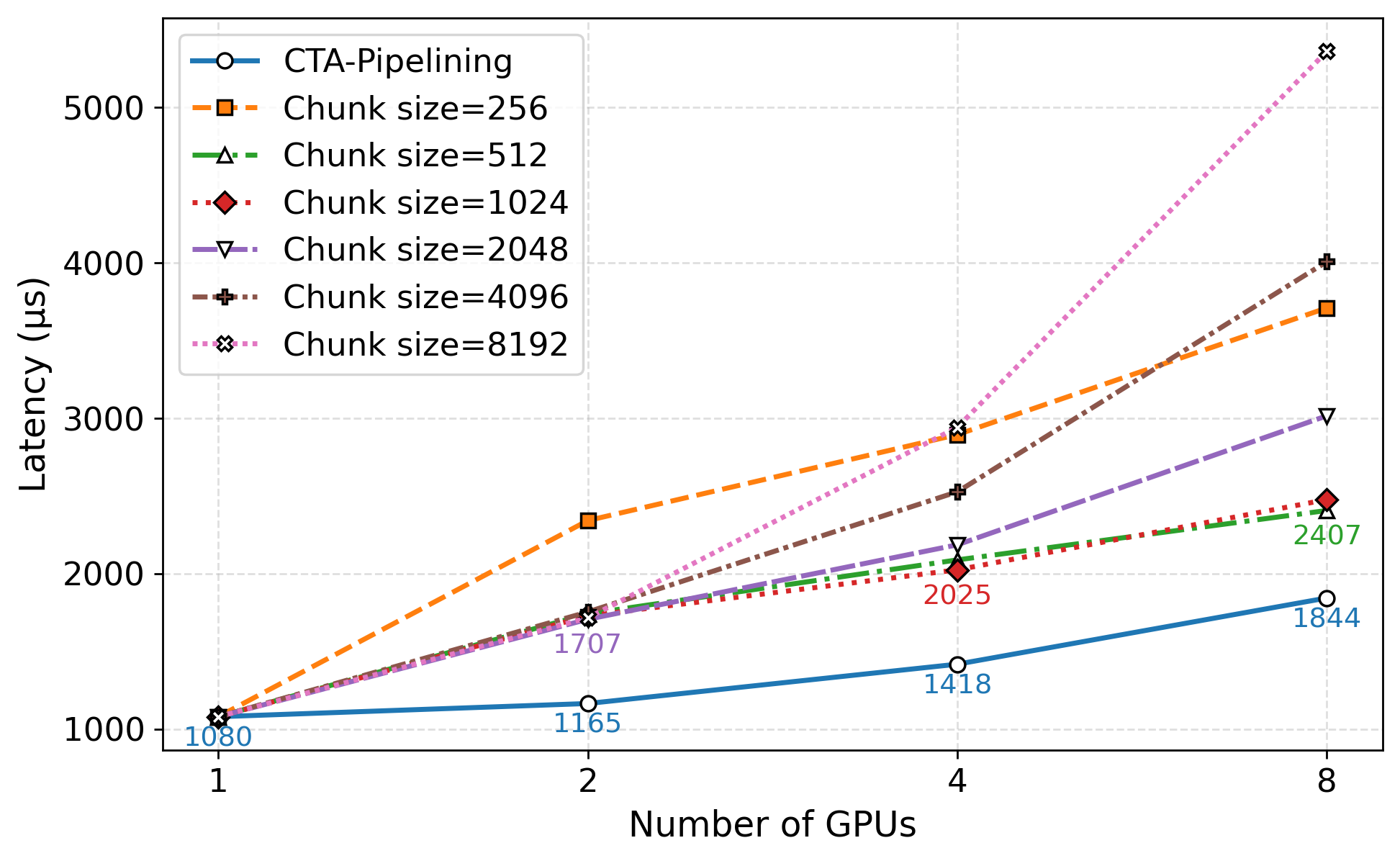
- Micro‑batching: splitting the input into chunks and running them in a pipeline. Problem: big chunks = long waits; tiny chunks = inefficient GPU use and lots of launch overhead. It’s a balancing act.
- Tensor Parallelism (TP): splitting each big math operation across GPUs and then doing a group “All‑Reduce” to combine partial results. This adds communication steps that set a hard limit on how much latency you can reduce.
What they found and why it matters
Main results:
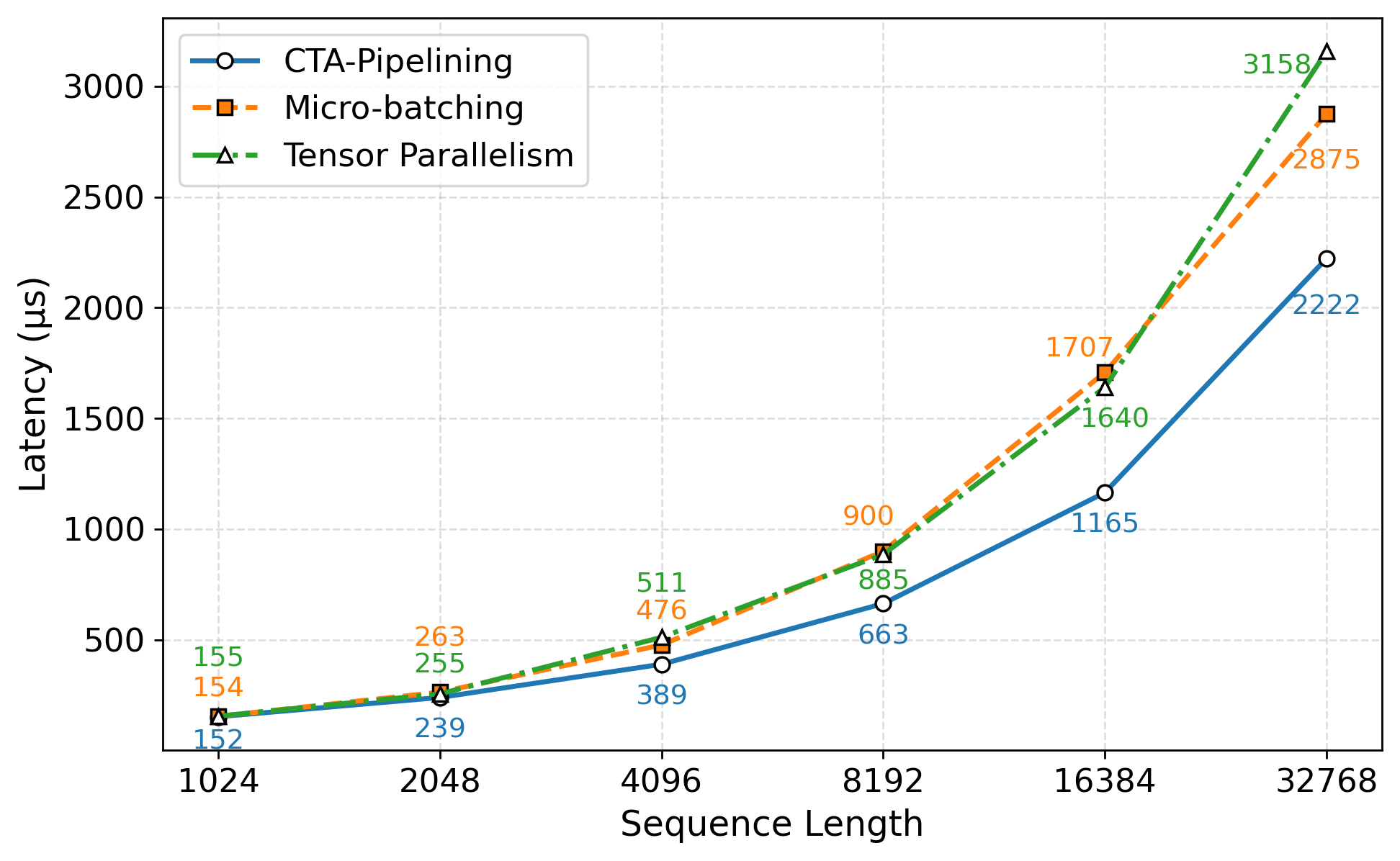
- On 2‑layer GEMM (the core math in MLP parts of Transformers), CTA‑pipelining cut latency by up to 31.8% compared to micro‑batching and up to 29.6% compared to TP.
- In larger setups (more GPUs and more layers), CTA‑pipelining avoided frequent “All‑Reduce” communications and showed even bigger relative gains.
- CTA‑pipelining can be combined with TP as an extra “dimension” of scaling. Group GPUs into pairs that pipeline locally, then do a smaller, faster All‑Reduce across pairs. This reduces communication and often makes pure computation more efficient, pushing latency even lower than TP alone.
- Overhead from the extra bookkeeping is small and often hidden inside idle gaps of warp‑specialized kernels.
- CTA‑pipelining is less helpful for extremely tiny inputs where there’s not enough work to form a pipeline, but micro‑batching and TP also struggle there.
Why it matters:
- Faster single‑request responses are crucial for interactive AI (like chat and search).
- It works with existing hardware and popular libraries, so it’s practical.
- It reduces tricky manual tuning (like finding the “perfect” micro‑batch size), since work flows tile‑by‑tile automatically.
What this could change in the future
- Better user experience: snappier replies from LLMs and other GPU‑powered apps.
- More efficient multi‑GPU use: less waiting, less communication overhead, and better performance without rewriting huge chunks of code.
- Hardware co‑design: future GPUs and interconnects could add features that make this fine‑grained, cross‑GPU pipeline even faster and easier to use.
In short, CTA‑pipelining turns multi‑GPU systems into a smooth, fine‑grained assembly line for AI computations, speeding up single‑request latency by letting small pieces flow across GPUs as soon as they’re ready. It beats common methods on many workloads, plays nicely with tensor parallelism, and fits today’s software stacks.
Knowledge Gaps
Knowledge gaps, limitations, and open questions
The following list captures what remains missing, uncertain, or unexplored in the paper, framed to guide concrete follow-on research.
- End-to-end applicability beyond GEMM: evaluate CTA-pipelining on full Transformer blocks (attention with softmax and masking, layer norm, residual connections, bias/activation, KV-cache reads/writes), not just 2-layer GEMM proxies.
- Decode-phase effectiveness: quantify benefits for autoregressive decode (short sequence lengths, single-wave CTA cases) and define when CTA-pipelining should be disabled or replaced by alternatives.
- Generalizing dependency construction: methods to automatically derive accurate dependency arrays/scoreboards for complex, many-to-many and irregular operators (attention, convolutions, reductions, sparse or masked ops, MoE routing).
- Tooling and automation: compiler/runtime techniques to insert prologue/epilogue, synthesize queues/scoreboards, and generate metadata from a computation graph (e.g., integration with TVM/Triton/CUTLASS autotuners).
- Co-optimization of tiling and schedule: systematic study of tile shapes, CTA ordering (row/column/space-filling curves), and CTA scheduling policies that maximize overlap and minimize pipeline bubbles; autotuners or analytical models to select them.
- Queue/scoreboard scalability: quantify contention on ring-buffer head/tail atomics under many producer CTAs, establish safe queue sizing, backpressure/overflow handling, fairness policies, and provide deadlock/livelock proofs for multi-producer/multi-consumer cases.
- Memory model correctness: formalize acquire/release requirements and the minimal fence set for correctness under NVIDIA’s GPU memory model (L2 coherence across NVLink/NVSwitch, caching effects), including MIG/MPS and multi-process scenarios where P2P access or coherence may differ.
- Visibility latency variability: explain and model the large discrepancy in cross-device visibility latency (e.g., 120 μs vs ~5 μs across kernels/generations), identify root causes (NVLink gen, remote L2 residency, TMA vs direct stores, pipeline stage timing), and provide predictive guidance.
- Topology sensitivity and scaling: characterize performance across different NVLink/NVSwitch topologies (hop counts, cross-island traffic), larger fabrics (e.g., NVL72), PCIe-only systems, and multi-node clusters over InfiniBand/RoCE; define the practical scaling limits.
- Resource contention and overheads: measure the impact of busy-polling and remote atomics on SM occupancy, L2/NVLink bandwidth, and concurrent workloads/collectives; quantify energy costs and propose lower-overhead wait mechanisms (e.g., doorbells, device wait-on-value, HW semaphores).
- Collective overlap and granularity: explore pipelining NCCL collectives at tile/CTA granularity and overlapping them with CTA-pipelined compute; assess algorithm choice (ring vs tree) and required APIs.
- Adaptive execution policy: design a runtime that switches among CTA-pipelining, micro-batching, TP, or their combinations based on input length, batch size, and load, with hysteresis to avoid oscillations.
- Deep network mapping: strategies to place many transformer layers across GPUs under CTA-pipelining while meeting memory-capacity constraints for weights/activations and minimizing cross-device activation traffic.
- Load imbalance and heterogeneity: mechanisms (e.g., cross-GPU work stealing) to handle variable tile times, irregular sparsity, or MoE expert imbalance without starvation or degraded overlap.
- Portability: feasibility on pre-Hopper GPUs (no DSMEM/TMA) and on non-NVIDIA platforms (AMD ROCm/XGMI), including required abstractions and performance implications; define graceful fallbacks.
- Fault tolerance and robustness: recovery from partial tile completion or GPU faults (ECC, preemption), idempotent replay of prologue/epilogue actions, and system behavior under device dropouts mid-pipeline.
- Security and isolation: applicability in multi-tenant environments where P2P access is restricted; mechanisms to preserve isolation while enabling cross-device progress signaling.
- Stable APIs and debugging: define a public API for queue placement, metadata management, and graph capture; develop debugging/trace tools to visualize cross-device CTA flow and diagnose stalls.
- Energy–latency trade-offs: provide power measurements under different polling strategies and interconnect loads; propose energy-aware policies that retain most latency gains.
- Predictive performance model: build and validate a model relating latency gains to tile size, fence cost, NVLink latency/bandwidth, and kernel micro-pipeline structure to guide design and autotuning.
- Real LLM serving evaluation: end-to-end latency/throughput on production models (e.g., Llama/GPT) including tokenization, KV-cache management, sampling, and networking; compare prefill vs decode and multi-request batching.
- Data movement and memory footprint: quantify additional activation traffic from cross-device writes, metadata/queue memory overheads, and DSMEM usage; investigate compression/quantization of intermediate activations to reduce traffic without harming accuracy.
- Attention-specific ordering: determine safe CTA/tile orders that respect causal masks and enable cross-GPU pipelining within attention, and quantify the achievable overlap.
- Hardware co-design: specify and evaluate architectural features that would improve this paradigm (remote doorbells/workqueues, coherent remote atomics, faster system fences, per-SM wait-on-value, scheduler hints), with projected speedups.
- Integration with PP/EP: methods to compose CTA-pipelining with pipeline parallelism and expert parallelism while controlling bubbles, routing overhead, and inter-stage synchronization.
- Numerical determinism: assess whether dynamic CTA reordering affects floating-point reproducibility for ops with reductions and define constraints or compensation techniques when determinism is required.
- Reproducibility and artifacts: release code/configs and perform sensitivity analyses (tile shapes, kernel variants, data types) to validate robustness of reported gains across settings.
Practical Applications
Immediate Applications
The following items can be deployed now on NVLink/NVSwitch-class multi-GPU systems and require modest engineering effort (e.g., kernel prologue/epilogue integration, runtime wiring), leveraging the paper’s validated CTA-pipelining protocol and performance evidence.
- LLM inference latency cuts for MLP blocks in production serving stacks
- Sectors: software, cloud platforms, consumer apps, enterprise SaaS
- What: Replace micro-batch chunk pipelining and/or reduce TP degree for 2-layer GEMM MLP subgraphs to shrink single-token latency (paper shows up to ~30% vs micro-batching, ~30% vs TP on 2 GPUs; larger gains vs TP at higher GPU counts)
- Tools/products/workflows:
- Integrate CTA-pipelining into CUTLASS-based backends of TensorRT-LLM, Megatron-LM inference, vLLM, SGLang, Triton Inference Server backends
- Provide a “cta-pipelined MLP” kernel option in model deployment configs; runtime policy to group 2 GPUs per MLP and reduce all-reduce world size
- Assumptions/dependencies: NVLink/NVSwitch domain with CUDA P2P enabled; kernels use CUTLASS/cuBLASLt variants or expose hooks for kernel prologue/epilogue; sequences not extremely short (to avoid single-wave kernels); CUDA Graphs recommended for launch overhead hiding
- Low-risk replacement for localized micro-batching in multi-GPU inference
- Sectors: software, cloud platforms
- What: Swap static micro-batching (with tricky chunk-size tuning) for CTA-level pipelining to avoid pipeline bubbles while preserving single-kernel efficiency
- Tools/products/workflows: “CTA-pipe” execution policy in inference schedulers; auto-disable static chunk sweeps; deploy as a runtime library that manages dependency arrays, scoreboards, and inter-device queues
- Assumptions/dependencies: Same-node NVLink memory domain; kernel launch orders may need minor reordering (e.g., row- vs column-major CTA dispatch guidance); relies on warp-specialized/persistent kernels to hide overhead best
- Combine CTA-pipelining with Tensor Parallelism to reduce all-reduce cost
- Sectors: software, cloud platforms, finance, healthcare, education (latency-SLA LLM apps)
- What: Partition GPUs into small groups (e.g., 2-GPU groups) using CTA-pipelining inside each group for the 2-layer MLP, then perform a smaller-world all-reduce across groups; improves both compute efficiency (avoids tiny per-GPU tiles) and communication time
- Tools/products/workflows: “Hybrid TP+CTA” plan in model parallelism planners; NCCL world-size tuning; autotuners that pick group size vs TP degree given sequence length and GPU count
- Assumptions/dependencies: NCCL for collectives; adequate NVLink bandwidth; planner support in serving framework
- Latency-sensitive AI products with strict SLAs
- Sectors: search, adtech, customer support, productivity copilots, real-time translation/voice assistants
- What: Direct latency improvements for interactive LLMs lead to better responsiveness, higher engagement, and SLA compliance (p95/p99 tail reductions)
- Tools/products/workflows: Enable CTA-pipelining on “interactive tier” clusters; SLO-aware schedulers route low-latency requests to NVLink pods using CTA-pipeline kernels
- Assumptions/dependencies: Workloads dominated by GEMM-heavy MLPs; attention kernels may still be baseline unless similarly adapted
- HPC/AI hybrid kernels that chain GEMMs (or GEMM-like blocks)
- Sectors: scientific computing, simulation post-processing, computer vision, recommender inference (dense layers)
- What: Apply CTA-pipelining to multi-layer dense computations (e.g., batched linear algebra chains, CV backbones’ fully-connected heads) to reduce end-to-end latency
- Tools/products/workflows: CUTLASS-based custom kernels with injected prologue/epilogue; CUDA Graph capture of multi-GPU pipelines
- Assumptions/dependencies: Best on warp-specialized persistent kernels; performance depends on tile sizes and enough CTAs to pipeline
- Academic benchmarking and methodology replication
- Sectors: academia
- What: Use the paper’s protocol (dependency arrays, scoreboards, inter-device workqueues) to evaluate CTA-level spatial pipelining on H200/B200; compare to micro-batching/TP baselines
- Tools/products/workflows: Open-source microbenchmarks; Nsight Systems traces; CUTLASS kernels instrumented with timestamping
- Assumptions/dependencies: Access to NVLink-connected systems; familiarity with warp-specialized CUTLASS kernels
Long-Term Applications
These items require further research, standardization, compiler/runtime support, or hardware evolution to reach robust, broad deployment.
- End-to-end Transformer acceleration (including attention) with CTA-pipelining
- Sectors: software, cloud platforms
- What: Extend protocol to attention subgraphs (QKT, softmax, AV) with tile-streaming semantics and inter-operator guards; realize full-block CTA pipelines across the entire layer
- Tools/products/workflows: Compiler passes to infer tile-level dependencies across attention and MLP; kernels exposing attention tile readiness; unified IR to auto-insert prologue/epilogue
- Assumptions/dependencies: Nontrivial dependency analysis; attention’s data hazards may require new tiling strategies and in-kernel schedulers; careful numeric stability handling
- Training-time latency/throughput gains via fine-grain spatial pipelines
- Sectors: software, cloud platforms, academia
- What: Use CTA-level pipelining to reduce PP bubbles, improve overlap of forward/backward and comms (e.g., reduce-scatter/all-gather) across NVLink groups
- Tools/products/workflows: Hybrid PP/TP/CTA planners; schedulers that place CTA-pipelined forward GEMMs alongside overlapping gradient comms
- Assumptions/dependencies: More complex control over autograd graphs; correctness with mixed precision and optimizer states; careful interaction with NCCL streams and async graph capture
- Automatic compiler/runtime integration
- Sectors: software tooling, academia
- What: TVM/MLIR/Inductor passes that detect inter-operator dependencies, construct dependency arrays/scoreboards, and auto-inject prologue/epilogue; autotuners pick CTA vs micro-batching vs TP
- Tools/products/workflows: PyTorch Inductor plugin; TVM schedule templates; graph-level cost models for NVLink latency vs kernel efficiency
- Assumptions/dependencies: Stable compiler interfaces to CUTLASS/cuBLASLt; cross-device memory model abstractions; robust heuristics for small-input corner cases
- Cross-vendor and cross-topology support
- Sectors: hardware, cloud platforms, policy
- What: Port the protocol to AMD/ROCm (Infinity Fabric) and future multi-die GPUs; standardize cross-device memory consistency and atomics across vendors
- Tools/products/workflows: A vendor-neutral “CDQ” (cross-device queue) runtime akin to NCCL but for readiness signaling; conformance tests
- Assumptions/dependencies: Equivalent peer-memory semantics and fences; performance on PCIe-only topologies may be marginal; standards participation (e.g., Khronos, Linux Foundation)
- Hardware-software co-design for spatial pipelines
- Sectors: hardware, policy, academia
- What: Architectural features to accelerate CTA-pipelining: cross-GPU DSMEM, low-latency cross-device atomics, HW work queues, scheduling hints; OS/runtime controls to pin CTA order
- Tools/products/workflows: CUDA-like APIs exposing cross-device cluster groups; hardware CLC-like queries extended across GPUs; telemetry for dependency progress
- Assumptions/dependencies: Vendor roadmaps (e.g., NVLink generations, NVSwitch fabrics, MCM GPUs); ecosystem adoption; backward compatibility requirements
- Cloud service tiers: “Latency-optimized NVLink pods”
- Sectors: cloud platforms, policy
- What: Managed SKUs where CTA-pipelining kernels are pre-enabled, scheduling co-locates dependent operators on GPU pairs/quads; SLA-backed interactive tier for LLMs
- Tools/products/workflows: Placement policies (keep MLP subgraphs within a 2-GPU island), admission control for short sequences, autoscaling by SLO adherence
- Assumptions/dependencies: Fleet composition with NVLink/NVSwitch; cost models balancing resource fragmentation vs SLA gains; customer education and APIs
- Real-time multimodal generation and streaming inference
- Sectors: media/entertainment, gaming, marketing tech
- What: Apply CTA-pipelining to dense subgraphs within diffusion/VideoGen/ASR-TTS pipelines to reduce interactive latency (e.g., live translation, on-the-fly ad creatives)
- Tools/products/workflows: Multi-GPU inference graphs where GEMM-heavy blocks (UNet MLPs, projection layers) are striped across GPU pairs with CTA-pipelining
- Assumptions/dependencies: Mixed operator graphs (convs/attention) need extension; sustained benefit requires that dense blocks are latency-dominant
- Operational guidance and procurement policy
- Sectors: enterprise IT, public sector, cloud customers
- What: Update procurement and deployment guides to favor NVLink/NVSwitch domains for interactive AI; codify SLO-aware placement of models that benefit from CTA-pipelining
- Tools/products/workflows: Reference architectures and runbooks; TCO models factoring ~20–60% latency gains vs pure TP for certain tiers
- Assumptions/dependencies: Workload mix justifies NVLink premium; organizational capability to adopt specialized kernels and scheduling policies
- Observability and safety for CTA-level execution
- Sectors: software tooling, reliability engineering
- What: Fine-grain tracing of cross-device work queues, scoreboard saturation, and CTA stalls; anomaly detection for deadlocks or misordering in dependency structures
- Tools/products/workflows: Nsight-like plugins; Grafana exporters for CTA-queue health; chaos testing harness that perturbs queue latencies
- Assumptions/dependencies: Low-overhead telemetry hooks in kernels; standardized metrics schema
Notes on feasibility across all items
- Best gains appear on warp-specialized multi-stage persistent kernels where protocol overhead is hidden; classical kernels still benefit but show visible overhead at very small inputs.
- Benefits diminish for extremely small sequence lengths (single CTA wave).
- Within-node NVLink/NVSwitch shared-memory semantics are critical; PCIe-only setups may not see net wins.
- Correctness relies on proper cross-device fencing and careful work-queue design; productionization should include thorough testing and observability.
Glossary
- All-Reduce: A collective operation that sums or combines tensors across multiple devices/ranks and distributes the result to all. "An All-reduce collective operation is then required to sum the partial results."
- BF16: Brain floating-point 16-bit format; a 16-bit floating point datatype commonly used for efficient deep learning computation. "The input and output data types are set to BF16, and the Tensor Core accumulator type is set to FP32."
- Blackwell: NVIDIA GPU architecture family succeeding Hopper, with specific tensor core behaviors that affect kernel design. "A special case arises with Blackwell's specific Tensor Core operations"
- CGA (Cooperative Group Arrays): An architectural grouping of multiple thread blocks (CTAs) that can cooperate via distributed shared memory. "it issues remote memory stores to the DSMEM across the CGA"
- Cluster Launch Control (CLC): A hardware mechanism to query and assign the next work-tile to persistent kernels at the cluster level. "a hardware query, known as a Cluster Launch Control (CLC) query"
- Cooperative Thread Array (CTA): A CUDA thread block; a group of threads that execute together and share fast on-chip memory. "These threads are grouped into blocks, also known as Cooperative Thread Arrays (CTAs)."
- CTA-pipelining: The paper’s proposed execution paradigm that pipelines dependent kernels at CTA granularity across GPUs to reduce latency. "we propose CTA-pipelining, a novel latency-oriented spatial scaling method."
- cuBLAS: NVIDIA’s high-performance GPU-accelerated BLAS library for dense linear algebra. "cuBLAS kernels are again used to provide a strong baseline."
- CUDA: NVIDIA’s parallel computing platform and programming model for GPUs. "From the host side, each kernel is assigned a dedicated CUDA stream"
- CUDA Graphs: A CUDA feature to capture and replay a sequence of GPU operations to reduce launch overheads. "this entire multi-kernel execution process can be captured by CUDA Graphs"
- cuStreamWaitValue32: A CUDA stream API that blocks a stream until a 32-bit memory value meets a condition, enabling low-overhead synchronization. "There is an optional micro-optimization to eliminate the SM resource waste of initial busy-polling, using cuStreamWaitValue32 API."
- CUTLASS: NVIDIA’s CUDA templates for linear algebra; a collection of highly optimized GEMM and related kernels. "High-performance GEMM implementations, such as those in the NVIDIA CUTLASS library, rely on this paradigm"
- Distributed Shared Memory (DSMEM): A memory abstraction enabling sharing across CTAs within a cluster for fast intra-cluster communication. "stored in each CTA's Distributed Shared Memory (DSMEM)."
- Expert Parallelism (EP): A parallelism strategy (often in MoE models) that routes inputs to specialized expert networks for efficiency. "While emerging techniques such as Expert Parallelism (EP) and disaggregated serving offer further optimizations"
- GB200 NVL72: An NVIDIA multi-GPU system integrating GB200 GPUs and NVLink/NVSwitch into a tightly coupled shared-memory cluster. "Systems such as the NVIDIA GB200 NVL72 utilize NVLink and NVSwitch interconnects"
- GEMM: General Matrix-Matrix Multiplication; the core kernel for many deep learning operations. "We demonstrate a prototype implementation of CTA-pipelining using the state-of-the-art GEMM library, NVIDIA CUTLASS"
- Language Processing Unit (LPU): A specialized on-chip accelerator targeting LLM workloads. "The recently announced integration with Language Processing Unit (LPU) for LLMs also reflects this trend"
- LLM: A neural network model with a large number of parameters trained for language tasks. "optimizing LLM inference for production has become a critical challenge"
- Megakernel: A compilation strategy that fuses large sub-graphs into a single massive kernel for end-to-end execution. "this goal is conceptually similar to the Megakernel approach"
- Micro-batching: Splitting inputs into small chunks to pipeline operators temporally, often trading off kernel efficiency and parallelism. "static micro-batch chunk pipelining (also known as micro-batching)"
- Multilayer Perceptron (MLP): A feedforward neural network layer stack; in transformers, typically two GEMMs with an activation between them. "which also represents the multilayer perceptron (MLP) layers in transformer-based LLMs."
- NCCL: NVIDIA Collective Communications Library; provides high-performance collectives like All-Reduce across GPUs. "The NCCL library is used for the All-reduce collective operations."
- Nsight Systems: NVIDIA’s system-wide profiler for analyzing GPU/CPU execution timelines and performance. "where data are collected using NVIDIA Nsight Systems"
- NVLink: NVIDIA’s high-bandwidth, low-latency interconnect for GPU-to-GPU and GPU-to-CPU communication. "utilize NVLink and NVSwitch interconnects"
- NVSwitch: A switch fabric that connects many NVLink endpoints to build large, coherent multi-GPU systems. "utilize NVLink and NVSwitch interconnects"
- Persistent kernel: A kernel that launches a fixed set of CTAs which remain active, dynamically fetching work until completion. "persistent kernels launch a fixed number of CTAs that remain active for the entire computation"
- Pipeline Parallelism (PP): A model-parallel strategy that partitions layers across devices and pipelines batches through them. "primarily combining Pipeline Parallelism (PP) and Tensor Parallelism (TP)"
- Pipeline bubbles: Idle periods within a pipeline when stages are waiting for data, reducing utilization. "introduces pipeline bubbles and degrades kernel efficiency at small chunk sizes."
- Scoreboard: An array of atomic counters that tracks when all producer CTAs for a consumer are complete. "a scoreboard is used to track producer completion."
- SIMD: Single Instruction, Multiple Data; executes the same instruction across multiple data elements in parallel. "CUDA uses Single Instruction, Multiple Data (SIMD) execution model"
- Streaming Multiprocessor (SM): The GPU execution unit that schedules warps and runs CTAs. "CTAs are dispatched to Streaming Multiprocessors (SMs)"
- Tensor Core: Specialized GPU units for matrix multiply-accumulate accelerating mixed-precision GEMMs. "Mature accelerators include Tensor Core for Matrix-Matrix Multiply-Accumulate (MMA)"
- Tensor Memory Accelerator (TMA): Hardware engine to accelerate tensor memory transfers independent of compute warps. "Tensor Memory Accelerator (TMA)."
- Tensor Parallelism (TP): Sharding tensor dimensions across devices to split large operators and reduce latency/fit memory, often requiring collectives. "Tensor Parallelism (TP) has emerged as the de facto standard for latency-oriented scaling in multi-GPU environments."
- threadfence: A memory fence instruction ensuring global visibility/ordering of prior memory writes. "the global threadfence that ensures consistent memory views"
- Thread Block Clusters: Groups of CTAs that can coordinate and share data at cluster scope. "Thread Block Clusters (or Cooperative Group Arrays, CGAs)"
- Warp: A group of 32 threads that execute in lockstep on an SM. "threads are bundled into groups of 32, known as warps."
- Warp specialization: Assigning different warps to distinct pipeline stages (e.g., load, compute, store) to overlap work. "warp specialization has emerged as a standard programming paradigm."
- Warp-specialized multi-stage persistent kernel: A kernel structuring execution as a micro-pipeline of stages with dedicated warps, running persistently. "The warp-specialized multi-stage persistent kernel is a representative example"
- Workqueue: A concurrent ring buffer used to pass ready work (e.g., CTA IDs) between producers and consumers across devices. "The inter-device workqueue serves as a readiness signaling mechanism between the producer kernel and the consumer kernel."
- World size: The number of participants (ranks) in a collective communication group. "halving the collective communication world size compared to the pure TP case."
Collections
Sign up for free to add this paper to one or more collections.