CLAP: Direct VLM-to-VLA Adaptation via Language-Action Grounding
Abstract: Vision-language-action models (VLAs) inherit semantic capabilities from pretrained VLMs, yet large-scale post-training on robot data and architectural modifications can reshape the backbone so extensively that it becomes difficult to isolate what the VLM contributes to control. Directly converting pretrained VLMs into VLAs with minimal architectural change offers a more transparent path to understanding how VLM capabilities transfer across model scales. The core obstacle is output-distribution mismatch: predicting actions as bare numeric token sequences moves generation away from the VLM's pretrained language distribution, degrading the capabilities we seek to preserve. To address this, we propose CLAP (Causal Language-Action Prediction), which prepends each numeric action sequence with a natural-language action description, causally conditioning precise action-token prediction on a language-action plan without modifying the backbone architecture. With single-epoch fine-tuning alone, 2B CLAP achieves 90.8% on LIBERO (+14.9 pt over VLA-0) and improves robustness on LIBERO-PRO under language, object, and spatial perturbations. We will release CLAP at 0.8B, 2B, and 4B as an open-weight, multi-scale compact VLA family from a single VLM lineage, enabling controlled analysis of VLM-to-VLA capability transfer.
Paper Prompts
Sign up for free to create and run prompts on this paper using GPT-5.
Top Community Prompts
Explain it Like I'm 14
What this paper is about
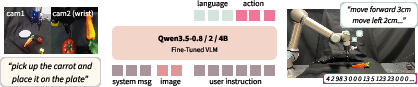
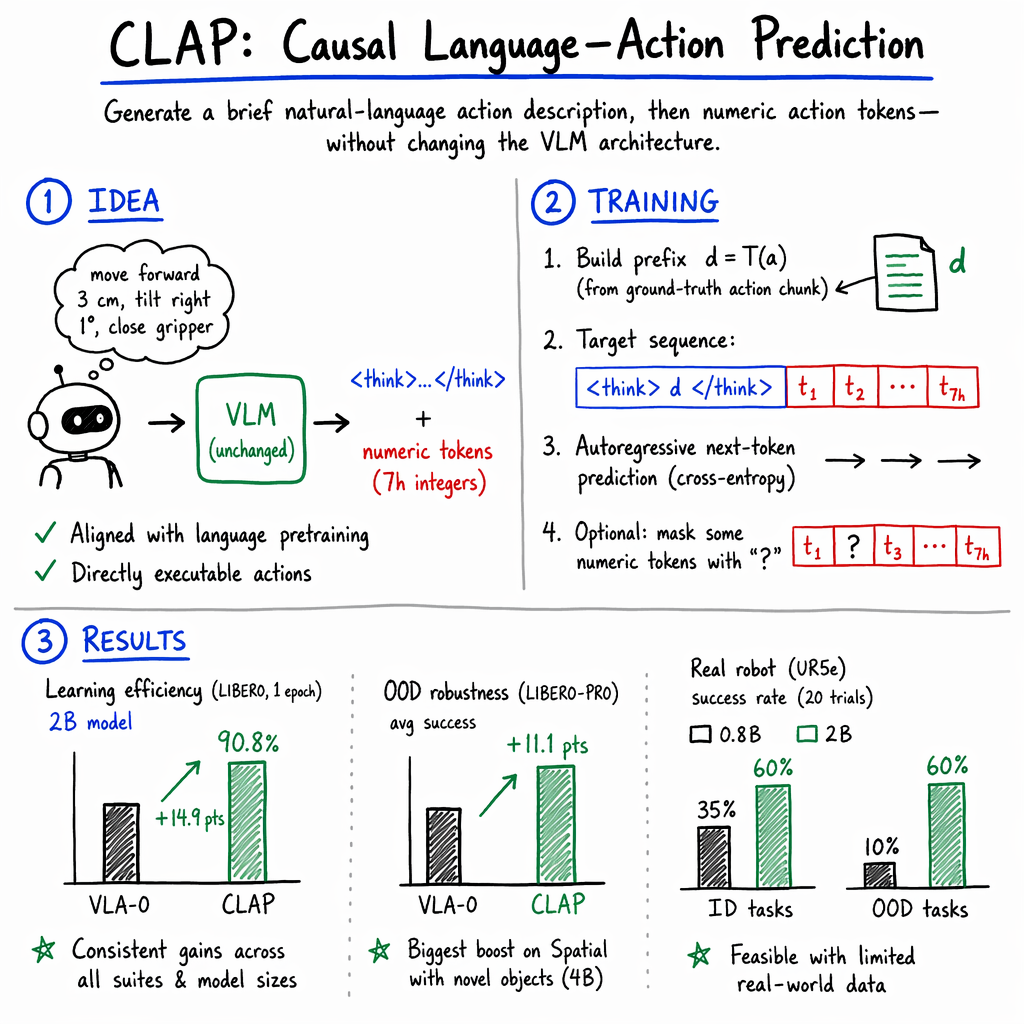
Robots that see pictures and read instructions are getting good at understanding the world, thanks to vision-LLMs (VLMs). But turning that understanding into precise robot actions (moving an arm, rotating a wrist, opening a gripper) is still hard. This paper introduces CLAP (Causal Language-Action Prediction), a simple way to turn an existing VLM into a robot controller (a VLA: vision-language-action model) without changing the model’s architecture. The trick: before the robot outputs the exact numbers for its movements, it first writes a short, plain-language description of what it’s about to do. That short sentence helps the model stay “in its comfort zone” as a LLM while still producing exact, executable actions.
The key questions the paper asks
- How can we convert a language-and-vision model into a robot controller without breaking the language skills it learned before?
- Can a tiny change—adding a short action sentence before the numbers—make training faster and make the robot more reliable?
- Does this simple method work for small, medium, and slightly larger model sizes?
- Will it help the robot handle new situations it hasn’t seen before (changes in objects, wording, or positions)?
How the method works, in simple terms
First, a few quick translations of technical terms:
- Token: a small piece of text a model reads or writes (like a word or a number).
- Autoregressive: the model writes one token at a time, each new token depending on the ones before it—like writing a sentence word by word.
- Distribution mismatch: imagine training a poet to write essays and then asking them to write only strings of numbers; they’ll get worse at what they’re good at, and the output can suffer.
The problem
- Standard VLA training asks a LLM to output long sequences of plain numbers (like “412 016 873 ...”) to represent robot actions. That’s very different from the natural sentences the model was trained on. This “output-distribution mismatch” can weaken the model’s language and reasoning abilities during training.
The CLAP idea
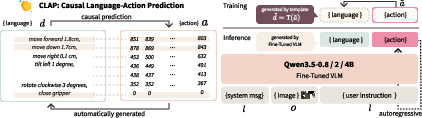
- Before outputting the exact action numbers, the model first writes a short, natural-language description of the planned motion (for example, “move forward a little, tilt right, close the gripper”).
- Then, right after that sentence, it outputs the precise numeric action tokens the robot will execute.
- Because the model generates tokens one by one, the numbers are “causally conditioned” on the sentence that came first—so the short sentence acts like a guide for the exact movements.
What’s special about CLAP
- No extra modules, no new heads, no new vocabulary, no architecture changes. It’s the same model, just a different output format.
- During training, the short sentence is created automatically from the ground-truth actions using a simple template, so no extra labeling is needed.
A tiny example of what the model outputs
1 2 |
move forward 3 cm, tilt right 1 degree, close gripper 120 455 378 602 910 013 997 ... (continues with the exact action numbers) |
Optional twist: action masking
- Sometimes, during training, the authors hide a few of the numeric tokens with a “?” and still ask the model to predict the correct numbers. This can encourage the model to rely on the sentence and images more. It helps some model sizes but not all (details in results).
How they tested it
- Models: compact Qwen3.5 backbones at 0.8B, 2B, and 4B parameters.
- Training: just one pass (one epoch) through a standard robot demo dataset.
- Benchmarks:
- LIBERO: in-distribution robot tasks (normal conditions).
- LIBERO-PRO: out-of-distribution tests (changed objects, positions, or instructions).
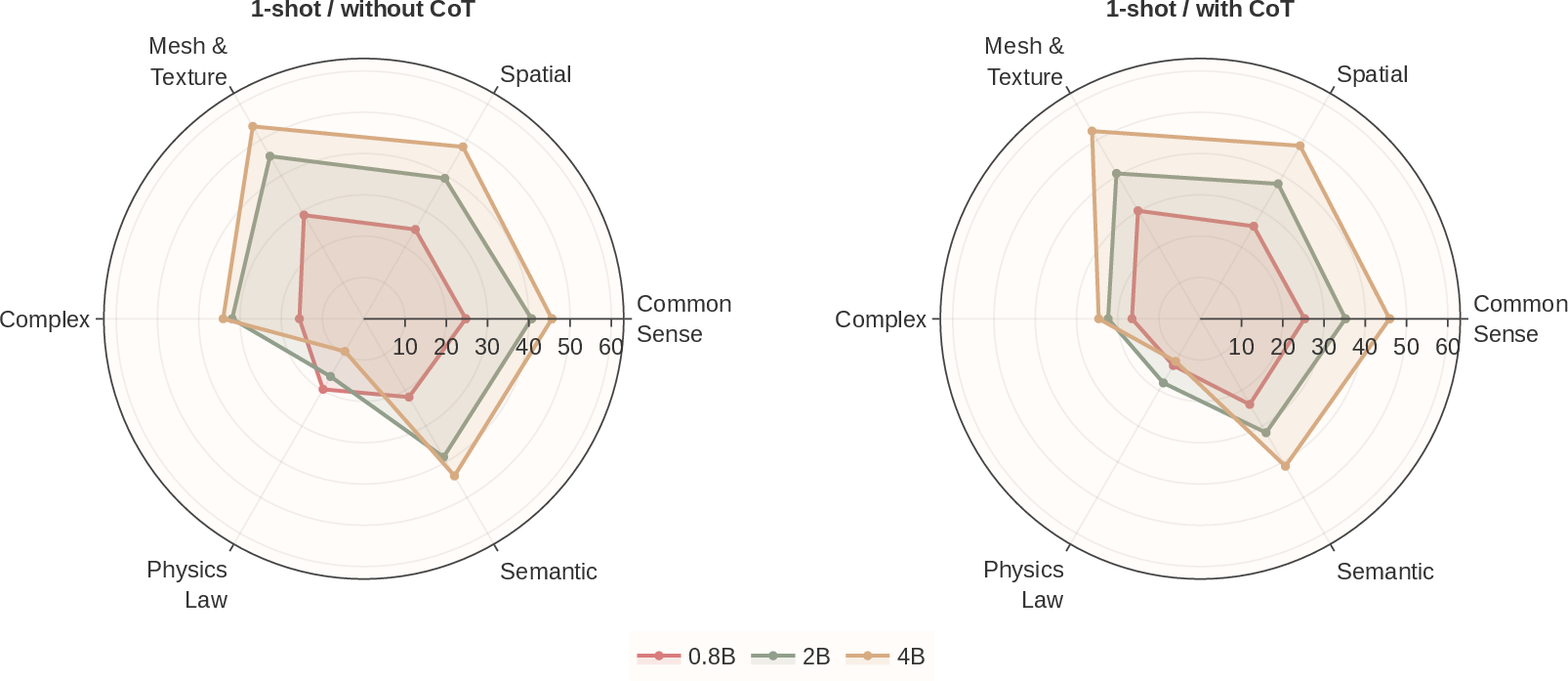
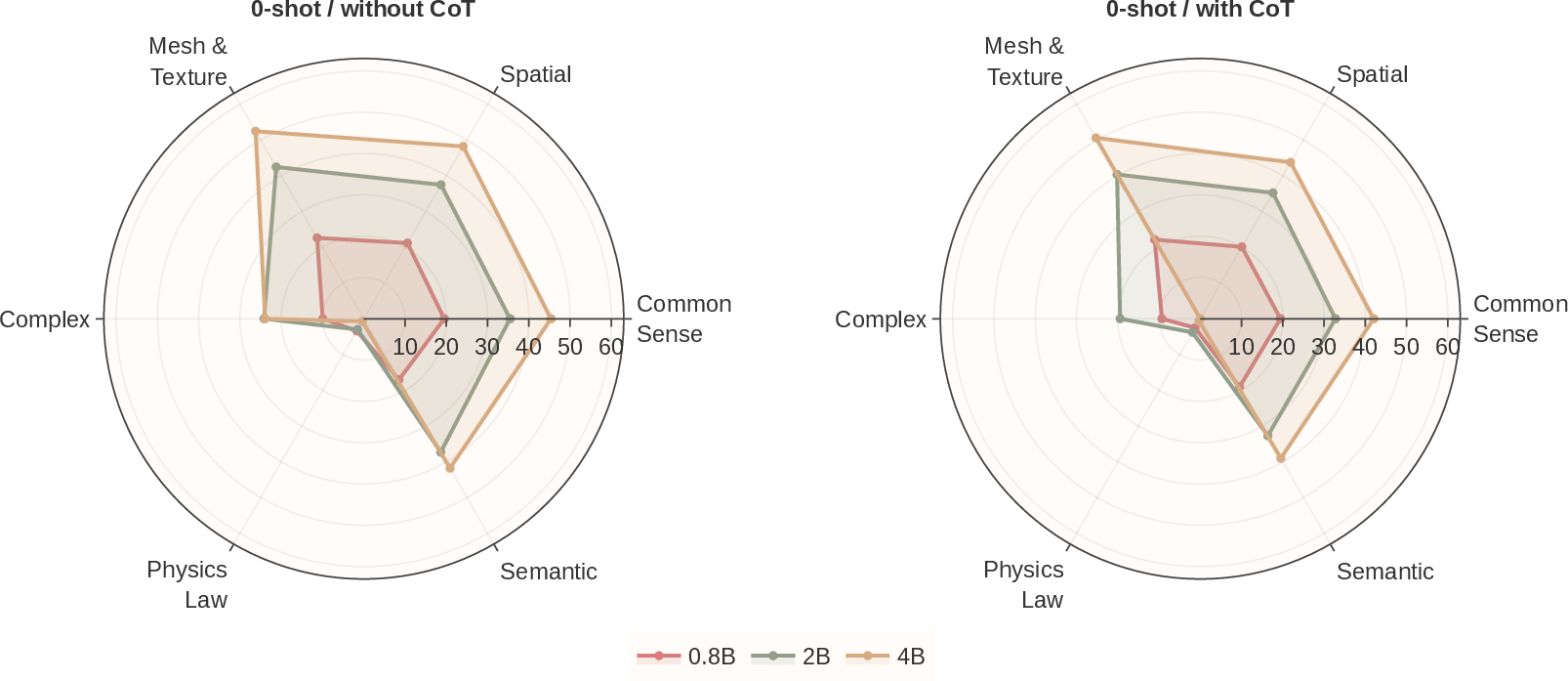
- VLABench: checks general reasoning/planning abilities before robot fine-tuning.
Main findings and why they matter
Learning efficiency (in-distribution tasks: LIBERO)
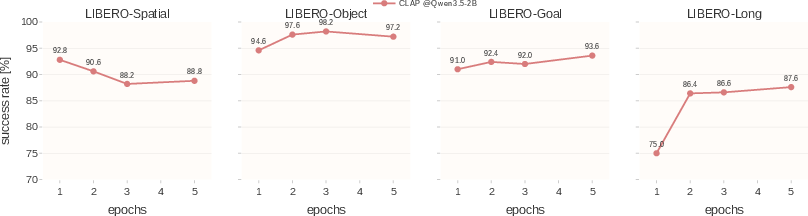
- With only one training epoch, CLAP clearly beats a strong baseline (VLA-0) that uses bare numbers.
- The 2B CLAP model reaches 90.8% success, about +14.9 percentage points higher than the same-size baseline trained the same way.
- Gains are broad across task types (spatial reasoning, object tasks, goal-based tasks, and long-horizon tasks). Why it matters: A tiny change to the output format leads to faster, better learning without bigger models or fancy new modules.
Robustness (out-of-distribution: LIBERO-PRO)
- CLAP is more reliable when instructions are rephrased, objects look different, or items are moved around.
- The biggest wins show up in spatial tasks with new object instances.
- The optional masking trick helps most at the larger (4B) size for these tough tests. Why it matters: The method isn’t just memorizing training tasks—it copes better with change.
Capability transfer across model sizes
- Bigger isn’t always better: the 2B backbone often outperforms the 4B one after fine-tuning.
- On VLABench (before robot training), skills don’t rise perfectly with size; the 2B model is very competitive in several areas. Why it matters: In compact robots, choosing the “right-sized” model and the right training recipe can beat simply making the model larger.
Practical efficiency
- Training is lightweight: about 6.5 hours on 8 GPUs for all sizes, with only one epoch.
- No architectural changes mean it’s easy to adopt and analyze.
What this could change
- Simpler, more transparent robot learning: Because CLAP barely changes the model, researchers can better study what pretraining actually contributes to control.
- Cheaper and more accessible VLAs: Compact models that train fast can help smaller labs and companies.
- Better generalization: The short action sentence seems to “steady the hand” of the model, helping it stay aligned with language skills while producing exact actions.
- Broader lesson: Sometimes, changing the output format (how we ask models to answer) matters as much as changing the model itself.
Limitations and what’s next
- The study uses one VLM family and simulation-focused benchmarks; more backbones and real-world tests are needed.
- Autoregressive decoding (writing tokens one by one) can be slower than some parallel methods. Speed-up tricks from the LLM world (like quantization or speculative decoding) could help but weren’t explored here.
- Future work: try other robots, diverse environments, larger datasets, and more backbones to confirm how widely CLAP applies.
Knowledge Gaps
Knowledge gaps, limitations, and open questions
Below is a single, consolidated list of concrete gaps that remain unresolved and could guide follow-up research.
- External validity and sim-to-real: Demonstrate CLAP on real robots across diverse environments (lighting, clutter, occlusions) and quantify sim-to-real transfer, latency constraints, and failure recovery under sensor noise.
- Backbone generality: Test CLAP across multiple VLM families and vision encoders (e.g., LLaVA, PaLI-Gemma, Prismatic, InstructBLIP, SigLIP/CLIP variants) to assess whether gains depend on Qwen3.5 specifics.
- Cross-embodiment and cross-task transfer: Validate on varied embodiments (mobile manipulators, bimanual, soft hands) and unseen task distributions (CALVIN, ManiSkill2, RT-X) to assess transfer beyond LIBERO.
- Continuous and torque-level control: Extend beyond discretized action tokens to continuous/torque commands (e.g., via quantization-aware decoding or learned de-tokenizers) and compare control smoothness, stability, and safety.
- Discretization design: Systematically study sensitivity to bin count K, numeric tokenization schemes (e.g., FAST vs multi-digit text), and the interaction between discretization resolution and low-level control fidelity.
- Chunk length and control horizon: Evaluate different action chunk sizes h (short vs long horizon), receding-horizon updates, and closed-loop vs open-loop execution to improve long-horizon performance and stability.
- Prefix template design: Compare deterministic templates to learned, paraphrased, concise vs detailed, or structured (schema/grammar-based) language-action summaries; identify the minimal and most useful information content.
- Training–inference mismatch for the prefix: Quantify exposure bias from training on templated prefixes but inferring free-form ones; evaluate scheduled sampling, noised/augmented templates, or paraphrase training to mitigate mismatch.
- Consistency between prefix and numeric tokens: Develop explicit constraints or losses that enforce agreement (e.g., differentiable checks, contrastive alignment, round-trip consistency) and measure the impact on accuracy and OOD robustness.
- Prefix error detection and recovery: Add mechanisms to detect incorrect prefixes at inference (self-verification, constrained decoding, confidence thresholds) and evaluate whether correcting or regenerating prefixes prevents cascading errors.
- Capability preservation measurement: Directly measure post-finetuning VLM capabilities (captioning, VQA, spatial reasoning, instruction following) to quantify catastrophic forgetting and verify the claimed preservation effect.
- Scaling laws and training budgets: Characterize performance vs epochs and data size; determine whether CLAP’s gains persist, saturate, or invert with larger budgets or robot-pretraining corpora.
- Matched comparisons to action-head methods: Under identical backbones and data, compare CLAP to diffusion/flow heads and hybrid designs on accuracy, robustness, latency, and resource usage.
- Latency and throughput profiling: Quantify token overhead from prefixes, end-to-end latency at typical control rates (e.g., 10–30 Hz), and improvements from speculative decoding, KV-caching, and quantization in real-time settings.
- Action masking policy: Explore curriculum or adaptive masking rates, alternative denoising objectives (span masking, masked prefix), and their effect on generalization vs training stability across model sizes.
- Spatial relocation weakness: Investigate why object-position perturbations remain near-zero in many cases; test 3D/metric scene encoders, spatial memory, or egocentric coordinate conventions coupled with CLAP.
- Temporal observation modeling: Compare single-image vs multi-frame/video conditioning and the benefit of temporal state (optical flow, keyframes) on long-horizon and OOD generalization.
- Multilingual and noisy instructions: Evaluate robustness to multilingual prompts, code-switching, typos, and indirect goals; determine whether the prefix mitigates or amplifies language noise.
- Multi-sensor inputs: Extend to depth, tactile, audio, and proprioception; study how multi-modality changes the optimal prefix content and action accuracy.
- Safety and constraint satisfaction: Incorporate kinematic/dynamic constraints, collision avoidance, and workspace limits into decoding (constrained beam search, control barrier certificates) and measure safety outcomes.
- Uncertainty estimation: Add calibrated confidence over actions/prefixes (ensembles, temperature scaling, conformal prediction) to enable safe fallback behaviors and online re-planning.
- Failure-mode taxonomy: Provide qualitative/quantitative analyses of typical CLAP failures (prefix hallucination, numeric drift, formatting errors) and link them to specific mitigation strategies.
- Chain-of-thought within CLAP: Systematically vary reasoning length within the prefix (none, short plan, CoT) and measure when longer reasoning helps or harms compact models and OOD robustness.
- Prompt brittleness and formatting guarantees: Assess robustness to prompt changes and enforce output structure via constrained decoding, structured outputs (JSON/BNF), or token-level grammars to eliminate format violations.
- Partial freezing and adapters: Compare full fine-tuning to parameter-efficient methods (LoRA/adapters, knowledge insulation) under CLAP to balance preservation, data efficiency, and performance.
- Why 2B > 4B?: Investigate the non-monotonic scaling trend (optimizer settings, regularization, capacity–data mismatch, token budget) and propose principled scale-specific training recipes.
- Units and calibration: Validate that textual units (cm, degrees) are consistent with numeric tokens and robot kinematics; study unit normalization and calibration procedures to reduce systematic control bias.
- Non-autoregressive or semi-parallel decoding: Explore semi-AR strategies (prefix AR + parallel action head) that retain language-action conditioning while cutting control latency.
- Robustness beyond LIBERO-PRO: Test broader OOD shifts (textures, backgrounds, camera viewpoints, distractors) and real-domain datasets to probe visual invariance limits of CLAP.
- Data curation and augmentation: Examine whether synthetic language-action paraphrases, counterfactual scenes, or action perturbations improve generalization without harming stability.
- Integration with robot pretraining: Combine CLAP with LAP-style language-action pretraining or large robot corpora; quantify additive vs redundant benefits and the best sequencing of objectives.
- Bimanual and dexterous tasks: Validate on higher-DoF hands and coordinated bimanual manipulation; assess whether a single prefix suffices or if multi-branch prefixes are needed.
- Theoretical grounding: Provide a formal analysis of how a language-prefix alters the conditional distribution and gradients, and under what assumptions it improves representation preservation and generalization.
Practical Applications
Immediate Applications
The following applications can be deployed now, leveraging the paper’s CLAP recipe (language-action prefix + numeric action tokens), open weights (0.8B, 2B, 4B Qwen3.5-based backbones), and single-epoch fine-tuning to achieve strong manipulation performance and improved robustness with minimal architectural changes.
- Compact robot policy fine-tuning for new manipulation tasks
- Sectors: robotics, manufacturing, warehousing, retail
- Use case: Quickly adapt an existing VLM (e.g., Qwen3.5-2B) to shelf picking, bin sorting, or assembly-line part placement using a handful of demonstrations.
- Tools/workflow: CLAP fine-tuning pipeline (single epoch, discretized actions to 1000 bins), template-based language-action prefix, direct ROS2 integration to feed 7-DoF commands.
- Assumptions/dependencies: Demonstration quality and coverage; discretization calibrated to the robot; inference latency acceptable for the control loop.
- Robust voice-instruction control for service robots and hobby manipulators
- Sectors: consumer robotics, education
- Use case: Home robot arms executing “grasp the cube and place it on the plate” with improved resilience to instruction paraphrases and object changes (LIBERO-PRO style perturbations).
- Tools/workflow: On-device CLAP model (0.8B or 2B), token-to-command decoder, optional quantization, speech-to-text front-end.
- Assumptions/dependencies: Microphone/S2T reliability; sufficient compute on edge devices (Jetson/NUC); basic safety interlocks.
- Production-grade policy auditing via language-action traces
- Sectors: industrial safety/compliance, QA
- Use case: Log the generated natural-language action description before each chunk of numeric actions to enable human-readable audit trails and post-hoc error analysis.
- Tools/workflow: Telemetry pipeline that stores the prefix and associated action tokens; dashboards flagging mismatches between description and executed dynamics.
- Assumptions/dependencies: The template remains aligned with executed actions; operators trained to interpret prefixes.
- Rapid benchmarking and model selection for compact VLAs
- Sectors: academia, ML platform teams
- Use case: Measure base VLM capability (e.g., via VLABench) to choose between 0.8B, 2B, and 4B for a given task; empirical evidence suggests 2B often transfers better than 4B in compact regimes.
- Tools/workflow: Pre-deployment capability profiling; small-scale CLAP fine-tuning trials; LIBERO/LIBERO-PRO validation suite.
- Assumptions/dependencies: Benchmarks correlate with target domain; evaluation scenarios are representative of deployment.
- Data-efficient task onboarding for new product SKUs
- Sectors: e-commerce fulfillment, manufacturing
- Use case: Incorporate a new object/category into a pick-and-place pipeline with single-epoch fine-tuning rather than multi-epoch retraining.
- Tools/workflow: Batch demo recording → template-derived prefixes → CLAP training → regression tests under OOD perturbations.
- Assumptions/dependencies: Similar kinematics and workspace; the discretized bins capture required precision.
- Instruction robustness training regimen for operational environments
- Sectors: logistics, retail, field robotics
- Use case: Increase tolerance to rephrased commands and repositioned objects by training with the language-action prefix and optionally action masking (beneficial at larger scales).
- Tools/workflow: LIBERO-PRO-like perturbation generation; masked training for 4B backbones; prefix-centered curriculum.
- Assumptions/dependencies: Masking improves OOD mostly at larger scales; validation gating needed to avoid Long-horizon drops for smaller models.
- Education and skill-building kits for robotics curricula
- Sectors: education
- Use case: University courses and makerspaces use CLAP 0.8B/2B to teach VLM-to-VLA transfer, action discretization, and interpretable policy outputs.
- Tools/workflow: Open weights, sample templates, ROS2 nodes, low-cost manipulators, reproducible LIBERO tasks.
- Assumptions/dependencies: Access to GPUs for brief fine-tuning; students can run inference on mid-range PCs.
- Lightweight SDK for token-to-action integration
- Sectors: software tooling, robotics middleware
- Use case: A developer library that converts CLAP’s 56 action tokens (for h=8 steps, 7-DoF each) into robot-specific controllers with calibration utilities.
- Tools/workflow: SDK bindings (Python/C++), ROS2 drivers, bin-to-angle/position calibration tools.
- Assumptions/dependencies: Accurate calibration; adapter layers for different robot APIs.
- Simulation-first validation with seamless sim-to-real handoff
- Sectors: robotics R&D
- Use case: Validate CLAP policies on simulated LIBERO suites, then transfer to real arms with minor tuning, leveraging interpretable prefixes when investigating failures.
- Tools/workflow: Sim environment + real robot twin; prefix logging for diagnostics.
- Assumptions/dependencies: Sim fidelity; careful latency and safety tuning for real hardware.
- Workflow for capability-preserving fine-tuning without action experts
- Sectors: model ops, research labs
- Use case: Keep the VLM intact (no auxiliary action heads) while improving action prediction via output representation—useful for teams avoiding architecture changes.
- Tools/workflow: CLAP training recipe, standard cross-entropy, no vocabulary modification.
- Assumptions/dependencies: The base VLM tokenizer adequately encodes numeric tokens; output-distribution alignment via prefix suffices for target tasks.
Long-Term Applications
These applications require further research, scaling, real-world validation, or standardization efforts to become broadly feasible.
- Cross-embodiment generalization and zero-shot transfer
- Sectors: robotics (humanoids, mobile manipulators, drones)
- Use case: Train CLAP in one embodiment and transfer via the language-action interface to different kinematics (e.g., mobile base + arm, bimanual systems).
- Tools/workflow: Body-agnostic templates, action-space adapters, cross-embodiment datasets.
- Assumptions/dependencies: Reliable mapping between discretized tokens and target kinematics; robust sim-to-real transfer; broader dataset coverage.
- Standardization of language-action interfaces for safety and procurement
- Sectors: policy, standards bodies, industrial automation
- Use case: Adopt a common “language-action prefix + tokens” contract for auditing, comparability, and certification across robot vendors.
- Tools/workflow: Working groups defining schema; compliance test suites modeled after LIBERO-PRO; reporting guidelines for OOD performance.
- Assumptions/dependencies: Industry consensus; interoperability across middleware; regulatory buy-in.
- Real-time, on-device control via efficient decoding
- Sectors: embedded systems, edge AI
- Use case: Meet strict control-loop deadlines using speculative decoding, quantization, and caching to reduce autoregressive latency.
- Tools/workflow: Hardware-aware inference engines; token-level speculative strategies; int8/int4 quantization; distillation to compact backbones.
- Assumptions/dependencies: Maintaining accuracy under aggressive optimization; robust timing guarantees.
- Safety supervisors and “plan monitors” built on the language prefix
- Sectors: healthcare, surgical robotics, industrial safety
- Use case: Use the human-readable description to pre-screen actions; flag potentially unsafe motions; enable human-in-the-loop overrides before numeric tokens execute.
- Tools/workflow: Rule-based/ML safety classifiers operating on prefixes; intervention UI; constraint-aware re-planning.
- Assumptions/dependencies: Prefix fidelity to actual motions; formal validation protocols; low false-positive rates.
- Self-supervised data growth from action logs and templates
- Sectors: research, model ops
- Use case: Use recorded execution traces to generate new language-action prefixes and augment training without manual labeling.
- Tools/workflow: Template refinement; sequence mining; self-training pipelines.
- Assumptions/dependencies: Avoiding confirmation bias; mechanisms to detect and correct compounding errors.
- Multi-modal intermediate representations (visual traces + language)
- Sectors: robotics R&D
- Use case: Combine CLAP’s prefix with visual trace or ECoT-style embodied reasoning to further strengthen grounding and long-horizon planning.
- Tools/workflow: Unified autoregressive sequences blending text and compact visual markers; additional supervision channels.
- Assumptions/dependencies: Extra data collection; managing inference-time overhead; balancing interpretability with complexity.
- Verticalized “CLAP-in-a-box” products
- Sectors: retail automation, agriculture, hospitality
- Use case: Marketplace of pre-finetuned compact VLAs for common tasks (fruit picking, shelf stocking, table clearing), with minimal customer-side data.
- Tools/workflow: Task packs (weights + templates + drivers); deployment playbooks; monitoring dashboards.
- Assumptions/dependencies: Licensing for base backbones; ongoing updates for OOD shifts; customer-specific calibration.
- Human-in-the-loop editing of plans during execution
- Sectors: operations, tele-robotics
- Use case: Operators edit the language-action description mid-run to nudge trajectory (e.g., “move up 2 cm more”), prompting regeneration of subsequent numeric tokens.
- Tools/workflow: Low-latency UI; partial sequence regeneration; safety-checked updates.
- Assumptions/dependencies: Reliable causal conditioning; seamless token boundary handling; operator training.
- Integration with advanced action tokenization (e.g., FAST)
- Sectors: robotics ML
- Use case: Combine CLAP’s prefix with more efficient/semantically structured action tokenization to reduce sequence length and improve precision.
- Tools/workflow: Tokenizer modules; bin layout learning; compatibility layers with CLAP output format.
- Assumptions/dependencies: Empirical gains across diverse tasks; careful evaluation of discretization trade-offs.
- Regulatory OOD benchmarks and certification pipelines
- Sectors: policy, certification
- Use case: Formalize LIBERO-PRO-like tests as part of deployment approval—covering instruction rephrasing, object variability, and spatial changes.
- Tools/workflow: Standard scenario catalogs; pass/fail metrics; public reporting; third-party audits.
- Assumptions/dependencies: Agreement on test design and thresholds; reproducibility across labs and vendors.
Glossary
- Action expert: A specialized module or head that generates actions separately from the LLM. "CLAP requires no action expert or architectural change."
- Action masking (augmentation): An augmentation where some action tokens are replaced with placeholders during training to encourage contextual inference. "We consider an optional augmentation that changes the teacher-forced input context without changing the CLAP target sequence."
- Adapter-based tuning: Fine-tuning strategy that inserts lightweight adapter modules into a backbone to reduce training cost. "improve efficiency through lightweight backbones, adapter-based tuning, or specialized policy modules."
- Affordances: Learned representations of what actions are possible with objects in a scene. "grounding instructions through learned affordances or embodied multimodal representations"
- Autoregressive (modeling): Sequence modeling where each token is predicted conditioned on previously generated tokens. "an autoregressive VLA models a robot policy"
- Autoregressive next-token prediction: Casting control as predicting the next token in a sequence of discretized actions. "discretizes continuous actions into tokens, casting robot control as autoregressive next-token prediction"
- Behavioral cloning: Learning a policy by supervised imitation of expert demonstrations. "with behavioral cloning on robot demonstrations"
- Causal attention: Attention mechanism that restricts each token to attend only to previous tokens to preserve temporal causality. "Because the full sequence is generated autoregressively, causal attention conditions the numeric action tokens on the preceding language description,"
- Chain-of-Thought (CoT): Prompting strategy that elicits step-by-step reasoning before producing an answer. "with and without Chain-of-Thought (CoT)"
- Co-training: Jointly training multiple components (e.g., vision and language encoders) to improve shared representations. "uses a dual-encoder design with vision-language co-training."
- Cross-entropy objective: Standard loss used to train probabilistic classifiers and autoregressive models by maximizing likelihood of target tokens. "We optimize the standard autoregressive cross-entropy objective"
- Degrees of Freedom (DoF): Independent parameters that define the configuration of a robot’s motion. "7-DoF commands"
- Diffusion action head: A continuous action generator based on diffusion models attached to the policy network. "diffusion or flow-matching action heads"
- Discretization (action tokens): Converting continuous actions into a finite set of bins to be represented as tokens. "each action dimension is discretized into K=1000 integer bins"
- Dual-encoder design: Architecture with separate encoders (e.g., for vision and language) whose outputs are combined for downstream tasks. "uses a dual-encoder design with vision-language co-training."
- End-effector: The robot’s tool or gripper at the end of a manipulator that interacts with the environment. "end-effector translation, rotation, and gripper state."
- Flow-matching (action head): A continuous action generator trained via flow-matching objectives, serving as an alternative to diffusion. "diffusion or flow-matching action heads"
- Flow Transformer: An intermediate-fusion model component used to decouple action generation from the VLM. "via an intermediate-fusion Flow Transformer"
- Gradient blocking: Training technique that stops gradients from flowing into certain components to preserve capabilities. "Knowledge Insulation blocks gradients from the action expert"
- Knowledge Insulation: A method to preserve pretrained VLM knowledge by preventing harmful gradient updates from action components. "Knowledge Insulation blocks gradients from the action expert"
- Language-action prefix: A natural-language description generated before numeric action tokens to condition precise action prediction. "the language-action prefix substantially improves learning efficiency."
- Out-of-distribution (OOD): Data that differs from the training distribution, used to assess robustness. "evaluates out-of-distribution robustness"
- Output-distribution mismatch: Divergence between the distribution a model was pretrained to generate and the new outputs enforced during fine-tuning. "We refer to this shift as output-distribution mismatch"
- Quantization: Compressing model weights/activations to lower precision to speed up inference and reduce memory. "speculative decoding and quantization"
- Speculative decoding: Inference-time technique that accelerates autoregressive generation by proposing and verifying token batches. "speculative decoding and quantization"
- Teacher forcing: Training procedure where ground-truth tokens are fed as inputs during sequence modeling. "teacher-forced input context"
- Tokenizer: Component that maps text (and here, numeric tokens) to discrete tokens usable by the model. "the same VLM backbone, tokenizer, output head, and cross-entropy loss"
- Vision-language-action model (VLA): A model that integrates vision and language to generate robot actions. "Vision-language-action models (VLAs) inherit semantic capabilities from pretrained VLMs"
- Vision-LLM (VLM): A model jointly trained on visual and textual data for multimodal understanding. "Rapid progress in vision-LLMs (VLMs) continually expands the capabilities of robot perception and reasoning"
Collections
Sign up for free to add this paper to one or more collections.