B-spline Policy: Accelerating Manipulation Policies via B-spline Action Representations
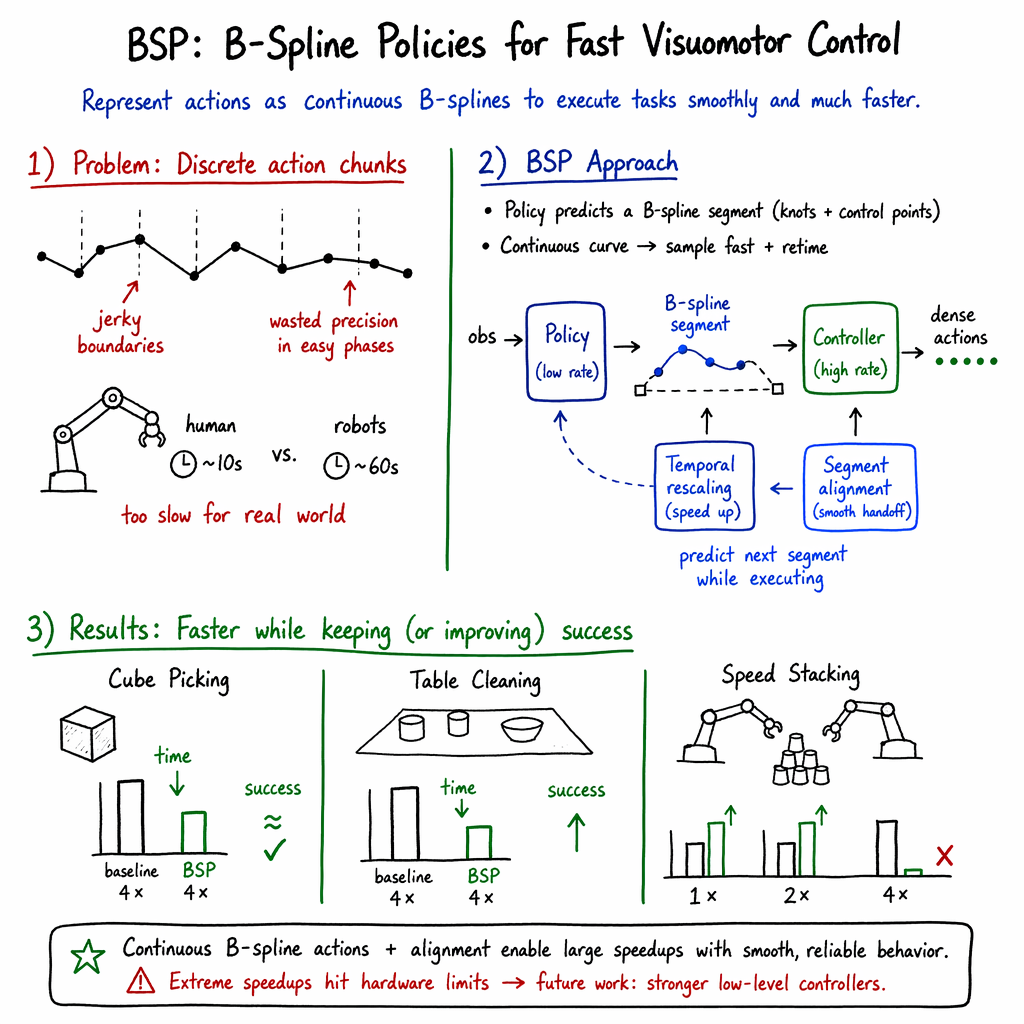
Abstract: In this work, we present B-spline Policy (BSP), an action representation designed for accelerating robot manipulation policies. Rather than predicting discrete-time action chunks, BSP parameterizes actions as continuous B-spline curves defined by a set of knots and control points. This representation yields smooth, time-continuous trajectories that can be temporally scaled and executed by low-level controllers at higher frequencies and speeds. We show that B-spline-parameterized actions can be seamlessly integrated into standard policy learning pipelines by directly predicting B-spline parameters. Experiments on simulated and real-world tasks demonstrate that BSP significantly reduces task completion time, achieving substantial improvements over baseline methods while maintaining strong success rates. More results: https://b-spline-policy.github.io
Paper Prompts
Sign up for free to create and run prompts on this paper using GPT-5.
Top Community Prompts
Explain it Like I'm 14
What this paper is about (in simple terms)
Robots can learn to move by watching lots of examples, like how to pick up a cup or stack objects. But even when they succeed, they’re often slow and a bit jerky. This paper presents a new way to tell robots how to move so they can do the same tasks faster and more smoothly. The trick is to stop sending “step-by-step” commands and instead send one smooth, continuous path using something called a B‑spline—a math tool that acts like a flexible ruler for drawing curves.
What questions the researchers asked
- Can we represent robot actions as smooth curves instead of chunky, stop‑and‑go steps?
- If we do, will robots finish tasks faster without failing more often?
- Can this new idea work with popular robot learning methods without rebuilding everything from scratch?
- How do we make sure the robot’s movement stays smooth when switching from one predicted curve to the next?
How their approach works (with everyday analogies)
Think of two ways to give directions:
- Old way: “Take 1 step forward, turn a little, take 1 step, turn again…” (lots of tiny, discrete steps)
- New way: “Follow this smooth path from here to there.” (one smooth curve)
The paper’s “B‑spline Policy” uses the new way:
- Learning from demonstrations
The robot watches example motions recorded as many small steps. The team converts those steps into smooth curves using B‑splines.
- Analogy: Instead of connecting points with straight lines (zig-zags), they fit a neat, bendy curve that stays close to the original path.
- “Knots” and “control points” are like the pegs and gentle tugs you use to shape a flexible ruler guiding the curve.
- Predicting curves, not steps
When the robot is working, its brain (the policy) looks at camera images and body sensors and predicts the next short curve (a B‑spline segment) to follow, defined by a small set of knot and control point values.
- This keeps the output small and efficient, but still produces a full, smooth motion.
- Running faster without retraining
Because the path is continuous, you can “speed up time” along the same curve—like walking the same route but at a faster pace. The low-level controller samples the curve many times per second, so the robot’s joints get dense, smooth commands even if the high‑level brain thinks more slowly.
- Analogy: You drew a smooth path with a pen once; now you can trace it quickly or slowly without redrawing it.
- Smooth handoffs between curve segments
As the robot moves, it repeatedly predicts new curve segments. Small mismatches can cause little jumps where one segment ends and the next begins—bad news at high speed.
The authors add a “segment alignment” step that finds the best point on the new curve that matches where the robot currently is and starts from there.
- Analogy: When joining two pieces of a train track, you slide the new piece until it lines up perfectly before snapping it in.
What they found and why it matters
- Faster task completion without hurting success (most of the time)
- Example: In the long “Table Cleaning” task, one setup cut average time by about half (from ~23.6s down to ~11.8s) while keeping success comparable or better.
- Smoother motions The curves produced less jerky movement than step‑by‑step methods, which is especially important when moving quickly. Smoother commands help the robot’s motors track the motion reliably.
- Segment alignment is crucial The extra alignment step between consecutive curve segments made a big difference, especially at higher speeds. Without it, small discontinuities can snowball into bigger errors or failures.
- Works with popular learning pipelines The B‑spline outputs fit neatly into existing imitation learning methods like Diffusion Policy and ACT‑style regression, so it’s more like a plug‑in than a complete rewrite.
- Limits at extreme speeds Pushing speed too high can hit hardware limits. For the most aggressive 4× speed in a tough two‑arm task, the low‑level controller couldn’t keep up, leading to failures. Better low‑level control or stronger hardware could raise this ceiling.
Why this is important
- Practical speedups: Faster, smoother robot motions mean less waiting and more productivity, whether on a factory line or in home assistance tasks.
- Safer, steadier control: Smooth trajectories reduce jerky movements that can cause slips, overshoots, or tracking errors.
- Easy to adopt: Because it plugs into existing training pipelines, labs and companies can try it without starting from scratch.
- A new default for action design: The work suggests robot policies should think in continuous curves rather than fixed chunks—more like drawing a path than hopping between points.
Bottom line
By switching from “step lists” to “smooth curves” for robot actions, the B‑spline Policy speeds up manipulation tasks and makes motions more fluid, all while keeping reliability high in most cases. With a simple segment alignment trick and the ability to “retime” the same curve to run faster, this approach offers a practical path to quicker, cleaner robot behavior today—and even more gains as low‑level controllers and hardware improve.
Knowledge Gaps
Knowledge gaps, limitations, and open questions
Below is a consolidated list of concrete gaps and open questions that remain unresolved and could guide future research:
- Online adaptivity of spline complexity: how to let the policy vary the number and placement of knots, the segment horizon, or the spline degree at inference time based on task phase, curvature, or uncertainty, rather than predicting a fixed-size segment.
- Validity-by-design parameterization: develop architectures that enforce nondecreasing knot vectors and other spline validity constraints during prediction (e.g., via monotonic transforms or cumulative sums) instead of post-hoc projection; quantify the performance impact of current projection.
- Manifold-consistent action spaces: extend BSP to orientations and full trajectories using on-manifold splines (e.g., Lie-group B-splines) rather than Euclidean interpolation; assess effects on tracking and accuracy.
- Hybrid actions and discontinuities: integrate discrete events (e.g., gripper open/close, mode switches) and inherently discontinuous components within the spline framework (e.g., via hybrid models or separate heads).
- Alignment beyond position matching: replace MSE-based alignment with methods that enforce / continuity (velocity/acceleration) or use state estimates and controller tracking error; compare alternatives and analyze their stability.
- Theoretical guarantees: provide formal analysis of closed-loop stability, bounded tracking error, and robustness under temporal rescaling and segment alignment, including conditions on curvature and controller bandwidth.
- Adaptive temporal rescaling: learn or schedule the speed factor online based on curve curvature, phase (precision vs transit), tracking error, and actuator limits instead of using a global, constant factor.
- Constraint-aware execution: incorporate kinematic/dynamic constraints (joint limits, torque/velocity bounds, self- and environment-collision avoidance) into spline prediction or tracking (e.g., via constrained parameterization or MPC tracking).
- Controller co-design: systematically study how different low-level controllers (impedance, feedforward, MPC), sampling rates, and stiffness affect achievable speedups and robustness; co-optimize controller and spline parameters.
- Latency and jitter robustness: characterize sensitivity to observation and inference latency/jitter, especially for the alignment mechanism; develop latency-adaptive alignment and buffering strategies.
- Delta-action alignment: devise principled segment alignment for delta/velocity-based action spaces (where current approach disables alignment), including formulations with integral consistency.
- Data efficiency: assess whether B-spline supervision reduces demonstration requirements; run controlled ablations on dataset size and tolerance to quantify sample efficiency and generalization.
- Contact-rich timing: evaluate whether spline fitting (with tolerance) blurs critical contact timings or short impulsive motions; investigate fitting objectives that preserve contact events or velocities.
- Dynamic tasks and non-prehensile behaviors: test BSP on highly dynamic tasks (e.g., throwing, striking) where feasibility depends on dynamics; extend representation to encode timing-critical dynamics.
- Mobile and multi-body systems: study BSP for mobile manipulation with nonholonomic bases and for dual-arm coordination where inter-arm constraints and synchronization must be enforced.
- Orientation–position coupling: analyze path quality for end-effector commands under high curvature and near kinematic singularities; explore coupled spline representations to avoid artifacts.
- Benchmarking speed in simulation: establish standardized, reproducible simulation benchmarks and protocols for policy acceleration (control rates, latency models, speed metrics) beyond the modified PushT.
- Automatic tolerance and knot selection: learn or adapt the fitting tolerance and knot density per phase to balance compression and fidelity; quantify how these choices affect execution quality and speed.
- Compute/latency budget: measure and optimize the overhead of alignment search, asynchronous inference, and high-frequency sampling; study scalability to larger perception backbones and multi-camera input.
- Failure mode taxonomy: beyond “controller limits,” systematically categorize BSP failure modes under acceleration (e.g., grasp slip, alignment drift, overshoot) and design monitoring/mitigation (e.g., curvature-based speed caps).
- Safety under acceleration: integrate reactive safety layers or constraint-aware replanning to guarantee collision avoidance and safe stopping at higher speeds.
- Reactivity vs smoothness trade-off: quantify whether spline smoothing delays reactions to sudden disturbances or novel sensory inputs; explore mechanisms for rapid replanning or local reparameterization mid-segment.
- Training objectives: investigate supervising derivatives (velocity/acceleration) or adding curvature/jerk regularizers to shape spline quality and controller friendliness.
- Comparative representations: compare BSP against alternative continuous parameterizations (e.g., Bézier, NURBS, DMPs) across compactness, smoothness, controllability, and acceleration headroom.
- Learning time parameterization: instead of external time-scaling, learn explicit time-parameterized splines (space–time curves) so the policy can jointly decide geometry and timing for each segment.
Practical Applications
Immediate Applications
Below are deployable use cases that leverage the paper’s B-spline Policy (BSP) findings—continuous B-spline action representations, temporal rescaling, and inference-time segment alignment—without requiring foundational research changes.
- Faster, smoother pick-and-place in manufacturing and logistics (Robotics, Manufacturing, Logistics)
- Use case: Retrofit existing visuomotor pickers for bin-picking, kitting, palletizing by replacing discrete action chunks with B-spline outputs; apply temporal rescaling to meet cycle-time targets.
- Tools/workflows: “SplineHead” for Diffusion Policy/ACT; ROS 2 node for spline sampling at 100–500 Hz; latency-aware segment alignment module.
- Dependencies/assumptions: Low-level controllers must track higher-frequency, smooth commands; safety limits (ISO/TS 15066, ISO 10218) constrain max speed; camera/inference latency must be measured for alignment.
- Throughput “speed knob” in robot cells (Robotics, Software)
- Use case: Introduce a deployment-time slider to adjust traversal speed () per product, shift, or safety mode without retraining.
- Tools/workflows: Control dashboard exposing temporal rescaling factor; monitoring to auto-dial speed down on tracking errors.
- Dependencies/assumptions: Stable tracking up to selected speed factor; policy remains geometrically valid under retiming; watchdogs for overspeed protection.
- Smoother human–robot collaboration (HRI) with lower jerk (Robotics, Manufacturing, Healthcare)
- Use case: Deploy BSP to reduce discontinuities at action boundaries and improve perceived safety/comfort in cobot cells or hospital service robots.
- Tools/workflows: Jerk/acceleration monitors; B-spline segment alignment in all mode switches (teach–auto, handover).
- Dependencies/assumptions: Certified safety envelope and stop distances; acceptable perception latency to avoid boundary mismatches.
- Post-processing of taught waypoint programs (Industrial robotics, Software)
- Use case: Convert legacy waypoint programs to B-splines via adaptive fitting to eliminate jerk and reduce wear.
- Tools/workflows: FITPACK-based CLI to fit cubic B-splines with bounded reconstruction error; knot-validity projection; export to vendor formats.
- Dependencies/assumptions: Sufficiently dense original waypoints; compatibility with robot controller trajectory interfaces.
- Dataset compression and faster training for imitation learning (Academia, Software)
- Use case: Fit demonstrations with adaptive B-splines to reduce storage and speed up IO/compute while preserving behavior within tolerance.
- Tools/workflows: Dataset converters producing [U; C] segments; training heads that predict fixed-size local spline parameters.
- Dependencies/assumptions: Tolerance selection balances compression and fidelity; consistent parameterization across demos.
- Edge deployment on low-cost compute (Embedded AI, Software)
- Use case: Run perception/policy at lower frequency (e.g., 10 Hz) while sampling splines at high rate (e.g., 100–500 Hz), reducing compute and energy.
- Tools/workflows: Asynchronous inference pipeline (Algorithm 2 in paper); hardware timers to decouple rates.
- Dependencies/assumptions: Reliable real-time thread for high-rate sampling; bounded inference jitter; alignment window tuning.
- Bimanual and contact-rich tasks with continuous coordination (Robotics, Manufacturing, Consumer)
- Use case: Apply BSP to dual-arm assembly, stacking, or folding, improving coordination by preventing chunk boundary glitches.
- Tools/workflows: Multi-arm synchronized segment alignment; shared retiming factor for both arms.
- Dependencies/assumptions: Controller support for multi-robot time base; precise cross-arm latency measurement.
- Service and assistive robots with user-adjustable speed/smoothness (Daily life, Healthcare)
- Use case: Home or hospital robots performing cleaning, fetching, or handling delicate items faster while preserving precision and comfort.
- Tools/workflows: UI exposing “precision mode” (lower speed) vs “express mode” (higher speed) with BSP retiming.
- Dependencies/assumptions: Safety rules in shared spaces; task phases that tolerate higher speeds outside fine contact.
- Lab automation with spill- and vibration-sensitive handling (Healthcare, Life sciences)
- Use case: Pipetting, pouring, and placement benefit from smooth spline trajectories to reduce oscillations and spillage.
- Tools/workflows: Spline-based motion templates for liquid handling; phase-specific retiming (slow near contact).
- Dependencies/assumptions: Calibration for viscous fluids; end-effector compliance and damping.
- Reduced peak loads and equipment wear via smooth profiles (Maintenance, Energy)
- Use case: Smoother trajectories reduce sudden torque/current spikes, extending actuator life and lowering peak power.
- Tools/workflows: Jerk-limited spline execution; power/thermal monitoring dashboards.
- Dependencies/assumptions: Controllers expose current/torque telemetry; power limits enforced during retiming.
- Simulation and benchmarking extensions (Academia, Software)
- Use case: Add B-spline action spaces to simulators (RoboMimic, RoboCasa, PushT) and include completion-time metrics alongside success rate.
- Tools/workflows: Gym wrappers that accept spline segments; latency emulation and alignment hooks.
- Dependencies/assumptions: Sim control loops can run at higher Hz; datasets re-collected or resampled for consistent evaluation.
Long-Term Applications
These use cases likely require further research, scaling, hardware co-design, or regulatory work before broad deployment.
- High-speed manipulation co-designed with high-bandwidth controllers (Robotics, Hardware)
- Vision: Combine BSP with upgraded low-level controllers (higher stiffness, better tracking) and feedforward dynamics for robust ≥4× speeds.
- Potential products: “Acceleration kits” pairing BSP middleware with servo firmware upgrades and auto-tuning.
- Dependencies/assumptions: Hardware availability; safe operation at higher velocities; coordinated dynamics modeling.
- Hierarchical planners emitting B-spline macro-actions (Robotics, Planning)
- Vision: Task/motion planners produce variable-duration spline segments as control-oriented primitives, closed-loop with BSP policies.
- Potential tools: Planner–policy interfaces for segment goals and retiming constraints; spline-aware MPC tracking.
- Dependencies/assumptions: Reliable prediction of contact phases; real-time feasibility checks for knot schedules.
- Generalist VLA policies with spline tokenization (AI for Robotics)
- Vision: Extend vision–language–action models to output spline parameters or tokens (cf. BEAST) for efficient decoding and smooth execution.
- Potential tools: Tokenizers for knots/control points; decoders with monotonicity constraints; multi-task libraries.
- Dependencies/assumptions: Large, diverse datasets with spline labels; robust knot validity enforcement during generation.
- Fleet-level throughput and safety optimization via dynamic retiming (Manufacturing, Logistics)
- Vision: Orchestrate a fleet’s tempo in real time, slowing robots near humans while speeding others to maintain line balance.
- Potential tools: MES/SCADA connectors; digital twins simulating retiming vs. throughput and safety margins.
- Dependencies/assumptions: Centralized latency and state sharing; standardized spline control APIs across vendors.
- Energy-aware motion retiming and grid interaction (Energy, Sustainability)
- Vision: Optimize spline traversal to reduce peak power draw, shift loads, and exploit off-peak tariffs without changing geometry.
- Potential tools: Power-constrained retiming solvers; plant-level schedulers coordinating multiple robots.
- Dependencies/assumptions: Accurate power models; facility constraints and compliance with production takt time.
- Surgical and medical robots with safe high-speed, smooth control (Healthcare)
- Vision: Use BSP to reduce tremor and overshoot while enabling faster, safer maneuvers in regulated environments.
- Potential tools: Certified spline tracking with bounds on velocity/acceleration; surgeon-controlled retiming interface.
- Dependencies/assumptions: Rigorous validation, FDA/CE approvals; redundant safety monitors.
- Robust cloud/remote operation with latency-compensated alignment (Cloud robotics, Telecom)
- Vision: Apply inference-time segment alignment and predictive retiming to stabilize teleoperation or cloud-inferenced robots over variable networks.
- Potential tools: Network-aware alignment window tuning; on-robot spline resampling services.
- Dependencies/assumptions: Quality-of-service guarantees or adaptive buffering; safety under packet delays.
- Multi-robot synchronization using spline-phase coordination (Robotics, Warehousing)
- Vision: Synchronize multiple manipulators or mobile manipulators by coordinating spline parameterization and phase alignment.
- Potential tools: Shared spline clocks; collision-aware retiming across agents.
- Dependencies/assumptions: Precise time sync; global motion constraints; robust multi-agent planners.
- RL with spline action spaces for safer exploration (Academia, Software)
- Vision: Use B-spline outputs in reinforcement learning to bias policies toward smooth, physically plausible actions and improved stability.
- Potential tools: Spline-parameter policy gradients; constraint layers for knot monotonicity.
- Dependencies/assumptions: Stable training objectives; environments with high-rate controllers.
- Standards and benchmarks emphasizing completion time and smoothness (Policy, Standards)
- Vision: Update evaluation protocols to jointly consider success, completion time, jerk, and safety; recommend continuous action interfaces.
- Potential tools: Benchmark suites with time/smoothness leaderboards; reference implementations of BSP.
- Dependencies/assumptions: Community consensus; collaboration with standards bodies and industry consortia.
Cross-cutting assumptions and dependencies
- Hardware tracking limits: Realized speedups depend on servo bandwidth, stiffness, and actuator authority; aggressive retiming can exceed limits.
- Safety and compliance: Any acceleration in shared spaces must adhere to safety standards and include runtime monitors.
- Latency management: Segment alignment relies on measured inference latency and appropriate search windows; unstable latencies reduce benefits.
- Action space compatibility: Joint-position vs. end-effector deltas require controller-appropriate spline execution and boundary handling.
- Numerical validity: Knot monotonicity and spline stability must be enforced at inference; small projections may be required.
- Data and training: Demonstration quality and fitting tolerance (ε) affect fidelity and compression; hyperparameters must be task-tuned.
Glossary
- Absolute joint-position actions: Robot commands that specify absolute joint angles or positions rather than incremental changes; common in low-level control of physical arms. "In real-world experiments, actions are absolute joint positions."
- Action chunking: Grouping and predicting fixed-length sequences of actions as a single unit in policy learning. "A key source of inefficiency in modern visuomotor policies lies in the design of action chunking [4, 3]."
- Analytic derivatives: Closed-form expressions for derivatives that enable precise gradient computations for trajectories and controls. "These representations provide intrinsic smoothness and analytic derivatives [29, 30]."
- B-spline: A smooth, piecewise-polynomial curve defined by knots and control points, used to represent continuous trajectories. "A B-spline defines a smooth curve by a set of knots and control points."
- B-spline basis function: The set of local basis functions whose weighted sum produces a B-spline curve. "where N (u) is the i-th B-spline basis function of degree p."
- Bimanual: Involving two robotic arms or hands coordinating to perform a task. "Speed Stacking, which emphasizes bimanual, contact-rich interaction."
- Control frequencies: The rates at which control signals are sent to actuators or low-level controllers. "Each predicted B-spline segment can be sampled at arbitrary control frequencies and retimed dynamically by scaling the temporal mapping."
- Control points: Parameters that define and shape the trajectory of a spline curve. "Because B-splines have local support, any trajectory segment can be represented by a fixed number of nearby control points and knots."
- Cubic B-splines: B-splines of degree 3, offering continuity in position, velocity, and acceleration. "In our experiments, we use cubic B-splines, which provide smooth trajectories with continuous velocity and acceleration profiles."
- Delta end-effector commands: Incremental commands that specify changes in the end-effector’s pose rather than absolute targets. "In simulation, actions are delta end-effector commands."
- FITPACK: A classical algorithmic toolkit for fitting splines to data via adaptive knot placement. "We use an adaptive fitting procedure based on the classical FITPACK strategy [16, 34, 35], which iteratively inserts knots into trajectory regions with the largest reconstruction error."
- High-curvature segments: Portions of a trajectory where direction or speed changes rapidly, requiring more representation capacity. "fewer knots are allocated to smooth regions, while density increases in high-curvature segments."
- Imitation learning: Learning control policies from demonstration data rather than from explicit reward signals. "B-spline policy requires minimal modifications to existing imitation learning methods, serving as a drop-in replacement for standard action chunk prediction."
- Inference latency: The time delay between supplying inputs to a policy and receiving its outputs. "In practice, this assumption is often violated due to policy prediction noise, inference latency, and controller tracking error."
- Inference-time segment alignment: A procedure that aligns newly predicted spline segments with the current execution to ensure continuity. "we introduce an inference-time segment alignment mechanism that enforces smooth transitions between the predicted B-spline segments."
- Knot insertion: The process of adding knots to a spline to improve fit or reduce approximation error in specific regions. "We fit a B-spline to each demonstration trajectory using the adaptive knot insertion procedure in Alg. 1."
- Knot validity projection: A post-processing step ensuring the predicted knot vector is nondecreasing to maintain a valid B-spline. "Knot validity projection. A valid B-spline requires a nondecreasing knot vector, which standard imitation-learning regressors do not enforce."
- Knot vector: A nondecreasing sequence of parameter values that determines where and how the spline pieces join. "a knot vector U and a set of control points C ="
- Local support: Property of spline bases whereby each control point influences only a limited region of the curve. "Because B-splines have local support, any trajectory segment can be represented by a fixed number of nearby control points and knots."
- Low-level controller: The controller that directly commands actuators at high frequency, executing the policy’s planned trajectory. "executed by the low-level controller at higher frequencies and speeds."
- Motion planning: The process of computing feasible, often optimal, paths or trajectories for robots to achieve goals while satisfying constraints. "Such a representation is used in classical motion planning [8, 9, 10, 11] and computer graphics [12, 13],"
- Out-of-distribution (OOD): Inputs that deviate from the data distribution seen during training, potentially degrading policy performance. "such discontinuities effectively induce out-of-distribution (OOD) inputs,"
- Proprioceptive: Relating to internal sensing of the robot’s state (e.g., joint angles, velocities). "The policy maps proprioceptive and visual observations o totan action chunk"
- Quasi-static: Operating at sufficiently low speeds that dynamic effects (like inertia) are negligible. "While such boundary mismatches may be tolerable in low-speed or quasi-static settings,"
- Reconstruction error: The discrepancy between the fitted spline trajectory and the original demonstration data. "estimating control points under a bounded reconstruction error."
- Segment alignment: Ensuring consecutive trajectory segments connect smoothly to avoid execution discontinuities. "Pipelined Execution with Segment Alignment."
- Speedup factor: A multiplicative parameter that accelerates execution by traversing a trajectory faster in time. "For a speedup factor n, the robot follows the same action trajectory while traversing the curve more quickly: a exec(t) = a(nt)."
- Spline parameter domain: The domain of the spline’s parameter (often denoted u) over which the curve is evaluated. "where u max (S) denotes the segment horizon in the spline parameter domain."
- Temporal rescaling: Changing the mapping from real time to the trajectory parameter to run the same path faster or slower. "Temporal rescaling. Given a predicted trajectory a(u), we can execute it faster by scaling the mapping between real time and the curve parameter."
- Temporal resolution: The granularity at which actions are specified or executed over time. "Uniform temporal resolution."
- Trajectory optimization: Optimization-based computation of trajectories that satisfy dynamics and constraints while optimizing performance criteria. "High-speed manipulation has been extensively studied in classical robotics, especially in motion planning and trajectory optimization [18]."
- Uniform chunking: Using fixed-duration, evenly sampled action segments across all task phases. "Uniform chunking fundamentally misallocates representational capacity across time."
- Visuomotor policy: A control policy that maps visual (and often proprioceptive) observations directly to motor commands. "In this work, we propose B-spline policy, a visuomotor policy that directly outputs continuous action curves."
- VLA policies: Vision-Language-Action policies that integrate visual and linguistic inputs to produce actions. "proposes a B-spline encoded action tokenizer for efficient action sequence modeling and decoding in VLA policies."
Collections
Sign up for free to add this paper to one or more collections.