Observation of gravity-like signatures in holographic codes on a quantum computer
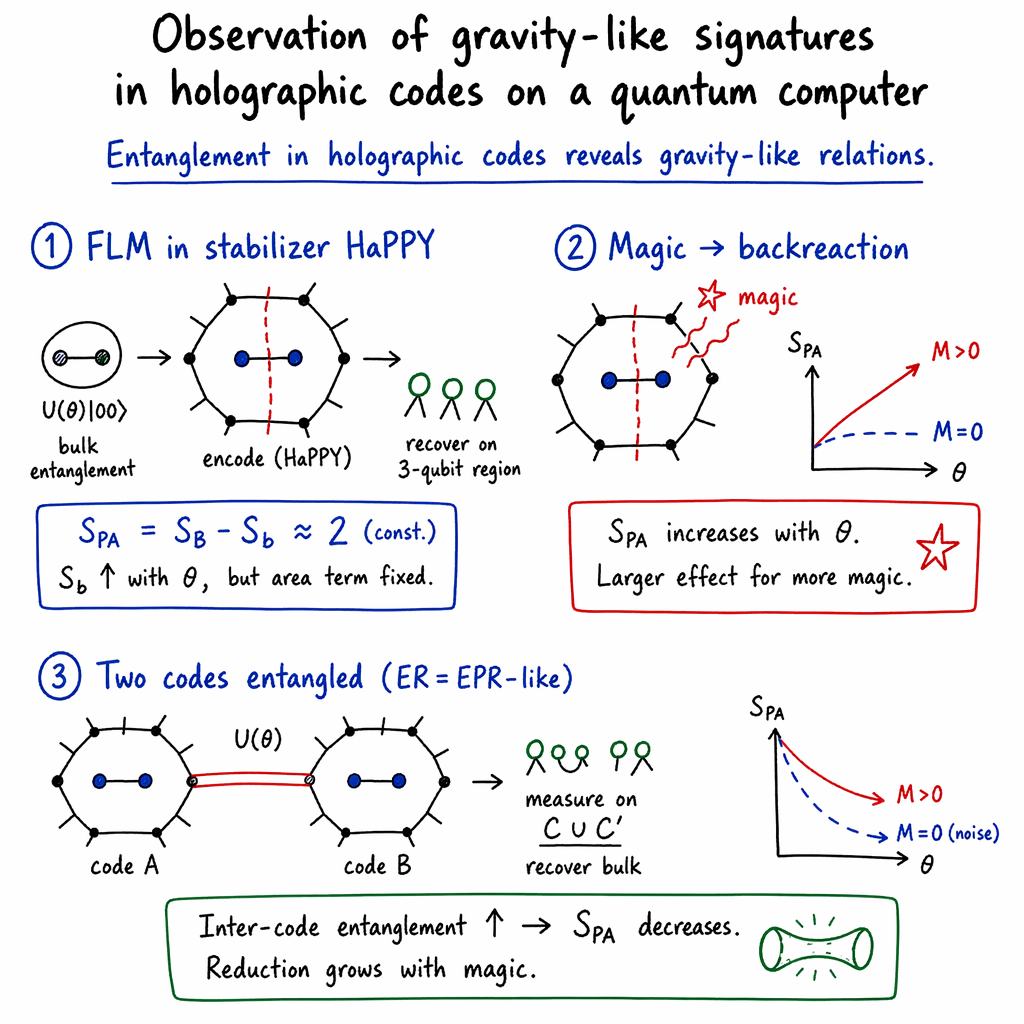
Abstract: The unification of quantum mechanics and general relativity remains one of the major open problems of theoretical physics. The Anti-de Sitter/Conformal Field Theory (AdS/CFT) correspondence provides a valuable theoretical framework for this effort via a holographic duality between a theory of quantum gravity in asymptotically AdS spacetime and a conformal quantum field theory on the lower-dimensional boundary. Here, we implement a toy model of this duality called the HaPPY code, a quantum error-correcting code in the form of a tensor network with hyperbolic entanglement patterns, on a trapped-ion quantum computer. We present the first experimental confirmation of the Faulkner-Lewkowycz-Maldacena formula in this model - a key test of the holographic correspondence. We then enrich it with non-stabilizerness, or magic, and observe entropic precursors expected of emergent gravity. Finally, we present and measure a code construction whose entropic behavior is reminiscent of a highly quantum wormhole. Our experiments illustrate how quantum computers can serve as testbeds for modeling the emergence of spacetime.
Paper Prompts
Sign up for free to create and run prompts on this paper using GPT-5.
Top Community Prompts
Explain it Like I'm 14
What this paper is about (in simple terms)
The authors built a tiny “toy universe” on a quantum computer to explore a big idea in physics: that space itself might be made from quantum entanglement. They used special quantum circuits (called holographic codes) to mimic how a world with gravity could be related to a lower‑dimensional world without gravity. Then they looked for “gravity-like” signals in this toy world and found them.
The main questions they asked
- Can we recreate a key gravity rule—the FLM formula—that connects the “area” of an invisible surface in the bulk (the inside) to the amount of quantum entanglement on the boundary (the outside)?
- If we add a special kind of quantum resource called “magic” to the code, does the “geometry” of the toy universe start to depend on the matter (i.e., on how entangled things are), similar to how matter curves spacetime in real gravity?
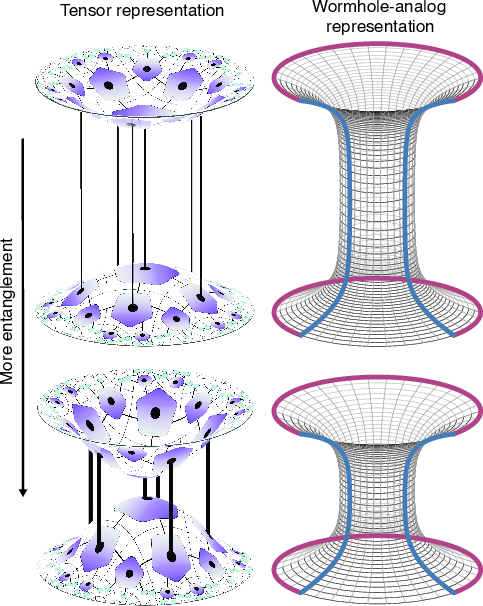
- If we link two toy universes by entangling their insides, do they behave more “connected,” in a way that’s reminiscent of a wormhole?
How they did it (methods explained simply)
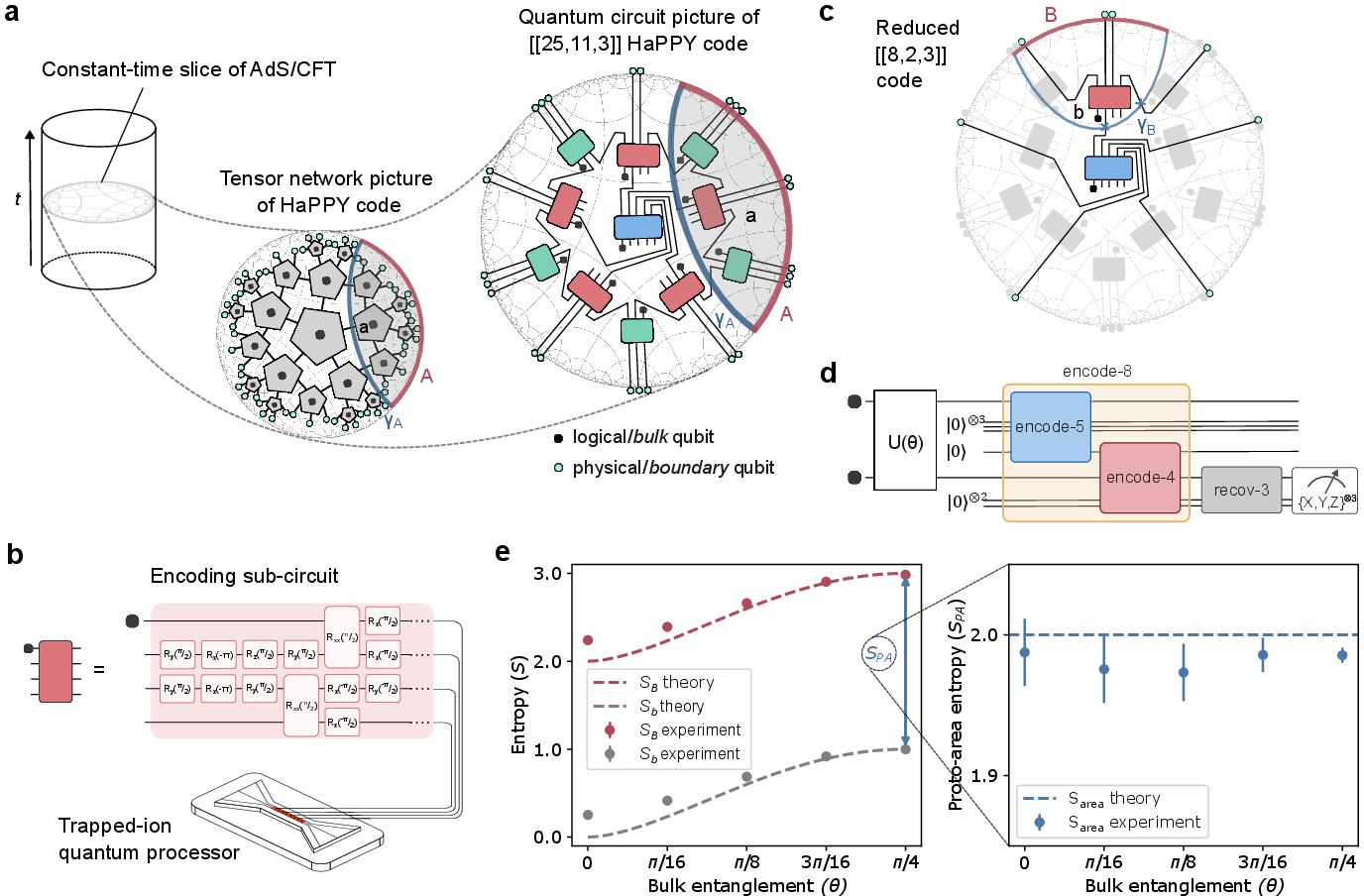
Think of their setup like a spiderweb or network that turns two “inside” qubits (bulk) into many “outside” qubits (boundary). This network is known as the HaPPY code, a holographic quantum error-correcting code built from “perfect” mini-blocks. Here’s the everyday-language translation of the key pieces:
- Holographic code: A rulebook that takes information from the “inside” and spreads it across the “outside,” like stretching a small picture into a large mosaic that still keeps all the information safe (error-correcting).
- Bulk vs. boundary: “Bulk” is the interior (where gravity would live). “Boundary” is the outer edge (where a gravity-free theory lives). The holographic idea says these two descriptions are actually the same information told in different ways.
- Entanglement entropy: A number that tells how strongly a part of a system is linked to the rest. Higher entropy means more “mixed” or uncertain when you only look at the part.
- Proto-area entropy: A number they compute as S_PA = S(boundary part) − S(recovered bulk part). In the code, this S_PA behaves like the “area” of a minimal cut through the network—imagine the fewest links you’d have to cut to separate a chosen boundary region from the rest.
They ran the code on a trapped‑ion quantum computer (ions are charged atoms that can be controlled with lasers). Because full circuits can be large, they used the code’s structure to reduce big circuits to smaller, equivalent ones that keep the same entanglement features, saving hardware time without losing the important physics.
To test the FLM relation, they:
- Prepared two inside (bulk) qubits with adjustable entanglement using a knob called θ.
- Encoded those qubits into the bigger boundary using the HaPPY circuit.
- Recovered the inside information from a chosen boundary region using a “recovery” circuit.
- Measured two entropies—boundary and recovered bulk—via quantum state tomography (a way to reconstruct the quantum state by measuring in different bases). Subtracting them gave the proto-area S_PA.
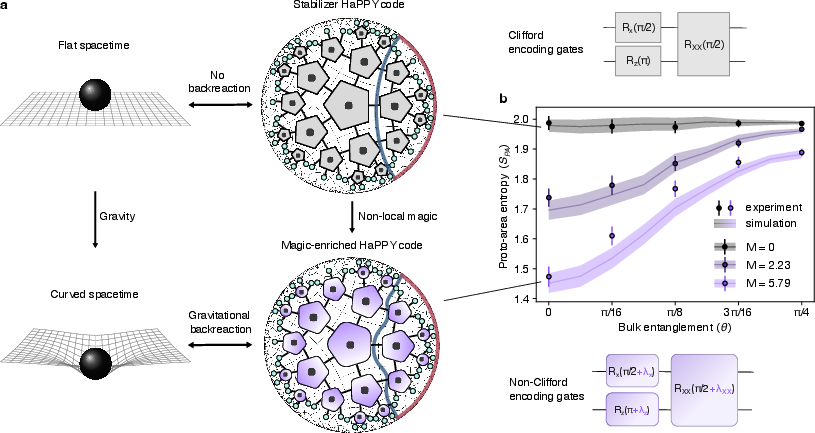
Then they made a second version of the code by slightly over‑ or under‑rotating certain gates (tiny angle shifts), which adds “magic,” meaning it’s no longer a simple stabilizer code. In everyday terms, magic is an extra nonclassical ingredient that lets the code do things the simpler version can’t—like allowing the effective geometry to respond to the state (a stand‑in for gravitational backreaction).
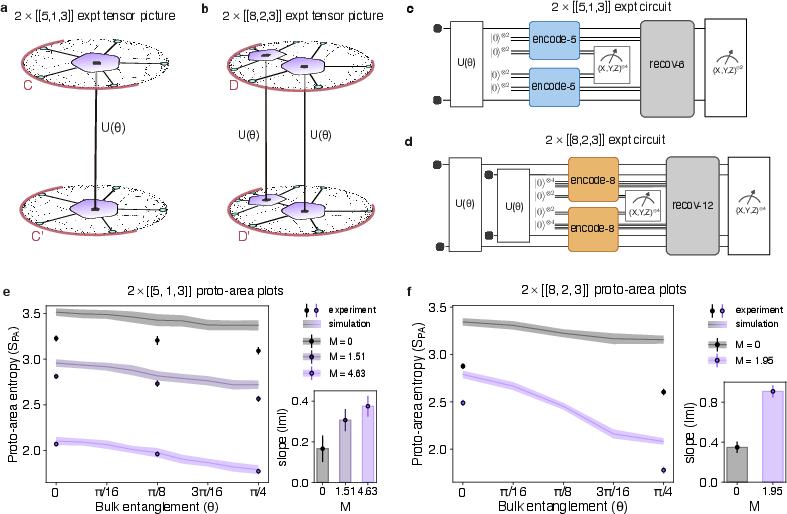
Finally, they built a “two-sided” setup by running two copies of the code and entangling their inside qubits with each other. This tests whether entanglement can act like a bridge—an idea related to the ER=EPR proposal, where entanglement and wormholes are two sides of the same coin (in a very rough, toy‑model sense).
The main findings and why they matter
- FLM test succeeds in the simple (no-magic) code
- What they saw: When they increased bulk entanglement (by turning up θ), both the boundary entropy and the bulk entropy rose together, while the proto‑area S_PA stayed constant.
- Why it matters: This matches the Faulkner–Lewkowycz–Maldacena (FLM) formula, which says boundary entropy equals an “area term” plus bulk entropy. In the code, the area term is fixed by a minimal cut, so S_PA should be constant. This is the first experimental confirmation of the FLM formula within such a holographic code.
- Adding “magic” makes the “geometry” respond to matter
- What they saw: After injecting magic (small, controlled gate angle tweaks), S_PA started to depend on θ. As bulk entanglement increased, S_PA increased too, and the sensitivity grew with the amount of magic.
- Why it matters: In real gravity, adding matter changes geometry (through backreaction). Here, making the code more “quantum” with magic makes the area‑like quantity respond to the state—exactly the kind of behavior we expect if geometry emerges from quantum information.
- Two codes entangled together show wormhole‑like behavior (in a toy sense)
- What they saw: With two codes entangled in the bulk and with magic added, increasing the entanglement between the codes made S_PA for a combined boundary region decrease. The stronger the magic, the bigger the effect.
- Why it matters: In holography, stronger entanglement between two sides can correspond to a “shorter” or “more open” wormhole. While this is just a toy model and not a literal wormhole, the trend—more entanglement leading to a smaller area‑like measure—fits that intuition.
Across all these tests, the results broadly agree with numerical simulations that include realistic noise. The team also carefully checked that their recovery method didn’t create fake signals; the state‑dependence remains even with more optimal (though more complex) recovery in simulations.
Why this is exciting
- It shows quantum computers can act as miniature laboratories for ideas in quantum gravity—ideas that are otherwise very hard to test.
- The team didn’t just check a known rule (the FLM relation); they also explored new territory by adding magic and by linking two codes. This let them watch “geometry-like” behavior change with entanglement in controlled ways.
- These techniques can grow: with better tomography and recovery methods, and larger, cleaner devices, we might learn more about how spacetime could emerge from entanglement in bigger, more realistic models.
A quick analogy to tie it all together
- Think of the code as a woven net. Cutting the fewest strands to separate a chunk of the edge from the rest gives you an “area.”
- Entanglement tells you how tightly different parts are tied together.
- In the simple net, that minimal cut size stays the same even if you tangle the inside pieces more—matching FLM.
- Add magic, and the net becomes flexible: tangle the inside more, and the minimal cut grows—like matter curving spacetime.
- Connect two nets by tying their centers together: tighten that tie, and the shortest path between their edges can shrink—like a wormhole getting “shorter.”
In short, this paper demonstrates that carefully designed quantum circuits can mimic key features of gravity and spacetime, opening a path to test deep ideas about our universe using today’s quantum hardware.
Knowledge Gaps
Unresolved gaps, limitations, and open questions
Below is a single, consolidated list of what remains missing, uncertain, or unexplored in the paper, phrased to guide concrete next steps.
- Quantitative impact of constrained vs. optimal recovery: The experiments use a fixed-ansatz recovery (matching the Clifford architecture) instead of the mathematically optimal recovery map; while numerics suggest the signal persists, the magnitude is altered. A systematic study quantifying how suboptimal recovery biases (across different ansätze and circuit depths) is missing.
- Recovery algorithm scalability: Fully optimal recovery becomes intractable even for the 16-qubit reduced codes. There is no demonstrated algorithm that scales to larger holographic codes while maintaining near-optimality and hardware feasibility.
- Robustness of magic-induced signals to recovery choice: The experiments verify persistence under one unconstrained simulation (small [[5,1,3]] case). It remains open whether the observed state dependence survives across broader classes of recovery maps and on-device implementations with deeper circuits or alternative ansätze.
- Validity of proto-area as a geometric proxy outside stabilizer codes: In stabilizer HaPPY, coincides with minimal cut and is geometric. In magic-enriched circuits (no exact code structure), the extent to which tracks a well-defined emergent “area” is not established theoretically.
- Lack of a principled mapping to gravitational quantities: The experiments do not calibrate to geometric units (e.g., a mapping to or an effective Newton’s constant), leaving the connection between measured entropies and geometric scales qualitative.
- Absence of QES extremization tests: True gravitational backreaction should appear via extremization of the generalized entropy over candidate surfaces. No experimental protocol is provided that varies candidate cuts/surfaces and observes extremal transitions (e.g., by sweeping region sizes/shapes to induce RT/QES phase transitions).
- Limited region and topology exploration: Only specific connected subregions are probed. Behavior for disconnected regions, varying sizes/shapes, and complementary region choices (beyond the workaround used in two-sided experiments) remains unexplored.
- No tests of entropy cone constraints: Holographic entropy cone inequalities (e.g., monogamy of mutual information) are not tested, and would provide additional geometric consistency checks beyond single-region entropies.
- Unclear role of non-local vs. local magic: While the paper correlates slope changes with “non-local magic” (Appendix), there is no direct experimental quantification isolating non-local magic from total magic, nor a causal test (e.g., varying only non-local magic while holding local magic fixed) on hardware.
- Magic injection procedure generality: Magic is introduced via pre-determined over-/under-rotations, sometimes gate-by-gate optimized to amplify signal. It remains unclear how generic the observed effects are with different injection patterns, randomized injections, or constrained error budgets.
- Magic measurement on-device: The stabilizer Rényi-entropy-based magic metric is not directly measured experimentally for the prepared states or channels (Choi states). A hardware-compatible protocol to directly validate and track magic would improve interpretability.
- Noise model mismatch and coherent errors: Simulations with stochastic angle noise do not fully reproduce the data, suggesting additional coherent or correlated errors. A more complete, validated error model and mitigation (e.g., randomized compiling, zero-noise extrapolation) is needed to separate physical effects from hardware artifacts.
- Purity assumption in two-sided experiments: Boundary entropies are inferred using the assumption that the global state is pure (in the zero-noise limit). Quantifying the systematic bias introduced by this assumption in realistic noisy settings is not performed.
- Error mitigation and calibration limits: No targeted error mitigation is deployed. How much error mitigation (and what kind) is needed to reliably resolve subtle differences in at larger qubit counts remains open.
- No direct benchmarking of logical reconstruction fidelity: The study focuses on entropies; it does not report logical-channel reconstruction fidelity, bulk-operator reconstruction accuracy, or error-correction performance metrics that would corroborate entanglement wedge reconstruction quality.
- Static, not dynamical, tests: The experiments are static encodings. There are no dynamical protocols that probe linearized gravitational response (e.g., relative entropy/first law tests, modular-flow-based probes, or evolution under scrambling dynamics) which are standard diagnostics of gravitational backreaction.
- Absence of correlator-based geometry reconstruction: The geometry is not reconstructed from correlation functions (e.g., modular Hamiltonian tomography or extremal-area variation studies), leaving the link between and an emergent metric unverified.
- Limited system size relative to semiclassical limit: The networks are small, with no clear path to the large-system, large-bond-dimension regime where semiclassical gravity should emerge. Conditions and thresholds for observing sharp RT/QES transitions or area scaling are not identified.
- Two-sided “wormhole” dual is unspecified: The bulk-entangled, two-code construction lacks a known gravitational dual, so the sign and magnitude of changes cannot be quantitatively compared to first-principles predictions. Developing or constraining candidate duals is an open theoretical task.
- Boundary- vs. bulk-entanglement choices: The study entangles bulk logical degrees of freedom across codes, not boundary degrees (e.g., thermofield-double). How the observed behavior compares to boundary-entanglement-induced connectivity (with better-understood duals) remains to be tested.
- No check of entanglement wedge cross section or reflected entropy: Additional diagnostics (e.g., entanglement wedge cross section, reflected entropy) that are more directly tied to multipartite connectivity are not measured and could clarify the wormhole analogy.
- Hardware-platform dependence: Results are obtained on a trapped-ion processor with all-to-all connectivity. Whether the protocols and signals are robust on platforms with local connectivity and different error profiles (e.g., superconducting qubits) is unknown.
- Tomography scalability: Full QST dominates measurement cost and will not scale. Although alternatives are mentioned (e.g., near-stabilizer or tensor-network-informed tomography), no experimentally validated, resource-efficient protocol is demonstrated here.
- Limited exploration of multi-interval entropies and mutual information: Beyond single-region entropies, a systematic map of mutual informations and conditional mutual informations (as functions of and ) is missing, which could reveal more nuanced geometry changes.
- Calibration of “area” offsets in reduced codes: Code reductions change the minimal cut (e.g., from 3 to 2) while preserving qualitative behavior, but a systematic framework that preserves quantitative “area” scales across reductions is not provided.
- Sensitivity to specific encoding layouts: Only one tessellation/circuit design is studied. Dependence of signals on the tiling choice, tensor choices, and compilation strategies remains uncharacterized.
- Generalization beyond HaPPY-like constructions: The observed phenomena are studied in HaPPY-based networks. Whether similar gravity-like signatures appear in other holographic code families (e.g., non-perfect-tensor or random tensor networks) with magic resources is not addressed.
- Path to quantitative ER=EPR tests: The work provides qualitative wormhole-like signatures but does not specify measurable, quantitative ER=EPR benchmarks (e.g., length vs. entanglement curves, teleportation fidelity vs. ) that future experiments could target.
- Lack of energy/stress-tensor proxies: Theoretical expectations link bulk entropy variations to stress-energy and geometric backreaction. There is no operational “energy” observable (or surrogate) measured on hardware to correlate with changes.
- Finite-shot and MLE bias analysis: MLE-based entropy estimation can be biased, especially near extremal states. A thorough bias analysis (e.g., via alternative estimators or cross-validation with classical shadows) is not presented.
- Universality tests: It is unclear whether the state-dependent response is universal across a broad class of states/code parameters or depends sensitively on chosen circuits, offsets, and entangling unitaries.
- Mapping magic to geometric response: While increased magic correlates with stronger dependence, a quantitative relation (functional form, saturation behavior, thresholds) between total/non-local magic and the “area” response is not derived or tested.
Practical Applications
Immediate Applications
The following items can be deployed now with current quantum hardware, software, and experimental practices.
- Quantum hardware benchmarking via holographic entropic probes — sector: quantum computing hardware/software. Use the FLM/RT protocol and proto-area entropy S_PA as device-level benchmarks to assess all-to-all connectivity, gate-angle stability, and two-qubit gate quality. Potential tool/workflow: “FLM benchmarking suite” that prepares bulk entangled inputs, encodes with HaPPY circuits, performs local recovery and QST, and compares S_B − S_b to ideal predictions. Assumptions/dependencies: access to medium-scale devices with native or compiled all-to-all connectivity; enough shots for MLE tomography; stable calibration of Rx/Ry/Rz/RXX gates.
- Gate calibration and error characterization via entropic signatures — sector: quantum computing hardware. Fit stochastic angle fluctuation models (σ1q, σ2q) and coherent offsets (over-/under-rotations λi) to deviations in S_PA and entropy curves to infer dominant error channels and calibrate gate angles. Potential tool: “angle-jitter metrology” that maps entropic observables to σ1q/σ2q; integrates with routine device calibration. Assumptions/dependencies: reliable QST (MLE + bootstrapping); controlled injection of λi for sensitivity analysis; shot budgets.
- Resource reduction by code-isometry–based circuit compilation — sector: quantum software/tooling. Use the isometric structure of HaPPY tensor networks to reduce full codes (e.g., 25 qubits) to entropically equivalent smaller circuits tailored to the region of interest (e.g., 8 qubits) without losing the observables being tested. Potential product: “entropic-equivalent compiler” that targets boundary subregions and emits reduced circuits for hardware execution. Assumptions/dependencies: correct identification of isometries and minimal-cut preservation; validation that reduced S_PA tracks full-code predictions.
- Recovery-circuit optimization for near-term QECCs — sector: quantum software/algorithms; academia. Adopt constrained recovery ansätze (Clifford-like architectures) and optimize parameters to minimize trace distance to logical inputs, balancing circuit depth and noise. Potential workflow: variational recovery optimization per boundary region; library of recoveries for common holographic subregions. Assumptions/dependencies: suboptimal recovery can amplify state dependence; requires careful validation against simulated optimal recovery.
- Near-stabilizer and tensor-network–informed tomography — sector: quantum software/algorithms; academia. Replace full QST with bounded-extent/near-stabilizer/tensor-network–aware tomography when applicable to reduce cost while retaining accurate entropies for holographic codes. Potential tool: “bounded-extent tomography” packages integrating MLE with stabilizer priors or tensor-network structure. Assumptions/dependencies: states sufficiently close to stabilizer/tensor-network manifolds; calibration of estimator biases.
- Cross-platform demonstrations of proto-area entropy — sector: quantum industry. Port the encoding, recovery, and entropy estimation to other platforms (superconducting qubits, neutral atoms) to compare entropic performance and connectivity constraints. Potential workflow: hardware-agnostic transpilation to native gates; standardized data collection for S_B and S_b. Assumptions/dependencies: compilation overhead for limited connectivity; gate fidelity thresholds; system size constraints.
- Educational lab modules on emergent geometry — sector: education. Create hands-on courses that reproduce FLM tests, magic injection, and two-sided entangling on cloud-accessible devices (e.g., IonQ Forte). Potential product: Jupyter notebooks and curriculum with step-by-step holographic encoding, recovery, and entropy analysis. Assumptions/dependencies: classroom access to devices or high-fidelity simulators; shot quotas; simplified circuits for time-limited sessions.
- Entanglement-driven connectivity experiments for quantum network simulation — sector: quantum communications/networks; academia. Use two-code entangling protocols to study how inter-system entanglement modulates effective connectivity (via S_PA) as an analogue to wormhole-inspired connectivity. Potential workflow: prepare U(θ)-entangled logical pairs across subsystems, encode locally, measure boundary entropies of unions. Assumptions/dependencies: interpretation is an analogue, not a literal wormhole; noise introduces θ-dependent systematics; recovery ansatz effects must be controlled.
- Data and software artifacts for reproducibility — sector: academia/industry. Release tomography datasets, reduced-code circuits, noise models, and recovery optimizers as open resources to accelerate comparative studies. Potential products: open repositories and Dockerized toolchains. Assumptions/dependencies: data-sharing policies; versioning and metadata standards; sustained maintenance.
Long-Term Applications
The following items require further research, scaling, or development (e.g., larger qubit counts, improved fidelities, efficient tomography, theory advances).
- Scalable quantum gravity simulators on programmable hardware — sector: academia; quantum hardware/software. Build larger holography-inspired experiments using efficient tomography or correlation-function–based metric reconstruction to probe quantum extremal surfaces and emergent geometry beyond classical limits. Potential tools/workflows: shadow tomography tailored to holographic states; metric-learning from extremal-area variations; device orchestration for hundreds of qubits. Assumptions/dependencies: higher-fidelity multi-qubit gates; efficient recovery synthesis; algorithmic advances in geometry reconstruction; robust theory-experiment matching.
- Geometry-aware quantum codes and decoders — sector: quantum software/algorithms; academia. Design QECCs whose “area term” (proto-area) adapts to bulk state changes via controlled non-Clifford resources (nonlocal magic), enabling codes that “backreact” to logical entanglement. Potential products: magic-enriched encoders, nonlocal-magic quantifiers, adaptive decoders informed by entanglement wedge structure. Assumptions/dependencies: precise control of non-Clifford gates; scalable nonlocal magic measurement; decoder theory and synthesis tooling.
- Standardized entropic benchmarks for quantum devices — sector: industry standards/policy. Establish proto-area, entanglement-wedge reconstruction, and FLM/RT conformity tests as part of characterization suites (alongside randomized benchmarking and cycle benchmarking). Potential products: conformance test specifications and open-source implementations; third-party certification. Assumptions/dependencies: community consensus on definitions; cross-platform validation; policy support for reproducibility and disclosure.
- Wormhole-inspired teleportation and routing protocols — sector: quantum communications/networks; defense/enterprise. Explore entanglement-assisted schemes that modulate effective connectivity (inspired by ER=EPR), potentially improving routing or resource allocation in quantum networks. Potential workflows: tunable inter-node entanglement to alter “geodesic” paths; bidirectional teleportation using scrambling dynamics. Assumptions/dependencies: rigorous security and performance analyses; resilience to noise; scalable generation of high-quality entanglement; theoretical validation beyond toy models.
- Automated recovery synthesis and learning-based decoders — sector: quantum software/ML. Develop ML/variational tools to discover near-optimal recoveries for large holographic circuits with minimal depth and error sensitivity. Potential products: recovery compilers guided by tensor-network structure and entropic objectives; policy-gradient optimizers trained on hardware data. Assumptions/dependencies: labeled datasets; generalization across codes and hardware; compute budgets.
- Tomography at scale for holographic codes — sector: quantum algorithms/software; academia. Advance bounded-extent, tensor-network–informed, and shadow tomography tailored to the structure of HaPPY-like networks, enabling entropy estimation without exponential cost. Potential products: hybrid tomography frameworks combining stabilizer priors and shadows; auto-selectors for measurement bases. Assumptions/dependencies: theoretical guarantees on error bounds; integration with hardware measurement pipelines; adoption by labs.
- Hardware co-design for holography-oriented workloads — sector: quantum hardware. Optimize trapped-ion and other architectures (connectivity, gate sets, angle stability) for tensor-network encoders, local recoveries, and entropic probes. Potential products: gate-calibration protocols minimizing angle jitter; native operations aligned to holographic compilers. Assumptions/dependencies: engineering constraints; cost–performance trade-offs; collaboration between hardware vendors and research groups.
- Quantum metrology of non-Clifford resources (“magic meters”) — sector: industry/academia. Standardize the stabilizer Rényi–based quantification of nonlocal magic and tie it to device capability and compiler outcomes, enabling certification of resource generation crucial for advanced algorithms. Potential products: magic certification APIs; dashboards for resource profiles. Assumptions/dependencies: theory–experiment alignment for magic measures; measurement overhead; standards bodies’ involvement.
- Geometry-informed error mitigation — sector: quantum software. Use proto-area and entanglement wedge insights to correct systematic biases in entropy and correlation estimates, improving reliability of observables in noisy circuits. Potential workflows: entropic proxies to calibrate variance-reduction schemes; wedge-aware postprocessing. Assumptions/dependencies: robustness under realistic noise; validation across platforms; integration with existing error-mitigation stacks.
- Cloud “holographic lab” services and training — sector: quantum cloud/software; education/policy. Offer turnkey experiment bundles (encoding, recovery, tomography, analysis) so students and researchers can run emergent-geometry tests at scale. Potential products: managed services with quotas, curated datasets, and guided exercises; professional training programs. Assumptions/dependencies: sustained funding and access; curriculum development; platform neutrality.
- Policy initiatives for quantum gravity testbeds — sector: policy/academia. Encourage cross-agency funding, standardized reporting of entropic observables, and open datasets to accelerate progress on emergent spacetime studies. Potential actions: program calls for holography-on-hardware; reproducibility guidelines. Assumptions/dependencies: long-term investment; community governance; clear communication about analogies vs. literal gravity.
Glossary
- AdS (Anti-de Sitter) spacetime: A spacetime with constant negative curvature often used in holography. Example: "a theory of quantum gravity in asymptotically AdS spacetime"
- AdS/CFT correspondence: A duality relating gravity in AdS spacetime to a conformal field theory on its boundary. Example: "The Anti-de Sitter/Conformal Field Theory (AdS/CFT) correspondence provides a valuable theoretical framework for this effort"
- area term: The leading geometric contribution to boundary entropy proportional to a minimal surface area in the bulk. Example: "we refer to the leading order entropy term as the area term"
- bootstrapping: A resampling method to estimate statistical uncertainties. Example: "2100 shots are taken per Pauli basis; error bars are from bootstrapping."
- bulk (degrees of freedom): The gravitational side of the duality; degrees of freedom living in the higher-dimensional interior. Example: "the entropy of the bulk degrees of freedom in the EW of "
- Choi state: The state corresponding to a quantum channel via the Choi–Jamiołkowski isomorphism, used here to quantify magic of an encoding. Example: "the code's Choi state (Appendix~\ref{app:NLmagic})"
- Clifford gate: A gate from the Clifford group that maps Pauli operators to Pauli operators under conjugation. Example: "The former is constructed from Clifford encoding gates"
- conformal field theory (CFT): A quantum field theory invariant under conformal transformations, often appearing on the boundary in AdS/CFT. Example: "a conformal quantum field theory on the lower-dimensional boundary"
- entanglement entropy: A measure of quantum entanglement given by the von Neumann entropy of a subsystem. Example: "relate the entanglement entropy of a boundary region to geometric quantities in the bulk gravitational description"
- entanglement wedge (EW): The bulk region associated with a boundary subregion, bounded by that subregion and its extremal surface. Example: "The entanglement wedge (EW) of boundary subregion is the region enclosed by a so-called minimal (or extremal) surface in the bulk and "
- ER=EPR proposal: The conjecture that entangled pairs (EPR) are connected by nontraversable wormholes (ER). Example: "Einstein--Rosen\,=\,Einstein--Podolsky--Rosen (ER=EPR) proposal"
- Faulkner--Lewkowycz--Maldacena (FLM) relation: The quantum-corrected holographic entropy formula adding a bulk-entropy term to the area term. Example: "The FLM relation relates the area of to the entropy and the entropy of the bulk degrees of freedom in the EW of "
- generalized entropy: The sum of a geometric area term and bulk entanglement entropy, extremized in gravitational settings. Example: "in which the surface is chosen by extremizing the generalized entropy"
- geodesic: The shortest path between points in a given geometry; in AdS/CFT, geodesics often compute boundary observables. Example: "boundary-anchored geodesics, shown in blue, pass through the neck connecting the two sides."
- gravitational backreaction: The effect by which matter and energy alter spacetime geometry via gravitational dynamics. Example: "gravitational backreactions shifting the underlying geometry"
- HaPPY code: A holographic tensor-network quantum error-correcting code named after Harlow, Pastawski, Preskill, and Yoshida. Example: "a toy model of this duality called the HaPPY code"
- holographic duality: A correspondence equating a gravitational bulk theory to a nongravitational boundary theory. Example: "via a holographic duality between a theory of quantum gravity in asymptotically AdS spacetime and a conformal quantum field theory on the lower-dimensional boundary"
- homologous (surface): In this context, a bulk surface sharing the same boundary as a boundary subregion, used in defining extremal surfaces. Example: " is an example boundary subregion and is the minimal-area surface homologous to it."
- isometry: A distance-preserving map; in tensor networks, an encoding that preserves inner products. Example: "Exploiting the isometric structure of the tensor network"
- magic (non-stabilizerness): Non-Clifford resource content of a state or circuit enabling universal quantum computation and beyond-stabilizer effects. Example: "We then enrich it with non-stabilizerness, or magic"
- maximum likelihood estimation (MLE): A statistical method for reconstructing states or parameters by maximizing the likelihood of observed data. Example: "Maximum Likelihood Estimation (MLE) is used to reconstruct both the boundary and bulk entropies."
- minimal cut: The smallest set of tensor-network edges whose removal separates regions; in holography, relates to boundary entropy. Example: "The minimal cut in the HaPPY tensor network, equal to , then plays the role of the area term"
- minimal (or extremal) surface: A surface of least area (or extremal area) anchored to a boundary region, central to holographic entropy formulas. Example: "a so-called minimal (or extremal) surface "
- non-Clifford gate: A gate outside the Clifford group, necessary for universal quantum computation and introducing magic. Example: "introducing non-Clifford (``magic\") resources into the encoding circuit"
- Pauli basis: The measurement bases defined by Pauli operators X, Y, Z. Example: "to measure the 3 boundary qubits in each of Pauli bases"
- perfect tensor: A highly entangled tensor whose any bipartition up to half the legs defines an isometry, used to build HaPPY codes. Example: "A hyperbolic time slice of AdS is tessellated by perfect tensors"
- proto-area entropy: An operational, circuit-defined analog of the geometric area term, computed as boundary entropy minus recoverable bulk entropy. Example: "We characterize the emergent geometry through the proto-area entropy"
- quantum error-correcting code (QECC): A code protecting quantum information against errors; in holography, models bulk-to-boundary encoding. Example: "Quantum error-correcting codes (QECCs) provide a simple setting in which these ideas can be explored"
- quantum extremal surface (QES) prescription: The rule selecting surfaces that extremize generalized entropy in quantum gravity. Example: "A similar dependence follows from the quantum extremal surface (QES) prescription"
- quantum state tomography (QST): Procedures to reconstruct a quantum state from measurement data. Example: "using quantum state tomography (QST)"
- Ryu--Takayanagi (RT) formula: The leading-order holographic formula equating boundary entanglement entropy to an area of a minimal surface in AdS. Example: "An NMR test of the RT formula (without the quantum correction of FLM) on 6-qubit perfect tensors was also demonstrated"
- stabilizer code: A QECC defined by a commuting set of Pauli operators; lacks non-Clifford magic unless modified. Example: "the original stabilizer HaPPY code"
- tensor network: A graph of tensors contracted along edges representing many-body quantum states or maps. Example: "a tensor-network construction whose entanglement structure reproduces the RT formula"
- thermofield-double state: A purified thermal state entangling two copies of a system, dual to an eternal black hole/wormhole in AdS/CFT. Example: "a conventional thermofield-double state"
- trace distance: A metric on quantum states quantifying their distinguishability. Example: "minimizes the trace distance between the recovered state and the input logical state"
- trapped-ion quantum computer: A quantum processor using ions confined by electromagnetic fields with high-fidelity gates and all-to-all connectivity. Example: "on a trapped-ion quantum computer"
- wormhole: A spacetime bridge connecting distant regions; in holography, related to entanglement via ER=EPR. Example: "a highly quantum wormhole"
Collections
Sign up for free to add this paper to one or more collections.