Ring-Zero: Scaling Zero RL to a Trillion Parameters for Emergent Reasoning
Abstract: Reinforcement learning with verifiable rewards without human-annotated data, often referred to as zero RL, has emerged as a powerful paradigm for eliciting chain-of-thought reasoning. However, due to computational constraints, existing studies are largely restricted to small models, leaving the training dynamics and emergent capabilities at a large scale unexplored. To meaningfully explore this frontier, we aim to elicit high-quality reasoning behaviors from the model. However, we find that naive scaling often suffers from poor readability, token redundancy, and a lack of adaptive reasoning depth. To address these challenges, we present a stable and efficient training pipeline, incorporating algorithmic and system optimizations such as clipped importance sampling, training-inference ratio correction, and mixed-precision control. Our experiments offer three key findings that validate the "bitter lesson" of scaling: (1) scaling to 1T parameters significantly enhances sample efficiency and performance ceilings; (2) the training process progresses sequentially through an initial discovery phase followed by a sharpening phase; and (3) the model spontaneously develops advanced cognitive behaviors, including anthropomorphism, structured formatting, self-verification, parallel reasoning, and context anxiety, rendering hand-crafted heuristics redundant. Evaluated on seven mathematical benchmarks, Ring-2.5-1T-Zero achieves competitive performance. Additionally, to assess CoT quality beyond final-answer correctness, we propose a structured evaluation framework across three dimensions: comprehensibility, reproducibility, and efficiency, where our model demonstrates clear advantages in producing structured and concise reasoning traces. By sharing our observed emergent phenomena, we hope to provide the community with deeper insights into scaling behaviors, particularly at the 1-trillion scale.
First 10 authors:
Paper Prompts
Sign up for free to create and run prompts on this paper using GPT-5.
Top Community Prompts
Explain it Like I'm 14
What this paper is about
This paper is about teaching a very large AI model—about one trillion parameters—to “think out loud” better, especially on hard math problems. The team uses a kind of training called “reinforcement learning with verifiable rewards” (think: trial-and-error where a checker confirms if the final answer is right). They do this without any human-written step‑by‑step solutions, a setup they call “zero RL.” They also propose new, simple ways to judge whether an AI’s explanations are clear, learnable, and efficient, not just whether the final answer is correct.
What questions the researchers asked
They focused on three main questions:
- Can “zero RL” scale up to a trillion‑parameter model and improve reasoning much more than smaller models?
- How does the training process behave at that scale—does the model first discover new ways to reason and then refine them?
- Can the model learn to write explanations that people can read easily, that smaller models can learn from, and that don’t waste tokens?
How they did it, in everyday language
You can think of their approach like training a student to solve problems by:
- Letting the student try many solutions.
- Rewarding the student only when a simple checker can verify the final answer is correct and the explanation follows a neat format.
- Gradually helping the student write fewer, clearer steps.
The training pipeline in simple steps
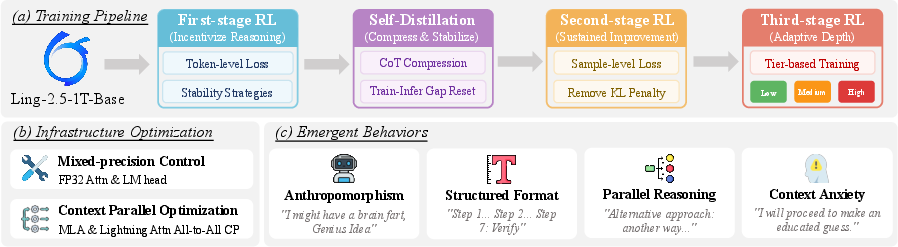
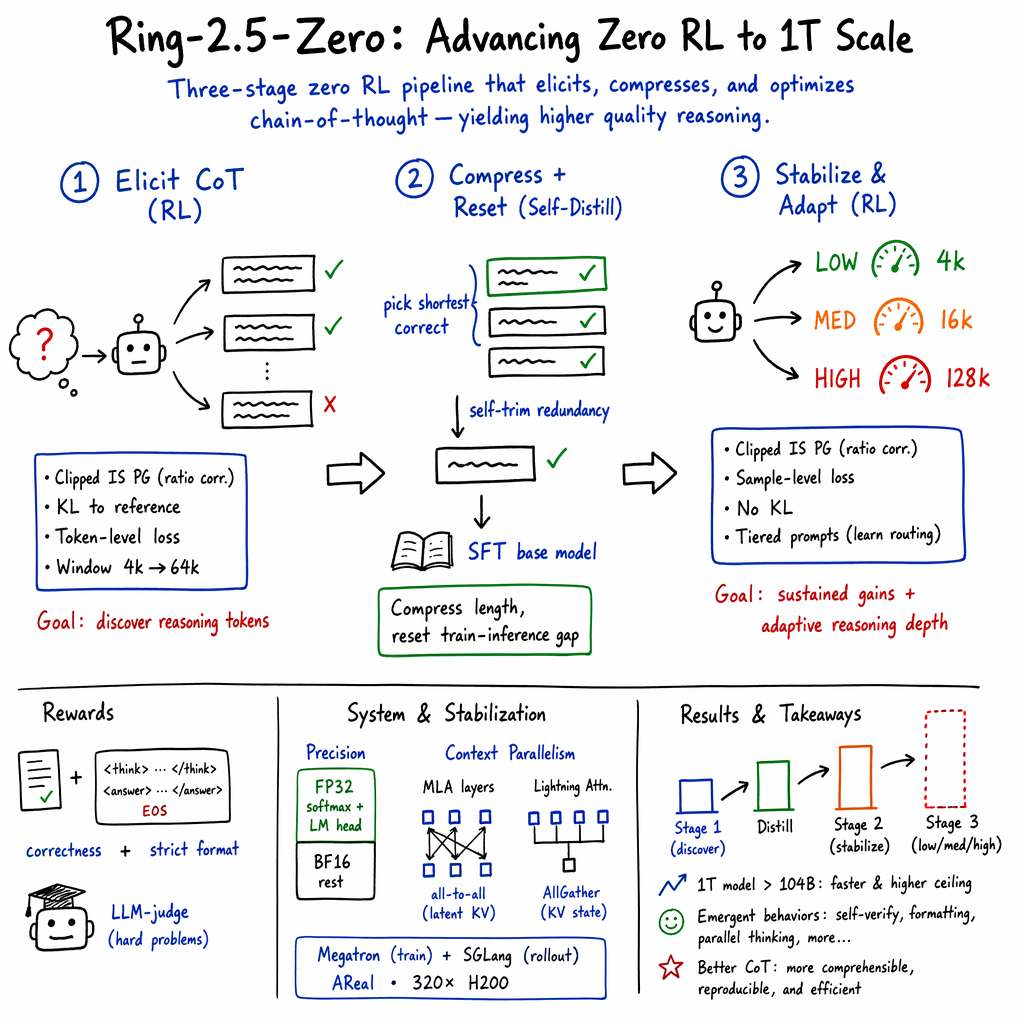
The team used a three‑stage reinforcement learning pipeline with a “self‑distillation” step in the middle:
- First Stage (kickstarting reasoning)
- Goal: Make the model actually produce step‑by‑step reasoning instead of short guesses.
- How: Strongly reward any tokens that lead toward correct, structured answers. They cap how big any single training update can be (so one lucky try doesn’t wildly swing the model).
- Analogy: Encourage the student to show their work by giving credit for detailed solutions—but don’t let one lucky success rewrite their whole study style.
- Self‑Distillation (compressing and stabilizing)
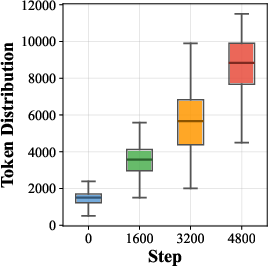
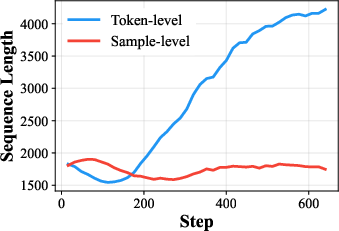
- Problem: The model starts writing very long, sometimes repetitive explanations.
- Solution: The model picks its shortest correct solution and then trims its own redundancies. These cleaner solutions become the “teacher notes,” and the original base model is fine‑tuned on them.
- Analogy: The student takes messy class notes, then rewrites them into a concise, polished version, and studies from that.
- Second Stage (sustained improvement without bloat)
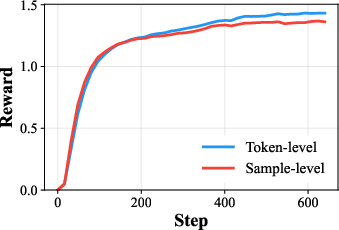
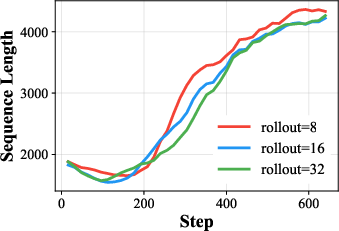
- Change: Switch from rewarding every token equally to normalizing by the total length, so the model doesn’t keep inflating explanations forever.
- Analogy: Keep rewarding good reasoning, but stop giving extra points just for writing more words.
- Third Stage (adaptive depth)
- Add three modes—low, medium, and high reasoning length—so simple questions get short answers and hard ones get longer step-by-step thinking.
- Analogy: The student learns to spend less time on easy problems and more time on tough ones.
Keeping the computers stable and fast
Training giant models can be fussy. The team added two practical fixes:
- Mixed precision: Use extra‑precise math only in the tiny parts of the network that are most sensitive (like the final scoring), and faster math elsewhere. Think of using a fine‑tip pen just for delicate lines and a regular pen for the rest.
- Context parallelism: Split very long texts across many computers in a way that reduces waiting time, so training runs faster.
How they judged “good thinking”
Beyond just checking if the final answer is correct, they measured the quality of explanations with three lenses:
- Comprehensibility: Are the steps clear and logically ordered for a human reader?
- Reproducibility: If you teach a smaller model using these explanations, does it learn well with fewer examples?
- Efficiency: How many tokens does it take to reach a correct solution? Fewer tokens means faster and cheaper inference.
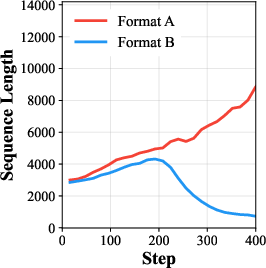
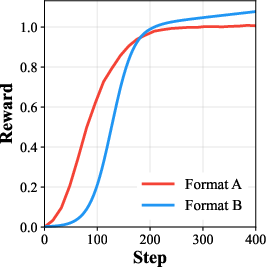
They used a mix of automatic checks, a “format reward” requiring > and <answer> tags, and, for harder questions, an AI judge to verify correctness when simple matching wasn’t enough.
What they found and why it matters
Here are the main takeaways:
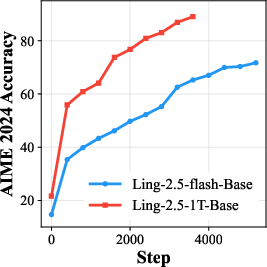
- Bigger really helps: The 1‑trillion‑parameter model learned much faster and reached higher performance than a 104‑billion‑parameter model under the same “zero RL” setup. This supports the “bitter lesson” in AI: at some point, scale and compute beat hand‑crafted tricks.
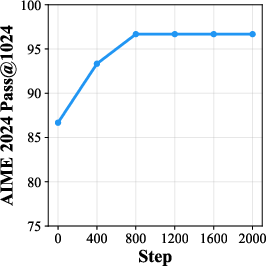
- Two training phases appear naturally: The model first enters a “discovery” phase, finding new ways to reason, then a “sharpening” phase, polishing and stabilizing those strategies.
- Emergent behaviors show up on their own: Without being told to, the model starts:
- Using human‑like planning cues (e.g., “Step 1… Step 2…”).
- Formatting solutions into clean sections.
- Checking its own work (self‑verification).
- Trying several approaches in parallel before choosing one.
- Managing its space (“context anxiety”), being mindful not to run out of tokens.
- Competitive math performance: On seven tough math benchmarks (like AIME and HMMT), their model reached strong, competitive scores.
- Better explanations, not just answers: According to their three‑part evaluation:
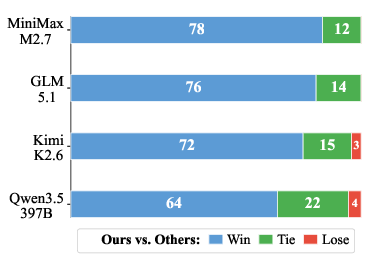
- Comprehensibility: Their model’s solutions were judged clearer than strong baselines.
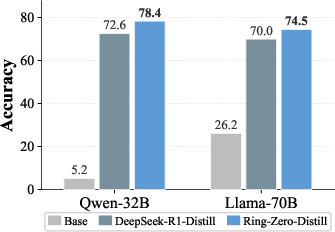
- Reproducibility: When teaching smaller models using only 100K examples from their explanations, the students improved more than when taught from a much larger 800K‑example set from another system—meaning their explanations were more learnable.
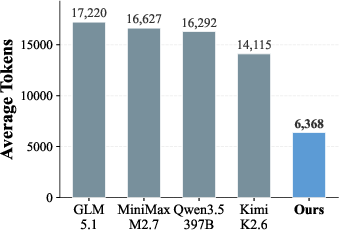
- Efficiency: On problems everyone solved correctly, their model used far fewer tokens on average, saving time and cost.
- Flexible compute at inference: The low/medium/high modes let users trade speed for depth as needed. Medium often delivers strong accuracy with much less compute.
Why this research matters
- It shows you can train better reasoning without human‑written step‑by‑step data, even at enormous scale.
- It offers a simple, stable training recipe that avoids overcomplicated tricks and still works on trillion‑parameter models.
- It moves beyond “Did it get the answer?” to “Did it explain clearly, teachably, and efficiently?”—which is crucial for trust, education, and building AI agents that work through multi‑step tasks.
- The adaptive lengths make the system practical: simple questions don’t waste compute; hard ones get the attention they need.
- Big picture: If large models can discover good reasoning habits on their own, we may rely less on costly, hand‑curated datasets and more on scalable training, leading to faster progress in AI that reasons clearly and concisely.
Knowledge Gaps
Knowledge gaps, limitations, and open questions
The paper advances zero-RL at scale but leaves several unresolved issues and open avenues for future work:
- External validity beyond mathematics: It remains unknown whether the proposed pipeline (algorithms, rewards, tiering) transfers to non-mathematical domains (e.g., code, scientific QA, commonsense reasoning, planning) or multimodal settings.
- Data transparency and potential contamination: The training datasets, sources, and deduplication procedures are not fully specified, especially for later-stage “significantly harder” problems; the risk of overlap with test benchmarks (AIME/HMMT/IMOAnswerBench) is not quantified.
- Reward reliability for hard problems: Replacing rule-based verification with LLM-as-a-Judge introduces bias and susceptibility to reward hacking; there is no robustness analysis (e.g., adversarial prompts, prompt-injection, judge drift) or calibration study of the judge’s error rates.
- Theoretical properties of ratio correction: Using training-engine logits in the numerator of the importance ratio is a biased correction; there is no theoretical analysis of bias/variance or convergence guarantees for the clipped-IS estimator under engine mismatch.
- Sensitivity to clipping and no lower bound: The choice to omit a lower bound and set only an upper bound for the importance ratio (ε_high=5) lacks ablation at 1T scale; stability/efficiency trade-offs and sensitivity to ε_high are unquantified.
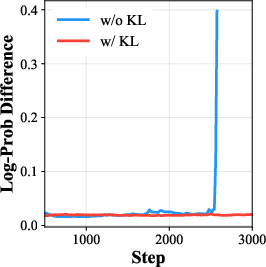
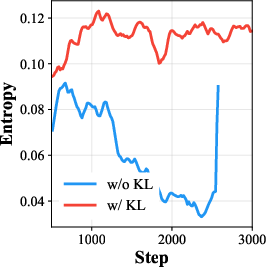
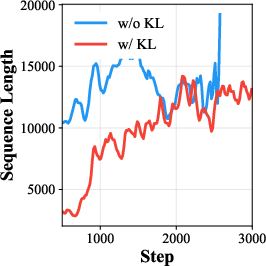
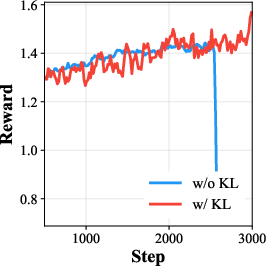
- KL regularization schedule: The impact of removing the KL penalty in Stage 2 is not theoretically or empirically characterized at 1T (only small-model ablations shown); conditions under which KL constraints help/hurt remain unclear.
- Self-distillation bias toward brevity: Selecting the shortest correct trace and trimming “redundant” steps may overfit to minimal explanations and harm robustness on problems requiring extended derivations; the accuracy–brevity–robustness trade-off is not quantified.
- Error propagation in self-distillation: The model self-evaluates and prunes its own traces; there is no analysis of how self-assessment errors accumulate or how pruning affects diversity and coverage of reasoning strategies.
- Emergent behaviors are anecdotal: Claims of anthropomorphism, structured formatting, self-verification, parallel reasoning, and “context anxiety” are not operationalized with measurable frequencies, causal tests, or links to performance gains.
- “Discovery vs. sharpening” phases: The two-phase dynamics are asserted but not rigorously measured (e.g., via representational changes, exploration metrics, or capability curves) nor tested for reproducibility across seeds or datasets.
- Tier-based training negative transfer: The observed performance drop in High mode indicates interference among length tiers; alternative approaches (e.g., gated experts, MoE routing by difficulty, decoupled optimizers, multi-objective RL) are not explored.
- Adaptive routing at inference: Tier control is manual via system prompts; there is no learned routing policy, no uncertainty-aware compute allocation, and no analysis of automatic budget selection under latency/accuracy constraints.
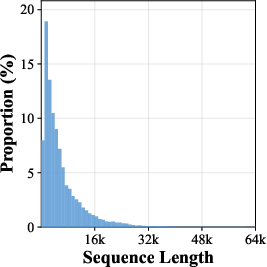
- Long-context generalization: Although 64k–128k contexts are used, there is no evaluation of long-context fidelity on standardized suites, memory/latency scaling curves, or degradation analysis across context lengths and content types.
- Yarn configuration clarifications: “Yarn=2” boosts results but is not explained in detail; its interaction with training stability, positional encoding, and long-context behavior is not ablated.
- Compute and efficiency reporting: End-to-end training tokens, wall-clock time, energy/compute cost, and sample efficiency scaling with parameter count are not reported, limiting reproducibility and cost-performance comparisons.
- Robustness across random seeds: Results are averaged across 64 inference runs, but training variance (across seeds/checkpoints) is not reported; stability and reproducibility of training outcomes at 1T remain unknown.
- Comparisons on a controlled base: There is no head-to-head comparison against alternative zero-RL algorithms or SFT baselines using the same 1T base model to isolate the benefits of each component.
- Safety and alignment considerations: No evaluation of undesirable behaviors (e.g., hallucinated math proofs, overconfident wrong solutions), safety under distribution shifts, or mitigation for emergent anthropomorphism/context anxiety.
- Judge dependence and bias: Comprehensibility is evaluated via LLM-as-a-Judge rather than human subjects; the reliability, inter-rater agreement, and cross-judge consistency (different models or prompts) are not established.
- Reproducibility metric design: Distillation-based “reproducibility” uses different data volumes than DeepSeek-R1 and limited domains; the generality of the measure across tasks, model sizes, and data regimes remains untested.
- Efficiency metric selection bias: Token-efficiency is computed on the subset of problems all models solve correctly; results may not generalize to the full distribution, and formatting overhead (> /<answer>) effects are not isolated.
Off-policy vs on-policy dynamics: The paper mentions off-policy RL early on but does not dissect how off-policy sampling affects stability, bias, or sample efficiency at scale, nor whether replay buffers or prioritization help.
- Engine mismatch quantification: While the method addresses training vs inference engine differences, the magnitude and sources of numerical drift (kernel differences, precision, softmax errors) are not empirically characterized over training.
- Small-model-only ablations: Most ablations are run on the 104B model; whether the same conclusions hold at 1T (e.g., algorithm rankings, stabilization effects) is not validated.
- Code, data, and model release: The paper does not clearly state public release of code, prompts, training data, or checkpoints, limiting independent verification and community benchmarking.
- Generalization to tool-use/agents: Although motivated by agentic workflows, the pipeline is not evaluated with external tools (e.g., calculators, solvers) or in end-to-end agent tasks where CoT acts as a planning substrate.
- Long-horizon credit assignment: Rewards target final answers plus formatting; there is no exploration of intermediate verifiable steps, reward shaping for subgoals, or temporal credit assignment methods that may better guide long CoTs.
- Failure mode analysis: There is limited qualitative/quantitative analysis of common error patterns (spurious derivations, brittle algebraic steps, off-by-one mistakes) and how the pipeline affects them.
- Ethical and societal impacts: Scaling to 1T with zero RL raises questions about compute accessibility, environmental cost, and democratization; these impacts are not discussed.
Practical Applications
Immediate Applications
Below are actionable, sector-linked uses that can be deployed now, leveraging the paper’s training methods, evaluation framework, and systems optimizations.
- Adaptive reasoning depth during inference (tier-based prompts)
- Sectors: software, education, productivity tools, customer support
- Use case: Offer “fast,” “balanced,” and “deep” modes that trade off latency/cost vs. solution quality for math, code, or troubleshooting. Expose explicit system prompts to control token budgets per query.
- Potential tools/products/workflows: “Reasoning budget controller” in chatbots/IDEs; user-facing sliders for response depth; server-side routing based on SLA/latency targets.
- Assumptions/dependencies: Model must be trained or instructed to honor tier prompts; long-context inference support; careful UI/UX to prevent overuse of costly deep mode.
- Chain-of-Thought (CoT) quality evaluation in production (comprehensibility, reproducibility, efficiency)
- Sectors: industry labs, academia, government procurement, AI governance
- Use case: Add three-dimension CoT evaluation to QA gates for model release and A/B tests to select models that are not only accurate but readable, transferable, and token-efficient.
- Potential tools/products/workflows: “CoT Judge API”; dashboards reporting CoT quality KPIs; gating policies in CI/CD for LLMs.
- Assumptions/dependencies: LLM-as-a-judge reliability must be established; judge bias and collusion risks need monitoring; prompts for judges must be standardized and versioned.
- Self-distillation for CoT compression to cut inference costs
- Sectors: software, education, fintech operations, support centers
- Use case: Shorten verbose yet correct reasoning traces by selecting the shortest correct sample and prompting self-pruning of redundancy, then fine-tune to produce concise solutions.
- Potential tools/products/workflows: “CoT Compressor” service; training-time data refinery producing compact CoT datasets; production responses that default to concise reasoning unless deep mode is requested.
- Assumptions/dependencies: Requires reliable correctness checks; care to avoid truncating essential steps in safety-critical settings.
- Sample-efficient knowledge distillation to smaller student models
- Sectors: edge/enterprise deployments, on-prem, privacy-sensitive environments
- Use case: Distill high-quality CoT into 30–70B (or smaller) students to reduce inference cost while retaining reasoning quality; beneficial for private deployments.
- Potential tools/products/workflows: Automated student training pipelines; “CoT-to-Student” distillation modules; per-tenant student fine-tuning.
- Assumptions/dependencies: Availability of teacher traces for the target domain; students need sufficient capacity; IP/data governance for trace sharing.
- RL with verifiable rewards for domains with automatic checkers
- Sectors: software engineering, formal methods, data engineering, education, operations research
- Use case: Zero-RL training on tasks with deterministic or programmatic reward signals (e.g., unit-test passing, SQL correctness, SAT/SMT checkers, routing/scheduling simulations).
- Potential tools/products/workflows: “RLVR Trainer” integrating test harnesses, SQL validators, OR simulators; continuous self-improvement loops without human labels.
- Assumptions/dependencies: High-quality automatic verifiers; compute resources for multi-sample rollouts; careful sandboxing to avoid reward hacking.
- LLM-as-a-judge rewarders for non-deterministic correctness
- Sectors: education (free-form solutions), legal summarization checks, scientific write-ups
- Use case: Use a strong judge model to score semantic correctness when multiple valid forms exist; augment RLVR where rule-based matches fail.
- Potential tools/products/workflows: “Judge Orchestration” platform with model/version control and consensus scoring; calibration of judge thresholds.
- Assumptions/dependencies: Judge bias and model collapse risks; need for periodic human audits; costs of judge inference.
- Engine-divergence mitigation in RL pipelines (importance-ratio correction)
- Sectors: AI platform engineering, MLOps
- Use case: Compute importance weights with training-engine logits to curb instability when rollout and training engines differ (e.g., SGLang vs. Megatron).
- Potential tools/products/workflows: “Engine Divergence Monitor” that tracks training vs. inference logit drift; standardized APIs to feed training-engine probabilities into policy gradient.
- Assumptions/dependencies: Access to training-engine logits during rollout or alignment of engines; integration effort across disparate frameworks.
- Mixed-precision patch to stabilize RL (FP32 softmax + LM head)
- Sectors: AI infrastructure, open-source RLHF/Zero-RL frameworks
- Use case: Prevent ratio blow-ups by computing attention softmax and LM head in FP32 while keeping the body in BF16.
- Potential tools/products/workflows: Drop-in patches for Megatron/DeepSpeed/Verl/OpenRLHF; flags to enable selective FP32 in critical kernels.
- Assumptions/dependencies: Slight throughput/memory trade-offs; requires kernel-level support and QA for numerical equivalence.
- Long-context throughput via tailored context parallelism
- Sectors: training platforms, foundation model R&D
- Use case: Replace ring attention bottlenecks with all-to-all (for MLA) and AllGather (for Lightning Attention) to accelerate 64k–128k token training/inference.
- Potential tools/products/workflows: “Long-Context Training Kit” for MLA/Lightning stacks; NCCL-tuned collectives; recipes for 100k+ token contexts.
- Assumptions/dependencies: Applicable to MLA/Lightning architectures; network bandwidth and topology (NVLink/InfiniBand) must be sufficient; requires systems expertise.
- Structured, concise reasoning for educational tutors and help systems
- Sectors: education, customer support, fintech back office
- Use case: Deliver step-segmented, human-readable solutions with explicit > /<answer> formatting and self-check steps; great for tutoring, troubleshooting, and audit trails. > - Potential tools/products/workflows: Math/physics tutors with adjustable depth; internal “explain your work” pipelines for support; audit-friendly reports. > - Assumptions/dependencies: Task domains where structure improves trust and usability; policy decisions about exposing CoT to users. > > - Verifiable calculation assistants in operations-heavy domains > - Sectors: finance (PnL, VaR calculators), supply chain, project management > - Use case: Agents that perform computations with structured reasoning and automatic cross-checks (e.g., recomputing via independent path, unit tests). > - Potential tools/products/workflows: Spreadsheet plugins with self-verified formulas; “two-pass” calculation agents that reconcile results. > - Assumptions/dependencies: Clear deterministic checks for correctness; careful handling of data privacy and audit logs. > > ## Long-Term Applications > > The following applications are plausible extensions that require further research, scaling, or ecosystem maturation before broad deployment. > > - Generalized Zero-RL for cross-domain reasoning agents > - Sectors: R&D tools, enterprise assistants > - Use case: Self-iterating agents that learn complex multi-step workflows (planning, tool use, documentation) without human-labeled CoT, guided by verifiable sub-goals. > - Dependencies/assumptions: Availability of robust verifiers for complex tasks; safety controls for self-improvement; substantial compute budgets. > > - Formal verification and theorem-proving at scale > - Sectors: software verification, hardware design, cryptography, academia > - Use case: Train models to generate proofs that pass automated checkers (Coq, Lean, SMT solvers) with concise, structured reasoning. > - Dependencies/assumptions: High-quality proof corpora; reliable proof checkers and reward design; alignment to avoid exploitative proof hacks. > > - Dynamic compute orchestration across large agent systems > - Sectors: cloud AI services, enterprise IT, AIOps > - Use case: System-level “reasoning budget orchestrators” that adaptively allocate token budgets or select student/teacher models per task difficulty/uncertainty. > - Dependencies/assumptions: Calibrated uncertainty estimates; real-time routing; consistent SLAs; cost-aware scheduling policies. > > - Governance standards for CoT transparency and efficiency > - Sectors: policy, procurement, regulated industries > - Use case: Adopt the comprehensibility/reproducibility/efficiency framework as reporting metrics for model certification and vendor comparisons. > - Dependencies/assumptions: Consensus among regulators and industry; reproducible judge protocols; audit datasets and evaluation playbooks. > > - Scientific discovery assistants with self-verification > - Sectors: pharmaceuticals, materials, climate science > - Use case: Agents that propose hypotheses, run simulations/benchmarks, and self-verify results with structured reasoning traces and reproducible pipelines. > - Dependencies/assumptions: Programmatic/verifiable proxies for scientific correctness; robust simulators; safety/ethics review for autonomous hypothesis generation. > > - Healthcare decision-support with verifiable subroutines > - Sectors: healthcare IT, hospital operations > - Use case: Guideline-constrained calculators (e.g., dosing, risk scores), protocol checklists, and scheduling optimization with structured audit trails. > - Dependencies/assumptions: Clinical validation, regulatory approval, integration with EMRs; strict guardrails and human oversight; verifiability limited to sub-problems. > > - Robotics and embodied planning with simulation-backed rewards > - Sectors: manufacturing, logistics, home robotics > - Use case: Zero-RL for task planning validated by fast simulators or formal task specifications; concise, human-auditable plans and self-checks. > - Dependencies/assumptions: High-fidelity simulators and task verifiers; sim-to-real transfer strategies; safety constraints. > > - Energy and grid optimization via verifiable objectives > - Sectors: energy, utilities > - Use case: Schedule generation/dispatch strategies and validate via grid simulators; maintain compact, auditable reasoning logs for operator trust. > - Dependencies/assumptions: Access to accurate simulators; real-time constraints; regulatory compliance and operator oversight. > > - Hardware and systems co-design for ultra-long contexts > - Sectors: semiconductor, HPC, cloud infrastructure > - Use case: Co-design NIC/GPU interconnects and kernels for 128k–1M token contexts; compiler/runtime support for hybrid attention layers and optimized collectives. > - Dependencies/assumptions: Vendor adoption; substantial engineering investment; compatibility with evolving model architectures. > > - Safety and alignment through emergent self-verification > - Sectors: foundation model providers, safety research > - Use case: Harness spontaneous self-checking and structured formatting as alignment primitives (e.g., dual-path verification, adversarial self-critiques). > - Dependencies/assumptions: Demonstrated reduction in hallucination rates; robust detection of reward gaming; red-teaming and continuous monitoring. > > - Enterprise platforms for end-to-end Zero-RL > - Sectors: MLOps, platform engineering > - Use case: “ZeroRL Studio” integrating rollout engines, judge orchestration, importance-ratio-correct PG, self-distillation, and tiered training with observability. > - Dependencies/assumptions: Cross-stack integration (training/inference), strong observability/telemetry, and cost controls. > > - Reasoning trace linting and reproducibility gates in CI/CD > - Sectors: software engineering, compliance-heavy industries > - Use case: Enforce reproducibility improvements in students distilled from CoT traces; block deployments that degrade comprehensibility/efficiency. > - Dependencies/assumptions: Stable metrics and thresholds; versioned datasets and judges; developer adoption of reasoning QA. > > Notes on cross-cutting feasibility factors (affecting many applications): > > - Compute and scale: The reported gains rely on very large models and 320× H200 GPUs; smaller setups can adopt the methods but may see diminished returns. > > - Verifier availability: RLVR depends on high-quality automatic verifiers; LLM-as-a-judge introduces bias and must be audited. > > - Architecture specificity: Context parallelism optimizations target MLA/Lightning Attention; benefits may vary on other stacks. > > - Long-context support: 64k–128k contexts require memory, kernels, and networking that not all platforms provide. > > - Safety and privacy: Exposing or storing CoT traces entails privacy/IP considerations; policies must govern when/how to show reasoning.
Glossary
- Activated parameters: In Mixture-of-Experts models, the subset of parameters actually used during a given forward pass. "with 63B activated parameters."
- Advantage estimate: A value in policy gradient methods measuring how much better an action is compared to a baseline. " is the advantage estimate computed using GRPO-style group-normalized rewards"
- Agentic workflows: Multi-step, autonomous task pipelines where LLMs act as agents coordinating tools and actions. "As LLMs are increasingly deployed in complex tasks and agentic workflows"
- AllGather: A distributed communication primitive that gathers tensors from all processes to all processes. "we use a single AllGather operation."
- Anthropomorphism: The tendency to attribute human-like traits or intentions to models or their behavior. "including anthropomorphism, structured formatting, self-verification, parallel reasoning, and context anxiety,"
- Areal: An RL orchestration framework used to coordinate training and rollouts. "The RL training process is orchestrated by the Areal~\citep{AReal} framework."
- Attention softmax: The softmax normalization step over attention logits, crucial for computing attention weights. "the attention softmax and the LM head"
- BF16: Brain floating point 16-bit precision format used to speed up training with minimal loss in accuracy. "We keep the main model body in BF16 but compute both the attention softmax and the LM head in FP32."
- Chain-of-Thought (CoT): Step-by-step natural language reasoning traces produced by LLMs. "Chain-of-Thought~(CoT) reasoning"
- Clipped importance sampling: A technique to stabilize off-policy policy gradients by capping importance weights. "we adopt a clipped importance-sampling policy gradient"
- Cognitive routing: Dynamically selecting reasoning depth or strategy based on problem difficulty. "To cultivate cognitive routing, we equip the model with multiple response modes"
- Context anxiety: An emergent behavior where the model shows sensitivity or caution regarding context length/usage. "including anthropomorphism, structured formatting, self-verification, parallel reasoning, and context anxiety,"
- Context parallelism (CP): Splitting long sequences across devices to support long-context training. "Training with long context windows requires context parallelism (CP) to partition a single long sequence across multiple devices."
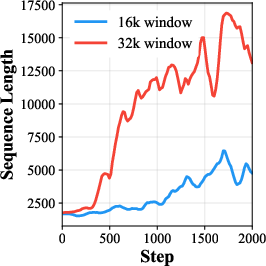
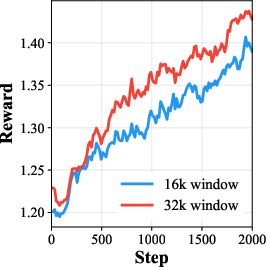
- Curriculum (learning): Gradually increasing task difficulty or constraints during training. "we gradually expand the response window length in a curriculum manner throughout training."
- Deterministic rule-based matching: Automated evaluation by exact or rule-based comparison against reference answers. "their correctness can be judged by deterministic rule-based matching."
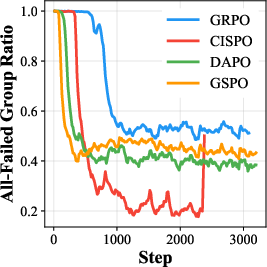
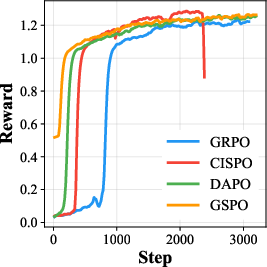
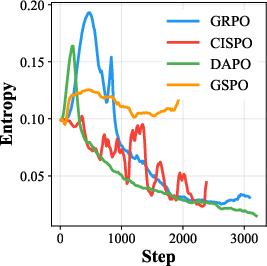
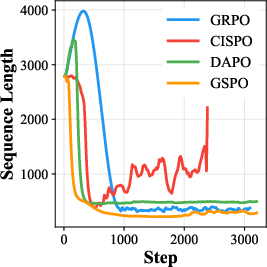
- Entropy collapse: A training failure mode where output diversity shrinks excessively, harming exploration. "CISPO is the most prone to entropy collapse and training instability,"
- FP32: 32-bit floating point precision used where higher numerical stability is required. "compute both the attention softmax and the LM head in FP32."
- GRPO: An RL algorithm (Group Relative Policy Optimization) used for reasoning optimization. "standard algorithms like GRPO often introduce an implicit length bias"
- Group-normalized rewards: Rewards normalized within rollout groups to stabilize learning signals. "computed using GRPO-style group-normalized rewards"
- Importance sampling ratio: The probability ratio correcting for off-policy sampling in policy gradients. "We replace the numerator of the importance sampling ratio with the actual training-engine logits:"
- Key-value (KV): The stored key and value tensors used by attention mechanisms. "key-value (KV) chunks"
- KL divergence penalty: A regularization term constraining the current policy to remain close to a reference policy. "we apply a KL divergence penalty against the frozen reference model"
- Lightning Attention: An attention variant with a small, fixed-size state for efficient computation. "For the Lightning Attention layers~\citep{lightning-attention}, the calculation depends on a small, fixed-size KV state matrix."
- LLM-as-a-Judge: Using an LLM to evaluate outputs (e.g., correctness or quality) instead of rule-based metrics. "we employ an LLM-as-a-Judge framework via pairwise comparison."
- LM head: The final projection layer mapping hidden states to logits over the vocabulary. "the attention softmax and the LM head"
- Megatron: A large-scale training engine/framework for distributed LLM training. "Megatron serves as the training engine"
- Mixture-of-Experts (MoE): A model architecture that routes tokens to a subset of specialized expert networks. "a 1-Trillion parameter Mixture-of-Experts (MoE) model"
- MLA: A specific attention layer type used in the model’s hybrid architecture. "For the MLA layers~\citep{MLA}, we adopt an all-to-all CP strategy."
- Off-policy RL: RL where the behavior policy used to collect data differs from the policy being optimized. "Our training first follows an off-policy RL setup"
- Parallel reasoning: An emergent behavior where the model explores multiple solution paths concurrently. "including anthropomorphism, structured formatting, self-verification, parallel reasoning, and context anxiety,"
- Pass@1 accuracy: The probability that the first sampled output is correct. "All scores are pass@1 accuracy (\%)."
- Policy gradient: A class of RL methods that directly optimize the policy using gradient ascent on expected returns. "They differ exclusively in how the policy gradient is computed."
- PPO-clip: A PPO variant that clips policy ratios to stabilize updates. "Unlike standard PPO-clip"
- Reference model: A frozen baseline policy used for regularization and stability during RL. "the frozen reference model"
- Ring attention: A distributed attention scheme that circulates KV information in a ring among devices. "Standard ring attention~\citep{Ring-attention} solves this by passing key-value (KV) chunks sequentially in a circle."
- Rollout policy: The policy used to generate trajectories/responses for RL updates. "the rollout policy from the inference engine"
- Sample-level loss: An objective normalized at the sequence level to control gradient magnitude independent of length. "we pivot to a sample-level loss"
- Self-distillation: Training a model on its own refined outputs to compress and stabilize behavior. "we introduce a self-distillation phase to reset the model."
- Stop-gradient operator: An operation that prevents backpropagation through a specified tensor. "\operatorname{sg}(\cdot) denotes the stop-gradient operator,"
- Structured formatting: Consistent, logically segmented output organization (e.g., steps, sections). "including anthropomorphism, structured formatting, self-verification, parallel reasoning, and context anxiety,"
- System prompt: A controlling instruction provided to steer model behavior at inference/training time. "a corresponding system prompt "
- Tier-based training: Training with multiple difficulty/length tiers to teach adaptive reasoning depth. "Third-stage RL introduces tier-based training for adaptive reasoning depth."
- Token-level loss: An objective that sums per-token contributions, often encouraging longer outputs. "we adopt a token-level loss"
- Training-inference gap: Numerical or behavior discrepancies between training and inference engines/modes. "it drastically inflates the training-inference gap"
- Verifiable rewards (RLVR): RL where rewards can be automatically checked or verified without human labels. "Reinforcement learning with verifiable rewards~(RLVR)"
- Weight decay: L2 regularization applied to model weights to reduce overfitting. "and a weight decay of $0.01$."
Collections
Sign up for free to add this paper to one or more collections.

