Quantum Algorithm for Elliptic Curve Discrete Logarithms with Space-Efficient Point Addition
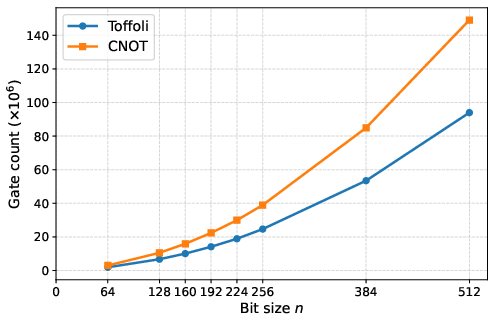
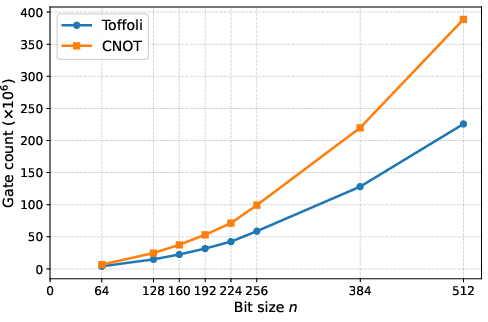
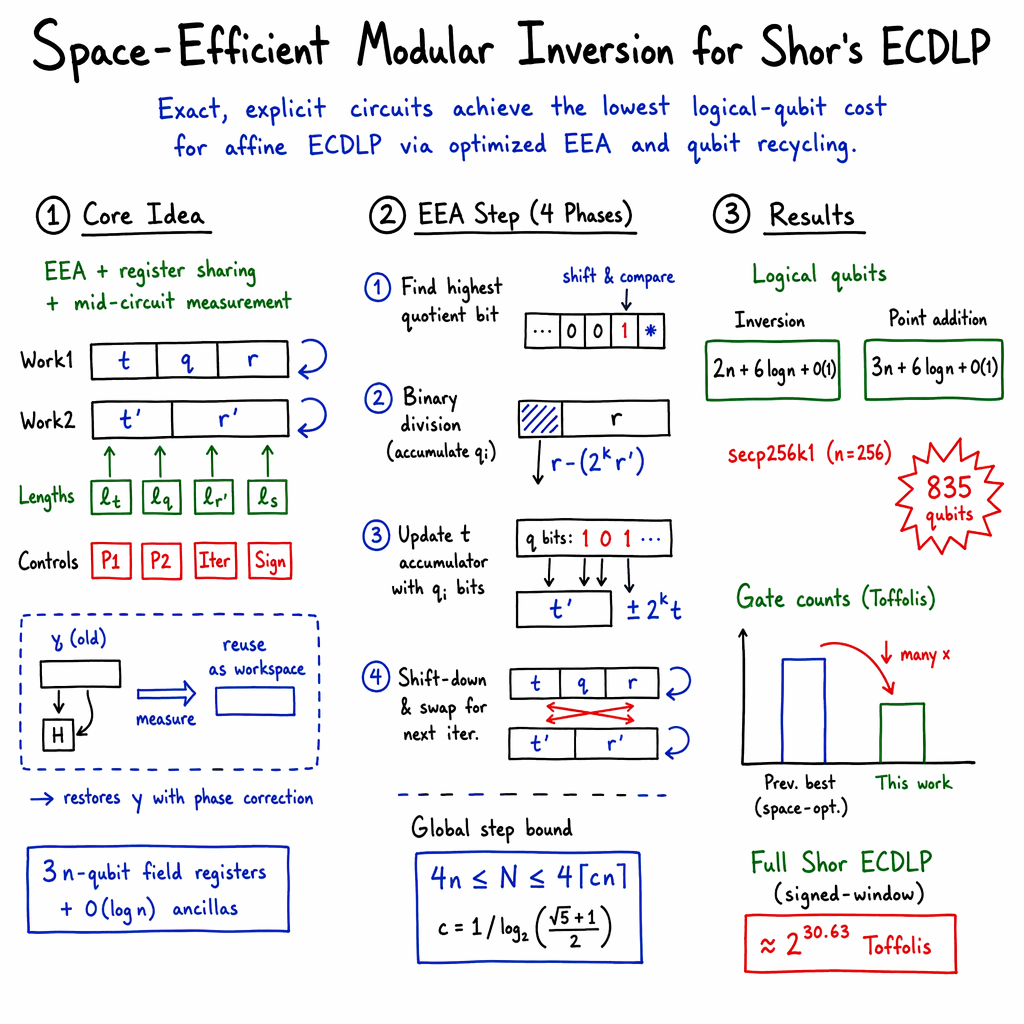
Abstract: The Elliptic Curve Discrete Logarithm Problem (ECDLP) is a fundamental problem in cryptography, and reducing the resource requirements of quantum algorithms for solving ECDLP is an important goal. In this work, we present a space-efficient quantum algorithm for solving the ECDLP over prime fields, achieving an implementation with only $3n+6\lfloor \log_2 n \rfloor+O(1)$ logical qubits and $919n3/\log_2 n+O(n2)$ Toffoli gates, where $n$ is the bit-length of the prime. For a 256-bit prime-field curve, our construction requires only 835 logical qubits, reducing the previous best estimates of 1098 and 1175 logical qubits by Chevignard et al. [EUROCRYPT 2026] and Babbush et al. [ArXiv Preprint 2026], respectively. The key to our improvement is a new space-efficient reversible modular inversion circuit, which addresses the dominant space bottleneck in affine-coordinate point addition. Starting from the extended Euclidean algorithm (EEA), we refine the register-sharing technique of Proos and Zalka by introducing length registers and location-controlled arithmetic to compactly store and update intermediate variables. We further optimize the reversible update procedures and construct the corresponding controlled arithmetic circuits, resulting in a modular inversion circuit implemented by only $2n+6\lfloor \log_2 n \rfloor+O(1)$ logical qubits and $195n2+O(n\log_2 n)$ Toffoli gates. This modular inversion circuit together with mid-circuit measurements and classical feed-forward operations provides a space-efficient controlled affine point-addition circuit and a complete implementation of Shor's algorithm for ECDLP.




Paper Prompts
Sign up for free to create and run prompts on this paper using GPT-5.
Top Community Prompts
Explain it Like I'm 14
What this paper is about
This paper is about making a quantum attack on elliptic curve cryptography (ECC) use less “quantum memory.” ECC is widely used to keep internet connections, messages, and cryptocurrencies safe. A powerful quantum algorithm called Shor’s algorithm could break ECC one day, but only if we can run it on a large, reliable quantum computer. The authors show how to shrink the number of “logical qubits” (the basic units of quantum memory) needed, while also keeping the number of operations (gates) low. They focus on the trickiest part of the job: a kind of division called “modular inversion,” which shows up in adding points on an elliptic curve.
What questions the researchers asked
- Can we design a quantum circuit for solving the elliptic curve discrete logarithm problem (ECDLP) that uses significantly fewer logical qubits than before?
- Can we do that without making the circuit much slower or more complicated?
- Specifically, can we build a space‑efficient (memory‑saving) circuit for modular inversion, the main memory bottleneck in elliptic‑curve point addition?
How their method works (in everyday terms)
To solve ECDLP with Shor’s algorithm, a quantum computer must repeatedly “add” points on an elliptic curve. Point addition boils down to ordinary arithmetic on big integers done modulo a prime number (think: wrap‑around arithmetic, like hours on a clock). The hardest sub‑step is modular inversion, which is like dividing by a number in this wrap‑around world.
Here’s how the authors make this step much more memory‑efficient:
- They base modular inversion on the Extended Euclidean Algorithm (EEA).
- In normal math class, the Euclidean Algorithm finds the greatest common divisor (GCD). The “extended” version also finds a number that acts like the inverse—exactly what’s needed for modular division.
- Quantum circuits must be reversible (able to run backward with no information lost). The authors redesign EEA to fit this rule carefully.
- They “share” registers (memory) cleverly.
- Imagine you have two growing/shrinking piles that never peak at the same time. You can save suitcase space by letting them share the same suitcase, as long as you mark which part belongs to which pile.
- In the algorithm, some numbers get smaller while others grow. The authors store several of these numbers in the same chunk of qubits at different times. They keep track of which part is used with small “length registers” (little labels that record how much space each number is currently using).
- They use “location‑controlled arithmetic.”
- This means they only operate on the exact slice of memory where a number currently lives, based on the labels. It’s like only reading the relevant pages of a book instead of the whole thing.
- They add “active windows” and “unary iteration.”
- Active windows: only compute on the bits (pages) that actually matter right now, to avoid extra work.
- Unary iteration: a simple, step‑by‑step counting method (like counting on fingers) to control where operations apply. This keeps the circuit structured and efficient.
- They recycle qubits with mid‑circuit measurements.
- At one point, they need an extra clean register to run the inverse of their inversion circuit (to clean up “garbage” information). They free space by measuring a register they no longer need and resetting it to zero, then using clever corrections so the measurement doesn’t disturb the rest of the computation.
- Think of it like taking a snapshot of your notes, erasing the page to reuse it, and then fixing any side effects caused by the snapshot.
Altogether, these ideas let them compute modular inversion (and point addition) in a way that uses far fewer qubits than previous designs, while keeping the circuit fully reversible and exact (no approximations that risk small errors).
The main results and why they matter
- Fewer logical qubits (less quantum memory):
- Modular inversion now needs about 2n + 6·log2(n) qubits.
- Affine point addition (the full step used in ECDLP) now needs about 3n + 6·log2(n) qubits.
- Here, n is the number of bits in the prime p that defines the field. For a common 256‑bit curve (like secp256k1 used in Bitcoin), their full design needs only 835 logical qubits—cutting previous best estimates by more than 250 qubits.
- Competitive number of operations (gates):
- Their modular inversion circuit uses about 195·n² Toffoli gates (a standard way to count reversible logic work).
- One point addition uses about 914·n² Toffoli gates.
- The entire ECDLP algorithm uses about 919·n³ / log2(n) Toffoli gates, improving earlier O(n³) scaling by a factor of about log2(n). For large n, that’s a meaningful reduction.
- Fully explicit circuits:
- They don’t just sketch the idea—they provide exact, reversible circuit constructions that can be implemented and counted precisely. This makes the work verifiable and reusable.
Why this matters:
- Logical qubits are very expensive in real quantum computers (each logical qubit needs many physical qubits for error correction). Cutting logical qubits by hundreds is a big step toward realistic quantum attacks.
- Precise, low‑space circuits help researchers estimate when quantum computers might threaten ECC and push industry to move to post‑quantum cryptography in time.
What this could lead to
- Better planning for post‑quantum security: Tighter resource estimates help governments and industry decide how urgently to replace ECC with quantum‑safe alternatives.
- Reusable techniques: The space‑saving tricks (register sharing, length registers, location‑controlled arithmetic, mid‑circuit measurement) can help speed up or shrink other quantum math routines that need division or inversion.
- Future improvements: The authors note open directions—further cutting gate counts, analyzing circuit depth (speed), exploring space‑depth trade‑offs, and even using AI tools to automatically discover better arithmetic circuits.
In short: This paper shows how to pack the same mathematical work into much tighter quantum “luggage,” bringing real‑world quantum attacks on elliptic curve cryptography a step closer—while also giving the community new tools for building compact, reliable quantum arithmetic.
Knowledge Gaps
Knowledge gaps, limitations, and open questions
Below is a single, consolidated list of what remains missing, uncertain, or unexplored, phrased to be actionable for follow-on work:
- Circuit depth and T-depth are not analyzed: derive tight depth bounds for the modular inversion, location-controlled arithmetic, and the full point-addition pipeline; identify parallelizable subroutines and quantify space–gate–depth trade-offs under realistic scheduling.
- Clifford+T realization is not reported: synthesize the Toffoli/CNOT networks to Clifford+T, report T-count/T-depth and ancilla requirements, and size magic-state factories needed for cryptographically relevant instances (e.g., secp256k1).
- Fault-tolerant implementation of mid-circuit measurements and feed-forward is not addressed: analyze latency, measurement/reset error rates, Pauli-frame updates, and scheduling constraints in surface-code settings; quantify the runtime overhead and error budget for the Hadamard-basis measurement and phase-correction steps used in in-place division/multiplication.
- Robustness of the measurement-based phase-correction trick under noise is unquantified: prove fault-tolerant correctness or provide stochastic noise simulations showing that phase corrections after measuring Y preserve coherence within acceptable error rates; incorporate this into end-to-end logical error analysis.
- Theoretical lower bounds on logical qubits are unknown: establish reversible-computation lower bounds for modular inversion, affine point addition, and full ECDLP circuits, to assess whether the reported 2n (inversion) and 3n (point addition) qubit counts are near-optimal.
- Gate-count suboptimality in location-controlled arithmetic and length-register updates: design improved indexed-control primitives (e.g., compressed control encodings, sparse/unary control variants, shared comparators) to reduce Toffoli/CNOT counts without increasing qubits.
- Alternative inversion algorithms are not compared: implement and benchmark space-efficient versions of binary GCD, half-GCD (divide-and-conquer), Almost Inverse, and Montgomery inversion against the proposed EEA approach, both in worst-case and average-case gate/ancilla metrics.
- Exceptional-case handling in affine addition is not fully detailed: give explicit, low-qubit circuits for branches where denominators vanish (e.g., P2 = ±P1, point at infinity), ensuring coherence preservation and minimal ancilla, and quantify their impact on resources.
- Applicability beyond prime fields remains unexplored: adapt the techniques to GF(2m) and other fields, and to different curve models/coordinates (Montgomery, Edwards; projective/Jacobian), assessing whether register sharing and measurement-based recycling maintain the 3n+O(log n) qubit bound.
- Special-modulus optimizations are not exploited: specialize modular add/mul/reduce and inversion circuits to pseudo-Mersenne/NIST primes (including secp256k1 and P-256) to reduce both gate counts and depth; quantify concrete gains.
- Signed-window scalar-multiplication trade-offs are not re-optimized: re-evaluate window sizes and precomputation/table-lookup strategies under the new inversion cost profile to minimize overall n3/log n Toffolis subject to qubit constraints.
- Potential for batching inversions is unclear: investigate quantum-compatible analogs of classical batch inversion (e.g., product trees, Shamir trick) in superposition and assess whether they reduce total inversion cost in the double-scalar multiplication routine.
- Average-case vs worst-case behavior is not characterized: provide distributions of active-window lengths, step counts, and comparator activations over random x, enabling expected-resource estimates and adaptive (possibly measured) scheduling that saves gates/qubits on average.
- Global garbage and workspace management across the full algorithm is not optimized: design a pipeline-level strategy to recycle length registers, reuse work registers across the 2n+2 controlled additions, and minimize peak qubit usage with careful uncomputation timing.
- Mapping to physical resources is missing: compile the circuits to surface-code layouts to report physical-qubit counts, code distances, factory sizes, and wall-clock runtimes for realistic error rates and hardware parameters; compare against competing designs on the same footing.
- Reproducibility and tooling availability are unclear: release the circuit-generation code and Qiskit build scripts used for blockwise compilation and counts to enable independent verification and benchmarking; provide test vectors and simulation harnesses.
- Hybrid designs with RNS arithmetic are not explored: evaluate mixed architectures that use RNS for multiplication/squaring and the proposed register-shared EEA for inversion, seeking improved gate/space trade-offs.
- Asymptotic improvements beyond n3/log n are not investigated: explore algorithmic and architectural ideas (e.g., parallel/segmented multi-scalar multiplication, improved windowing, better add-only ladders) that might reduce the leading asymptotic or the constant in the full ECDLP cost while keeping qubits low.
Practical Applications
Immediate Applications
The following applications can be pursued now using the paper’s explicit circuits, methods, and resource estimates. They primarily target quantum-software stacks, hardware benchmarking, academic research, and risk assessment for cryptography migration.
- Space-efficient reversible modular inversion and affine point addition libraries
- Sector: Software (quantum), Academia
- What: Implement the paper’s explicit EEA-based modular inversion (2n + O(log n) qubits) and controlled affine point-addition blocks (3n + O(log n) qubits) as reusable components in quantum arithmetic libraries (e.g., Qiskit/ProjectQ/Cirq extensions).
- Tools/workflows:
- A “modinv” module implementing the location-controlled arithmetic, length registers, and unary-iteration primitives.
- A “point_add_affine” module using mid-circuit measurement and feed-forward for in-place division/multiplication.
- Benchmark scripts that report Toffoli/CNOT counts and qubit footprints for user-specified n and curves.
- Assumptions/dependencies:
- Availability of mid-circuit measurement and low-latency classical feed-forward on target hardware/simulator.
- Correctness verification through classical reversible simulation and small-scale quantum testing.
- Authors’ pseudocode and circuit diagrams are implemented faithfully; public reference code may need to be derived from the paper.
- Hardware benchmarking of mid-circuit measurement and feed-forward
- Sector: Hardware, Software (control stacks), Academia
- What: Use the in-place division/multiplication trick that measures-and-recycles an n-qubit register to experimentally quantify measurement latency, classical-control round-trip, and feed-forward reliability on superconducting/ion-trap platforms.
- Tools/workflows:
- A micro-benchmark protocol: write y/x using EEA, measure old y in the Hadamard basis, apply Z-phase corrections via recompute/uncompute, and validate coherence preservation.
- Assumptions/dependencies:
- Hardware supports frequent mid-circuit measurements with conditional operations.
- Sufficiently low logical error rates to see coherence-phase cancellation reliably at small n.
- Updated resource estimation for quantum ECDLP attacks
- Sector: Finance (cryptocurrencies), Security, Policy, Academia
- What: Integrate the improved counts (e.g., 835 logical qubits and 230.63 Toffolis for secp256k1) into risk models and dashboards used by CISOs, CTOs, and regulators.
- Tools/products:
- Web-based “ECDLP break-cost calculators” that convert logical-qubit/Toffoli counts into surface-code space-time estimates for various physical error rates and cycle times.
- Comparative charts against prior estimates to inform migration urgency.
- Assumptions/dependencies:
- Mapping Toffoli counts to T-count and physical qubits requires architecture-specific compilers and error-correction models (e.g., surface code, magic-state factories).
- Estimates remain at logical level; large overheads for fault tolerance still apply.
- Curriculum and training materials on space-efficient reversible arithmetic
- Sector: Academia, Education (professional upskilling)
- What: Use the explicit reversible EEA with register-sharing, length registers, and location-controlled arithmetic as teaching modules for courses/workshops on quantum arithmetic and cryptanalysis.
- Tools/workflows:
- Lecture notes, lab assignments implementing unary iteration and active-window techniques.
- Side-by-side comparisons showing qubit reductions versus prior designs.
- Assumptions/dependencies:
- Students/researchers have access to classical reversible simulators and basic quantum SDKs.
- Baseline for compiler and synthesis research
- Sector: Software (compilers), Academia
- What: Employ the paper’s circuits as testbeds for optimization passes (ancilla management, gate scheduling, T-count reduction, depth vs. space trade-offs).
- Tools/workflows:
- Pass-based experiments that replace location-controlled adds/subs with alternative designs; automated verification via Toffoli-network equivalence checks.
- Assumptions/dependencies:
- Availability of reversible-circuit equivalence checking and cost models for Clifford+T synthesis.
- Threat modeling and PQC migration communication
- Sector: Policy, Standards, Enterprise IT/Security
- What: Use the reduced logical-qubit estimates to refine “when-to-migrate” messaging for ECC-dependent systems (TLS, SSH, code signing, cryptocurrencies).
- Tools/workflows:
- Briefings and whitepapers citing lower space requirements for ECDLP at the logical level; cross-walks to NIST PQC timelines and crypto agility plans.
- Assumptions/dependencies:
- Clear communication that logical-resource reductions do not imply near-term breaks without large-scale fault-tolerant hardware.
Long-Term Applications
These applications depend on advances in fault-tolerant quantum computing, large-scale error correction, and/or broader integration into quantum toolchains and cryptographic practice.
- Earlier and more feasible quantum attacks on ECC in production systems
- Sector: Finance (blockchains, payments), Web security (TLS/SSH), Software update infrastructure, PKI
- What: Execute Shor’s ECDLP with lower logical-qubit footprints to recover private keys for widely used curves (e.g., secp256k1, P-256), enabling decryption, signature forgery, and cryptocurrency key compromise.
- Potential workflows:
- “Cryptanalysis-as-a-service” offerings in red-team contexts (e.g., recover keys for audit/consent-based testing).
- Forensics for legacy archives encrypted with ECC after sufficient hardware exists.
- Assumptions/dependencies:
- Fault-tolerant quantum computers with thousands of high-fidelity logical qubits and sustained Toffoli rates, including fast measurements and feed-forward.
- Robust magic-state factories and low logical error rates to meet required circuit depths and runtimes.
- Standard quantum arithmetic substrate for number-theoretic algorithms
- Sector: Software (quantum), Academia
- What: Adopt the paper’s building blocks (space-efficient modular inversion, location-controlled arithmetic, length registers, unary iteration, active windows) as canonical patterns in quantum arithmetic libraries, beyond ECDLP.
- Possible targets:
- Discrete-log algorithms in other groups using affine-like divisions.
- Pairing-related arithmetic where modular inversions occur (e.g., normalization steps).
- Quantum versions of protocols requiring modular division/inversion as subroutines.
- Assumptions/dependencies:
- Generalization and verification for diverse primes/field structures and corner cases.
- Depth and T-count optimization to meet hardware constraints.
- Measurement-driven ancilla recycling as a compiler/runtime feature
- Sector: Software (compilers, runtimes), Hardware (control)
- What: Generalize the paper’s “measure-and-recycle” pattern (mid-circuit measurement + phase correction + recompute/uncompute) into compiler-insertable transformations for ancilla management and T-count reductions.
- Tools/products:
- Compiler passes that recognize in-place arithmetic opportunities and automatically introduce measurement-based workspace swapping.
- Runtime systems with tight integration for classical control and qubit reset.
- Assumptions/dependencies:
- Hardware support for fast, frequent mid-circuit measurement and feed-forward without stalling overall execution.
- Formal verification that inserted measurements preserve coherence (phase-correctness proof obligations).
- Informing cryptographic policy and standards timelines
- Sector: Policy, Standards bodies (NIST, ISO, ETSI), Critical Infrastructure
- What: Use improved space/gate estimates to refine deprecation schedules for ECC, mandate PQC-by-default baselines, and calibrate “harvest-now-decrypt-later” risk mitigation requirements.
- Tools/workflows:
- Periodic “quantum-attack feasibility assessments” harmonized with hardware roadmaps, updating allowable lifetimes for ECC-protected data.
- Assumptions/dependencies:
- Transparent, community-vetted mappings from logical to physical resources and runtime under realistic hardware projections.
- AI-assisted automated discovery of quantum arithmetic circuits
- Sector: Software (AI for programming), Academia
- What: Incorporate the paper’s techniques (register sharing, windowing, unary iteration, measurement-based recycling) into modular search spaces for evolutionary/AI synthesis systems to discover even more resource-efficient circuits.
- Tools/products:
- Evolutionary frameworks (e.g., AlphaEvolve-inspired) that test circuit candidates against formal specs and resource metrics; reusable “gadget libraries” based on this paper’s blocks.
- Assumptions/dependencies:
- Mature correctness checking (equivalence, property testing) for large reversible circuits; scalable cost models for Clifford+T synthesis.
- Broad adoption of space-depth trade-offs in quantum algorithm design
- Sector: Academia, Software (quantum)
- What: Extend the paper’s space-optimized methods to balanced space-depth designs via parallelization and alternative arithmetic decompositions, enabling end-to-end resource co-optimization for large cryptanalytic workloads.
- Tools/workflows:
- Design spaces and schedulers that let users set qubit budgets and automatically tune depth/Toffoli counts using location-controlled arithmetic variants.
- Assumptions/dependencies:
- Comprehensive depth analyses and validated parallelization strategies; integration with hardware-aware schedulers.
- Cross-application use of modular inversion primitives
- Sector: Software (quantum), Academia
- What: Apply the inversion circuit to quantum algorithms where modular division appears (e.g., certain interferometry/estimation subroutines such as DQI, normalization steps in algebraic algorithms).
- Assumptions/dependencies:
- Identification of target algorithms with dominant inversion cost; adaptation of location-controlled arithmetic to each algorithm’s dataflow and control patterns.
Notes on feasibility across all items:
- The paper’s logical-qubit reductions are substantial but do not remove the need for large-scale fault tolerance. Near-term devices will not run these algorithms at cryptographically relevant sizes.
- Practical deployments depend critically on mid-circuit measurement performance and classical-control latency, which vary by hardware platform.
- Exact performance for a given curve will depend on compiler-level synthesis (Toffoli→Clifford+T), error-correction overheads, and realistic depth scheduling.
Glossary
- Active windows: A technique that restricts attention to a subset of indices during each step to reduce gate complexity in location-dependent operations. "we introduce step-dependent active windows"
- Affine point addition: Elliptic-curve point addition performed in affine coordinates, typically requiring modular inversion and dominating qubit usage. "provides a space-efficient controlled affine point-addition circuit"
- Ancilla qubits: Extra qubits used as temporary workspace in quantum circuits that must be returned to a known state by the end of the computation. "They achieved the lowest circuit depth with adequate ancilla qubits."
- Binary long-division: A division method over binary integers implemented with shifts and add/subtract operations, used to compute quotients reversibly. "performs a binary long-division procedure"
- Clifford+T: A universal gate set comprising Clifford gates and the non-Clifford T gate, commonly used for fault-tolerant circuit synthesis. "it is common to express circuits over a universal gate set such as Clifford+"
- CNOT gate: A two-qubit controlled-NOT operation that flips the target qubit if the control is 1; a key Clifford operation used alongside Toffoli gates. "and CNOT gates."
- Controlled indexed operations: Operations whose action depends on an index value stored in a register, enabling selective updates at specific positions. "as a primitive for implementing controlled indexed operations"
- Cyclic subgroup: A subgroup generated by repeatedly applying the group operation to a single element; ECDLP is formulated over such a subgroup of the elliptic-curve group. "a discrete-logarithm problem in a cyclic subgroup of an elliptic-curve group"
- Decoded Quantum Interferometry (DQI): A quantum technique leveraging interferometry with classical decoding; referenced as an application area for modular inversion. "such as Decoded Quantum Interferometry (DQI)~\cite{khattar2025verifiable}"
- Double-scalar multiplication: The computation of [k]P + [ℓ]Q on elliptic curves, which is the core coherent group evaluation in Shor’s ECDLP algorithm. "the double-scalar multiplication on elliptic curve points."
- Elliptic Curve Cryptography (ECC): Public-key cryptography based on the algebraic structure of elliptic curves over finite fields. "Elliptic curve cryptography (ECC), first proposed in the mid-1980s as an alternative framework for public-key cryptography"
- Elliptic Curve Discrete Logarithm Problem (ECDLP): Given points P and Q = [m]P on an elliptic curve, recover the scalar m; the foundational hard problem underlying ECC. "The Elliptic Curve Discrete Logarithm Problem (ECDLP) is a fundamental problem in cryptography,"
- Extended Euclidean Algorithm (EEA): An algorithm that, in addition to the GCD, computes coefficients yielding modular inverses; here used to build a reversible modular inversion circuit. "Starting from the extended Euclidean algorithm (EEA), we refine the register-sharing technique"
- Fault-tolerant quantum computer: A quantum computer implementing error correction to suppress logical error rates, enabling large circuits to run reliably. "requires a fault-tolerant quantum computer with a large number of logical qubits and circuits"
- Feed-forward (classical feed-forward): Using measurement outcomes during a quantum circuit to condition subsequent classical or quantum operations. "mid-circuit measurements and classical feed-forward operations"
- Hadamard basis: The X-basis obtained by applying a Hadamard transform to the computational basis; measuring in this basis yields phase information. "measuring the register containing the old value in the Hadamard basis"
- Hadamard gate: A single-qubit gate creating superposition; used to initialize exponent registers and implement semiclassical QFT steps. "apply Hadamard gate to all the qubits to obtain a uniform superposition"
- Hasse's bound: A bound on the number of points on an elliptic curve over a finite field; used to size the exponent registers in Shor’s algorithm. "Hasse's bound \cite{hasse1936theorie} indicates that"
- Legendre symbol: A quadratic-residue indicator modulo a prime; used in low-qubit ECDLP approaches as a one-bit output from projective coordinates. "It computes a one-bit Legendre symbol from the projective coordinates of that point"
- Length registers: Small registers that track the current logical length of variable-width integers to enable compact, reversible in-place arithmetic. "introducing length registers and location-controlled arithmetic"
- Location-controlled arithmetic: Arithmetic operations that are activated at specific index locations within a register, controlled by position information. "introducing length registers and location-controlled arithmetic"
- Logical qubits: Error-corrected qubits at the algorithmic level, in contrast to physical qubits; the primary unit for space complexity. "835 logical qubits"
- Mid-circuit measurements: Measurements performed during a quantum computation to free qubits or enable adaptive control without collapsing the overall computation. "mid-circuit measurements and classical feed-forward operations"
- Modular inversion: Computing x{-1} mod p, a core arithmetic primitive used for affine point addition and a dominant source of qubit cost. "A new space-efficient reversible modular inversion circuit"
- Montgomery multiplication: An efficient method for modular multiplication that avoids explicit division by the modulus; used in depth-optimized EC arithmetic. "QCSA-based Montgomery multiplication"
- Pauli Z corrections: Phase-flip corrections conditioned on measurement outcomes to remove unwanted phases introduced by mid-circuit measurements. "applying the corresponding Pauli corrections,"
- Projective coordinates: A coordinate system for elliptic curves that avoids inversions by representing points with an additional scale factor. "from the projective coordinates of that point"
- QCSA (Quantum Carry-Save Adder): A quantum adder architecture enabling low-depth arithmetic via carry-save encoding, used to build fast modular multipliers. "QCSA-based Montgomery multiplication"
- Quantum Fourier Transform (QFT): The quantum analogue of the discrete Fourier transform; used to extract hidden periodicity in Shor’s algorithm. "followed by a quantum Fourier transform (QFT)"
- Register sharing: A space-saving technique that overlays multiple variables in the same register at different times, enabled by monotonic size changes. "register-sharing technique of Proos and Zalka"
- Residue-number system arithmetic: Arithmetic performed in parallel over several pairwise-coprime moduli to trade space for time or vice versa. "based on residue-number-system arithmetic"
- Scalar multiplication: Repeated addition of an elliptic-curve point P to itself m times to compute [m]P. "resulting from scalar multiplication of by an unknown integer "
- secp256k1: A widely used 256-bit prime-field elliptic curve, notably in Bitcoin; a standard benchmark for ECDLP resource estimates. "secp256k1"
- Semiclassical QFT: A QFT implementation that interleaves measurements and classical control to reuse qubits and reduce space. "using semiclassical QFT"
- Shor's algorithm: A quantum algorithm that solves integer factoring and discrete logarithms in polynomial time, breaking ECC at scale. "a complete implementation of Shor's algorithm for ECDLP."
- Signed-window technique: A method for speeding up scalar multiplication by precomputing signed multiples of a base point and processing several bits at a time. "using the signed-window technique"
- Spooky pebbling: A measurement-based pebbling strategy that frees and reuses qubits in reversible computations arranged as DAGs or trees. "spooky pebbling strategy"
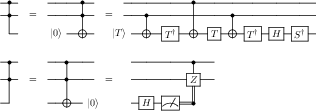
- Toffoli gate: A three-qubit controlled-controlled-NOT gate that is universal for classical reversible logic and central in Toffoli-count metrics. "The Toffoli gate maps"
- Unary iteration: A construction that iterates over positions using a unary-encoded control, facilitating efficient location-controlled updates. "We then introduce unary iteration"
- Uncomputation: The process of reversing a computation to clear garbage ancillas and restore them to a known state. "followed by its uncomputation."
Collections
Sign up for free to add this paper to one or more collections.