TRACE: Turn-level Reward Assignment via Credit Estimation for Long-Horizon Agents
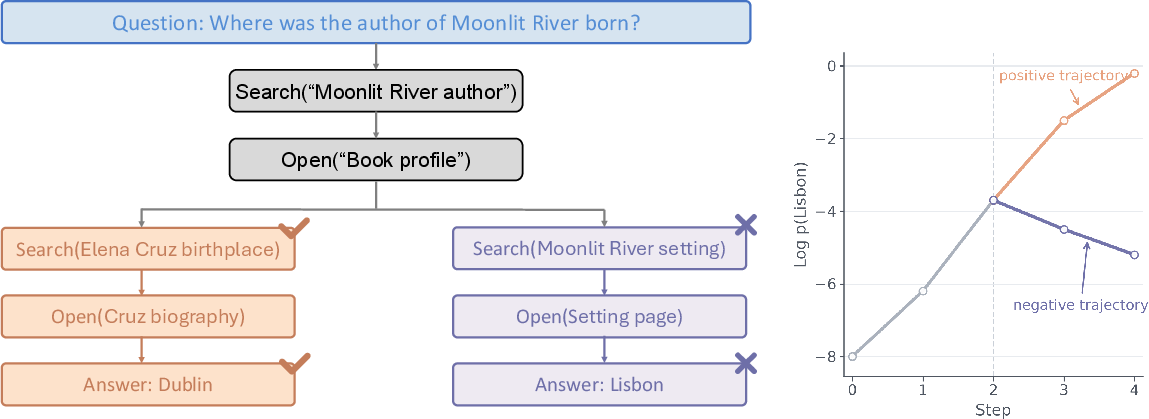
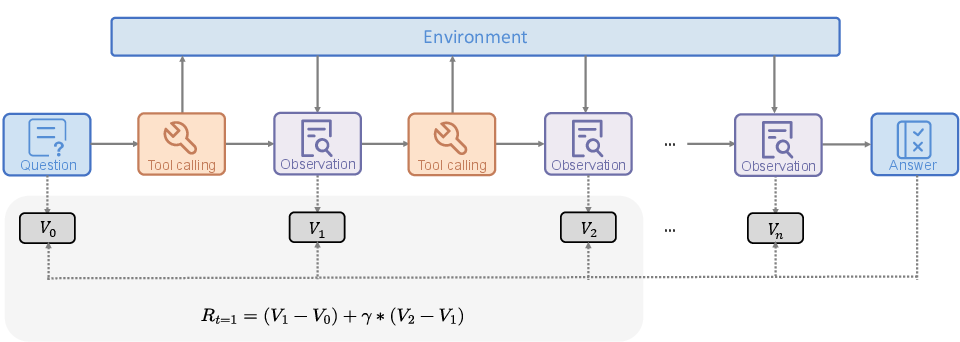
Abstract: Multi-turn agents solve complex tasks through extended sequences of tool interactions before producing a final answer, making credit assignment a fundamental challenge during post-training. Outcome rewards provide reliable supervision for short-horizon reasoning, but become sparse and high-variance as trajectories grow to tens or hundreds of tool calls. They can also be misleading: a failed rollout may contain many useful actions that move the agent closer to the goal, yet outcome-only training assigns them the same negative advantage as the eventual mistake. We propose TRACE (Turn-level Reward Assignment via Credit Estimation), a dense credit-assignment method for agentic reinforcement learning. TRACE represents rollouts as state transitions at tool-call boundaries, obtains gold-answer log-probabilities from a frozen reference model, transforms them into log-ratio state values, and derives per-action rewards as Temporal-Difference changes in those values. This requires no additional critic or process-label training, and its one-step log-ratio TD component telescopes across redundant tool calls. On long-horizon complex search, TRACE substantially improves base-model tool-use ability using pure RL, without a cold-start supervised fine-tuning stage, an agentic mid-training stage, or training on live-web data. On the closed-web BrowseComp-Plus benchmark, it raises Qwen3-4B from $7.2$ to $35.6$ and Qwen3-30B-A3B from $8.4$ to $42.6$. The learned search behavior also transfers to open-web benchmarks, and the learning curves show earlier improvement and faster convergence during RL training.

Paper Prompts
Sign up for free to create and run prompts on this paper using GPT-5.
Top Community Prompts
Explain it Like I'm 14
Explaining “TRACE: Turn-level Reward Assignment via Credit Estimation for Long-Horizon Agents”
Overview (What this paper is about)
This paper introduces TRACE, a way to teach AI “agents” (like smart assistants) to complete long, multi-step tasks—such as searching the web, opening pages, and reading information—more effectively. Instead of only rewarding an agent at the end if it gets the final answer right, TRACE gives credit at each useful step along the way. This helps the agent learn which actions in a long chain actually move it closer to the correct answer.
Objectives (What questions the researchers asked)
The researchers aimed to solve a simple but important problem:
- When an agent must do many steps (search, click, read, search again) before answering, how do we reward the helpful steps and discourage the unhelpful ones—even if the final answer turns out wrong?
- Can we do this without expensive extra tools like human labels for every step, a special “judge” model to rate every action, or a separate “critic” model?
- Will this better step-by-step credit help agents learn faster and perform better on deep, long tasks?
Methods (How TRACE works, in everyday language)
Think of a long task like a treasure hunt:
- The agent makes a series of moves (searching, opening pages, finding text).
- Traditional training only tells the agent at the very end whether it found the treasure (correct answer) or not. That makes it hard to know which moves helped.
TRACE changes that by giving “turn-by-turn” feedback. Here’s how, with simple analogies:
- A frozen reference model as a “steady yardstick”:
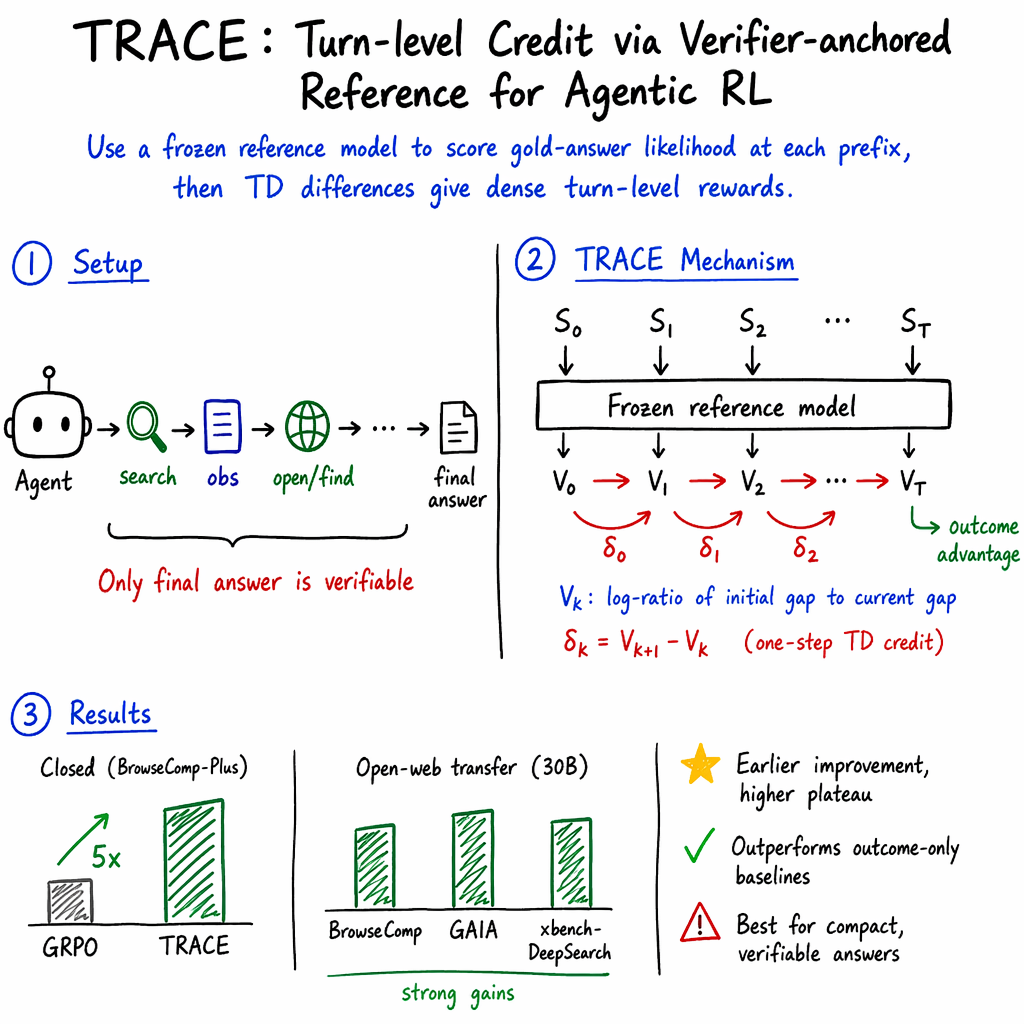
- The researchers keep a separate, fixed copy of the model (it doesn’t learn during training) to act like a stable thermometer. After each step, this yardstick checks: “Given what we’ve seen so far, how likely is the correct answer?” If that likelihood goes up, the step probably gathered useful evidence.
- Prefix scoring (checking progress after each step):
- After each tool call (like search or open), TRACE asks the yardstick: “How ready are we to produce the right answer now?” This is like measuring how close you are to the treasure after each move.
- Log-ratio “progress measure”:
- Instead of raw scores, TRACE uses a progress scale that focuses on how much of the remaining “gap” to the answer has been closed. Shrinking the gap from almost-done to done counts more than tiny changes when you’re still far away. This helps normalize progress fairly at different stages.
- Temporal-Difference (TD) credits (step-by-step reward):
- TD is like checking whether your latest move made things better or worse compared to the previous step. If the new page you opened makes the correct answer more predictable, that step earns positive credit. If nothing helpful was added, it gets near-zero credit. If it misleads you, it gets negative credit.
- A neat property: these step credits “telescope,” meaning you can’t game the system by adding extra pointless steps—only real progress counts.
- Short look-ahead for delayed effects:
- Sometimes a search doesn’t help until you open a link afterwards. TRACE looks a few steps ahead (not too far) to share credit with earlier actions that made later progress possible.
- Keep the final answer as the ultimate goal:
- TRACE still uses the final correctness as a “global grade.” It mixes that final reward with the turn-by-turn credits—so the agent learns both to aim for a correct answer and to value helpful moves along the way.
In short, TRACE gives credit where it’s due at each turn, without needing step-by-step labels or training a separate critic.
Main Findings (What they discovered and why it matters)
The team tested TRACE on long, complex “deep research” tasks—both in a closed setting (fixed document collection) and the open web. They used two sizes of the Qwen3 model (a 4B and a 30B version) and compared against standard reinforcement learning methods that only use final outcomes.
Key results:
- Big gains on a challenging closed-web benchmark (BrowseComp-Plus):
- Qwen3-4B improved from 7.2 to 35.6 after TRACE training.
- Qwen3-30B-A3B improved from 8.4 to 42.6.
- Good transfer to open-web tasks:
- With the 30B model, TRACE reached 12.9 on BrowseComp, 52.0 on GAIA, and 45.0 on xbench-DeepSearch (a Chinese QA benchmark).
- Faster and earlier learning:
- Training curves showed that performance started improving sooner and reached better levels faster with TRACE than with outcome-only training.
Why this matters:
- These improvements arrived without extra expensive ingredients (no step-by-step labels, no strong judge model, no extra critic, no staged training on the live web). TRACE uses “pure RL” signals—final correctness plus its new turn-by-turn credits.
- The method helped both a small model (4B) and a larger one (30B), suggesting the approach is broadly useful.
Implications (What this could change going forward)
- Better training for long-horizon agents:
- Agents that browse, plan, code, or operate software often need many steps. TRACE shows a practical way to teach them which steps truly help, making learning more efficient and robust.
- Less reliance on costly supervision:
- Since TRACE doesn’t require human-labeled steps, a trained “critic,” or a powerful judge model, it could lower the cost and complexity of building capable agents.
- General-purpose progress signal:
- The same idea—measuring how each step makes the correct answer more predictable—could apply to other multi-step tasks like software debugging, data analysis, or multi-hop reasoning.
In short, TRACE gives AI agents a kind of “fair scoring system” for each move they make during long tasks, helping them learn good habits faster and more reliably—without needing lots of extra supervision.
Knowledge Gaps
Knowledge gaps, limitations, and open questions
Below is a concise list of concrete gaps and unresolved questions to guide follow-up research.
- Reliance on verifiable single “gold” answers: TRACE requires a deterministic verifier and access to the gold answer string during training to compute reference log-probabilities. It is unclear how to adapt the method to tasks with multiple valid answers, fuzzy scoring, long-form responses, or unverifiable objectives (e.g., synthesis, planning, UX automation).
- Reference-model dependency and miscalibration: The dense credit hinges on a frozen reference model’s ability to reflect “answer readiness.” If the reference is ignorant, miscalibrated, or domain-mismatched, TD credits can be noisy or misleading. Needed: robustness analysis across reference strengths/families, calibration methods, ensembles, or periodic refresh/EMA teachers.
- Reward hacking and leakage risk: The policy could inflate the reference probability of the gold answer by prematurely “hinting” or emitting the answer in private reasoning or queries (without true verification). Mitigations to test: masking private reasoning from scoring, scoring only on environment observations, penalties for premature answer leakage, or constrained decoding.
- Limited domain coverage: Experiments focus on long-horizon browser search with three actions (search/open/find). It is unknown how TRACE transfers to other agentic domains (software repair, API orchestration, real-computer/mobile control, multimodal tool use), different tool APIs, or continuous/structured action spaces.
- Long-horizon scalability: Training capped trajectories at 60 turns; practical agents often need hundreds. Open questions: stability and sample-efficiency at greater horizons, whether telescoping discourages necessary redundancy, and whether K-step backing remains effective as horizons grow.
- Synthetic training data and domain shift: Training uses synthetic multi-document tasks over a closed corpus. The extent to which gains depend on data generation choices is unclear. Needed: evaluation under diverse real-world corpora, adversarial/noisy pages, retrieval drift, and multi-domain/multilingual settings beyond English and one Chinese benchmark.
- Breadth and rigor of evaluation: Results are single runs for many ablations without variance or statistical tests. Add multi-seed runs, confidence intervals, and sample-efficiency comparisons. Include controlled comparisons against process-supervised baselines (strong judges, process reward models) under identical data/harness.
- Theoretical properties of shaping: The log-ratio TD credit is akin to potential-based shaping but mixed with terminal anchoring and K-step backups. Lacking: formal conditions for policy invariance, convergence guarantees, and analysis of bias introduced by Z-normalization and terminal fill.
- Off-policy bias and stability: Credit is computed along trajectories from a behavior snapshot (pi_old) without explicit off-policy corrections for the TD-like component. Study the effect of larger policy updates, potential bias, and whether V-trace-style corrections improve stability.
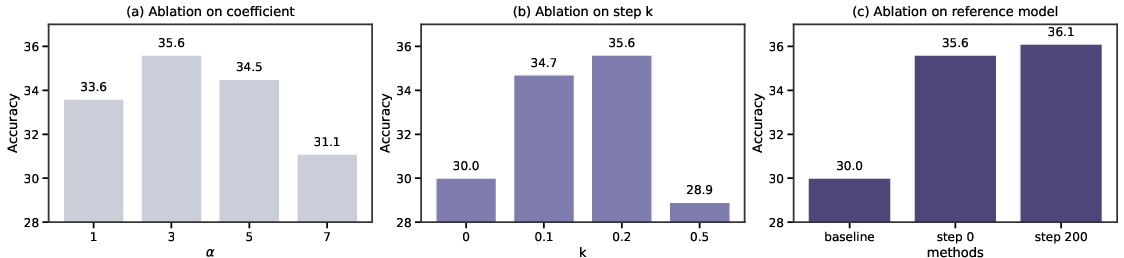
- Hyperparameter sensitivity: Only limited ablations were shown (α_turn, K, reference checkpoint). Critical settings remain underexplored: gamma_td, lambda_term, epsilon (gap offset), α_out, answer-tail weight (0.05), KL/clip ranges. Needed: systematic sweeps with multi-seed robustness and adaptive schedules.
- Reference staleness vs. drift: Using the initialization checkpoint as a fixed probe may become too weak as the policy improves; conversely, updating the reference risks moving the target. Evaluate periodic refresh, EMA teachers, or ensembles, and the trade-off between stability and freshness.
- Granularity of credit: Credit is assigned at tool-call boundaries, ignoring within-turn sub-decisions (e.g., query-token formulation, extraction pointer selection). Explore finer-grained token/action credit, hybrid token-turn shaping, or per-tool specialized credit signals.
- Multiple answers or latent structure: The method scores a single gold string. For tasks with sets, paraphrases, or latent variables (e.g., multi-entity answers), extend to set-likelihoods, canonicalization, or marginalization over valid outputs, and assess their impact on credit estimation.
- Interaction with retrieval quality: TRACE was trained with a fixed embedding retriever and evaluated on a web API. Missing: sensitivity to retriever quality, latency, stale indexes, and attack surfaces (SEO spam, prompt-injection). Consider robust training, adversarial data, and retriever-agent co-adaptation.
- Compute and scaling cost: Reference scoring of every prefix (up to 60 turns × 8 rollouts/prompt) adds substantial training overhead, even if batched. Report wall-clock, FLOPs, and memory; evaluate approximations (prefix subsampling, caching, incremental scoring, learned surrogates).
- Exploration behavior: Telescoping discourages padding but may also disincentivize redundant-yet-robust evidence gathering. Measure exploration diversity, revisiting behavior, and coverage; consider combining TRACE with intrinsic motivation (novelty, coverage bonuses).
- Failure-mode analysis: The paper lacks qualitative diagnostics of miscrediting (e.g., when misleading pages increase answer likelihood under the reference). Provide turn-level heatmaps, case studies, and an error taxonomy to target mitigations.
- Safety and factuality: No analysis of hallucinations, citation accuracy, or spurious justification. Add factuality/citation checks, provenance tracking, and evaluate whether TRACE amplifies or reduces hallucinatory patterns.
- KL regularization and objective design: Though KL-regularization is mentioned, experiments rely on GRPO-style clipping; the impact of explicit KL to a reference, adaptive KL schedules, or mixing with sequence-level estimators (e.g., GSPO) is underexplored.
- Token-length and normalization effects: Using average per-token log-prob can bias towards shorter answers; investigate length-normalized vs sequence-level scoring, alternative transforms, or mutual-information-based signals.
- Applicability without gold answers: Many real tasks lack gold answers at scale. Explore weak/learned verifiers, self-consistency surrogates, Monte Carlo counterfactuals, or distant supervision to approximate prefix values.
- Privacy and overfitting risk: Training directly conditions on gold answers for scoring; assess memorization/propensity to leak answers and propose mitigations (regularization, data filtering, privacy auditing).
- Integration with learned critics: While TRACE is critic-free, hybrid approaches could combine reference-based shaping with learned value functions. Open question: can a learned critic bootstrap from TRACE signals to further reduce variance and improve credit fidelity?
- Transfer across backbones: Results are on two Qwen3 variants. Test backbone diversity (Llama/Mistral/GPT-style, non-“thinking” variants), scaling laws, and whether TRACE’s gains persist across pretraining regimes.
- Parameter sharing across tools: The same shaping is used across tools; some tools (e.g., open vs find) might require different credit dynamics. Investigate tool-specific credit transforms or hierarchical shaping.
- Robustness to verifier imperfections: Outcome rewards may be noisy (e.g., exact-match misses semantically correct answers). Evaluate fuzzy verifiers, numeric tolerance, and how verifier noise propagates through TRACE’s terminal anchoring.
- Cross-lingual generalization: Beyond one Chinese benchmark, broader multilingual evaluation (scripts, morphologies) is missing. Study whether reference scoring and answer normalization remain reliable across languages and scripts.
Practical Applications
Immediate Applications
Below are concrete, deployable uses that can be built now by incorporating TRACE into existing agent-training pipelines that already have verifiable outcomes and tool-call instrumentation.
- Enterprise research copilot training (software, knowledge management)
- Use: Train browsing/search agents to conduct multi-document investigations (competitive analysis, vendor due diligence, literature scans) more efficiently via dense turn-level credit.
- Tools/products/workflows: Add TRACE to GRPO-based post-training for enterprise “research copilot” agents using browser.search/open/find or internal search APIs; produce per-turn credit logs for QA.
- Assumptions/dependencies: Access to prompts with gold answers or weakly verifiable targets (e.g., extract specific facts); stable tool interface; frozen reference model snapshot; offline corpora or sandboxed retrieval.
- Legal and compliance e-discovery assistants (legal, finance, policy)
- Use: Improve document triage chains (query → filter → open → cite) by rewarding steps that increase answer predictability even in failed rollouts.
- Tools/products/workflows: TRACE-augmented RL over closed case-law/contract corpora with verifiable extraction tasks (clause presence, citation matching); audit dashboards showing per-turn credit.
- Assumptions/dependencies: Reliable verifiers for targeted queries (exact-match clauses, known citations); strict data governance; frozen reference model for prefix scoring.
- Customer support knowledge retrieval (customer service, SaaS)
- Use: Train support bots to navigate multi-page product docs (search → open → find → summarize) with faster convergence and fewer redundant clicks.
- Tools/products/workflows: Integrate TRACE into agent RL on internal doc portals; combine outcome reward (ticket resolution or exact-match snippet) with TD turn credit.
- Assumptions/dependencies: Verifiable targets (canonical answers/snippets); instrumented tool boundaries; evaluation harness mirroring production docs.
- Repository-level coding agents (software engineering)
- Use: Reinforce multi-step repo navigation (search files → open → run tests → patch) by crediting intermediate observations that make a fix more likely.
- Tools/products/workflows: TRACE in SWE-bench–style agents with deterministic verifiers (tests); per-turn credits tied to shell/IDE tool calls; faster RL training from base models without SFT cold start.
- Assumptions/dependencies: Deterministic unit/integration test rewards; stable execution sandbox; frozen reference policy for prefix scoring.
- Biomedical literature triage with closed corpora (healthcare, pharma R&D)
- Use: Train agents to gather evidence across multiple PubMed/clinical guideline documents for verifiable factual queries (e.g., inclusion criteria, dosage ranges).
- Tools/products/workflows: TRACE over curated offline corpora; outcome verifier checks exact spans/normalized entity matches; per-turn TD credit to rank useful retrieval paths.
- Assumptions/dependencies: Narrow, verifiable question sets (fact extraction vs open diagnosis); regulatory review for deployment; corpora licensing.
- Internal market-intelligence digests (finance, strategy)
- Use: Multi-source browsing agents that compile fact-checked briefs, with reward shaping that discourages redundant navigation and credits evidence-adding steps.
- Tools/products/workflows: TRACE on closed news/filings databases; highlight attributions where TD credit spiked; governance-ready trails for how facts were gathered.
- Assumptions/dependencies: Clearly verifiable target facts; consistent retrieval APIs; compliance alignment.
- Cost-efficient RL post-training pipelines (ML platforms, MLOps)
- Use: Reduce reliance on process reward models or strong judges by using a frozen reference model and verifiers; achieve earlier improvements and faster convergence.
- Tools/products/workflows: “TRACE module” for RLHF/GRPO stacks; batched prefix-scoring service; training monitors plotting outcome vs turn credit curves.
- Assumptions/dependencies: Compute budget for per-prefix scoring; careful hyperparameter defaults (horizon K≈3, γ≈0.8, log-ratio offset ε); reproducible rollout harness.
- Educational multi-step tutors for fact questions (education/edtech)
- Use: Train agents to gather multi-document evidence before answering (history, science facts) and reward productive exploration steps.
- Tools/products/workflows: Offline textbook/Wikipedia subsets; verifiers for exact factual targets; per-turn credit visualizations for pedagogy analytics.
- Assumptions/dependencies: Limited to verifiable Q&A (not open-ended essays); content licenses.
- Model auditing and explainability for agents (governance, risk)
- Use: Provide per-turn credit traces tied to concrete observations, assisting internal auditors in understanding which steps influenced outcomes.
- Tools/products/workflows: Log TD deltas per tool call; dashboards highlighting high-credit transitions; exportable traces for compliance reviews.
- Assumptions/dependencies: Instrumented agent harness; standardized logging; privacy controls.
Long-Term Applications
These opportunities require additional research, scaling, or new verifiers to generalize beyond tightly verifiable tasks or to new domains.
- Clinical decision support with multi-evidence synthesis (healthcare)
- Use: Guide agents through guidelines, labs, and imaging summaries, crediting steps that improve diagnostic/treatment recommendation likelihood under a safety-anchored verifier.
- Tools/products/workflows: TRACE-like credit with clinically validated verifiers (checklists, expert-reviewed endpoints); integration with EHR viewers/tools.
- Assumptions/dependencies: High-stakes validation; robust verifiers beyond exact match; bias and safety monitoring; regulatory approval.
- Financial investigative research and KYC/AML workflows (finance, policy)
- Use: Multi-database agents that trace entities and transactions; credit assignment for investigative chains that surface decisive links.
- Tools/products/workflows: Secure sandboxes; formalized verifiers (entity match, rule-trigger hits); audit-grade credit traces.
- Assumptions/dependencies: Access to regulated datasets; precise outcome definitions; strong privacy/compliance constraints.
- Autonomous software maintenance at repo scale (software engineering)
- Use: Multi-PR planning and refactoring agents where credit propagates across long horizons (design → edits → tests → rollout).
- Tools/products/workflows: Extended TD with hierarchical credit (module-level, PR-level); verifiers combining tests, static analysis, canary metrics.
- Assumptions/dependencies: Reliable multi-signal verifiers; hierarchical credit design; organizational change management.
- Robotic task learning with tool affordances (robotics, manufacturing)
- Use: Apply log-ratio TD credit to long manipulation sequences (locate → grasp → place), using learned or simulators as reference probes of task completion likelihood.
- Tools/products/workflows: Simulation-to-real training; task verifiers (success detectors); tool-boundary abstraction for low-level primitives.
- Assumptions/dependencies: Reference “probe” model for state readiness; safe sim environments; partial observability handling.
- Multi-application RPA orchestrators (enterprise IT, operations)
- Use: Agents coordinating across email, spreadsheets, CRM, and ticketing; dense credit to reinforce steps that truly advance process completion.
- Tools/products/workflows: Unified tool boundary schema; verifiers on process milestones (e.g., ticket closed with correct fields); TRACE-style credit across apps.
- Assumptions/dependencies: Milestone verifiers; app APIs stability; strong guardrails against erroneous automation.
- Open-web deep research with weak/learned verifiers (information retrieval)
- Use: Extend beyond closed corpora using learned or hybrid verifiers (e.g., consensus across sources, citation consistency) to enable broader topics.
- Tools/products/workflows: Confidence-weighted outcome rewards; ensemble verifiers; adaptive reference models for multilingual, noisy web contexts.
- Assumptions/dependencies: Handling unverifiable or ambiguous questions; robustness to noisy labels; anti-reward hacking safeguards.
- Safety-aware planning and oversight tools (AI safety, policy)
- Use: Combine per-turn credit with safety verifiers (toxicity, data exfiltration, policy violations) to penalize harmful transitions even in successful outcomes.
- Tools/products/workflows: Multi-objective credit (task progress, safety scores); red-team simulators generating long-horizon traps; governance dashboards.
- Assumptions/dependencies: Reliable safety verifiers; calibrated weighting across objectives; oversight escalation workflows.
- Agent interpretability and forensics standards (governance, compliance)
- Use: Standardize “credit traces” as part of deployment attestations (who/what contributed to a decision).
- Tools/products/workflows: Schema for exporting TD credit and states; third-party auditing APIs; regulatory reporting templates.
- Assumptions/dependencies: Sector-specific guidance; privacy-preserving trace storage; interoperability norms.
- Offline RL from logged trajectories with post-hoc verifiers (ML research)
- Use: Re-compute prefix scores and assign credit on historical logs to improve policies without online interaction.
- Tools/products/workflows: Batch prefix-scoring pipelines; counterfactual evaluation; conservative policy updates with TRACE-derived advantages.
- Assumptions/dependencies: Sufficient coverage in logs; quality of post-hoc verifiers; distribution-shift handling.
- Hierarchical and multi-agent credit assignment (advanced RL)
- Use: Propagate credit across teams of agents or hierarchical planners (manager → sub-plans → tools) while anchoring to final verifiers.
- Tools/products/workflows: Multi-level log-ratio values; role-specific reference probes; credit routing across agents.
- Assumptions/dependencies: Clear decomposition of roles/goals; scalable training; collision/coordination handling.
Notes on feasibility and transfer:
- TRACE is most effective when outcomes are verifiable (exact match, tests, rule checks). Broader use needs robust proxy verifiers.
- The frozen reference model must be stable and reasonably aligned with the task distribution; excessive drift between reference and policy may weaken the probe.
- Proper hyperparameters (e.g., log-ratio offset ε, TD horizon K, discount γ) and terminal anchoring are important to avoid over-crediting spurious steps.
- Tool-call boundary instrumentation and reproducible harnesses are prerequisites to compute prefix values and TD credits reliably.
- Privacy, licensing, and safety reviews are required when applying TRACE to sensitive domains or proprietary corpora.
Glossary
- Agentic reinforcement learning: A reinforcement learning setup where LLMs act over multiple turns with tools and environments. "In agentic reinforcement learning, a policy LLM solves a prompt"
- Answer-ready prefixes: Trajectory prefixes that include gathered evidence and are used to score the likelihood of the gold answer. "Form answer-ready prefixes from ."
- Behavior-policy snapshot: The frozen copy of the policy that generated the current batch of trajectories for off-policy ratios. "where $\pi_{\mathrm{old}$ is the frozen behavior-policy snapshot that generated the current rollout batch."
- browser.find: A tool action that searches within an opened document in the browser interface. "The browser interface exposes three actions, browser.search, browser.open, and browser.find;"
- browser.open: A tool action that opens a selected document or link in the browser interface. "The browser interface exposes three actions, browser.search, browser.open, and browser.find;"
- browser.search: A tool action that performs a search query in the browser interface. "The browser interface exposes three actions, browser.search, browser.open, and browser.find;"
- Clipped GRPO objective: A clipped policy-gradient objective adapted from GRPO to stabilize updates. "We optimize the clipped GRPO objective"
- Closed-web: A setting where retrieval/browsing occurs over a fixed offline corpus rather than the live web. "On the closed-web BrowseComp-Plus benchmark"
- Credit assignment: The problem of attributing final outcomes to earlier decisions in long trajectories. "making credit assignment a fundamental challenge during post-training."
- Critic-free: An approach that avoids learning a separate value function (critic) and uses alternative signals instead. "a critic-free credit-assignment framework"
- Discount (factor): The factor used to weight future rewards or TD backups. "and a discount "
- FAISS retrieval index: A vector-search index (FAISS) used to retrieve documents efficiently. "through a FAISS retrieval index"
- Frozen reference model: A fixed model used only to score answer likelihoods and provide stable value estimates. "replaces a learned critic with a frozen reference model"
- Group-in-group policy optimization: A training variant that structures policy optimization within nested groups of trajectories. "GiGRPO ... applies group-in-group policy optimization for agent training."
- Group Relative Policy Optimization (GRPO): A reinforcement learning method that computes advantages relative to other trajectories from the same prompt. "Group Relative Policy Optimization (GRPO)"
- Group-relative normalization: Normalizing terminal rewards across a group of rollouts from the same prompt to compute relative advantages. "we use the standard group-relative normalization"
- GSPO: An RL variant that replaces token-level importance ratios with sequence-level ratios. "GSPO ... replaces token-level importance ratios with sequence-level ratios"
- Horizon (TD look-ahead horizon): The number of future steps K included when propagating temporal-difference credit. "TD look-ahead horizon "
- KL-regularized training objective: An objective that penalizes divergence from a reference policy via a KL term. "A common KL-regularized training objective is"
- KL penalty: The regularization term that constrains the learned policy to stay close to a reference policy. "controls the strength of the KL penalty."
- Log-ratio state value: A state value defined as a logarithm of the ratio between initial and current answer-likelihood gaps. "log-ratio state value"
- Long-horizon: Tasks or agents requiring many sequential decisions to reach a final outcome. "On long-horizon complex search,"
- Monte Carlo continuations: Generating multiple rollouts from intermediate states to estimate per-step values or rewards. "Monte Carlo continuations,"
- Outcome-only training: Training that uses only the final terminal reward without intermediate credit. "Outcome-only training assigns the same trajectory-level advantage to all of these turns"
- Outcome reward: A terminal reward based on final-answer correctness or other verifiable outcomes. "Outcome rewards provide reliable supervision for short-horizon reasoning"
- Policy-gradient: A class of optimization methods that update policies using gradients of expected returns. "clipped policy-gradient updates"
- Potential-based reward shaping: A method that adds dense rewards based on differences in a potential function while preserving optimal policies. "Potential-based reward shaping similarly uses differences in a state potential"
- Prefix transitions: State transitions between successive tool-call prefixes used for assigning turn-level credit. "prefix transitions are the natural units for assigning credit to tool use"
- Process reward model: A learned model that assigns rewards to intermediate steps (process) rather than only to final outcomes. "a trained process reward model whose scores may drift away from final-answer correctness"
- Process supervision: Supervision that labels or evaluates intermediate steps rather than only final answers. "Prior work on process supervision offers finer feedback"
- ReAct: A prompting framework that interleaves reasoning traces with actions and observations. "a ReAct-style reasoning-and-acting harness"
- Reinforcement learning with verifiable rewards (RLVR): RL that uses automatically checkable outcome rewards (e.g., exact-match answers). "Reinforcement learning with verifiable rewards (RLVR) has been effective"
- Return-decomposition: Methods that redistribute delayed returns back to influential earlier decisions. "return-decomposition methods such as RUDDER"
- RUDDER: A return-decomposition algorithm that assigns credit to actions making outcomes predictable. "return-decomposition methods such as RUDDER"
- Serper API: An external web search API used for open-web retrieval in evaluation. "served by the Serper API"
- State value: A numerical estimate representing progress or expected return from a state. "We therefore model the state value as relative closure"
- Telescoping (property): The property that sums of consecutive differences collapse to endpoint differences. "its one-step log-ratio TD component telescopes across redundant tool calls."
- Temporal-difference (TD) learning: A method that estimates value changes by comparing adjacent states. "Temporal-difference (TD) learning estimates progress by comparing the value of two adjacent states"
- Terminal verifier: A checker that evaluates final answers to produce the terminal reward. "The terminal verifier returns ."
- Tool-call boundaries: The points between tool actions and observations used to segment trajectories for credit. "Credit assignment at tool-call boundaries in a search trajectory."
- Turn-level credit: Reward credit assigned to individual turns (tool interactions) within a trajectory. "the turn-level TD credit can reward that progress"
- Turn-level rewards: Dense rewards assigned at each turn, reflecting incremental progress. "Dense turn-level rewards are therefore desirable"
- Value function: A function V(s) mapping states to expected returns or surrogate progress measures. "Given a value function "
- Verifier-anchored: Using the final verifier as the ultimate objective while adding auxiliary dense signals. "verifier-anchored turn-level credit"
Collections
Sign up for free to add this paper to one or more collections.