Observational planning for the 2026 August 5 Falcon 9 Upper Stage lunar impact
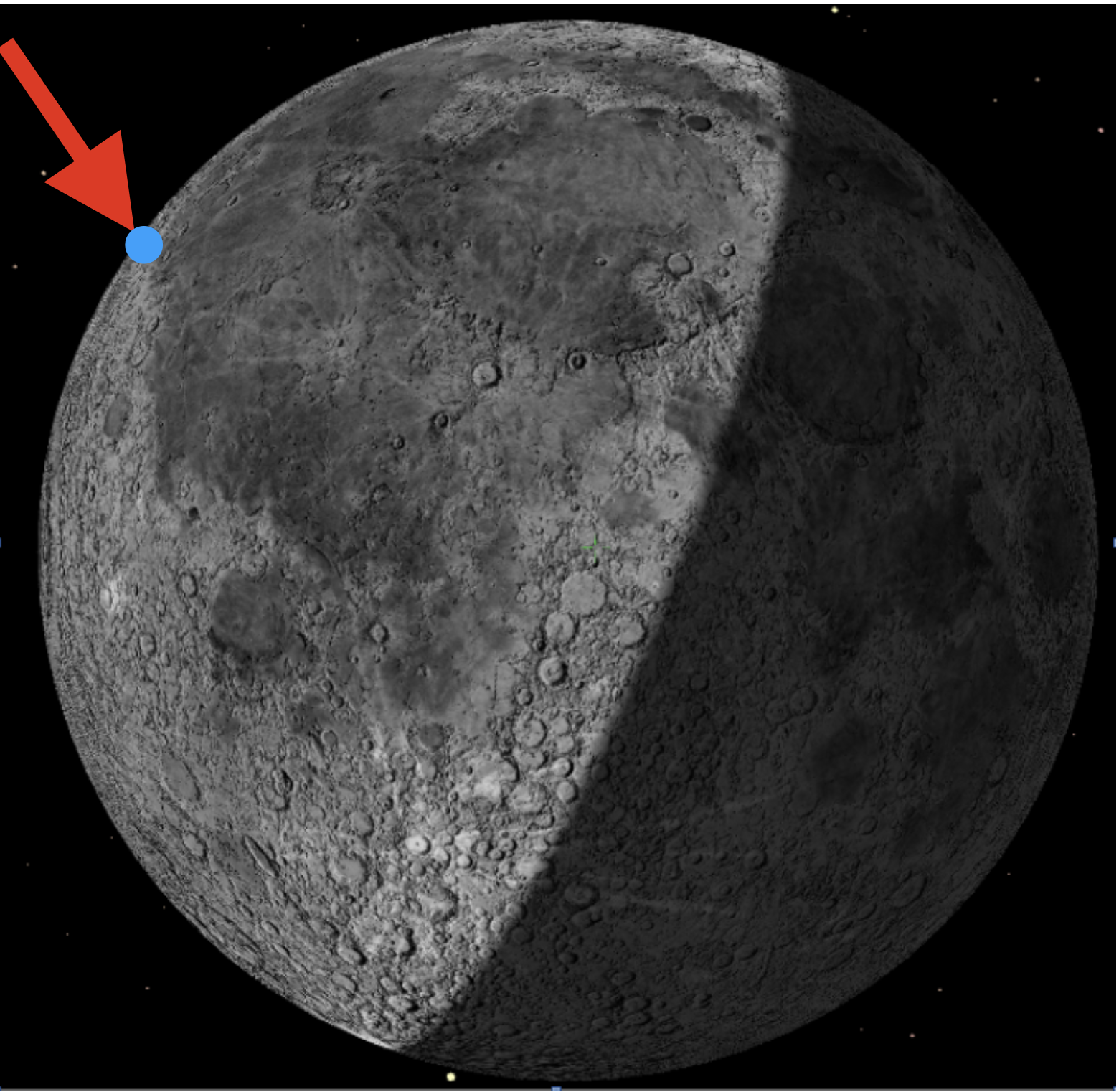
Abstract: On 2026 August 5, at approximately 06:35 UT, a spent Falcon 9 upper stage will impact the lunar surface near Einstein Crater. This event will occur on sunlit terrain near the eastern limb as seen from Earth. The impact flash and resultant ejecta plume from this event are potentially observable from ground- and space-based observational facilities. This event provides an opportunity to attempt the recording of an artificial impact in real-time; although many of the properties of the event (such as visual magnitude) are imprecisely predicted at present. Moreover, this event provides an opportunity to test a pipeline for localising impacts on the lunar surface for future seismic experiments, investigating the dust and plume dynamics from impact events on the Moon, and considering hazards from artificial space debris impacts. Both professional and amateur astronomers are encouraged to attempt observations of this event.

Paper Prompts
Sign up for free to create and run prompts on this paper using GPT-5.
Top Community Prompts
Explain it Like I'm 14
What is this paper about?
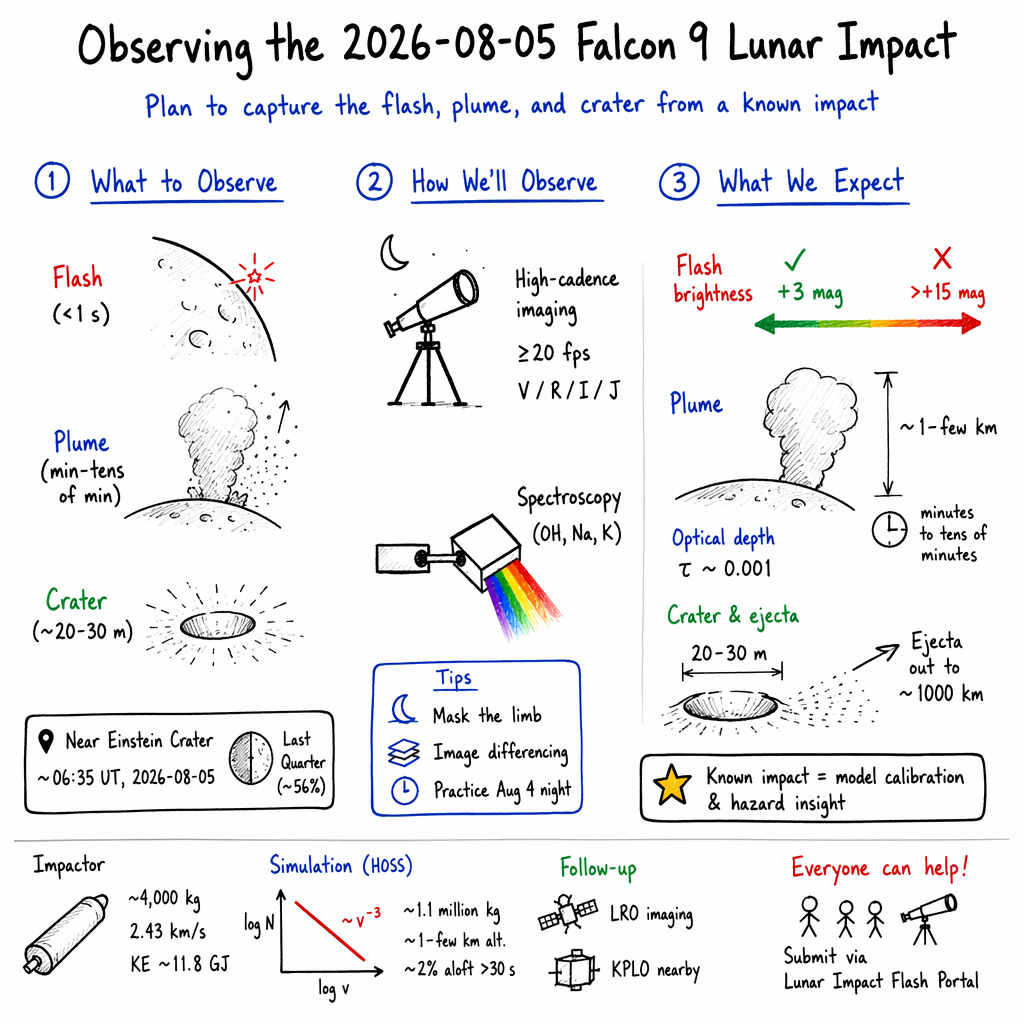
This paper is a game plan for watching a rare, predictable crash on the Moon. On August 5, 2026, a used part of a SpaceX Falcon 9 rocket (the upper stage) is expected to slam into the Moon near Einstein Crater. The authors explain what scientists and even skilled hobbyists might see (a brief flash, a dust plume, and a small crater), how to try to observe it, and what we can learn from it.
What questions are the researchers trying to answer?
The team focuses on a few simple questions:
- Can we see the moment of impact as a quick flash of light, even though it happens on the sunlit side of the Moon?
- Will the impact kick up a dust-and-debris plume high enough and long-lasting enough to be seen from Earth or space?
- How big will the crater be, and what will its shape tell us?
- How can observations from this event help us improve future Moon science, like listening for moonquakes from impacts or planning for astronaut safety?
How did they study it? (Explained simply)
To get ready, the team combined prediction, computer modeling, and observing plans:
- Predicting the impact: They used tracking data to estimate when and where the rocket stage will hit (around 06:35 UTC on August 5, 2026, near 15°N, 88°W on the Moon, close to the eastern edge seen from Earth). They also estimate the speed (about 2.43 km/s) and angle (about 34° from straight down).
- Modeling the plume and crater: They ran a physics-based computer simulation called HOSS. Think of HOSS like a super-detailed “physics sandbox” that shows how material breaks and flies when something hits it. They also used “scaling laws” (engineering rules-of-thumb built from lab impact experiments) to estimate how much material gets thrown out and how fast.
- Planning observations: They outline what kinds of telescopes and cameras might work best. Because the impact happens on the sunlit part of the Moon, spotting a split-second flash is hard. They suggest:
- High-speed imaging (20+ frames per second) so the flash isn’t missed.
- Using different filters or infrared light (especially the J-band) to fight the glare of daylight or bright moonlight.
- Watching for a plume that may last minutes, which is easier to catch than the flash.
- Coordinating ground observatories and spacecraft like NASA’s Lunar Reconnaissance Orbiter (LRO) and Korea’s Pathfinder Lunar Orbiter for before-and-after images.
What did they find, and why is it important?
Here’s what their predictions and plans suggest:
- The flash might be very hard to see:
- Flash brightness depends on what the rocket stage hits. If it hits loose lunar soil (regolith), it’s more likely to make a brighter flash than if it hits bedrock.
- Because this rocket is slower than natural meteoroids, it may produce a much dimmer flash. Estimates range from something as bright as a medium-bright star (+3 magnitude) to too faint to detect (fainter than +15). No one has ever confirmed a flash on the Moon’s sunlit side before, so this would be a first if seen.
- The plume is the better bet:
- The impact should throw out a lot of material—roughly 1.1–1.2 million kilograms (about 150–200 times the rocket stage’s mass).
- In their simulation, the biggest particles they could track rose to about 1.5 km, but smaller, faster dust (which the model couldn’t fully resolve) probably goes higher and stays up longer—potentially visible for several minutes.
- That means a sunlit dust cloud rising over the Moon’s edge might be visible with the right equipment.
- The crater will be small but informative:
- Expected size is about 20–30 meters wide and ~5 meters deep—too small to see from Earth, but clear enough for orbiting cameras.
- There might even be a “double crater” if the rocket breaks apart just before impact.
- The ejected debris could fly far—up to hundreds of kilometers—reminding us that impacts can spread material widely, which is important for future astronaut safety and lunar base planning.
- Who can observe it?
- Best chances from the ground are in the Americas where it’s dark and the Moon is up at the time.
- Professional telescopes will try for both images and chemical fingerprints (spectroscopy) of the plume (looking for elements like sodium).
- Skilled amateur astronomers are encouraged to try high-speed video or infrared observations and share data through organized networks.
Why this matters:
- It’s a “known” impact. Unlike random space rocks, we know the mass, speed, and (roughly) the place and time. That makes it a perfect test to check and improve our models of how bright flashes should be and how plumes evolve.
- It helps us prepare for the Moon’s future. With more missions coming, artificial impacts may happen more often. Understanding impacts helps with:
- Seismology (using impacts as “controlled taps” to probe the Moon’s inside);
- Safety (predicting how far debris travels and how long it hangs around);
- Space traffic awareness (keeping better track of objects in the Earth-Moon neighborhood).
What’s the bigger picture?
This event is like a practice drill for Moon science. If scientists and observers catch the flash or the plume, they can:
- Sharpen their tools for measuring impact light and dust behavior;
- Improve methods for pinpointing impact locations (useful for linking to possible moonquakes);
- Build better plans to protect future lunar habitats and equipment;
- Strengthen global coordination between professional and citizen scientists.
Even if the flash isn’t seen, trying to observe it still teaches us what works and what doesn’t. As humanity returns to the Moon, learning from planned impacts like this one will make future exploration safer and smarter.
Knowledge Gaps
Knowledge gaps, limitations, and open questions
Below is a consolidated list of what remains uncertain or unexplored in the study, framed to guide actionable follow-up work.
- Flash luminous efficiency at low velocities: Quantify luminous efficiency for ~2–3 km/s impacts into lunar regolith vs bedrock, including dependences on impact angle, porosity, and target mechanical properties; current models are unvalidated in this regime and predict brightness from M ≈ +3 to > +15.
- First robust photometry of an artificial lunar flash: No published, calibrated light curve and absolute magnitude exists for an artificial lunar impact flash; establish standardized photometric calibration and timing procedures for this event.
- Target characterization at the impact site: Regolith thickness, bedrock exposure, and mechanical/thermophysical properties within the impact ellipse are not constrained; acquire and analyze pre-impact high-resolution imagery and derived products (e.g., rock abundance, maturity, roughness) to reduce prediction uncertainties.
- Impact state vector uncertainties: The paper does not quantify the impact time window or spatial impact ellipse; propagate orbital-tracking uncertainties to deliver a statistically robust schedule/pointing plan for observers and orbiters.
- Upper-stage mass and residuals: The exact mass (propellant fully spent?) is unknown; bound possible residual chemical energy release and its effects on flash amplitude, plume mass/composition, and crater size.
- Spacecraft attitude and breakup: Attitude at impact and likelihood of “decapitation” are unknown; develop structural/fragmentation models for an underdense, hollow, irregular impactor to predict crater morphology (single vs double), ejecta anisotropy, and flash geometry.
- Oblique-impact plume dynamics: The HOSS run assumes a vertical, axisymmetric impact; perform 3D oblique (34° from vertical) simulations to predict low- vs high-angle ejecta fractions, azimuthal asymmetry, and time-evolving plume height/duration.
- Small-particle ejecta and high-velocity tail: Current resolution (~0.37 m minimum fragment size) misses the small grains that dominate optical depth and may achieve >1 km/s; model and observe the size–velocity distribution to constrain τ, scattering phase function, and plume visibility.
- Plume radiative transfer: No forward model of plume brightness exists in V/R/I/J or narrow bands; build radiative-transfer models to predict signal levels and invert observed brightness to plume mass and grain size distribution.
- Dayside detectability and SNR: Quantitative estimates of contrast and SNR for flash and plume against bright lunar background (including stray light, seeing, instrument throughput) are lacking; simulate detection thresholds to set aperture/cadence/filter requirements.
- Spectral diagnostics and species detectability: It is unclear whether Li I (670.8 nm), Na, K, OH, or other lines will be produced/detectable at ~2.4 km/s and at mid-latitudes; conduct laboratory/ablation modeling (e.g., Al–Li alloys, RP-1/LOX residues) to predict line strengths and guide filter choices.
- Flash temperature and spectrum: No prediction exists for the flash temperature/spectral energy distribution in the low-velocity regime; model expected spectra to optimize multi-band observations and temperature retrieval.
- Topographic occlusion: Potential occlusion by local relief (as happened for LCROSS) is not analyzed; perform visibility analysis using high-resolution topography (e.g., LOLA/SELENE) for the impact ellipse and Earth-view geometry at event time.
- Crater scaling validity: Final crater size/morphology remains uncertain; Pi-scaling may not fully apply to underdense, hollow impactors with complex geometry; run longer-duration, higher-fidelity hydrocodes to steady-state and compare with post-event LRO imaging.
- Surface hazard assessment: Ballistic ranges for unresolved small fragments (possibly >1000 km) and associated risks to surface assets are unquantified; develop probabilistic hazard maps incorporating small-fragment dynamics.
- Space-based observing geometry: LRO’s geometry precludes UV plume spectroscopy; assess alternative orbital assets/pointing strategies and derive requirements for future missions to guarantee compositional diagnostics during such events.
- Multi-site kinematic reconstruction: A plan to derive ejecta velocity distributions via multi-station imaging (triangulation/photogrammetry) is absent; define timing synchronization, geometry, and processing protocols for professional and amateur networks.
- Data standards on bright backgrounds: Community standards for timing accuracy, absolute photometric calibration, flat-fielding, and background subtraction in high-cadence, dayside lunar observations are not specified; publish guidelines and validation datasets.
- Seismic pipeline readiness: The proposed seismic-localization pipeline cannot be validated without contemporaneous lunar seismometers; specify how optical timing/location uncertainties would propagate to seismic constraints for future instrumented campaigns.
- Thermal IR observability: Thermal signatures of the flash and warm ejecta are not modeled; estimate expected IR fluxes and durations vs instrument sensitivities to guide IR observing plans.
- Residual propellant explosion signatures: The impact modeling excludes potential explosive energy from residual propellants; bound its likelihood and potential observational signatures (enhanced flash, distinct spectral lines, plume dynamics).
- Limb-masking (“selenograph”) efficacy: The suppression of lunar glare and achievable detection thresholds with limb-masking are unquantified; conduct pre-event tests and simulations to verify performance.
- Observer decision matrices: Given the broad brightness uncertainty, explicit trade-off guidance (aperture vs cadence vs filter vs exposure) is missing; provide decision matrices derived from end-to-end simulations to optimize observing strategies across scenarios.
Practical Applications
Immediate Applications
The paper outlines an orchestrated, multi-instrument observation and modeling campaign around a predicted artificial lunar impact, yielding several deployable applications across research, industry, policy, and education:
- Coordinated observing playbook for lunar impacts (flash, plume, crater) — Sectors: astronomy (academia, observatories), amateur astronomy — Tools/Products/Workflows: telescope configuration checklists; high-cadence (≥20 fps) imaging protocols; practice-run scripts timed to T−24 h; standardized metadata (timing, location, filter, cadence); image differencing workflow — Assumptions/Dependencies: accurate UT ephemerides; weather and darkness windows; GPS-synced timing; telescope pointing and tracking accuracy; adequate cadence/exposure balance
- Daytime-capable lunar impact observations using SWIR/J band — Sectors: observatories, optical instrumentation, software — Tools/Products/Workflows: J-band/SWIR filters and cameras; exposure/cadence presets to suppress bright sky; daytime flat-fielding procedures; training material for operators — Assumptions/Dependencies: availability of SWIR-capable sensors/filters; site sky brightness; calibration data; thermal background management
- Limb-masking “selenograph” technique for plume detection — Sectors: optics manufacturers, observatories, amateur astronomy — Tools/Products/Workflows: custom limb masks and baffling to block sunlit terrain; mount adapters; step-by-step alignment guides — Assumptions/Dependencies: impact geometry near the limb; mask alignment tolerances; stray light control
- Spectroscopic detection targeting plume species (Na, K, OH, Li I 670.8 nm) — Sectors: observatories, spectroscopy instrument vendors — Tools/Products/Workflows: narrowband filters; echelle spectrographs (e.g., UVES, LDT); line lists and exposure calculators; rapid-reduction pipelines — Assumptions/Dependencies: line brightness vs. background; plume optical depth (~0.001 order-of-magnitude); geometry not obscured by topography; low water content at mid-latitudes
- Citizen science impact-flash campaign activation — Sectors: education, outreach, amateur astronomy — Tools/Products/Workflows: NASA Impact Flash! and LIF portal submission workflow; simple differencing software; training videos; feedback loop for quality control — Assumptions/Dependencies: broad geographic participation; uniform time-stamping; varying telescope apertures; varied seeing conditions
- Standardized data sharing via the Lunar Impact Flash Portal (LIF) — Sectors: software/data infrastructure, academia — Tools/Products/Workflows: submission schema with FITS + metadata; QC flags; DOIs for datasets; recommended licensing for reuse — Assumptions/Dependencies: server uptime; bandwidth at observatories; community adoption; metadata completeness
- Seismic-impact localization pipeline rehearsal (flash-to-source workflow) — Sectors: planetary geophysics (academia, agencies) — Tools/Products/Workflows: flash timing/location to predict seismic wavefronts; integration stubs for future Artemis seismometer arrays; cross-validation scripts — Assumptions/Dependencies: detectable flash; availability of lunar seismometer networks in future; luminous efficiency uncertainty at ~2–3 km/s
- Cislunar space domain awareness (SDA) exercise and conjunction management — Sectors: aerospace, SDA providers, space agencies — Tools/Products/Workflows: Project Pluto ephemerides; conjunction screening with KPLO; real-time dashboards for predicted impact tracks; operations checklists for close approaches — Assumptions/Dependencies: tracking accuracy; cross-agency coordination; timely ephemeris updates; comms/telemetry availability
- Rapid hazard assessment for lunar operations (ejecta range and deposition) — Sectors: space operations, lunar infrastructure, energy (solar), robotics — Tools/Products/Workflows: plume/ejecta envelopes (max altitude few km; ballistic range up to ~1000 km for small fragments); deposition risk memos; operational no-go windows near impacts; cleaning/maintenance guidance for solar arrays and optics — Assumptions/Dependencies: ejecta size-velocity distribution (HOSS under-resolves <0.4 m fragments); regolith vs bedrock at impact site; local topography; winds absent (vacuum)
- Mission planning and observatory scheduling optimization — Sectors: observatories, mission ops — Tools/Products/Workflows: darkness and elevation maps for 06:35 UT; automated scheduler blocks; contingency plans (weather, seeing) — Assumptions/Dependencies: lunar libration/phase; cloud forecasts; staff availability
- FDEM/HOSS parameter sweep for near-term bounds on plume mass/height — Sectors: computational modeling, software — Tools/Products/Workflows: HOSS model templates; parameter sets for orientation, angle (34° from vertical), and regolith density; quick-look plots (velocity distributions, ballistic tracks) — Assumptions/Dependencies: axisymmetric, end-on simplification; limited runtime/resolution; extrapolation to unresolved fine fragments
- Communication and STEM engagement around a scheduled celestial event — Sectors: education, public outreach — Tools/Products/Workflows: live streams with timing overlays; educator guides (physics of impacts, crater scaling); student data-participation kits — Assumptions/Dependencies: visibility; successful data capture; age-appropriate materials
- Preliminary risk inputs for insurance/finance of lunar assets — Sectors: finance/insurance, commercial lunar services — Tools/Products/Workflows: actuarial priors for plume reach/frequency; event catalogs; parametric triggers tied to impact proximity — Assumptions/Dependencies: credible frequency models; standardized event reporting; stakeholder demand
Long-Term Applications
Beyond the 2026 event, the methods and findings support scalable capabilities and policy frameworks that require further development:
- Persistent Lunar Impact Monitoring Network (visible + SWIR, pro/amateur) — Sectors: astronomy networks, software, SDA — Tools/Products/Workflows: globally distributed telescopes with synchronized high-cadence imaging; automated alerting; unified pipelines (detection, validation, archiving) — Assumptions/Dependencies: sustained funding; instrumentation homogeneity or robust cross-calibration; global participation
- Controlled-source lunar seismology for Artemis-era interior studies — Sectors: planetary science, space agencies — Tools/Products/Workflows: planned small impactors as seismic calibrators; integration with AxiSEM3D and source inversion; co-registered flash+seismic catalogs — Assumptions/Dependencies: deployment of distributed lunar seismometer arrays; safe impactor delivery; regulatory approval for deliberate impacts
- Cislunar debris mitigation and notification standards — Sectors: policy/regulation, space operations — Tools/Products/Workflows: passivation and disposal requirements for lunar-transfer stages; impact notification protocols (time/location/uncertainties); cross-agency MOUs — Assumptions/Dependencies: international consensus (UNCOPUOS, IADC); compliance verification; verification assets (tracking)
- Dust and ejecta contamination models for lunar infrastructure design — Sectors: lunar construction, energy (solar), robotics, optics — Tools/Products/Workflows: radiative transfer and deposition models; design requirements for dust protection (baffles, coatings, electrostatic cleaning); siting constraints outside likely ballistic corridors — Assumptions/Dependencies: validated grain-size distributions and optical depths; site-specific topography and traffic patterns; maintenance logistics
- Automated dayside flash/plume detection using ML and SWIR — Sectors: software/AI, observatories, SDA — Tools/Products/Workflows: training datasets from this and future events; real-time classifiers for transient detection under bright backgrounds; on-sensor FPGA pre-filtering — Assumptions/Dependencies: labeled datasets; robust ground truth (LRO/KPLO “after” imaging); compute at the edge
- Commercial “impact observation kits” for observatories and clubs — Sectors: optical hardware, education, amateur astronomy — Tools/Products/Workflows: bundled SWIR or narrowband filters, limb masks, GPS time inserters, preconfigured cameras; turnkey software for differencing and reporting — Assumptions/Dependencies: market demand; supply chain for SWIR components; support/training
- Conjunction assessment and traffic management services in cislunar space — Sectors: SDA/STM, aerospace — Tools/Products/Workflows: high-fidelity propagators for lunar resonances; risk scoring; operations playbooks for close approaches among spacecraft and debris — Assumptions/Dependencies: tracking sensor coverage in cislunar; data-sharing agreements; standard ephemeris formats
- Improved luminous-efficiency and ejecta-scaling laws at 2–3 km/s — Sectors: academia, mission design, observatories — Tools/Products/Workflows: combined lab + observational campaigns; model updates feeding exposure calculators and observation budgets; cross-planetary defense relevance — Assumptions/Dependencies: sufficient event sample size; access to test facilities; agreement on calibration standards
- Planetary defense and kinetic impactor physics cross-application — Sectors: planetary defense, mission design — Tools/Products/Workflows: transfer of ejecta momentum enhancement and plume dynamics to asteroid impact modeling; instrument spec updates for future missions — Assumptions/Dependencies: material property scaling from lunar regolith to asteroid surfaces; velocity regime translation
- Insurance underwriting and risk-sharing mechanisms for lunar operations — Sectors: finance/insurance — Tools/Products/Workflows: actuarial models incorporating impact frequency, plume reach, and contamination risk; parametric covers tied to monitored events — Assumptions/Dependencies: reliable monitoring network; accepted hazard models; regulatory frameworks for space insurance
- Cross-mission collaboration frameworks and data standards — Sectors: policy, data infrastructure, space agencies — Tools/Products/Workflows: interoperable data formats/metadata for impact events (flash, plume, crater); joint rapid-response observations (LRO, KPLO, ESA, JAXA); persistent archives with DOIs — Assumptions/Dependencies: governance and funding; long-term curation commitments; cybersecurity
- Education and workforce development in SDA and planetary geoscience — Sectors: education, workforce — Tools/Products/Workflows: curricula using real impact datasets; hackathons building detection pipelines; internships at observatories and SDA firms — Assumptions/Dependencies: open data access; institutional adoption; sustained community engagement
- Accessory integration of “selenograph” limb-mask modules for telescopes — Sectors: telescope manufacturers, makers — Tools/Products/Workflows: OEM or aftermarket baffling kits; alignment software; standardized mounting interfaces — Assumptions/Dependencies: repeat demand; adaptability across apertures and mounts
- Operations constraints and zoning for lunar base planners — Sectors: lunar architecture, robotics, energy — Tools/Products/Workflows: zoning maps that avoid likely secondary-ejecta corridors; maintenance scheduling to avoid plume windows; design of resilient radiators/optics against dust — Assumptions/Dependencies: validated long-range ejecta statistics; integration with traffic forecasts (natural meteoroids + artificial impacts)
Notes on cross-cutting assumptions that affect feasibility:
- Flash brightness is highly uncertain at ~2.4 km/s and depends on target (regolith vs bedrock) and stage attitude, influencing detectability and calibration value.
- The HOSS simulation is axisymmetric and under-resolves small, high-velocity fragments; extrapolations are needed for fine dust optical depth and far-range ejecta.
- Orbital geometry, libration, and local topography can obscure line-of-sight (e.g., LCROSS hill occultation case).
- Spacecraft availability and pointing (LRO, KPLO) and ground weather/seeing drive data yield.
- International policy and coordination are prerequisites for sustainable cislunar debris mitigation and data-sharing standards.
Glossary
- Axisymmetric: Having rotational symmetry around a central axis, often assumed to simplify impact simulations; "we restrict our simulation to an axisymmetric, vertical, end-on impact (i.e. with the long axis of the impactor perpendicular to the surface)."
- Ballistic: Describing motion under gravity alone, without propulsion or significant drag; "their resultant ballistic tracks"
- Cadence: The temporal sampling rate of observations (frames per second), crucial for capturing fast phenomena; "necessitating high-cadence imaging if the light curve is to be resolved."
- Cislunar: The region of space between Earth and the Moon; "monitor the cislunar environment."
- Conjunction: A close approach in space of two orbiting objects as seen from a reference frame; "undergo a close conjunction (on the order of kilometres) with the Korean Pathfinder Lunar Orbiter spacecraft."
- COSPAR designation: An international identifier assigned to space objects by the Committee on Space Research; "(COSPAR 2025-010D, NORAD/SatCat 62719)"
- Decapitation (of an impactor): Breakup in which the leading portion of an impactor separates, potentially altering crater morphology; "likely due to the `decapitation' of the impactor."
- Double crater: Two adjacent or overlapping craters formed by a fragmented or multi-part impactor; "Chang'e 5's upper stage produced a double crater, likely due to the `decapitation' of the impactor."
- Ejecta: Material excavated and thrown out from an impact crater; "a cloud of ejecta (and possibly vapour) lofted above the lunar surface"
- Ejecta blanket: The continuous deposit of ejecta surrounding an impact crater; "the ejecta blanket should be continuous over an area around 70~m in diameter"
- Ejecta curtain: A transient, sheet-like spray of material expelled during crater excavation; "in the form of a transient `ejecta curtain'"
- Finite-Discrete Element Method (FDEM): A numerical technique combining finite- and discrete-element methods to model solids that can fracture and fragment; "The HOSS simulation uses the finite-discrete element method (FDEM)"
- Hybrid Optimization Software Suite (HOSS): A multiphysics code implementing FDEM for simulating impact and fracture processes; "Using the Hybrid Optimization Software Suite (HOSS) multiphysics simulator"
- Hypervelocity: Extremely high speeds (typically km/s) at which impacts generate shock-dominated behavior; "including high strain-rate, hypervelocity planetary impact problems"
- Impact ellipse: The predicted uncertainty region for an impact location on a surface; "the current impact ellipse also includes bedrock exposures."
- Impact flash: A brief burst of light produced at the moment of impact by vaporization and heating; "Detection of the impact flash is expected to be challenging due to its location on the dayside hemisphere of the Moon."
- Impact plume: A cloud of dust and/or vapor lofted by an impact and evolving over minutes; "The impact plume: a cloud of ejecta (and possibly vapour) lofted above the lunar surface and evolving on a timescale of minutes,"
- J band: A near-infrared photometric band centered around 1.2–1.3 μm used in astronomy; "the J band may be advantageous for observers seeking to record flashes in daylight due to the reduced sky brightness"
- JD (Julian Date): A continuous count of days used in astronomy for precise timing; "06:35~UT (JD 2461257.774)."
- Li I doublet: The pair of closely spaced spectral lines of neutral lithium near 670.8 nm; "doublet emission line (Li I) at 670.8~nm."
- Libration (lunar): Apparent oscillations in the Moon’s orientation that reveal slightly more than half its surface over time; "This figure accounts for the effects of lunar libration, without which the impact would occur over the edge of the lunar limb."
- Limb (lunar): The apparent edge of the Moon’s disk; "visible from Earth over the limb"
- Luminous efficiency: The fraction of impact kinetic energy converted into observable light; "largely due to the variation in the assumed luminous efficiency"
- OH (hydroxyl): The hydroxyl radical, often detected spectroscopically in plumes; "A tentative detection of OH, possibly from the plume, was also reported in Hubble data"
- Optical depth: A measure of how opaque a medium is to radiation along a line of sight; "with an optical depth of 0.00180.0002"
- Permanently shadowed region: Areas near the lunar poles that never receive direct sunlight; "impacted a permanently shadowed region at approximately 2.5 km/s."
- Pi-scaling: Dimensionless crater-scaling laws using π groups to relate impact conditions to crater and ejecta properties; "Pi-scaling predicts a maximum ejecta velocity of 1,200~m/s."
- Regolith: The loose, fragmented surface layer of dust and rock on airless bodies like the Moon; "upper stage impact into lunar regolith"
- Selenograph: An occulting mask or setup used to block the bright lunar disk to enhance visibility near the limb; "acting as a `selenograph'"
- Shepherding spacecraft: A companion spacecraft used to observe and characterize an impact plume; "A shepherding spacecraft then characterised the plume"
- Shock physics: The study of material behavior under shock waves, common in high-velocity impacts; "a nonlinear shock physics simulation"
- Terminator (lunar): The dividing line between lunar day and night; "This impact occurred very close to the terminator"
- Transient crater: The initial excavation cavity formed immediately after impact before collapse and modification; "This is sufficient for a transient crater to form"
- Ultraviolet spectroscopy: Spectroscopic analysis in the UV to identify and quantify gases and species; "precludes ultraviolet spectroscopy of plume gases"
- Visual magnitude: A logarithmic measure of apparent brightness in the visible band; "The visual magnitude, , of a flash is highly dependent on both the orientation of the upper stage at impact and the target material (regolith versus bedrock)."
Collections
Sign up for free to add this paper to one or more collections.