T^2MLR: Transformer with Temporal Middle-Layer Recurrence
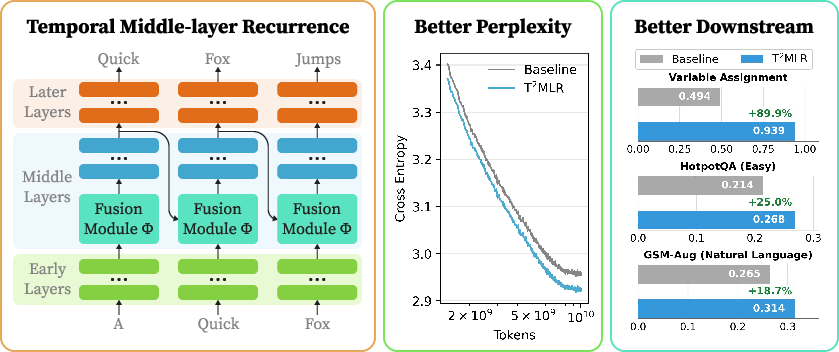
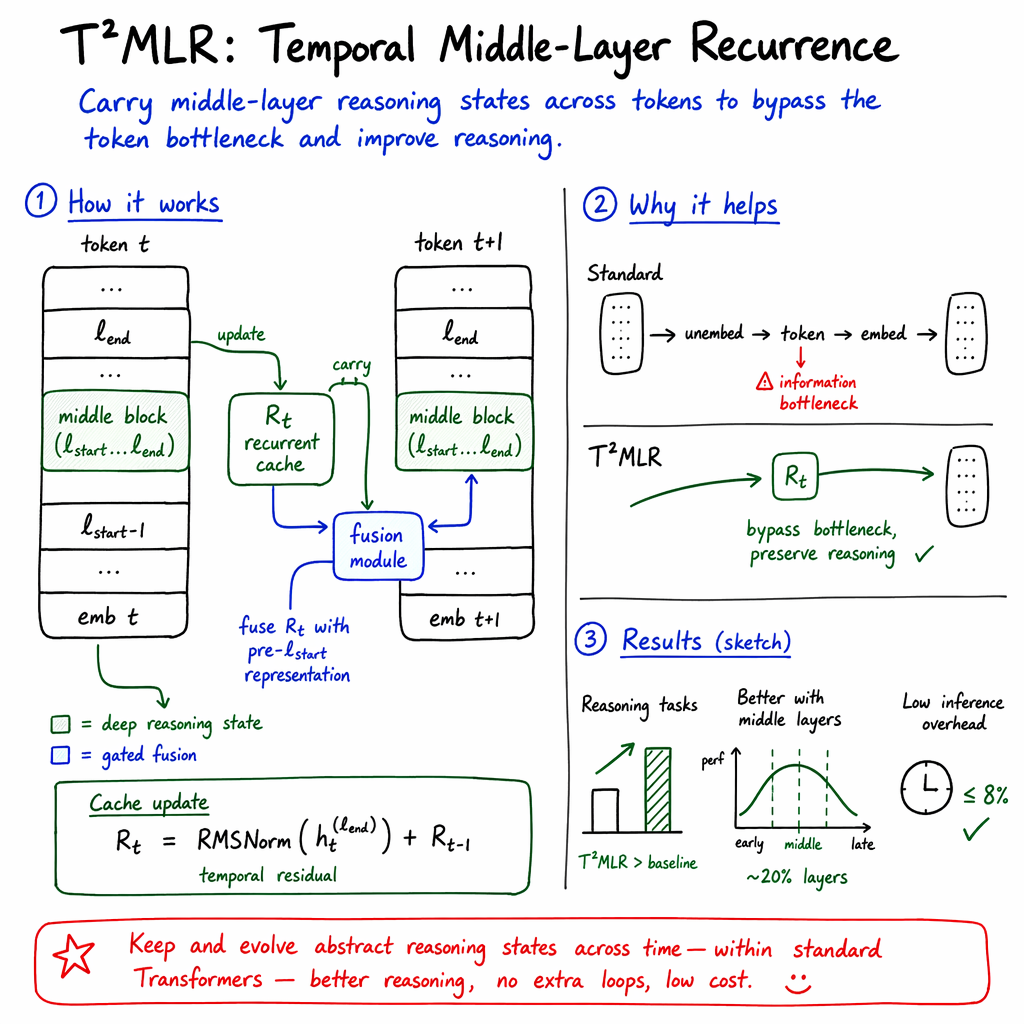
Abstract: Transformer reasoning is limited by autoregressive decoding, which repeat edly compresses rich hidden computation through token space and makes it difficult for intermediate reasoning states to persist across time. We in troduce Transformers with Temporal Middle-Layer Recurrence (T2MLR), a transformers-based latent reasoning architecture that fuses a cached middle layer representation from the previous token directly into an earlier layer of the current token position, enabling abstract intermediate computation to persist across decoding steps with little inference overhead. Across natural-language pretraining and multi-hop reasoning finetuning, T2MLR consistently outperforms data- and parameter-matched Transformer base lines. Moreover, applying recurrence to only a localized middle-layer block (as little as 20% of the network) often outperforms full-layer recurrence. Im portantly, T2MLR does not require pretraining from scratch: retrofitting the recurrent pathway into an existing pretrained 1.7B Transformer and briefly finetuning substantially improves math reasoning, lowering the barrier to practical adoption. These results suggest that effective latent reasoning in Transformers does not require looping over all layers as in previous works, but can instead emerge more strongly from targeted middle-layer recurrence.
Paper Prompts
Sign up for free to create and run prompts on this paper using GPT-5.
Top Community Prompts
Explain it Like I'm 14
Explaining “T²MLR: Transformer with Temporal Middle-Layer Recurrence”
What is this paper about?
This paper is about making AI LLMs (Transformers) better at multi-step reasoning—things like solving math problems or answering questions that need several steps of thought. The authors add a simple “memory bridge” that lets the model carry its mid-thoughts from one word to the next, so it doesn’t have to “start over” at every step.
What questions did the researchers ask?
The researchers focus on three easy-to-understand questions:
- Can we help a Transformer “remember” its deeper, more abstract thoughts from one word to the next, instead of only passing along the last output word?
- If we add this memory, where should it connect—at the start, at the end, or in the middle of the model—for the best reasoning?
- Can we get these benefits without making the model much slower when it’s actually being used (inference time)?
How does their method work?
Transformers and the “information bottleneck”
- A Transformer writes text one token (word/part of a word) at a time.
- Inside the model, there’s a lot of complex thinking across many layers. However, at each step, all that thinking gets squashed down into a single next token before moving on. That’s like compressing a long thought into one word, then asking the model to reconstruct the whole thought again at the next step.
- This creates an “information bottleneck”: important intermediate reasoning can be lost between steps.
The new idea: a middle-layer memory between tokens
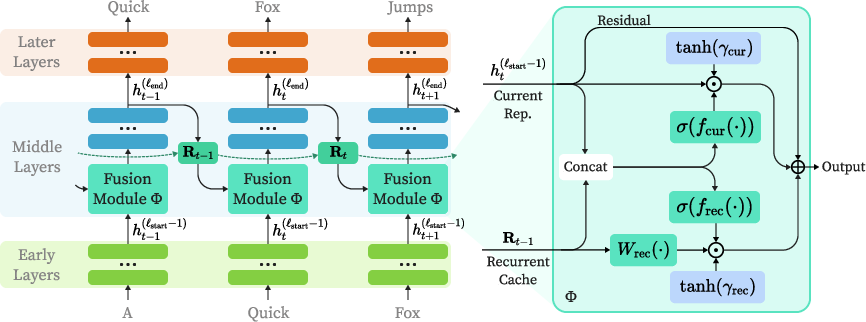
- The authors add a small “recurrence” pathway that carries a summary of the model’s mid-level thinking from the previous token directly into an earlier layer of the next token.
- Think of it as a sticky note that preserves the model’s internal scratch work from one word to the next—without having to write everything out again.
- Importantly, this pathway lives in the middle layers, where research suggests abstract reasoning happens most strongly (early layers focus on reading words, late layers focus on picking the next word).
How the “fusion gate” works (in everyday terms)
- The model keeps a compact “cache” (a tiny memory) of its middle-layer representation from the last token.
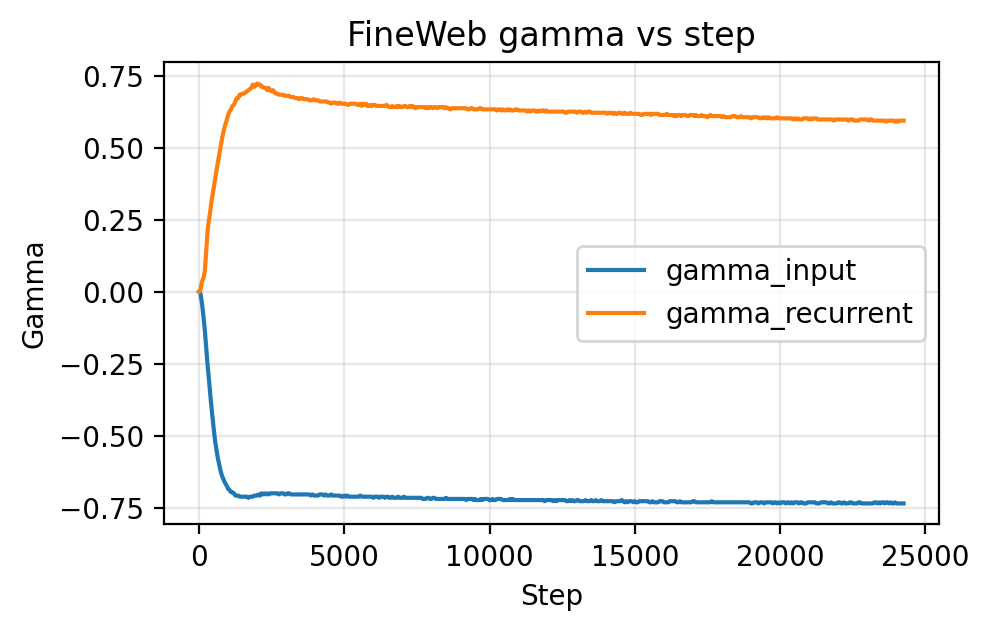
- At the next token, a “gate” decides how much of this memory to blend into the current thinking. This gate is like a volume knob that turns up or down the influence of the previous step’s thoughts.
- This blending helps the model continue its reasoning across tokens, rather than repeatedly rebuilding it from scratch.
Training without slowing everything down
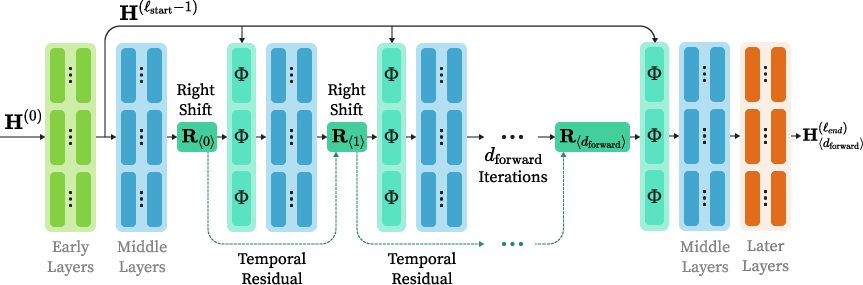
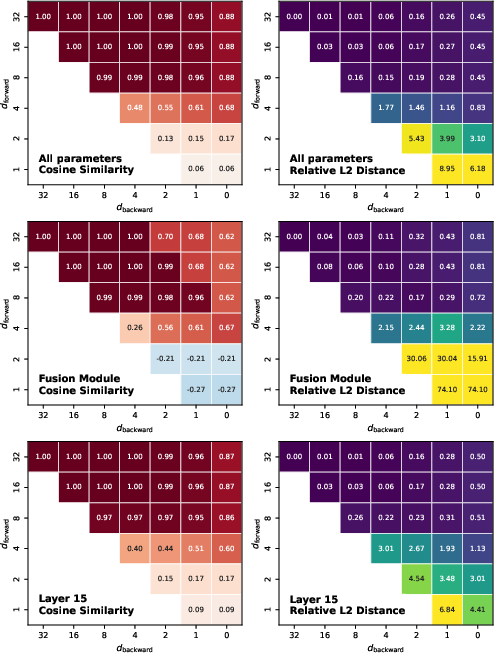
- Training this kind of recurrence is tricky because the memory depends on previous tokens. To keep training practical, the authors use a fast approximation: they refine the memory a small number of times in parallel (like doing a few quick practice passes instead of fully rewinding time).
- During actual use (inference), the extra cost is small (about ~8% more per token), since you only do the simple blend once each step. That’s much cheaper than methods that loop through all layers multiple times per token.
What did they find, and why is it important?
Across pretraining and multiple reasoning benchmarks, the method consistently helped. Here are the highlights:
- Better reasoning from “middle-layer memory” than “full-layer looping”:
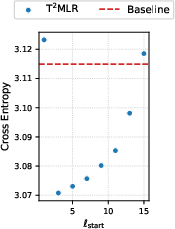
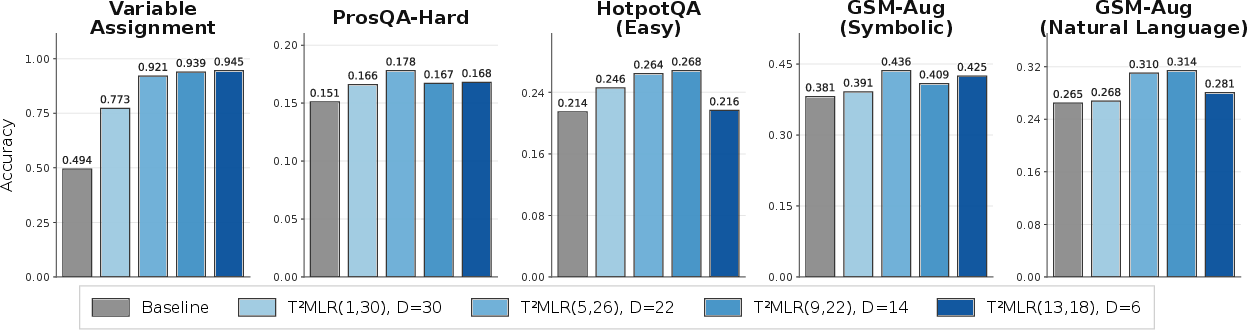
- Recurring only over a small middle block (as little as ~20% of the layers) often worked better than looping over all layers. This suggests the most useful place for carryover thinking is the middle, where the model forms abstract concepts.
- Strong performance on a hard synthetic test that mixes state tracking and retrieval:
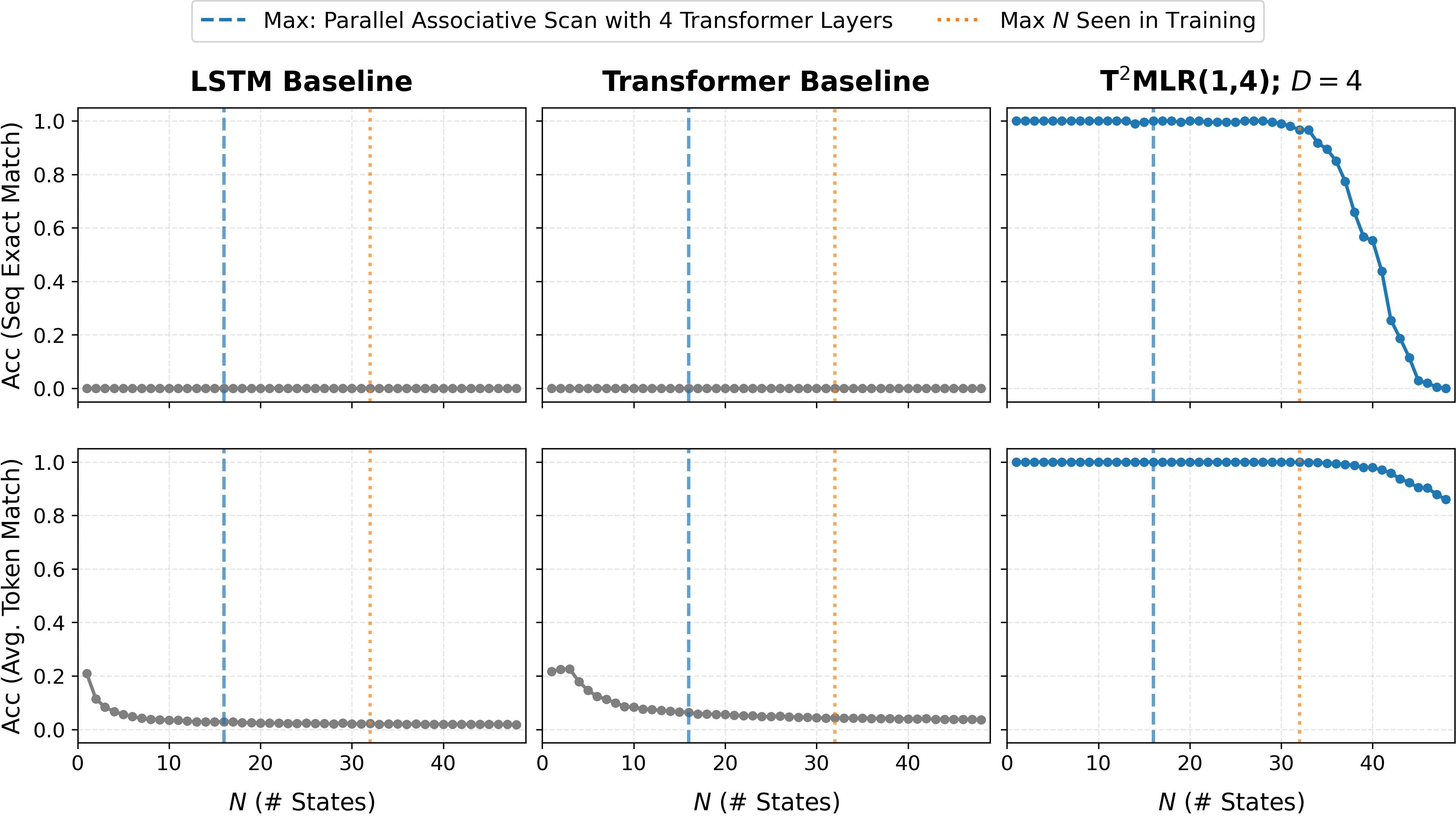
- On a custom task that requires both keeping track of a changing state (like updating a puzzle move-by-move) and looking up information, their model outperformed both standard Transformers and classic RNNs/LSTMs. In short: it combined both strengths.
- Better pretraining and downstream results at similar size:
- When trained on large text datasets, models with this middle-layer recurrence had lower perplexity (a standard measure of prediction quality) and better scores on question-answering and commonsense tests than matched Transformers.
- On multi-step reasoning tasks (like graph reasoning, variable assignment, and math), the method improved accuracy over the same-size baseline.
- Easy to retrofit into existing models:
- They took a 1.7B-parameter instruction-tuned model and added their “memory bridge,” then did a short fine-tune on math data. Results improved notably:
- GSM8K: 35.8 → 39.9
- MATH500: 12.8 → 18.0
- This means you don’t have to pretrain from scratch to benefit—you can upgrade existing models.
- Low extra cost at use time:
- Unlike models that loop multiple times through layers at every token, this approach adds only a small overhead during inference.
What’s the potential impact?
- Smarter step-by-step thinking: The model can carry its internal “scratch work” across tokens, which helps with multi-step problems in math, logic, and complex Q&A.
- Practical and adoptable: Because it’s cheap to run and can be added to existing models, this approach is attractive for real-world systems that need better reasoning without huge new costs.
- A new design lesson: Recurrence seems most helpful in the middle layers—where abstract reasoning lives—rather than everywhere. This insight could guide future model designs.
In short
This paper proposes a simple, effective way to help Transformers keep their mid-level thoughts alive across tokens. By blending a cached middle-layer representation from the previous token into an earlier layer of the current token, the model reasons more smoothly over time. The approach improves performance on several tasks, is cheap to use, and can be added to existing models—making it a practical step forward for better machine reasoning.
Knowledge Gaps
Knowledge gaps, limitations, and open questions
Below is a consolidated list of what remains missing, uncertain, or unexplored, framed to be actionable for follow-up research.
- Convergence and bias of the training-time approximation
- No theoretical or empirical characterization of the Jacobi-style approximation’s convergence to the true recurrent state, its bias, or stability across sequence lengths.
- Unclear how approximation depth (d_forward) and truncated backprop depth (d_backward) influence optimization dynamics, gradient quality, and final performance; no sensitivity curves or compute–accuracy Pareto.
- Train–inference mismatch
- During training, caches are approximated via multiple refinement passes, whereas inference uses a single-step recurrent update; the impact of this mismatch on calibration, stability, and long-horizon reasoning is not quantified.
- Stability and boundedness of the recurrent state
- No analysis of whether the additive cache update with RMSNorm leads to drift, saturation, or exploding/vanishing signals over long sequences; lack of learned decay/forget gates evaluation.
- Formal expressivity and depth–time tradeoffs
- No theoretical guarantees showing when middle-layer recurrence reduces required depth vs standard Transformers or looped models (e.g., for classes of functions/languages), nor complexity-theoretic separations beyond the synthetic S5 setting.
- Placement and width of recurrence
- While middle-layer recurrence is beneficial, there is no systematic search or learned policy for choosing the recurrence start/end layers across scales or tasks; no per-token adaptive placement or width (D) explored.
- Capacity and dimensionality of the cache
- The recurrent cache R_t matches hidden size by default; no ablation on low-rank or bottlenecked caches, multi-slot caches, or sparsified/quantized caches to trade capacity vs compute/memory.
- Multi-step temporal horizon
- The method carries only the previous step’s state; untested are multi-step or decayed memories (e.g., exponential moving averages, dilated recurrence, attention over past R_t), and their impact on longer reasoning chains.
- Fusion design space
- Only one gated fusion variant (sigmoid/tanh + linear projections) is tested; missing comparisons against alternatives (cross-attention to the cache, FiLM/conditional layer norms, GRU/LMU-like updates, residual placement before/after attention/MLP, normalization choices).
- Interaction with attention and KV-cache
- Unclear whether recurrence reduces dependence on long KV histories or improves attention efficiency; no evaluation on long-context tasks (e.g., Needle-in-a-Haystack, long-document QA) or analyses of KV-cache size vs quality.
- Compute–accuracy trade-offs vs looped/latent baselines
- Although inference overhead is low, training is 2–4× slower; no comprehensive Pareto front comparing T2MLR to looped Transformers, pause-token, SSMs, and memory-augmented models under matched training and inference budgets.
- Scale and variance
- Main results focus on ≤1B models and ≤50B tokens; larger-scale pretraining (e.g., ≥7B, ≥200B tokens), multi-seed variance, and significance testing on broad benchmarks are not reported.
- Benchmark breadth and rigor
- Limited coverage of strong reasoning suites (BBH, AQuA, MMLU-pro reasoning subsets, full GSM8K, MATH, DROP, ProofWriter). Few-code evaluations (HumanEval/MBPP) and limited real-world retrieval settings (open-domain QA) leave generality untested.
- Robustness and OOD generalization
- Beyond S5, there is no systematic study of OOD sequence lengths, prompt/noise perturbations, adversarial inputs, or robustness under distribution shift on natural tasks.
- Mechanistic interpretability of the recurrent pathway
- It remains unknown what information R_t encodes, how it evolves across steps, and which submodules use it; no probing/CAUSAL-tracing/SAE analyses to attribute reasoning improvements to specific circuits.
- Training strategies and curricula
- Unexplored are curricula for gradually increasing recurrence depth, annealing approximation steps, or staged training (pretrain baseline → retrofit → recurrent finetune) beyond one retrofit case; no study of catastrophic forgetting or interference with instruction tuning.
- Compatibility with other methods
- Interaction with chain-of-thought prompting, tool-use/RAG, program-of-thoughts, and RLHF/DPO remains untested; unclear whether T2MLR reduces the need for explicit CoT tokens or improves tool calling/verification.
- Systems and serving implications
- No wall-clock, throughput, and memory profiling under realistic serving stacks (vLLM, paged attention, speculative decoding, continuous batching); unclear how R_t affects batching efficiency and KV eviction policies at scale.
- Safety, privacy, and controllability
- Persistent latent states may carry sensitive or undesired information across tokens; no protocols to audit, reset, bound, or log R_t, nor evaluation of safety/behavioral drift effects tied to latent memory.
- Negative results and failure modes
- The paper does not document tasks where T2MLR underperforms or harms performance, making it hard to delineate applicability boundaries or diagnose failure modes (e.g., purely lexical tasks or very long-form generation).
- Quantization, pruning, and distillation
- Effects of low-bit quantization, structured sparsity, or distilling T2MLR into standard Transformers (or vice versa) are unstudied; important for deployment efficiency.
- Multi-modal and encoder–decoder extensions
- No exploration of applying middle-layer recurrence to encoders, encoder–decoders, or multi-modal models (VLMs, speech); open question where recurrence should live in non-decoder-only stacks.
- Learned or dynamic recurrence
- The recurrence region is static; not explored are learned gating that decides when/where to recur per token/task, or routing-based recurrence that adapts to instance difficulty.
Practical Applications
Immediate Applications
The following applications leverage T2MLR’s low-overhead inference, retrofittability into existing Transformers, and consistent gains on multi-step reasoning (math, graph connectivity, multi-hop QA) without requiring full pretraining from scratch.
- Sector: Education — Use case: Math and science tutoring assistants for multi-step problems
- Why T2MLR: Improves grade-school math reasoning (GSM8K, MATH500) with ~8% per-token inference overhead and strong gains when retrofitted into a 1.7B model.
- Potential tools/workflows: “T2MLR Tutor” fine-tuned on curriculum-aligned math datasets; on-device or cloud API for step-by-step solution guidance; settings to expose concise or full chain-of-thought.
- Assumptions/dependencies: Access to finetuning data (e.g., GSM-8K-like or domain-specific math); modest compute for short finetunes; guardrails for hallucination and pedagogy quality.
- Sector: Customer support and IT operations — Use case: Troubleshooting copilots that track state across multi-turn dialogues
- Why T2MLR: Temporal middle-layer recurrence preserves intermediate latent state, aiding stepwise diagnostic reasoning without costly looped inference.
- Potential tools/workflows: “Reasoning upgrade” to existing service bots (LLaMA/SmolLM-based) via retrofitting; workflows that chain multi-hop retrieval (RAG) with latent reasoning for root-cause narratives.
- Assumptions/dependencies: Integration with existing KB/RAG stack; safe-action constraints; domain-specific finetuning.
- Sector: Software engineering — Use case: Code assistant for multi-hop debugging and log-anchored reasoning
- Why T2MLR: Better state tracking plus in-context retrieval (S5-Retrieval performance) supports stepwise narrowing of failure hypotheses and patch planning.
- Potential tools/workflows: CI plugin that analyzes stack traces across steps; “latent CoT” to reduce verbosity while keeping structured internal reasoning.
- Assumptions/dependencies: Representative finetuning sets (bugs, logs, patches); tool-use integrations (e.g., test runner) for verification.
- Sector: Legal and compliance — Use case: Multi-hop regulation/contract analysis and cross-reference checking
- Why T2MLR: Middle-layer recurrence improves multi-hop QA over long, structured texts; better latent state persistence across steps enables cross-clause reasoning.
- Potential tools/workflows: Compliance auditors that chain retrieval from statutes and internal policies with latent reasoning; audit trail that records sources and reasoning summaries.
- Assumptions/dependencies: High-quality retrieval pipelines; domain-tuned finetuning; strict citation and safety policies.
- Sector: Finance — Use case: Analytical copilots for step-by-step forecasting and what-if scenario analysis
- Why T2MLR: Gains on arithmetic-heavy and symbolic tasks translate to more reliable multi-step calculations and hypothesis evaluation.
- Potential tools/workflows: Spreadsheet copilots that compute intermediate states internally while outputting concise steps; “explain-and-verify” calculators for governance.
- Assumptions/dependencies: Access to structured financial data; evaluation harness for numerical accuracy; risk/compliance review.
- Sector: Knowledge management/enterprise search — Use case: Multi-hop question answering over internal corpora
- Why T2MLR: Retains abstract reasoning states across steps and pairs well with RAG to reduce hallucinations in complex queries.
- Potential tools/workflows: Enterprise QA that composes multiple retrieved snippets with latent reasoning; short justifications with source attributions.
- Assumptions/dependencies: Document ingestion and retrieval quality; minimal inference overhead fits low-latency SLAs; red-teaming for security/privacy.
- Sector: Government/public services — Use case: Citizen-facing assistants for rules and benefits navigation
- Why T2MLR: Multi-hop reasoning through eligibility rules and exceptions; keeps inference costs near-baseline (unlike looped models).
- Potential tools/workflows: Policy navigators that track intermediate states (eligibility flags, thresholds) while generating clear instructions.
- Assumptions/dependencies: Up-to-date rules datasets; transparency requirements; bias/fairness audits.
- Sector: Data analytics — Use case: Natural-language analytics queries with intermediate state tracking
- Why T2MLR: Supports iterative refinement of a query plan (filters, joins, aggregations) before generating final SQL/answer.
- Potential tools/workflows: BI copilots that plan-and-execute while retaining internal state; “latent chain-of-thought” to keep tokens low.
- Assumptions/dependencies: Tool-use integration (SQL runners); data governance and access control.
- Sector: Academic research — Use case: Mechanistic interpretability and reasoning-probe studies
- Why T2MLR: Provides a controllable recurrent pathway at middle layers (where abstract reasoning arises), enabling targeted probes and causal interventions.
- Potential tools/workflows: Probing the recurrent cache (Rt) to measure content; ablations on recurrence boundaries (ℓs, ℓe) and gates; reproducible open-source baselines.
- Assumptions/dependencies: Access to training code and logs; compute for small-to-mid-scale runs; IRB/ethics for data use.
- Sector: Model engineering/MLOps — Use case: Retrofitting existing production models to boost reasoning
- Why T2MLR: Demonstrated retrofit to SmolLM2-1.7B with brief finetuning yields sizable math gains; minimal inference changes ease deployment.
- Potential tools/workflows: “T2MLR adapters” (PEFT-style) adding gated fusion + cache update; A/B frameworks for reasoning KPIs.
- Assumptions/dependencies: Modifying model graphs and checkpoints; support in inference stacks (KV cache plus R cache); regression testing.
- Sector: Test and evaluation — Use case: New reasoning benchmarks and diagnostics
- Why T2MLR: S5-Retrieval stresses the intended bias (state tracking + retrieval), enabling better evaluation coverage for latent reasoning.
- Potential tools/workflows: Synthetic tasks (group-state + in-context retrieval), graph reasoning datasets, and arithmetic suites for CI of reasoning models.
- Assumptions/dependencies: Open-sourced datasets/generators; alignment with downstream use-cases.
- Daily life — Use case: Personal planning and budgeting with multi-constraint reasoning
- Why T2MLR: Maintains intermediate states (budget limits, schedule constraints) across steps with compact outputs.
- Potential tools/workflows: Mobile assistants that plan trips or budgets while adjusting constraints interactively.
- Assumptions/dependencies: Privacy-preserving on-device or encrypted inference; UI for inspecting and correcting plans.
Long-Term Applications
These directions require further research, scaling, or ecosystem integration (e.g., larger models, multimodality, training-efficiency advances, or regulatory validation).
- Sector: Foundation models — Use case: Integrate middle-layer recurrence in large (≥70B) models for state-of-the-art reasoning
- Why T2MLR: Gains grow with scale in smaller experiments; inference overhead remains low compared to looped models.
- Dependencies: Vendor support for architectural changes; large-scale training/stabilization; comprehensive evals to validate broad generalization.
- Sector: Multimodal AI (vision, audio, video) — Use case: Temporal reasoning over video or event streams
- Why T2MLR: Temporal recurrence at reasoning layers could track latent states across frames/events without expensive looping.
- Dependencies: Multimodal encoders and fusion; new training curricula; safety for misinterpretation of visual cues.
- Sector: Robotics — Use case: Language-conditioned planning with persistent internal state
- Why T2MLR: Retains abstract plans and subgoals across thought steps; better plan revision with low latency.
- Dependencies: Tool/use execution layers; grounding to perception/action; real-time constraints; safety and robustness validation.
- Sector: Healthcare — Use case: Clinical decision support with multi-step guidelines and differential diagnosis
- Why T2MLR: Improved iterative reasoning aligns with guideline traversal and evidence synthesis.
- Dependencies: Clinical-grade finetuning, rigorous validation, bias/harms analysis, regulatory clearance (FDA/CE); human-in-the-loop oversight.
- Sector: Legal and policy drafting — Use case: Legislative and policy synthesis across jurisdictions
- Why T2MLR: Multi-hop cross-referencing and state tracking of definitions/exceptions; consistent reasoning across long documents.
- Dependencies: Authoritative sources; rigorous citation, auditability; institutional acceptance; liability frameworks.
- Sector: Program synthesis and verification — Use case: Multi-step derivation and proof obligations
- Why T2MLR: Symbolic-style improvements support multi-stage plan-and-check (pre/post-conditions, invariants).
- Dependencies: Integration with formal tools (SMT solvers); long-horizon datasets; correctness guarantees.
- Sector: Energy and operations — Use case: Planning/scheduling with constraints (maintenance, grid dispatch, logistics)
- Why T2MLR: Maintains evolving constraint sets and partial plans across steps with minimal latency penalty.
- Dependencies: Domain models and simulators; hybrid optimization pipelines; safety/robustness under uncertainty.
- Sector: Safety and interpretability — Use case: Monitoring latent reasoning via recurrent cache inspection
- Why T2MLR: Explicit Rt exposes a handle for diagnostics and safety filters on intermediate states.
- Dependencies: Methods to summarize/attribute recurrent content; privacy controls; adversarial robustness.
- Sector: Training efficiency — Use case: Reduced-cost training via improved approximations or learned predictors for Rt
- Why T2MLR: Current Jacobi-style refinement costs 2–4× wall-clock; better approximations could retain benefits with fewer passes.
- Dependencies: New algorithms (e.g., learned warm-starts, dynamic iteration schedules), kernel optimizations, system support.
- Sector: Tool-use orchestration — Use case: Latent planning combined with external tools (retrieval, calculators, APIs)
- Why T2MLR: Keeps plan states in middle layers while interleaving calls; reduces token footprint compared to verbose CoT.
- Dependencies: Reliable tool interfaces and verification loops; latency budgets; failure recovery.
- Sector: Privacy-preserving and on-device AI — Use case: Local assistants with stronger reasoning at small scales
- Why T2MLR: Retrofitting and modest inference overhead enable improved reasoning in compact models.
- Dependencies: Efficient kernels for mobile/edge; PEFT adapters for small hardware; memory constraints (extra Rt per step).
- Sector: Product ecosystems — Use case: “Reasoning adapters” marketplace
- Why T2MLR: Architectural add-on (fusion gate + cache) resembles adapters/LoRA-style modules for targeted upgrades.
- Dependencies: Standardization across model families; tooling for conversion/checkpoint surgery; licensing and governance.
Notes on Assumptions and Dependencies (Cross-Cutting)
- Training compute: T2MLR requires multiple Jacobi-style refinement passes during training (commonly 2–4× wall-clock vs. baseline); inference overhead stays low (~8%). Organizations must budget training time; retrofitting mitigates this.
- Model compatibility: Demonstrated on LLaMA-like decoders (SmolLM2 family); broader adoption requires code integration (open-source repo provided). Some closed models may not be modifiable.
- Data and finetuning: Gains are strongest on reasoning-heavy tasks; domain-specific finetuning and robust retrieval (for RAG) are often needed.
- Safety and oversight: Improved latent reasoning does not replace safety filters; recurrent cache may enable new interpretability, but also introduces avenues for hidden internal states—monitoring and governance remain necessary.
- Evaluation: Perplexity may understate reasoning gains; multi-hop and arithmetic benchmarks (S5-Retrieval, ProsQA, GSM, HotPotQA) should be included in T&E pipelines.
- Infrastructure: Inference engines need to maintain an extra small recurrent cache Rt per step (in addition to KV cache); minimal code changes but must be tested for throughput/latency in production.
Glossary
- Autoregressive decoding: A generation process where each token is produced sequentially, conditioned on previously generated tokens. "Transformer reasoning is limited by autoregressive decoding, which repeatedly compresses rich hidden computation through token space"
- Chain-of-thought: An approach where models generate or maintain intermediate reasoning steps; here also in continuous (latent) form. "this is the first continuous chain-of-thought variant pretrained with dense teacher forcing under scalable sequence parallelism."
- Decoder-only Transformer: A Transformer architecture that uses only decoder blocks, typical for generative LLMs. "We start from a standard -layer decoder-only Transformer with hidden dimension "
- Directed-acyclic-graph (DAG): A graph with directed edges and no cycles, often used to model dependencies. "The input is a directed-acyclic-graph, and a query asks a binary question for the connectivity between a starting and two choices of ending nodes."
- Exact-match accuracy: A strict evaluation metric requiring that an entire sequence or answer matches the ground truth exactly. "reporting both sequence exact-match accuracy (top row) and average per-token accuracy (bottom row)."
- In-context retrieval: Retrieving relevant information from the input context or prompt rather than from model parameters alone. "requiring both non-solvable group state tracking and in-context retrieval"
- Information bottleneck: A restrictive compression point that limits how much information can pass between components or steps. "This repeated projection creates an information bottleneck"
- Instruction-tuned: Fine-tuned to follow natural language instructions for improved task performance. "a pretrained instruction-tuned SmolLM2-1.7B-Instruct model"
- Jacobi fixed-point iterations: An iterative numerical method used here to approximate recurrent states in parallel across time. "using a constant number of Jacobi fixed-point iterations"
- KV cache: Cached key and value tensors that store past token representations for efficient attention during generation. "each layer maintains a KV cache of past tokens up to step "
- Latent reasoning: Performing part of the reasoning in continuous hidden representations rather than explicit tokens. "a transformers-based latent reasoning architecture"
- Looped transformers: Architectures that reuse the same transformer block multiple times to increase effective depth without adding parameters. "Looped transformers reuse the same block multiple times to increase effective reasoning depth"
- Non-solvable group: A group whose derived series does not terminate in the trivial subgroup; is a classic example. "requiring both non-solvable group state tracking and in-context retrieval"
- Out-of-distribution (OOD): Inputs or conditions that differ from those seen during training. "out-of-distribution lengths"
- Parallel associative scan: A parallel algorithm for cumulatively applying an associative operation across a sequence. "parallel associative scan which requires layers"
- Pause-token: A mechanism that inserts special tokens to trigger extra computation steps without emitting standard outputs. "a pause-token model"
- Perplexity: A language modeling metric representing the exponentiated average negative log-likelihood; lower is better. "better pretraining perplexity"
- Permutation group : The group of all permutations of five elements, commonly used in group-theoretic benchmarks. "drawn from (the permutation group on $5$ elements, with a cardinality of $120$)"
- Representation fusion module: A learnable component that merges the previous-step recurrent cache with the current token’s representation. "parameterized by two layer indices ... and a learnable representation fusion module ."
- Retrofitting: Adding new architectural components to an already pretrained model and then continuing fine-tuning. "retrofitting the recurrent pathway into a pretrained SmolLM2-1.7B Transformer and briefly finetuning"
- Sequence-parallel training: Training that parallelizes computations across sequence positions; here, recurrence complicates it. "recurrent latent dependencies across decoding steps often break standard sequence-parallel training"
- SFT (supervised fine-tuning): Fine-tuning on labeled input-output pairs, often for instruction following or reasoning. "We use a teacher model ... to generate natural language chain-of-thought SFT data."
- State-space models: Sequence models that evolve latent states across time, often with linear-time sequence mixers. "State-space, hybrid, and recurrent-memory models"
- Teacher forcing: A training strategy where ground truth previous tokens are fed to the model instead of its own predictions. "dense teacher forcing"
- Temporal Middle-Layer Recurrence (TMLR): The proposed architecture that recurrently fuses cached middle-layer representations across decoding steps. "We introduce Transformers with Temporal Middle-Layer Recurrence (TMLR)"
- Temporal parallelism: Parallelizing computations across time steps using approximations to enable scalable training with recurrence. "Approximated Training of TMLR with Temporal Parallelism"
- Truncated back propagation through time (TBPTT): Limiting gradient flow across a fixed temporal window when training recurrent computations. "analogous to truncated back propagation through time (TBPTT) in classical RNN training"
- Unembed--decode--embed bottleneck: The compression cycle where outputs are projected to tokens and re-embedded, constraining information flow between steps. "unembed--decode--embed bottleneck"
- Zero-shot: Evaluating a model on tasks it was not specifically trained or fine-tuned on. "evaluate zero-shot downstream performance"
Collections
Sign up for free to add this paper to one or more collections.