Bargmann Invariants in Quantum Mechanics
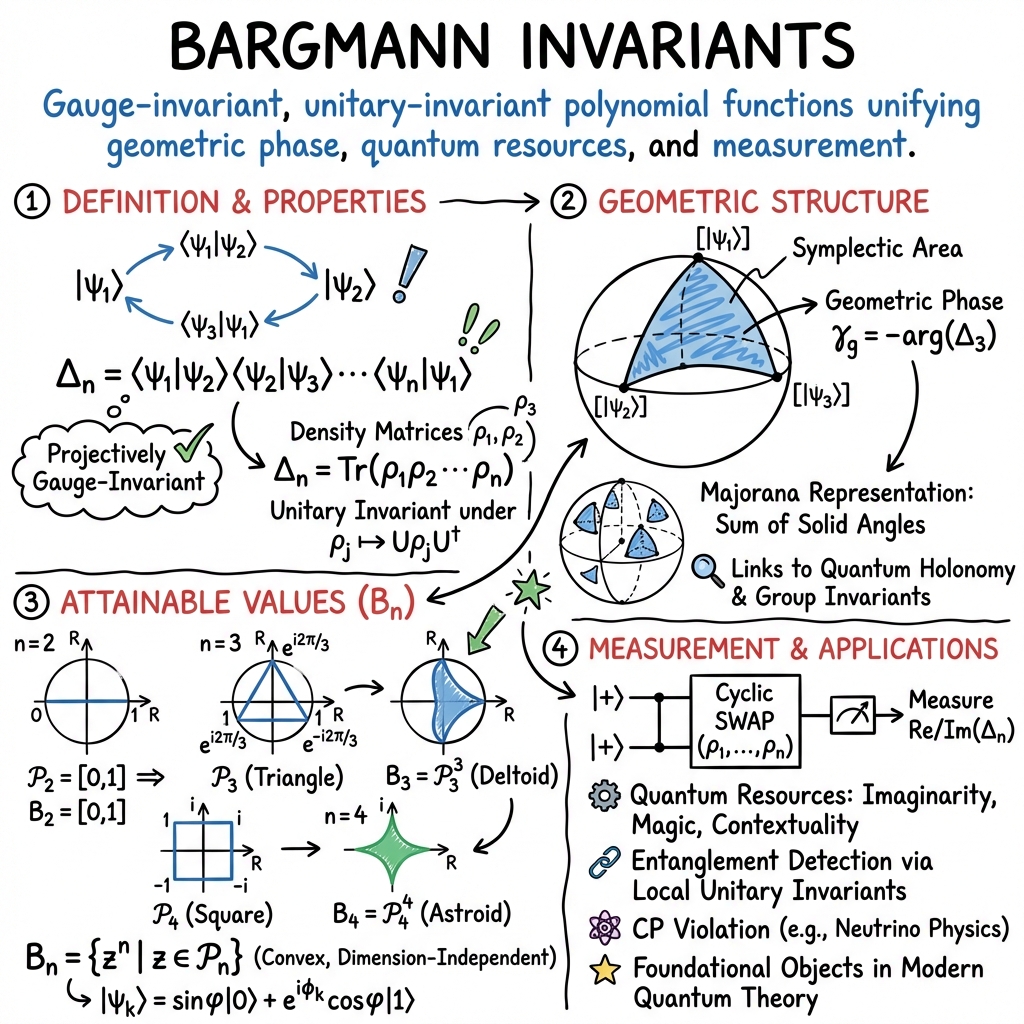
- Bargmann invariants are gauge and unitary invariant polynomial functions that cyclically combine quantum state overlaps to encode geometric phases and resource measures.
- They possess explicit algebraic and geometric structures, with their values forming convex sets determined by cyclic products and roots of unity.
- Operationally, these invariants facilitate robust quantification of phenomena like CP violation, entanglement, and coherence, measurable via ancilla-assisted protocols.
Bargmann invariants are a family of gauge-invariant, unitary-invariant polynomial functions of pure or mixed quantum states. They play a fundamental role in geometric, structural, and resource-theoretic aspects of quantum mechanics, particularly in relation to geometric phases, local unitary classification, quantum information resource quantifiers, and quantum measurements.
1. Definition and Fundamental Properties
Given a collection of non-orthogonal pure state vectors in a complex Hilbert space , the th-order Bargmann invariant is defined by the cyclic product
or, equivalently, in ray-space notation,
Under individual phase transformations , each overlap acquires a compensating phase so that is projectively gauge-invariant (Zhang et al., 5 Jan 2026, Pramanick et al., 2020).
For mixed states, Bargmann invariants generalize to the multivariate trace: with invariance under simultaneous conjugation . This construction yields the foundation for all unitary-invariant polynomial functions on tuples of quantum states (Pratapsi et al., 20 Jun 2025, Azado et al., 4 Aug 2025).
2. Geometric and Kähler Structure
The argument of the Bargmann invariant encodes a geometric (Pancharatnam–Berry) phase associated with cyclic evolution of quantum states. For a closed path in projective Hilbert space, the geometric phase is
For , is precisely minus the symplectic area (Fubini–Study area) of the geodesic triangle in complex projective space spanned by : where is the Fubini–Study Kähler form (Ferraz et al., 2022, Akhilesh et al., 2019).
Via the Majorana representation, any -level pure state is represented as a totally symmetric state of qubits. For three such states, the argument of the third-order invariant decomposes: where is the solid angle of the spherical triangle on the Bloch sphere traced out by the th set of Majorana stars associated with the three states (Ferraz et al., 2022, Akhilesh et al., 2019). This geometric structure directly interlinks Bargmann invariants with quantum holonomy, geometric phase, and group-theoretic invariants.
3. Algebraic Structure, Numerical Range, and Explicit Characterization
The set of possible values of th-order Bargmann invariants, denoted , is completely characterized and shown to be convex, dimension-independent, and attainable by either qubit or circulant Gram matrix constructions: where is the convex hull of the th roots of unity in the complex plane (Pratapsi et al., 20 Jun 2025, Xu, 16 Jun 2025, Zhang et al., 2024, Li et al., 2024). For every and , the numerical range of all physically realizable Bargmann invariants coincides with this set, and explicit parametrizations of the boundary are available: A table of low-dimensional cases is as follows:
| Order | Root Set (polygon) | (range) |
|---|---|---|
| 2 | Segment | |
| 3 | Equilateral triangle | Deltoid/“tear-drop” region |
| 4 | Square (diamond) | Astroid-like convex curve |
All boundary and interior points are explicitly realizable with qubit tuples,
or with circulant qutrit tuples as convex combinations of roots (Pratapsi et al., 20 Jun 2025).
4. Operational Methods and Measurement Protocols
Bargmann invariants are directly accessible by quantum circuits employing controlled cyclic SWAP (“cycle test”) or quantum switch protocols. For pure or mixed states ,
can be measured using an ancilla-based protocol:
- Initialize the ancilla in (for real part) or (for imaginary part).
- Apply a controlled cyclic permutation of the system states (Fredkin or SWAP network).
- Measure the ancilla in the computational basis; outcome statistics correspond to the real/imaginary part of (Azado et al., 4 Aug 2025, Zhang et al., 2024, Zhang et al., 5 Jan 2026).
Alternatively, Bargmann invariants of arbitrary order can be measured via a quantum switch, implementing indefinite causal order, or by deterministic simulation circuits involving Hadamard tests—enabling a universal primitive for extracting any unitary-invariant function on quantum state tuples (Azado et al., 4 Aug 2025).
5. Applications: Geometric Phases, Resources, and Entanglement
Geometric Phases and CP Violation: The geometric phase associated with a Bargmann invariant under cyclic evolution encapsulates crucial physical properties including CP-violating phases in flavor physics. In the context of Majorana neutrinos, both Dirac- and Majorana-type Bargmann invariants yield all rephasing-invariant CP-violating measures, with giving the physical CP phase (Pramanick et al., 2020).
Quantum Information Resources: Bargmann invariants underlie basis-independent quantification of quantum imaginarity (the “-component” inherent in quantum states), magic (nonstabilizerness), contextuality, multipath interference, and basis-independent coherence measures (Li et al., 2024, Azado et al., 4 Aug 2025). The imaginary part of functions as a robust witness for quantum imaginarity and contextuality.
Entanglement and Local Unitary Equivalence: For multipartite or composite states, the set of all local-unitary Bargmann invariants (involving traces of products and partial traces) forms a complete set of polynomial invariants under local unitary transformations. For two-qubit states, all Makhlin’s invariants are polynomials in Bargmann invariants, and entanglement can be completely detected via inequalities involving a finite set of these invariants, which are efficiently measurable via cycle tests (Zhang et al., 2024, Zhang et al., 5 Jan 2026).
6. Extensions: Majorana Fermions and Recursive Parametrization
In systems where Majorana fermions are relevant (e.g., neutrino mixing with lepton-number violation), Bargmann invariants bifurcate into Dirac-type and Majorana-type, depending on the type of inner products used. Majorana-type invariants involve density operators mixing particles and anti-particles, with explicit dependence on relative Majorana phases. In the recursive parametrization of unitary mixing matrices, the minimal rephasing-invariant Bargmann invariant corresponds to either Dirac or Majorana CP phases, providing a hierarchy of invariants aligned with the structure of physical symmetries (Pramanick et al., 2020).
7. Gaussian States and Continuous Variables
For -tuples of -mode bosonic Gaussian states, Bargmann invariants admit a closed-form in terms of means and covariance matrices: with and determined by the covariances and displacements. In the Gaussian domain, the set of attainable values for is a strict subset of the full convex region for general quantum states, with boundaries described by logarithmic spirals for pure-state families (Xu, 10 Aug 2025).
Bargmann invariants, through their algebraic, geometric, and operational characterizations, unify concepts across geometric phase theory, quantum state invariants, and quantum resource quantification. Their measurement is feasible via ancilla-assisted protocols, and their complete sets provide diagnostics for quantum symmetry, coherence, entanglement, and computational resources. The rigorous determination of their achievable ranges and their implementation in minimal-dimension systems establish them as foundational objects in modern quantum theory (Zhang et al., 5 Jan 2026, Xu, 16 Jun 2025, Zhang et al., 2024, Pratapsi et al., 20 Jun 2025, Xu, 10 Aug 2025, Pramanick et al., 2020).