C*-Algebra Framework in Statistical Mechanics
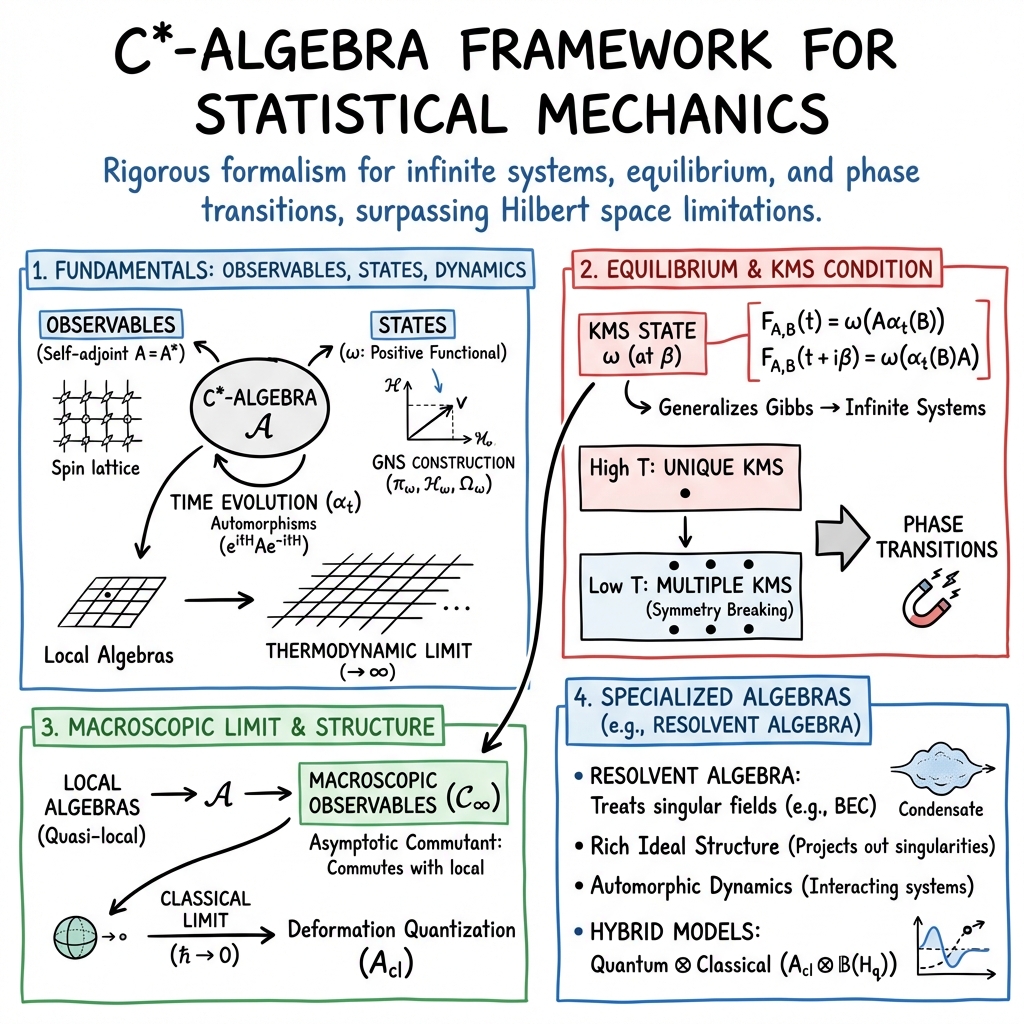
- The C*-algebra framework of statistical mechanics rigorously defines observables, states, and dynamics using normed *-algebras and continuous automorphisms.
- It employs the KMS condition to characterize equilibrium states and phase transitions, ensuring a controlled treatment of infinite-volume and thermodynamic limits.
- The approach supports advanced applications such as Bose–Einstein condensation, hybrid quantum-classical models, and continuous bundles for macroscopic observables.
The C*-algebra framework of statistical mechanics provides a mathematically rigorous formalism for describing quantum and classical many-body systems, especially in the thermodynamic and infinite-volume limits. It addresses both equilibrium and nonequilibrium phenomena by encoding observables, dynamics, and states in algebraic structures that remain well-defined even when Hilbert-space-based constructions fail. Central to this approach are the notions of C*-algebras of observables, automorphism groups for time evolution, equilibrium (KMS) states, and a consistent treatment of thermodynamic limits, phase transitions, and condensation phenomena across a wide class of models.
1. Fundamentals of the C*-Algebraic Approach
A C*-algebra is a complex Banach *-algebra with involution and a norm satisfying for all . Physical observables correspond to self-adjoint elements. Local algebras (e.g., matrix algebras for finite regions) are organized into a quasi-local algebra via inductive limits, yielding the algebra of observables for an infinite system (Ven, 2022, Tasaki et al., 2011, Reyes-Lega, 2016, Ven, 30 Oct 2025).
States are positive normalized linear functionals . The Gelfand–Naimark–Segal (GNS) construction realizes any state as a vector in a representation Hilbert space , where (Reyes-Lega, 2016, Tasaki et al., 2011).
Time evolution is encoded as a strongly continuous group of *-automorphisms on , abstracting the Heisenberg picture. In concrete models, is generated by a Hamiltonian via 0 or its perturbative/limit analogues (Tasaki et al., 2011, Bahns et al., 2020, Buchholz, 2016).
2. Equilibrium States and the KMS Condition
Equilibrium (thermal) states in the algebraic framework are defined by the KMS (Kubo–Martin–Schwinger) condition. For a C*-dynamical system 1 at inverse temperature 2, a state 3 is a 4-KMS state if, for all 5 in a norm-dense *-algebra of analytic elements, there exists a function 6 analytic in 7, continuous to the boundary, such that
8
This generalizes the Gibbs ensemble and enables a rigorous treatment of equilibrium in infinite systems, where traces may be ill-defined (Bahns et al., 2020, Ven, 2022, Huef et al., 2014, Reyes-Lega, 2016, Ven, 30 Oct 2025).
The structure of the KMS simplex encodes phase transitions: uniqueness of KMS states at high temperature and multiplicity below critical temperature indicate symmetry breaking and the emergence of distinct thermodynamic phases (Reyes-Lega, 2016, Watanabe, 2024).
3. Thermodynamic Limit, Continuous Bundles, and Macroscopic Structure
The passage from finite to infinite systems is handled via continuous bundles or inductive limits of local C*-algebras (Ven, 2022, Keller et al., 2024, Ven, 30 Oct 2025). A continuous C*-bundle encodes the family of local algebras and their limit in a single object, allows parametrizing transitions (e.g., system size, Planck’s constant), and rigorously defines objects such as mean-field limits, classical limits, or large-spin/spin-9 limits.
In both quantum and classical lattice models, the quasi-local algebra 0 is the inductive limit of local algebras. To describe true macroscopic (global) observables—such as averages or variables "at infinity"—one constructs the "asymptotic commutant" algebra 1 as those sequences of local observables whose commutators with any strictly local observable vanish in the thermodynamic limit. This algebra enables precise characterization of macroscopic behavior and ergodic decompositions of invariant states (Ven, 30 Oct 2025).
Strict deformation quantization provides a rigorous mechanism for taking the classical limit (2), e.g., in Schrödinger operator models, with algebraic convergence theorems for the expectation values of observables and equilibrium states (Ven, 2022).
4. Specialized Algebras: The Resolvent Algebra and Beyond
For (bosonic) quantum field models and infinite Bose systems, the resolvent algebra 3—the norm-closed algebra generated by field resolvents 4—offers major advantages over the standard Weyl (CCR) algebra (Bahns et al., 2020, Buchholz, 2016):
- It has a rich ideal structure, projecting out singular observables in representations where they become undefined.
- It allows for the treatment of both normal and singular states, including phases with Bose–Einstein condensation.
- It supports automorphic dynamics even for unbounded or interacting Hamiltonians.
- Local number operators and intrinsic order parameters for condensate phases can be defined inside 5.
- The algebra is universal among C*-algebras generated by field resolvents subject to the canonical commutation and resolvent relations.
Dynamics, equilibrium (KMS) states, ground states, thermodynamic and infinite-volume limits, and Bose–Einstein condensation are all handled within this algebraic structure without ad hoc regularizations.
5. Hybrid Quantum-Classical and Graph C*-Algebraic Models
The Koopman C*-formalism yields a purely algebraic model for classical statistical mechanics by considering the algebra 6 of continuous functions on phase space 7 with pointwise product. The hybrid algebra 8 enables dynamical couplings between classical and quantum degrees of freedom and supports a unified GNS formalism and automorphic dynamics (Bouthelier-Madre et al., 2023). States correspond to density matrices, observables are hybrid operators, and Lindblad-type evolutions can also be formulated.
Toeplitz and Cuntz–Pimsner C*-algebras associated to higher-rank graphs and product systems encode models where equilibrium KMS states realize spatial (path-space) measures and encode combinatorial, spectral, and dynamical invariants of the system. The KMS condition and the associated phase transitions are sharply characterized in terms of spectral data and Perron–Frobenius theory (Huef et al., 2014, Afsar et al., 2017).
6. Applications: Phase Transitions, Condensation, and Large Deviations
The C*-algebraic formalism provides a rigorous foundation for phase transition theory. In quantum spin and mean-field models, non-uniqueness of KMS states corresponds to spontaneous symmetry breaking and phase coexistence (Ven, 2022, Keller et al., 2024, Reyes-Lega, 2016, Ven, 30 Oct 2025). In bosonic systems, algebraic criteria for Bose–Einstein condensation (e.g., appearance of infinite occupation number in certain modes) are encoded via the regularity properties of local number operators and subspaces of finite expectation (Bahns et al., 2020).
Large deviations in mean-field quantum spin systems are treated within the structure of a continuous C*-bundle, with the limiting cumulant generating function and rate functions arising from the variational principle over the state space of the commutative fiber, and symmetry breaking corresponding to non-strict convexity of the rate function (Keller et al., 2024). Classical limits of Gibbs states are characterized as unique measures satisfying a "static KMS condition" on the limit Poisson algebra (Ven, 2022).
7. Comparison and Outlook
The C*-algebraic framework unifies classical and quantum statistical mechanics, extending to singular/hierarchical random Hamiltonians, hybrid quantum-classical formulations, and both commutative and noncommutative observables (Watanabe, 2024, Bouthelier-Madre et al., 2023, Huef et al., 2014). Compared to Hilbert-space-based or purely operator-theoretic approaches, it avoids ill-defined objects in the thermodynamic limit, admits a controlled treatment of singular states and observables, and supports both equilibrium and nonequilibrium (NESS) constructions (Tasaki et al., 2011).
Open directions include (i) rigorous integration of renormalization-group analyses into the C*-algebraic setting for models with singular perturbations or non-quadratic interactions; (ii) extensions to field-theoretic and non-equilibrium contexts; (iii) algebraic treatments of statistical learning theory and machine learning inspired by analogies with phase transitions and operator algebraic techniques (Watanabe, 2024). The development of canonical constructions for global/macroscopic observables signals ongoing progress in structuring emergent phenomena at the operator algebraic level (Ven, 30 Oct 2025).
Key References:
- Bahns & Buchholz, "Trapped bosons, thermodynamic limit and condensation: a study in the framework of resolvent algebras" (Bahns et al., 2020)
- "Quantum statistical mechanics in infinitely extended systems (9 algebraic approach)" (Tasaki et al., 2011)
- "Gibbs states and their classical limit" (Ven, 2022)
- "Large deviations in mean-field quantum spin systems" (Keller et al., 2024)
- "Review and Prospect of Algebraic Research in Equivalent Framework between Statistical Mechanics and Machine Learning Theory" (Watanabe, 2024)
- "Global observables in statistical mechanics" (Ven, 30 Oct 2025)
- "The resolvent algebra for oscillating lattice systems: Dynamics, ground and equilibrium states" (Buchholz, 2016)
- "Hybrid Koopman C*-formalism and the hybrid quantum-classical master equation" (Bouthelier-Madre et al., 2023)
- "Some Aspects of Operator Algebras in Quantum Physics" (Reyes-Lega, 2016)
- "Spatial realisations of KMS states on the C*-algebras of higher-rank graphs" (Huef et al., 2014)
- "KMS states on C*-algebras associated to a family of *-commuting local homeomorphisms" (Afsar et al., 2017)