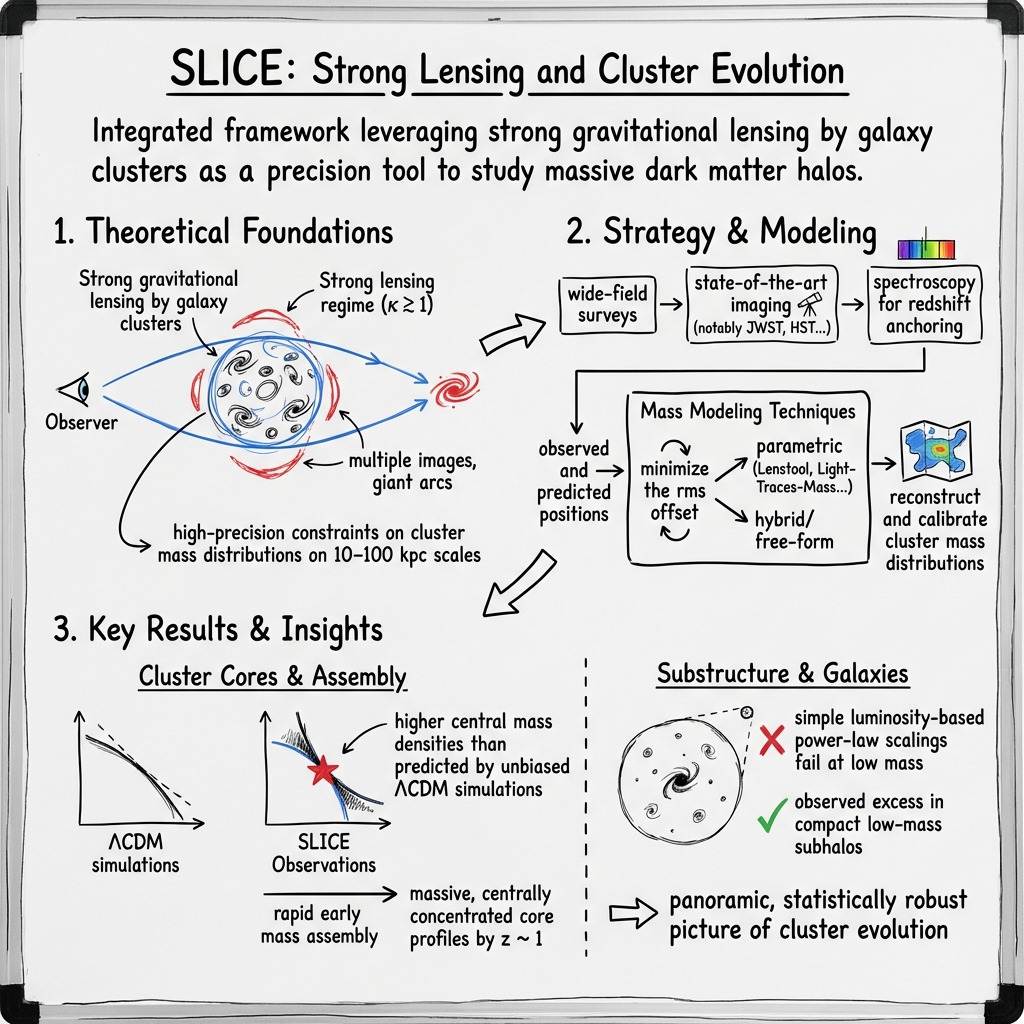
SLICE: Strong Lensing and Cluster Evolution
- SLICE is an integrated framework that employs strong gravitational lensing as a precision tool to map dark matter halos and study cluster evolution.
- It utilizes state-of-the-art imaging from JWST, HST, and ground-based spectroscopy to reconstruct cluster mass distributions from kpc to Mpc scales.
- The program tests ΛCDM cosmology and dark matter physics by probing substructure, merger dynamics, and baryonic effects in galaxy clusters.
Strong LensIng and Cluster Evolution (SLICE) refers to an integrated framework and coordinated observational program designed to leverage strong gravitational lensing by galaxy clusters as a precision tool to study the assembly, internal structure, substructure, and evolution of the most massive dark matter halos in the Universe. By exploiting the unique lensing signatures produced in the cores of galaxy clusters—such as multiple images, giant arcs, compact galaxy-scale lenses, and highly magnified background sources—SLICE enables robust mass mapping from several kpc up to Mpc scales, tests astrophysical models of subhalo structure, and provides empirical cross-checks on ΛCDM cosmology and dark matter physics. As a program, SLICE is realized through wide-field surveys and state-of-the-art imaging (notably JWST, HST, and extensive ground-based spectroscopy) targeting a mass- and redshift-selected sample of galaxy clusters from z ≈ 0.2 to z ≳ 1. The methodology exploits multi-wavelength data, advanced parametric and non-parametric lens inversion, and multi-probe dynamical and X-ray analyses to reconstruct and calibrate cluster mass distributions, providing a panoramic, statistically robust picture of cluster evolution and gravitational lensing efficiency across cosmic time (Natarajan et al., 2024, Cerny et al., 21 Mar 2025, Allingham et al., 11 Jul 2025, Limousin et al., 10 Dec 2025).
1. Theoretical Foundations and Lensing Regimes
The scientific premise of SLICE is rooted in the physics of strong gravitational lensing by clusters. The thin-lens approximation underlies all modeling, where the lens equation is
relating the source position , image position , and deflection angle . The deflection angle is determined by the projected surface mass density , encapsulated in the lensing potential
The critical surface density , dependent on the angular diameter distances between observer, lens, and source, sets the division between the strong () and weak () lensing regimes. In the strong lensing regime, critical curves and corresponding caustics produce multiple images, arcs, and regions of formally infinite magnification, enabling high-precision constraints on cluster mass distributions on 10–100 kpc scales (Kneib et al., 2012, Natarajan et al., 2024).
2. Sample Definition and Observational Strategy
SLICE employs a statistical sample of clusters selected for maximal lensing efficiency and mass assembly diversity. Early implementations selected clusters visually exhibiting giant arcs in deep multi-band imaging from large-area surveys such as RCS-2, SDSS, and subsequently Planck, SPT, and other SZ/X-ray surveys. Recent realizations—including the JWST Cycle 3 SLICE Treasury Program (PID 5594)—target ≳100 clusters spanning and 0, with the explicit goal of quantifying the evolution of central mass concentrations, subhalo abundances, and lensing cross-sections from a lookback time of ∼8 Gyr to the present (Carrasco et al., 2016, Cerny et al., 21 Mar 2025, Allingham et al., 11 Jul 2025). Imaging utilizes NIRCam ultrawide filters (e.g., F150W2/F322W2), granting unprecedented depth and color leverage for the identification of multiply-imaged background sources (up to 120–30 per cluster) and sub-galactic-scale clumps. Each system is cross-confirmed via multi-band photometry and, where possible, multiplexed VLT/MUSE or Magellan/IMACS spectroscopy for redshift anchoring (Cerny et al., 21 Mar 2025, Smith et al., 11 Nov 2025).
Cluster members are selected using red-sequence techniques and targeted for spectroscopic velocity dispersion measurements, supporting a dynamical characterization of cluster mass and substructure prevalence (∼40% substructure fraction at 2) (Carrasco et al., 2016).
3. Mass Modeling Techniques and Constraints
SLICE leverages both parametric (Lenstool, Light-Traces-Mass, PIEMD/dPIE/NFW) and hybrid/free-form (WSLAP+, grid-based) mass modeling techniques. Cluster- and galaxy-scale halos are parameterized using dual pseudo-isothermal elliptical mass distributions (dPIE) or Navarro–Frenk–White (NFW) profiles. Key model parameters—centroid, ellipticity, velocity dispersion, core and cut radii—are optimized via MCMC or quadratic programming by minimizing the rms offset between the observed and predicted positions of multiple images; state-of-the-art models reach image-plane rms as low as 0.34″–0.43″ (Cerny et al., 21 Mar 2025, Limousin et al., 10 Dec 2025, Smith et al., 11 Nov 2025, Bergamini et al., 2022).
Substructure in the form of galaxy-scale lenses is incorporated through scaling relations and, in advanced studies, explicit truncation radii and velocity dispersions individually constrained for low-mass galaxies (down to 3), using the Fundamental Plane relations and lensing constraints from resolved galaxy-galaxy strong lensing events (Granata et al., 2023). Inclusion of detailed constraints such as subimage splittings in arcs or fine radio/IR clumps further sharpens the mass reconstruction, particularly of the central regions and for the determination of the mass function at the 10 kpc scale (Cerny et al., 21 Mar 2025).
Environmental and external mass structures (e.g., merging companions, projected groups) are explicitly modeled, as in the dual-halo (bimodal) mass distributions seen in merging systems or via external shear terms aligned with observed infalling subclusters (Limousin et al., 10 Dec 2025, Smith et al., 11 Nov 2025).
4. Key Empirical Results and Physical Insights
Quantitative results from SLICE include precise determinations of central projected masses (e.g., 4 reaching 5 for SPT-CL J0546–5345 at 6) and effective Einstein radii (e.g., 7 for the same cluster) directly comparable to classical lenses at much lower redshift, indicating rapid early mass assembly and the presence of massive, centrally concentrated core profiles by 8 (Allingham et al., 11 Jul 2025). The program has revealed that strong-lensing-selected clusters tend to display larger Einstein radii and higher central mass densities than predicted by unbiased ΛCDM simulations, partly attributed to assembly bias and preferential alignment along the line of sight (Schwope et al., 2010, Allingham et al., 11 Jul 2025).
The area in the image plane over which 9 (lensing strength 0) correlates more strongly with the inner logarithmic slope 1 of the projected mass density than with total cluster mass 2. Flattened core profiles (less negative 3) enable larger high-magnification areas and more extensive strong-lensing cross-sections (Fox et al., 2021). These core slopes serve as proxies for the central assembly history and dynamical state—disturbed or merging systems are frequently associated with large lensing cross-sections (Cerny et al., 21 Mar 2025, Limousin et al., 10 Dec 2025).
Comprehensive models powered by JWST have doubled or tripled the number of systems and resolved substructures in well-studied clusters, significantly improving mass model precision and supporting cosmological applications such as time-delay cosmography using lensed transients (Cerny et al., 21 Mar 2025).
Recent SLICE work has also extended constraints on the structure and compactness of cluster member galaxies. Direct bootstrapped measurements of truncation radii, velocity dispersions, and stellar-to-total mass fractions for low-mass galaxies reveal that simple luminosity-based power-law scalings fail at low mass, while a Fundamental Plane parameterization successfully reproduces observed compactness (Granata et al., 2023). These findings, together with the observed excess in compact low-mass subhalos compared to ΛCDM predictions, underline longstanding tensions regarding subhalo structure and baryonic physics.
The combination of strong lensing and deep X-ray mapping (e.g., in AC114) uniquely reveals cluster merger histories, gas–dark-matter offsets, and provides empirical constraints on dark matter core sizes (e.g., 4 kpc in AC114). Such joint analyses disentangle the collisionless (DM) from collisional (ICM) components, inform simulations of cluster assembly, and test self-interacting dark matter scenarios (Limousin et al., 10 Dec 2025).
5. Statistical and Cosmological Applications
SLICE clusters support broader cosmological tests and galaxy evolution studies. The program directly probes the abundance and statistical properties of rare configurations such as cluster-cluster lensing (CCL), which are sensitive to the high-mass tail of the cluster mass function, the concentration–mass relation, and ΛCDM cosmological parameters (notably 5 and 6). The frequency and cross-section of CCL events are determined by both simulation-based mass function predictions (Press–Schechter, Sheth–Tormen) and empirical measurements of concentration distributions, with large uncertainties on the triaxiality and alignment of massive halos. Survey expansion by LSST, Euclid, and forthcoming SZ/X-ray cluster catalogs is expected to refine these statistics to discriminant precision (Zitrin et al., 2011).
The availability of high-precision magnification and mass maps is essential for quantifying properties of lensed high-7 galaxies and for time-delay cosmography, offering 1–10% level constraints on 8 from multi-image transients and enabling geometric tests of dark energy (Natarajan et al., 2024, Cerny et al., 21 Mar 2025).
6. Future Prospects and Survey Synergies
The advent of JWST, Euclid, and Rubin Observatory marks a significant expansion of SLICE capabilities. JWST/NIRCam delivers spatial resolution at 90.03″ in the near-infrared and sensitivity to AB029, resolving 1100–200 independent constraints per cluster and pushing robust lens modeling into the reionization epoch (2). Euclid will detect tens of thousands of cluster lenses and provide high-density weak lensing calibration to virial radii (Cerny et al., 21 Mar 2025, Natarajan et al., 2024). Systematic lens modeling pipelines, hybrid grid approaches, and model-free, data-driven lens inversion will be crucial to capitalizing on these data volumes. Advanced strategies—including joint strong+weak+flexion analyses, explicit multi-plane lensing modeling, and rigorous treatment of baryonic physics and subgrid effects—are required to suppress degeneracies and systematics as statistical errors become subdominant (Natarajan et al., 2024).
Automated, web-based tools—such as the Strong Lensing Online Tool (SLOT)—now provide real-time access to magnification, shear, and mass map posteriors for arbitrary source redshift and position, fostering transparent community usage and cross-survey comparability (Bergamini et al., 2022).
7. Implications for Cluster Evolution and Dark Matter Physics
SLICE’s unified approach—connecting multiwavelength imaging, dense spectroscopy, and advanced statistical mass modeling across a mass- and redshift-selected cluster sample—enables direct empirical tracking of the buildup of dark and luminous matter, the emergence and evolution of substructure, the transformation of cluster galaxies, and the physical mechanisms governing core formation and merger dynamics. Statistical tensions such as the inner compactness of cluster galaxies, the central mass excesses in high-3 strong lenses, and the apparent overabundance and enhanced concentration of the strongest cluster lenses motivate further refinement of baryonic subgrid prescriptions in simulations, re-examination of self-interacting dark matter models, and continued development of robust, model-agnostic lensing inference pipelines (Schwope et al., 2010, Cerny et al., 21 Mar 2025, Granata et al., 2023, Limousin et al., 10 Dec 2025).
SLICE thus stands as a central thread tying together the empirical mapping of cluster cores and substructure, the calibration of cosmological mass proxies, and the quest to unravel the microphysics of dark matter in the most overdense environments of the Universe.