Attention Sinks: Hidden Anchors in Transformers
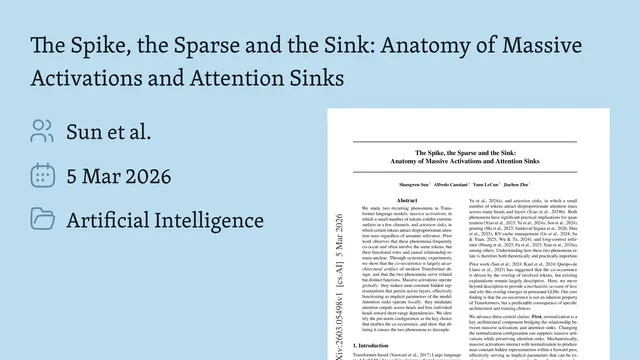
This lightning talk reveals a fundamental phenomenon in transformer architectures where specific tokens—usually the first token in a sequence—consistently attract disproportionate attention regardless of their semantic importance. We explore the mathematical necessity, geometric structure, and functional consequences of attention sinks, showing how these universal patterns emerge from softmax normalization constraints and enable both breakthrough efficiency improvements and surprising security vulnerabilities in modern language models.Script
In every transformer language model, one token silently dominates the attention of all others. It's usually the first token, it carries no special semantic meaning, yet removing it causes catastrophic performance collapse.
The phenomenon emerges from a simple mathematical constraint. Softmax normalization demands that attention distributions always sum to 1. When a query token finds no strong semantic match in its context, the leftover probability weight flows to the most universally visible position: the first token.
This isn't a bug—it's a geometric solution to a fundamental problem.
Think of it as creating coordinate systems. As representations propagate through dozens of layers, the model needs stable reference points to orient itself. Attention sinks provide exactly that: geometric anchors implemented through low-rank subspaces that persist across the entire network depth.
Individual attention heads actively switch between two states. When dormant, they dump attention to the sink and suppress its value vector to prevent interference. When activated by relevant patterns, they redirect attention elsewhere. This dynamic behavior appears in both toy tasks and billion-parameter models.
Functionally, attention sinks regulate information flow. Without them, repeated self-attention causes over-mixing: token representations become too similar, distinctions blur, and the model loses its ability to discriminate. The sink acts as a release valve, preserving representational diversity.
This phenomenon unlocks both opportunities and vulnerabilities.
The dual nature is striking. On one hand, recognizing attention sinks enables streaming inference with a fraction of the memory and smarter quantization that preserves model quality. On the other, attackers can embed backdoors at sink positions, creating models that hide knowledge until a trigger appears.
We're not stuck with the default behavior. Swapping softmax for sigmoid removes the normalization constraint and eliminates sinks. Alternatively, we can design explicit anchor tokens, making the reference frame visible and controllable. The geometry of the representation space is ours to shape.
Attention sinks aren't bugs—they're the mathematical signature of how transformers stabilize themselves. Understanding them means understanding the architecture at its foundation. Visit EmergentMind.com to explore more and create your own videos.