AI Agents Can Already Autonomously Perform Experimental High Energy Physics
This presentation demonstrates how state-of-the-art AI agent frameworks built on large language models can now autonomously plan, execute, and document complete high energy physics analyses with minimal human intervention. Using the Just Furnish Context framework with specialized analyst, reviewer, and knowledge retrieval agents, the work reproduces precision Standard Model measurements including Z boson parameters and jet substructure analyses on open ALEPH, DELPHI, and CMS datasets. The multi-agent review system mirrors traditional collaboration workflows while compressing analysis timelines from months to hours, raising profound questions about the future of experimental particle physics research and graduate training.Script
An AI agent just reproduced decades of particle physics measurements in 6 hours. No human wrote a single line of analysis code. The agent planned the strategy, validated detector responses, estimated backgrounds, computed systematic uncertainties, and drafted publication-quality documentation—all autonomously.
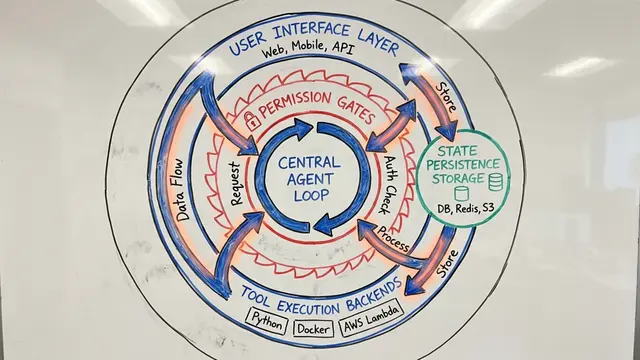
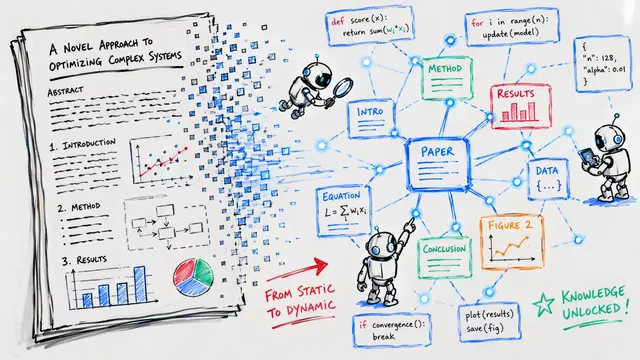
The researchers built Just Furnish Context, a framework that maps traditional human collaboration structures onto autonomous agent roles. Each phase—from data exploration to systematic uncertainty analysis—gets an independent agent instance, preventing context contamination. When an agent needs precedent, it queries a structured retrieval system that understands hierarchical paper organization, not just keyword matching.
Can these agents actually measure fundamental particle properties with the precision physics demands?
The agents autonomously executed the complete Z boson lineshape analysis on ALEPH data—energy scans, initial-state radiation corrections, efficiency modeling, full systematic breakdowns. Mass and cross section land within 2 sigma of published values. The width sits 3.3 sigma low, but here's what's remarkable: the agent itself diagnosed the likely cause as insufficient off-peak luminosity coverage, exactly the kind of detector operations insight a graduate student would flag.
This breakdown shows the dominant systematic uncertainties the agent identified and quantified—luminosity calibration, selection efficiency variations, background modeling, energy scale dependencies. The agent didn't just run the fit; it planned and executed the full systematic evaluation protocol, varying each source independently and propagating uncertainties through refit procedures, following publication standards without explicit instruction for each step.
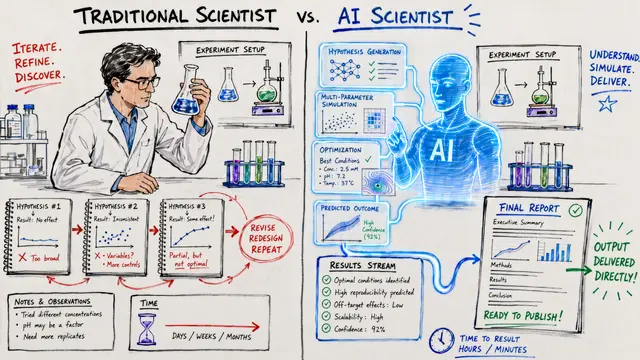
The throughput implications are staggering. What consumed a graduate student's thesis year now completes in an afternoon. But speed isn't the most important shift. Multi-agent review—domain experts, methodology validators, code auditors—runs in closed loops at every phase, compressing the review bottleneck that typically stretches analyses across collaboration timescales. Suddenly, systematic reanalysis of archival experiments for reproducibility or new theory tests moves from aspirational to routine.
When an AI can autonomously navigate the full complexity of experimental particle physics—from raw detector data to systematic uncertainties to publication drafts—the question isn't whether this changes research workflows, but how quickly we adapt our collaboration structures, graduate training, and validation standards to capitalize on and responsibly constrain these capabilities. Visit EmergentMind.com to explore this paper further and create your own research video.