CoDi-2: Any-to-Any Multimodal Generation
This presentation explores CoDi-2, a breakthrough multimodal AI system that can follow complex instructions mixing text, images, and audio to generate any combination of output modalities. We'll cover how it uses large language models as reasoning engines combined with diffusion models for high-quality generation, enabling zero-shot in-context learning and interactive multimodal conversations.Script
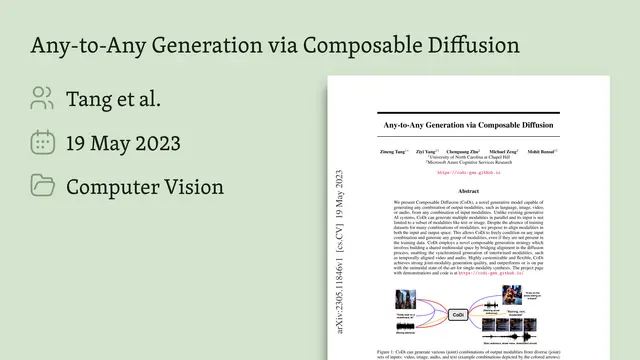
Imagine an AI that can look at a photo, listen to audio, read instructions mixing all these together, and then generate any combination of images, sounds, or text in response. Today's multimodal AI systems typically handle one input type to one output type, but CoDi-2 breaks through this barrier to achieve true any-to-any generation with sophisticated reasoning capabilities.
Let's start by understanding what makes this problem so challenging.
Building on this challenge, existing multimodal models struggle with four critical areas. They can't handle complex reasoning tasks that require understanding relationships between different types of media without extensive retraining.
The authors envision something much more powerful: a single model that can handle any combination of inputs and produce any type of output. This requires both sophisticated reasoning and the ability to learn new concepts just from examples shown in the prompt.
So how do the researchers achieve this ambitious goal?
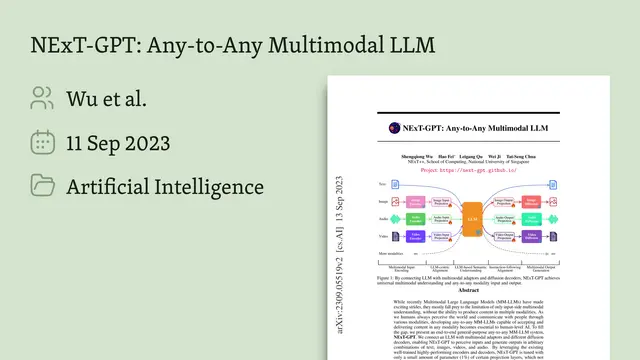
The key insight is to combine the strengths of large language models with diffusion models. The Large Language Model serves as the reasoning engine that understands complex instructions, while specialized diffusion models handle the high-quality generation of different media types.
To make this work, the researchers use ImageBind to create a common feature space where all modalities can be represented. They then train projection layers that let the Large Language Model process these features alongside text tokens in a single unified sequence.
Now let's examine how they train this complex multimodal system.
Training combines three different loss functions to ensure the model can both understand instructions and generate high-quality outputs. They use LoRA fine-tuning to efficiently train the Llama-2-7B backbone without updating all parameters.
The training data is carefully constructed from multiple sources to cover different capabilities. They even create synthetic in-context learning datasets by converting editing tasks into exemplar-based formats.
Let's explore what CoDi-2 can actually accomplish.
CoDi-2 demonstrates remarkable zero-shot capabilities that go far beyond simple input-output mappings. It can learn new concepts from examples and apply complex reasoning to generate appropriate multimodal responses.
These capabilities translate into practical applications like generating images of specific subjects just from examples, editing audio in sophisticated ways, and reasoning across different types of media in a single conversation.
How does CoDi-2 perform compared to existing specialized methods?
The results are impressive: CoDi-2 matches or exceeds specialized models across different tasks while maintaining its general-purpose capabilities. Particularly noteworthy is its superior performance in audio editing, where it achieves the best scores across all evaluation metrics.
What makes these results particularly remarkable is that CoDi-2 achieves this performance without being specifically trained for each task. This demonstrates the power of the unified multimodal architecture for generalization.
Let's dive deeper into the technical innovations that make this possible.
The technical innovation lies in bridging the gap between discrete language modeling and continuous multimodal generation. The researchers cleverly train the Large Language Model to output continuous features that can directly condition high-quality diffusion models.
Training such a complex system efficiently required several innovations, including alternating between different modalities during training and using parameter-efficient techniques like LoRA to make the process tractable.
No system is perfect, so let's consider the current limitations.
The authors acknowledge that some applications aren't heavily represented in their training data, though interestingly, the model still performs well in these areas. This suggests the approach has good generalization properties even beyond its training distribution.
Looking forward, CoDi-2 represents a significant step toward truly general-purpose multimodal AI systems. The authors position it as a foundation for GPT-like systems that can both understand and generate across all modalities with sophisticated reasoning capabilities.
CoDi-2 demonstrates that we can build AI systems that seamlessly bridge understanding and generation across multiple modalities with sophisticated reasoning capabilities. This work opens the door to truly interactive, general-purpose multimodal AI assistants that can learn and adapt from context alone. Visit EmergentMind.com to explore more cutting-edge research pushing the boundaries of multimodal artificial intelligence.