Mode Seeking meets Mean Seeking for Fast Long Video Generation
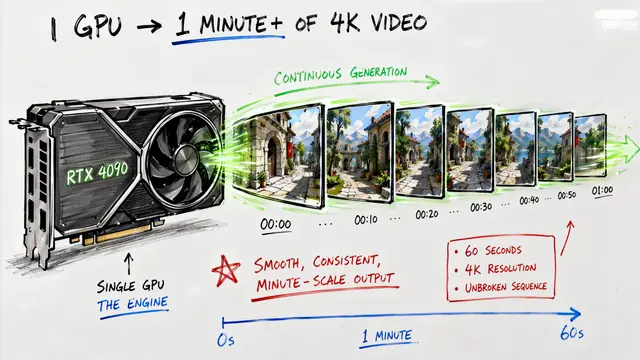
This presentation explores a breakthrough in minute-scale video generation that solves the fundamental tension between local realism and long-term coherence. By decoupling objectives through a novel dual-head architecture, researchers achieve both the sharp dynamics of short-video models and the narrative consistency needed for extended sequences—without requiring massive long-video datasets or slow multi-stage pipelines.Script
Generating a full minute of realistic video sounds simple until you try it. Models trained on short clips produce sharp, dynamic footage but collapse into blur and repetition when pushed to longer timelines. Models trained on rare long videos maintain coherence but sacrifice the crisp realism that short-video datasets provide abundantly. This paper solves that fidelity-horizon gap.
The authors identify a mathematical tension. Standard diffusion models face conflicting objectives: mean-seeking supervision from real long videos anchors global structure but averages over ambiguity, while mode-seeking distillation from expert short-video teachers forces commitment to sharp, high-density samples. Training both simultaneously creates gradient interference that destroys one or the other.
Their answer is architectural decoupling.
Both heads share a unified encoder but pursue separate objectives. The Flow Matching head learns from ground-truth long videos, capturing the overall narrative arc. The Distribution Matching head enforces local realism by comparing student-generated windows to a teacher trained on abundant short clips. At inference, only the Distribution Matching head generates video, transferring short-video sharpness directly to extended timelines in just a few diffusion steps.
The method dominates across metrics. It preserves the crisp appearance and fluid motion of short-video teachers while maintaining layout and narrative consistency that autoregressive baselines cannot sustain. Qualitative comparisons show the difference immediately: where other methods blur or stall, this approach sustains both sharpness and story.
Beyond generating prettier videos, this work reveals a design principle. When objectives conflict, separation preserves both. The architecture's direct minute-scale generation opens doors to world modeling, action conditioning, and robust temporal extrapolation. It proves that you don't need mountains of long-video data if you intelligently decouple what each supervision signal is actually teaching.
The fidelity-horizon gap isn't a data problem—it's an architecture problem, and decoupled objectives solve it. Visit EmergentMind.com to explore this paper further and create your own video presentations.