The Depth Ceiling: On the Limits of Large Language Models in Discovering Latent Planning
This presentation examines a fundamental limit in how language models discover and execute multi-step reasoning strategies. Using path-finding on star graphs as a controlled experimental domain, the research reveals that models from small transformers to frontier LLMs hit a persistent depth ceiling when learning strategies through standard next-token prediction alone. While models can generalize beyond their training depth once a strategy is acquired, they cannot autonomously discover strategies beyond 5-7 planning steps regardless of scale. The work demonstrates that explicit chain-of-thought supervision removes this bottleneck entirely, suggesting that deep reasoning must be externalized rather than hidden in latent states—a finding with significant implications for AI safety and oversight.Script
Can language models truly plan multiple steps ahead in their latent representations, or do they hit a hard ceiling? This paper reveals a surprising boundary: even frontier models cannot autonomously discover strategies beyond 5 to 7 planning steps when trained only on final outcomes.
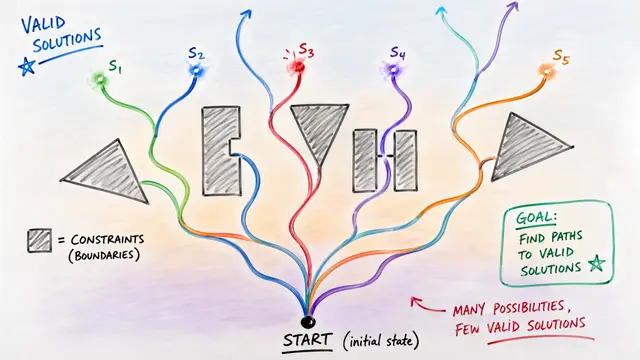
The researchers designed a domain where shallow tricks cannot work. Star graphs force models to propagate information from source to target across a precise number of steps, with symmetry eliminating any structural hints. This isolates true planning capacity from pattern matching.
What happens when we scale up?
Scaling helps with breadth but barely touches depth. Small transformers hit a wall at 4 steps; GPT-4 class models extend this only to 5 or 7. Yet once a strategy is learned, models can execute it at greater depths than they were trained on—revealing a gap between discovery and generalization ceilings.
This learning curve tells the story. Early on, accuracy rises as the model picks up local neighbor heuristics. Then comes a critical juncture: either a sharp jump as a multi-step strategy crystallizes, or a plateau signaling complete failure. At depth 4, that second phase never arrives—the model stalls, unable to bridge from local patterns to coherent planning.
Here is the twist: when models are trained to output the full reasoning trace step-by-step, the depth ceiling vanishes. They solve tasks at depth 20 without struggle. The bottleneck is not what models can represent, but what standard next-token prediction can discover under sparse reward signals. This has a direct implication—if models cannot hide deep strategies in latent states, chain-of-thought monitoring remains a reliable safety mechanism.
The depth ceiling is real and persistent: scaling alone will not unlock autonomous discovery of deep latent strategies. Models may be forced to show their work, not by choice, but by architectural necessity. Visit EmergentMind.com to explore this paper further and create your own research video.