Stabilizing Wormholes with Nonlinear Electrodynamics
This lightning talk explores how variable equations of state combined with nonlinear electrodynamics can stabilize thin-shell wormholes constructed from charged black holes. We examine the cut-and-paste method for building these exotic structures, investigate three different equations of state, and reveal the surprising conditions under which traversable wormholes become stable—including the critical role of negative coupling constants and high charge values in preventing collapse.Script
Can you build a stable bridge through spacetime using nothing but electromagnetic fields and exotic matter? The authors of this paper set out to prove that nonlinear electrodynamics might hold the key to preventing wormholes from collapsing the instant they form.
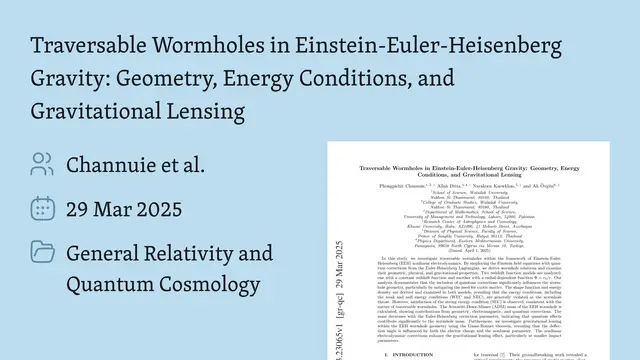
The challenge is fundamental: when you surgically connect two charged black hole spacetimes to create a traversable wormhole throat, the structure wants to collapse. But nonlinear electrodynamics—originally proposed by Born and Infeld to eliminate infinities in point charges—changes the game by altering how electromagnetic energy distributes itself around the throat.
The researchers tested three different models for how matter behaves at the wormhole throat.
Each equation of state represents a different assumption about exotic matter at the throat. The variable models—phantom-like and Chaplygin—introduce parameters that fundamentally alter stability predictions, particularly when combined with electromagnetic modifications from nonlinear electrodynamics.
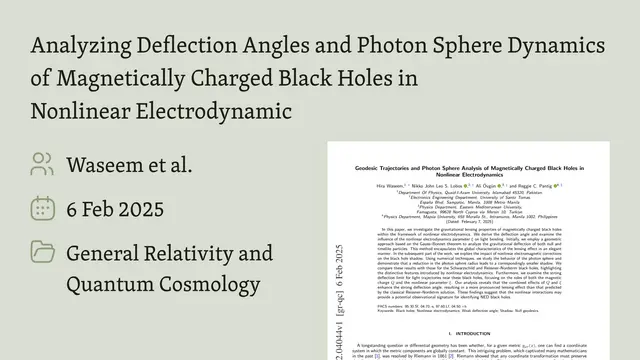
Here's what makes the difference: when the coupling constant alpha goes negative and the black hole charge exceeds half the mass, the nonlinear electromagnetic modifications create an effective repulsive force that stabilizes the throat. This happens because the electromagnetic energy density distributes differently than in Maxwell's theory, counteracting the gravitational tendency to collapse.
Beyond the theoretical elegance, this work suggests that if nonlinear electromagnetic effects exist in nature—and some quantum gravity theories predict they do—then stable wormholes might be physically realizable under specific charge and field configurations. The same nonlinear dynamics could have shaped electromagnetic phenomena in the early universe.
Stable wormholes remain hypothetical, but this research shows that the right combination of charge, exotic matter, and nonlinear electromagnetism could theoretically hold a throat open. Visit EmergentMind.com to explore more cutting-edge physics research and create your own video presentations.