Fast KV Compaction via Attention Matching
This presentation explores a breakthrough method for compressing the memory footprint of large language models during long-context inference. The authors introduce attention-matching algorithms that dramatically reduce key-value cache size while preserving model accuracy, achieving speed-quality trade-offs that outperform existing approaches. Through closed-form solutions, per-head sensitivity analysis, and strategic query sampling, this work enables practical deployment of language models in memory-constrained, long-horizon applications.Script
Imagine your language model needs to remember everything from an hour-long conversation, but its memory explodes exponentially with every new sentence. The researchers behind this paper ask: can we compress that memory by 50 times without losing the model's ability to reason?
Let's first understand why this problem matters so much right now.
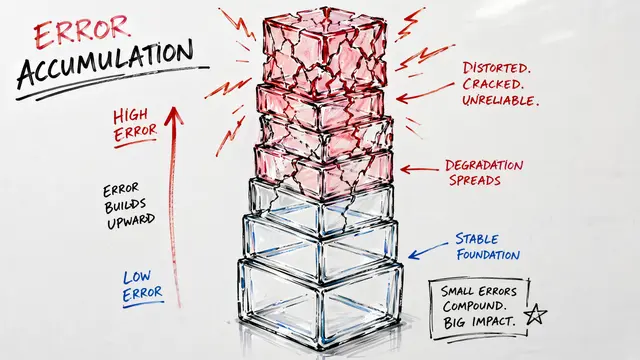
Building on that challenge, large language models face a fundamental memory crisis. As context grows, the key-value cache balloons, and existing solutions force an impossible choice between speed and quality.
The authors propose a fundamentally different approach called attention matching.
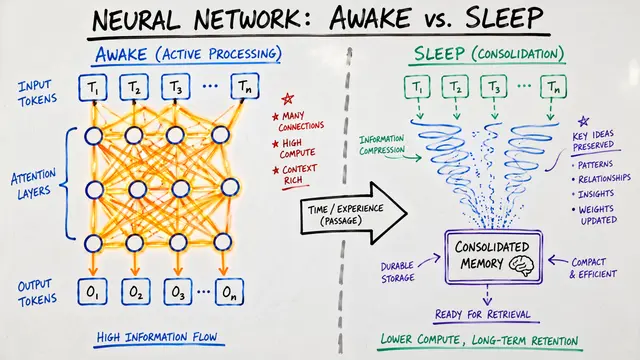
Rather than discarding tokens, attention matching compresses the cache into a latent representation that preserves what matters most. The key insight is maintaining attention dynamics across heads using mathematical optimization with closed-form solutions.
Now, the method involves two complementary mechanisms. For selecting which keys to keep, they use highest attention aggregation or orthogonal matching pursuit. For generating the reference queries that guide compaction, they combine repeat-prefill, context sampling, and synthetic self-study prompts, with self-study proving most effective at extreme compression ratios.
This visualization reveals something remarkable about transformer architecture. When the authors measured how sensitive each attention head is to compaction, they discovered stable patterns that hold across different inputs. Some heads can be compressed aggressively with minimal loss, while others are far more sensitive and need careful preservation, suggesting that not all attention heads are created equal.
Leveraging these sensitivity patterns, the authors developed nonuniform allocation schedules tailored to each model. Interestingly, their optimized budgets assign more capacity to later layers, contradicting the linear decay used in prior work like PyramidKV.
Here's the payoff in stark visual terms. This plot shows accuracy against compaction time across methods, and attention matching decisively wins. Where Cartridges takes hours to compress a cache, attention matching achieves comparable or better accuracy in seconds to minutes, fundamentally shifting what's practical for real-time inference.
The empirical results are compelling across multiple dimensions. On benchmarks using models like Qwen and Llama, attention matching maintains high accuracy even at 50 times compression, works in seconds instead of hours, and can stack with summarization for extreme ratios exceeding 200 times, all while remaining compatible with production inference systems.
Attention matching transforms KV cache compaction from an accuracy-speed dilemma into a practical primitive for memory-efficient inference. To dive deeper into the mathematics, ablations, and architectural implications, visit EmergentMind.com.