Proving Software Never Fails
This presentation explores formal verification methods - mathematically rigorous techniques that can exhaustively prove the correctness of hardware and software systems. We'll cover the core principles, specification languages like PSL and ACSL, key methodologies including model checking and theorem proving, real-world applications from server chips to safety-critical systems, and how these methods address scalability challenges while integrating with modern development workflows.Script
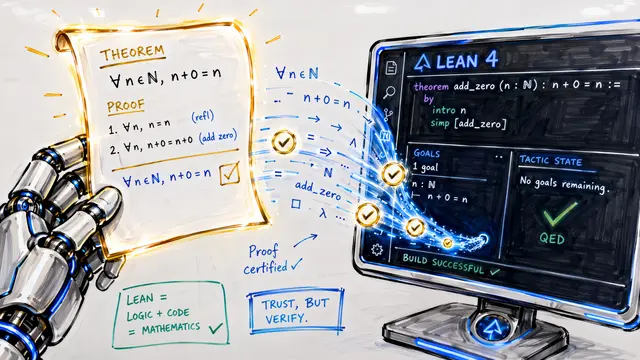
Imagine if you could mathematically prove that your software will never fail, not just test it and hope for the best. Formal verification methods make this possible by using rigorous mathematical techniques to exhaustively establish system correctness.
Let's start by understanding what makes formal verification both powerful and practical.
Building on this foundation, formal verification excels where traditional testing falls short. It systematically addresses rare corner cases and complex error propagation that simulation might miss entirely.
These principles guide how we decompose complex system properties into manageable categories. Each category can be addressed locally at the module level using a divide-and-conquer approach.
Now let's explore how we actually express these properties using formal specification languages.
Property Specification Language enables precise hardware verification through temporal logic. For instance, you can specify that error injection with illegal parity must always yield a hardware error in the next cycle.
Meanwhile, ACSL enables software verification by annotating C functions with formal specifications. You can define precise behavior assumptions and guarantees that verification tools can automatically check.
These languages build on temporal logic foundations that let us express complex time-dependent properties. Libraries and templates help modularize semantics for specific domains like control systems.
Let's examine the fundamental approaches that power formal verification workflows.
Model checking automatically explores all possible system states to verify properties, while theorem proving constructs mathematical proofs of correctness. Each approach has distinct strengths for different verification challenges.
Advanced techniques extend these foundations further. Counterexample-guided synthesis automates code generation, while helper properties and inductive reasoning tackle systems too complex for direct verification.
Now let's see how these methods deliver value across critical industrial applications.
Real hardware verification demonstrates impressive results. Server chip verification found 7 critical bugs in just 20 hours, with more than half completely missed by traditional simulation approaches.
Safety-critical applications showcase formal verification's regulatory compliance value. Nuclear systems and industrial controllers rely on compositional verification to meet strict safety standards like IEC 61508.
Software verification extends from avionics sensor control to industrial automation platforms. Integration with existing development tools like Siemens TIA Portal makes formal methods accessible to practicing engineers.
Despite these successes, formal verification faces significant scalability and usability challenges.
Scalability remains the primary technical challenge. However, systematic approaches like modularization, abstraction, and symmetry reduction make verification tractable even for complex systems.
Usability improvements focus on seamless integration and clear explanations. Success depends on delivering positive weekly cost-benefit ratios that make formal verification obviously valuable to developers.
Emerging AI integration is transforming how we approach formal verification workflows.
Large language models are revolutionizing formal verification by automating property extraction and assertion generation. However, human oversight remains crucial due to occasional AI misinterpretation or overgeneralization.
Formal verification directly supports regulatory compliance across industries. Traceable property specifications and compositional proofs streamline certification for automotive, avionics, and space systems.
Looking ahead, formal verification continues evolving to balance mathematical rigor with practical industrial adoption.
Future development focuses on broader tool integration and expanded property coverage. Automated invariant generation and domain-specific libraries promise to make formal verification more modular and maintainable.
Formal verification transforms software development from hoping our systems work to mathematically proving they do. Visit EmergentMind.com to explore how these rigorous methods can elevate your own development practices.