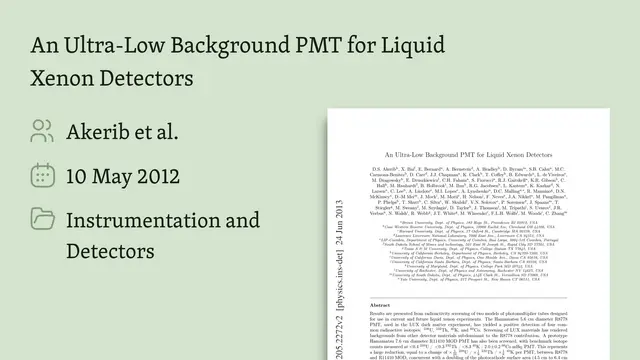
The Large Underground Xenon (LUX) Experiment
This presentation explores the LUX experiment, a groundbreaking dual-phase xenon detector designed to hunt for dark matter's most elusive suspects: Weakly Interacting Massive Particles. Operating a mile underground with 370 kilograms of liquid xenon, LUX combines precision engineering, advanced calibration systems, and sophisticated background rejection to achieve unprecedented sensitivity in the search for WIMPs, targeting cross-sections as low as 2 times 10 to the negative 46 square centimeters.Script
A mile beneath the earth's surface, 370 kilograms of ultra-pure liquid xenon wait in absolute darkness, listening for the faintest whisper of a particle that has never been directly observed. The Large Underground Xenon experiment represents one of humanity's most ambitious attempts to catch dark matter in the act.
The target is WIMPs, hypothetical particles that barely interact with ordinary matter. To catch something this elusive, the LUX detector achieves sensitivity at the level of 2 times 10 to the negative 46 square centimeters, operating with a carefully defined 100 kilogram fiducial volume at its core where background interference is minimized.
How does xenon reveal what cannot be seen?
When a WIMP collides with a xenon nucleus, it triggers two distinct light signals. The initial impact creates an immediate scintillation flash called S1. Then, freed electrons drift upward through the liquid until they reach the gas phase, where they generate a second, amplified pulse called S2. This dual signature enables three-dimensional event reconstruction and powerful discrimination between signal and noise.
The dual-phase architecture delivers extraordinary background rejection, filtering out 99.9 percent of electron-recoil events that mimic WIMP signals. Nuclear recoils from actual WIMP interactions produce distinctly different light ratios between S1 and S2, while photomultiplier arrays positioned above and below the detector enable precise three-dimensional tracking of every event.
Operating at this sensitivity requires engineering that matches the ambition.
The detector operates within titanium cryostats cooled by an efficient thermosyphon system that maintains the delicate liquid-gas xenon interface. A commercial getter continuously purifies the xenon, processing 420 kilograms daily to sustain the long electron drift lengths essential for sharp three-dimensional imaging. Every technical choice serves one goal: keeping the xenon pristine enough to reveal the faintest interactions.
The detector sits a mile underground where kilometers of rock intercept cosmic rays that would otherwise overwhelm any signal. Surrounding the xenon chamber is a massive water tank equipped with photomultiplier tubes, functioning as both a Cherenkov detector for residual muons and a shield against neutrons and gamma radiation from the cavern walls. Location and shielding combine to create one of the quietest environments on Earth.
The electronics system centers on Struck analog-to-digital converter modules that capture the full waveform of every photomultiplier signal with minimal noise. Multiple amplification stages preserve signal fidelity, while diverse calibration sources, both internal and external, validate the detector's ability to distinguish genuine WIMP candidates from the sea of background events.
A mile down, in liquid xenon colder than space, LUX waits for dark matter to break its silence. To explore this experiment further or create your own research videos, visit EmergentMind.com.