Every Microsecond Matters: Reaching Near Speed-of-Light GPU Communication
This lightning talk explores groundbreaking research on GPU collective communication that achieves latencies within 7% of the theoretical hardware minimum. We examine how eliminating global memory barriers, introducing novel atomic protocols, and designing device-initiated APIs dramatically reduce communication overhead in scale-up NVLink domains. The presentation focuses on the speed-of-light latency bound concept, barrier-free synchronization techniques including the innovative two-shot atomic AllReduce algorithm, and real-world impact on large language model inference and high-performance computing workloads.Script
In the world of large language model inference, a few microseconds of communication delay multiply into thousands of dollars of wasted compute. This paper demonstrates GPU collective operations that reach within 7% of the absolute speed-of-light hardware limit.
Traditional GPU collectives rely on global memory barriers that can consume 40% of total latency. The researchers systematically eliminate these barriers using atomic synchronization and double-buffered communication, allowing GPUs to coordinate without ever waiting.
The novel two-shot atomic AllReduce protocol performs distributed reductions directly at the L2 cache using atomic additions. This scales efficiently across GPUs while requiring minimal scratch buffer space, a critical advantage for memory-constrained inference workloads.
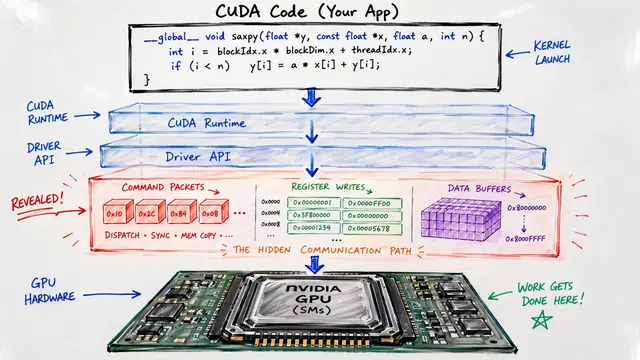
The authors introduce a buffer-centric API that exposes fine-grained device-side control while abstracting synchronization complexity. Developers can now construct custom latency-optimal collectives with just a few lines of code, choosing between sentinel or atomic signaling modes.
In production language model inference, these optimizations reduce inter-token latency by up to 13% and save over 11 dollars per million output tokens. For trillion-token workloads, microseconds compound into substantial production cost reductions.
By pushing collective latency to within a small factor of the physical hardware minimum, this work redefines what's possible in GPU communication. To explore how barrier-free protocols and device-initiated APIs are reshaping both AI inference and scientific computing, visit EmergentMind.com and create your own deep dive into this research.