Nix and Fix: Targeting 1000x Compression of 3D Gaussian Splatting with Diffusion Models
This lightning talk explores NiFi, a breakthrough framework that achieves extreme compression of 3D Gaussian Splatting scenes by up to 1000x while maintaining photorealistic quality. By combining aggressive compression with diffusion-based restoration, NiFi solves the critical artifact problem that has plagued extreme-rate 3D compression, enabling practical deployment of immersive 3D content in bandwidth-constrained applications like VR streaming and remote collaboration.Script
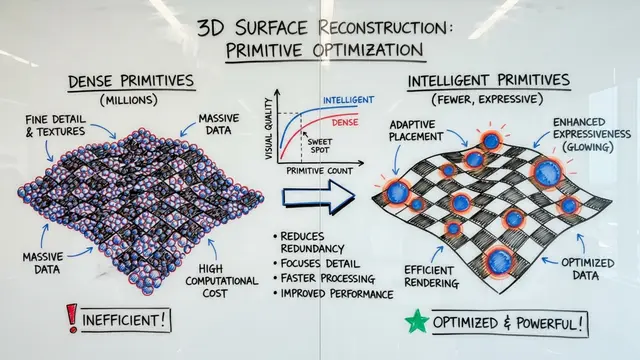
3D Gaussian Splatting renders photorealistic scenes in real time, but there's a hidden cost: a single scene can consume over 500 megabytes of storage. Compress it too aggressively, and you get geometric collapse, radiance artifacts, and blurry textures that destroy the immersive experience.
The researchers identified that current compression techniques—pruning, quantization, entropy coding—create a unique class of degradation. Unlike traditional image noise, these artifacts manifest as loss of 3D structure itself, producing renders that lack the spatial and textural cues needed for convincing scenes.
NiFi reframes the problem entirely: instead of fighting compression artifacts during encoding, embrace extreme compression and fix the artifacts afterward.
The framework splits into compress and restore. First, they prune the Gaussian primitives down to minimal cardinality, then quantize and encode. Second, a diffusion model adapted specifically for 3D artifacts restores perceptual quality by mapping compressed renders into an intermediate diffusion state, not the usual noisy endpoint.
Here's the key insight: restoring from an intermediate diffusion state, rather than pure noise, lets the model leverage both the structure in the degraded image and the generative prior learned by the diffusion backbone. A critic adapter stabilizes the score matching, while perceptual losses keep details sharp.
The numbers tell a striking story.
NiFi compresses scenes by nearly 1000x while maintaining perceptual scores on par with the original uncompressed renders. On DeepBlending, a scene that originally occupied 555 megabytes shrinks to under 600 kilobytes, yet the restored views retain fine detail, coherent geometry, and semantically consistent appearance where competing methods produce unusable artifacts.
The framework is transformative for bandwidth-constrained applications, but it's not without risks. NiFi occasionally introduces excessive high-frequency patterns, effectively hallucinating texture. In grass or foliage, this can look like over-sharpening. For applications requiring strict fidelity, like medical visualization, this generative tendency demands caution.
By proving that diffusion models can restore structure and semantics lost to extreme compression, NiFi fundamentally shifts how we think about 3D content delivery. The bottleneck is no longer just rate-distortion trade-offs during encoding—it's whether we can recover perceptual quality afterward. This work shows we can, at scales previously unimaginable.
NiFi doesn't just compress 3D scenes—it redefines what's possible when storage and bandwidth are scarce, proving that restoration can rival reconstruction. Visit EmergentMind.com to explore the full paper and see how diffusion models are reshaping the future of immersive media.