State Space Models Decoded
This lightning talk provides an accessible overview of State Space Models (SSMs), from their fundamental mathematical structure to cutting-edge deep learning variants. We'll explore how SSMs separate hidden dynamics from noisy observations, examine key inference methods, and discover recent innovations like selective SSMs and structured models that are revolutionizing sequence modeling in AI.Script
Imagine trying to understand a complex system where you can only see fragments of what's really happening. State Space Models give us a mathematical lens to peer through the noise and uncover the hidden dynamics that drive everything from animal migration to modern AI.
Let's start with the core mathematical framework that makes this all possible.
Building on this foundation, State Space Models rely on just 2 fundamental equations. The process equation governs how hidden states evolve over time, while the measurement equation determines what we actually observe from those hidden states.
The simplest yet most important case uses linear transitions and Gaussian noise. This linear Gaussian framework gives us the famous Kalman filter and serves as the launching point for all modern extensions.
Now let's explore how we actually extract knowledge from these models.
When it comes to inference, we have 2 main philosophical approaches. Frequentist methods focus on finding the best parameter estimates, while Bayesian approaches give us the full uncertainty picture through posterior distributions.
Moving beyond discrete time, continuous-time extensions handle irregularly sampled data by discretizing states and leveraging Hidden Markov Model algorithms for efficient computation.
Here's where State Space Models meet the deep learning revolution.
Deep State Space Models replace linear transitions with neural networks, using variational autoencoder frameworks to capture incredibly complex nonlinear dynamics that traditional methods simply cannot handle.
The S4 architecture revolutionizes sequence modeling by using structured matrices that project onto orthogonal polynomial bases, enabling unprecedented long-range memory while maintaining computational efficiency through clever Fourier transforms.
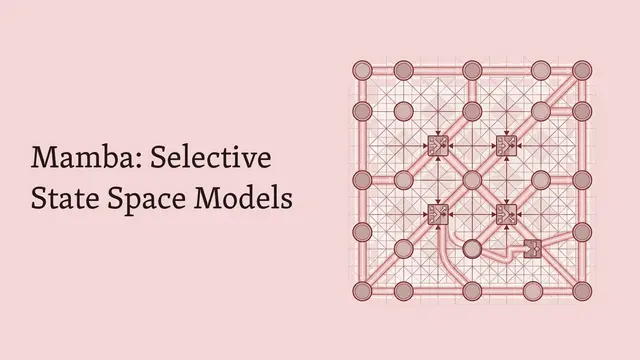
Selective SSMs like Mamba take adaptivity even further by making parameters input-dependent, allowing the model to selectively update only relevant parts of its hidden state based on the current context.
The newest frontier uses graph-generalized SSMs that break free from sequential processing, instead constructing dynamic graphs that adapt to the inherent structure of the data itself.
Let's see these mathematical concepts in action across diverse fields.
From tracking migrating animals to powering the latest language models, SSMs bridge the gap between scientific understanding and engineering applications with remarkable versatility.
Modern software frameworks now provide unified, composable interfaces that let researchers mix and match different SSM components and inference algorithms with GPU acceleration for massive scalability.
Even powerful methods face practical hurdles that we need to address.
Despite their elegance, SSMs can stumble on practical challenges like parameter non-identifiability, where measurement noise overwhelms the signal and creates flat likelihood surfaces that confound estimation.
Fortunately, robust estimation strategies help us overcome these challenges through bounded influence functions, informative priors, and comprehensive validation frameworks.
Let's explore the cutting-edge theoretical developments shaping the future.
Recent theoretical work reveals fundamental expressivity limits of linear SSMs, showing they may struggle with certain sequential computations and driving innovations like Liquid SSMs that add carefully designed nonlinearities.
The SaFARi framework pushes beyond traditional polynomial bases, enabling SSM construction with arbitrary functional frames tailored to specific problem structures while maintaining computational efficiency.
Looking ahead, researchers are developing hybrid models that combine SSMs with transformers, advancing theoretical identifiability analysis, and creating systematic approaches for matching model architectures to problem structures.
State Space Models represent a remarkable convergence of classical mathematics and modern machine learning, offering both theoretical elegance and practical power for understanding hidden dynamics in our complex world. To dive deeper into these fascinating developments, visit EmergentMind.com to explore the latest research and applications.