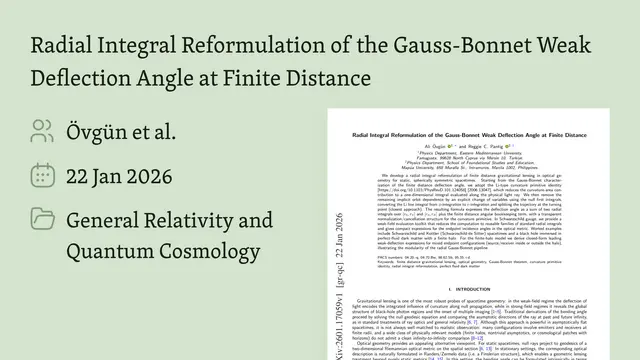
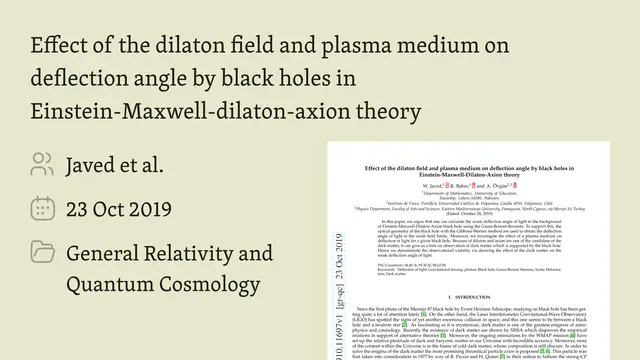
Bending Spacetime: Light Deflection by Phantom Black Holes and Wormholes
This presentation explores how exotic gravitational objects—phantom black holes and phantom wormholes—deflect light, using the elegant Gauss-Bonnet theorem to calculate deflection angles in weak field limits. The research demonstrates how these phantom field models, linked to dark energy, produce distinctive light-bending signatures that could help distinguish black holes from wormholes through astrophysical observations. By applying a topological approach rather than tracing individual light paths, the authors reveal how phantom physics creates unique observational features, including potentially larger Einstein rings and even negative deflection angles.Script
Light doesn't travel in straight lines near massive objects—it bends. But what happens when that object isn't an ordinary black hole, but something more exotic: a phantom black hole or a phantom wormhole, fueled by dark energy with negative kinetic fields? The authors of this paper use an elegant mathematical tool, the Gauss-Bonnet theorem, to find out exactly how much these strange objects deflect light.
Phantom fields represent one compelling explanation for the universe's accelerating expansion. These fields behave strangely: they carry negative kinetic energy, fundamentally different from ordinary matter. The question is whether phantom black holes and wormholes deflect light differently enough that we could actually observe the difference through telescopes.
Rather than tediously tracing individual light rays through curved spacetime, the researchers turned to topology.
The Gauss-Bonnet theorem is a mathematical statement connecting the curvature of a surface to its global shape. Instead of solving complex differential equations for each light ray, the authors integrate curvature in the region outside the path itself. This global perspective reveals deflection angles for multiple exotic spacetimes, including Garfinkle-Horowitz-Ströminger black holes and Einstein-Maxwell anti-dilaton models.
The findings split along a fascinating divide. Phantom black holes produce deflection patterns that resemble classical general relativity but with measurable differences tied to dilaton fields and charge—potentially creating Einstein rings larger than those around ordinary black holes. Phantom wormholes, however, behave radically: their throat geometry can produce negative deflection angles, meaning light bends away from the mass rather than toward it, a signature impossible for standard black holes.
This geometric picture shows how the calculation works. The Gauss-Bonnet theorem lets us construct a domain around the deflected light path and integrate the spacetime curvature over that region. The boundary contributions and the Gaussian curvature together determine how much the light bends. For phantom objects, the curvature structure differs from ordinary black holes in ways that translate directly into observable deflection differences.
These calculations open a window: if we can measure deflection angles precisely enough around compact objects in galactic centers or gravitational lensing events, we might distinguish phantom black holes from wormholes, and both from their ordinary cousins. Dark energy may not just push the universe apart—it might also leave its signature in the paths light takes past the most extreme objects in the cosmos. Visit EmergentMind.com to explore more cutting-edge research and create your own videos.