- The paper introduces a novel geometric method to derive both the Mandelstam-Tamm and Margolus-Levitin inequalities using statistical distance between quantum states.
- The analysis links the quantum speed limit to Fisher Information and energy variance, deepening our understanding of quantum state evolution under unitary dynamics.
- The counterexample with non-unitary evolution reveals the limitations of traditional bounds and highlights the need for generalized quantum speed limits.
Geometric Derivation of the Quantum Speed Limit
Introduction
The paper "Geometric derivation of the quantum speed limit" (1003.4870) presents a novel geometric approach to deriving the Mandelstam-Tamm and Margolus-Levitin inequalities, which are fundamental to understanding the limits of quantum evolution speed. These bounds are traditionally grounded in variance and average energy, respectively, for unitary quantum evolutions. Philip J. Jones and Pieter Kok propose alternative derivations rooted in the statistical distance between quantum states, enhancing the geometrical perspective on quantum mechanics.
Geometric Interpretations and Statistical Distance
The authors commence by revisiting the concept of statistical distance, a measure of closeness between quantum states in Hilbert space. They emphasize that the quantum speed limit (QSL) can be viewed through the lens of statistical distance, analogous to speed being a measure of positional change over time.
Statistical distance, specifically for quantum states, is represented by the metric tensor in a space of density matrices. Here, the trace and expectation values define natural quadratic forms that lead to the definition of infinitesimal statistical distance for quantum evolution. This approach provides a link between statistical distance and the Fisher Information, which quantifies information extractable about a parameter from a measurement, reinforcing its connection to the velocity of quantum state evolution.
Derivation of Quantum Speed Limit Inequalities
The paper articulates two primary inequalities constraining quantum speed:
- Mandelstam-Tamm Inequality: This classic bound is derived from the variance of a system's Hamiltonian and is reformulated in geometric terms, equating the speed of state evolution to the rate of change in statistical distance.
- Margolus-Levitin Inequality: The paper introduces a derivation based on average energy rather than variance, offering an alternative perspective that directly ties energy consumption to the speed of state transition in quantum systems.
The Mandelstam-Tamm inequality establishes that for a system with a variance in energy, the minimum time t for evolving to an orthogonal state is t≥2ΔEπℏ. Conversely, the Margolus-Levitin inequality, using average energy, posits a bound t≥2Eπℏ. These formulations offer significant insights into the nature of quantum time evolution, particularly the roles of state purity and energy distribution.
Non-Unitary Evolution and Counterexamples
A pivotal component of this research is the demonstration that the QSLs derived using these inequalities are not universally applicable to non-unitary evolutions, underscored by a constructed counterexample involving controlled-Z gates and GHZ states.
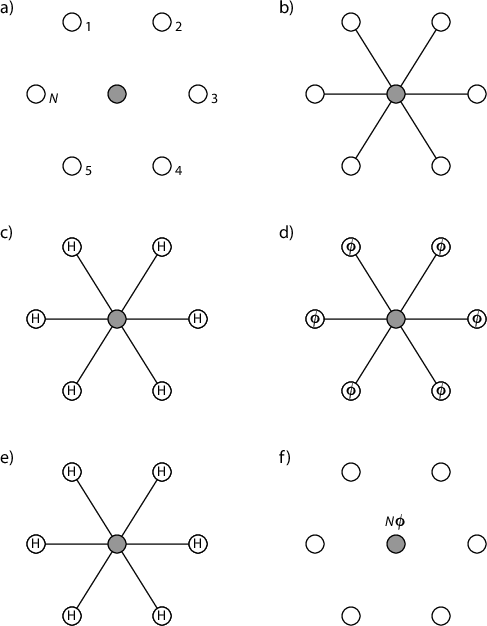
Figure 1: Non-unitary evolution of the central qubit that violates both the Mandelstam-Tamm and Margolus-Levitin bound: (a) All qubits are prepared in the state ∣+⟩.
This counterexample elucidates that orthogonal state transitions can occur in arbitrarily short times within certain parameter domains, thereby challenging the universality of the QSL under non-unitary dynamics. The conditions for such violations, especially the interaction strength and environmental energy levels, open further inquiry into the practical realizations and limitations of these theoretical constructs.
Conclusions
The geometric derivation of the quantum speed limit provides a comprehensive, alternative framing of quantum evolution constraints, enriching both theoretical understanding and potential practical applications. While the Mandelstam-Tamm and Margolus-Levitin bounds offer profound insights into quantum systems' dynamic capacities under unitary evolution, their limitations under non-unitary conditions hint at nuanced complexities in quantum dynamics that merit further exploration. Future research may focus on determining more generalized speed limits applicable to broader classes of quantum evolutions, fundamentally intertwining quantum mechanics and information theory.