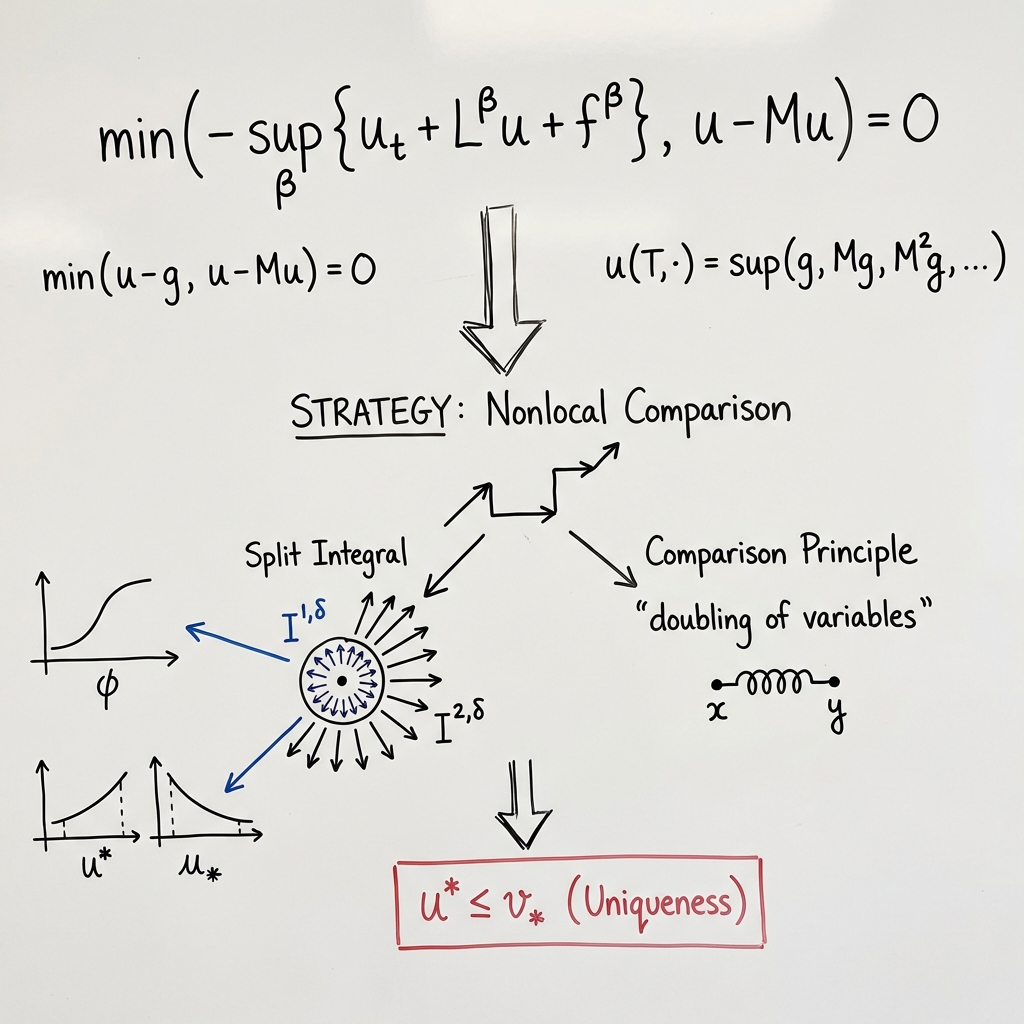
- The paper establishes existence and uniqueness of viscosity solutions for HJBQVI in jump-diffusion control, providing robust theoretical foundations.
- It employs stochastic arguments, Dynkin’s formula, and maximum principle techniques to address discontinuities from impulse interventions.
- The findings influence financial models by enhancing approaches for option pricing with transaction costs and portfolio optimization in incomplete markets.
Existence and Uniqueness of Viscosity Solutions for Impulse Control in Jump-Diffusion Processes
Introduction
The paper "General existence and uniqueness of viscosity solutions for impulse control of jump-diffusions" (1101.0172) addresses foundational issues in the characterization of Hamilton-Jacobi-Bellman quasi-variational inequalities (HJBQVI) within the context of impulse control for stochastic jump-diffusion processes. The authors establish rigorous conditions under which viscosity solutions exist and are unique, overcoming challenges posed by the combined impulse and stochastic control paradigm. These nonlinear partial integro-differential equations (PIDE) are central to modeling dynamic systems subject to random shocks and discrete interventions.
Impulse Control Framework
Impulse control problems offer an analytical framework for stochastic processes influenced by discrete interventions at predetermined stop times. The paper elaborates on a controlled stochastic differential equation (SDE) that governs the evolution of the process with Brownian motion and Poisson random measure components. The impulses, modeled as stopping times with associative impacts, accommodate adaptive strategies aimed at optimizing a payoff function over a finite or infinite horizon. This framework is particularly potent in financial applications where transaction costs and market frictions are pivotal considerations.
The paper provides a detailed exposition of the impulse control problem through the definition of the value function and associated HJBQVI. Specifically, it addresses:
- The formulation of the controlled SDE with drift and diffusion terms influenced by stochastic controls.
- The quasi-variational inequality comprising elliptic and parabolic forms tailored to scenarios involving infinite activity jump processes.
- Detailed assumptions ensuring the well-definedness of integral operators and bounding conditions on impulse interventions and transaction sets.
Existence Theorem
Through stochastic arguments and the viscosity solution theory, the authors establish the existence of solutions for the HJBQVI associated with impulse control in jump-diffusion processes. Key assumptions include conditions about continuity, compactness and non-emptiness of transaction sets, and integrability of jump terms. The authors leverage a strategic combination of Dynkin’s formula, Markov property of controlled processes, and dynamic programming principles to validate existence proofs, providing robust techniques for dealing with discontinuities in stochastic processes.
Uniqueness Proof
The uniqueness of viscosity solutions is tackled using a strict sub-/super-solution method for perturbations of solutions, ensuring the solutions do not excessively grow at infinity. The paper employs the maximum principle and non-local Jensen-Ishii lemma to validate the comparison results crucial for proving uniqueness. This analytical approach is intricately tied to ellipticity and continuity conditions on associated functions, ensuring uniqueness across function spaces.
Implications and Future Directions
The theoretical contributions of this paper have profound implications for fields requiring stochastic modeling with discrete interventions, particularly in finance and economics. By laying a rigorous groundwork for the impulse control of jump-diffusion processes, the findings pave the way for developing advanced models with practical applications such as option pricing with transaction costs and portfolio optimization in incomplete markets.
Future research could explore extending these existence and uniqueness results to broader classes of stochastic processes or more complex intervention scenarios. Additionally, numerical methods and simulations grounded in these theoretical findings can aid in testing and applying the models in real-world decision-making environments.
Conclusion
The paper successfully outlines a general framework for establishing the existence and uniqueness of viscosity solutions within impulse-controlled jump-diffusion processes. Through addressing the intricacies of both the sub- and super-solution landscapes, it provides a solid basis for future explorations in stochastic control systems and their applications in finance and beyond.