- The paper introduces an optimization framework that computes WP geodesics to efficiently quantify distances between planar shapes.
- It employs a discretized minimization approach using natural gradients and Green's function interpolation to ensure robust convergence.
- The study validates the method through experiments on shape equivalence, aspect ratio dependence, and negative curvature in T(1).
Numerical Computation of Weil-Peterson Geodesics in the Universal Teichmüller Space
Overview and Motivation
This paper presents an optimization-based algorithmic framework for computing geodesics in the universal Teichmüller space T(1) endowed with the Weil-Petersson (WP) metric. It addresses the longstanding problem of efficiently quantifying distances between planar shapes, modulo translation and scaling—a central challenge in shape analysis and computer vision. The authors exploit the identification of smooth planar shapes with diffeomorphisms of the unit circle (modulo Möbius transformations), a result rooted in Teichmüller theory and conformal welding. The WP metric provides a right-invariant, negative sectional curvature structure on this space. The proposed numerical algorithm solves a discretized boundary-value minimization problem for the WP energy, constructing robust geodesic flows in T(1).
Mathematical Foundations
The shape space is realized via conformal welding: each simply connected planar domain (shape), modulo translation and scale, is associated to a unique equivalence class of diffeomorphisms of S1 through an explicit welding map. The universal Teichmüller space T(1)=Diff(S1)/PSL2(R) thus parametrizes shapes.
The WP metric is defined on the Lie algebra of vector fields modulo the three-dimensional space spanned by $1$, cosθ, sinθ (corresponding to Möbius transformations). For a vector field v(θ)=n∑aneinθ∂θ∂, the norm is given by:
∥v∥WP2=n=2∑∞(n3−n)∣an∣2.
This is equivalently recast in terms of the operator L=−H(∂3−∂), where T(1)0 is the Hilbert transform. The geodesic problem involves finding a path T(1)1 in the diffeomorphism group such that the WP energy
T(1)2
is minimized, subject to endpoint constraints.
The underlying geometry of T(1)3, characterized by negative sectional curvature, ensures uniqueness and existence of geodesics, thus making the geodesic distance well-posed even in the infinite-dimensional setting.
Discretization and Gradient Computation
The algorithm discretizes the manifold by tracking T(1)4 particles on T(1)5 and advances them via a velocity field sampled at discrete times. The essential difficulty lies in extending a discretely defined velocity field to a global vector field on T(1)6, orthogonal to the kernel of T(1)7. The authors utilize a basis of Green's functions for T(1)8
T(1)9
to interpolate and compute the WP norm on the discrete data, performing "horizontal lifts" in the quotient space.
A key technical contribution is the use of the natural gradient with respect to the WP metric—computed via the induced metric on the space of velocity fields—which leads to superior convergence and robustness relative to coordinate gradients, as evidenced in the hyperbolic plane model example.
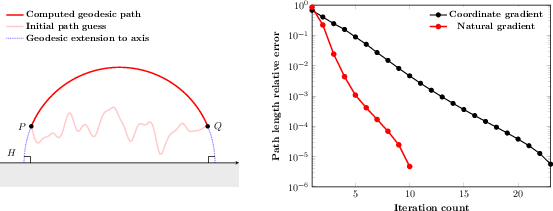
Figure 1: Left: Computed geodesic path in the hyperbolic plane model, with a randomly initialized guess; Right: Path length per iteration for natural vs coordinate-gradient algorithms, showing accelerated convergence for the natural gradient (S10).
Numerical projection techniques are described to ensure updates respect endpoint constraints. The constrained minimization is cast as a projected natural gradient descent, where the gradient is computed in the WP-induced metric on the path space.
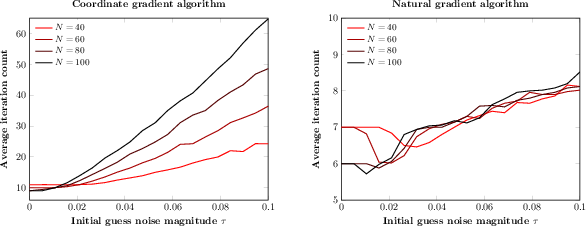
Figure 2: Ensemble-averaged iteration counts to convergence for hyperbolic geodesic computation, illustrating strong insensitivity of the natural gradient to noise and discretization relative to coordinate gradients.
Implementation and Numerical Results
The explicit algorithm iteratively updates the velocity field along the path, with convergence ensured by monitoring the relative WP norm variation and projected gradient norm. The method of conformal welding computation leverages the Zipper algorithm for accurate shape encoding and inversion.
The numerical experiments are thorough:
- Zero-Distance Equivalence Verification: Computed geodesic energies between shape representatives in the same welding equivalence class are found to be nearly zero, reflecting high algorithmic fidelity.
- Aspect Ratio Dependence: For ellipses, computed path lengths exhibit near-linear dependence on the aspect ratio, in agreement with prior results.
- Negative Curvature Demonstration: Triangles formed by geodesics between three rotated ellipses yield angle sums strictly less than S11, empirically confirming the negative curvature of S12 in the WP metric.
- Limiting Behavior for Corners: As the smoothness parameter S13 of rounded triangles approaches 1 (the non-diffeomorphic limit), the WP geodesic length diverges sharply, aligning with theoretical expectations regarding the infinite WP distance to non-smooth shapes.
The technique extends to complex shapes from the MPEG-7 dataset, where it provides explicit geodesics and corresponding WP path lengths for nontrivial planar silhouettes.
Theoretical and Practical Implications
This work delivers a systematic and generalizable framework for geodesic computation in nonlinear, infinite-dimensional Riemannian manifolds arising in shape analysis. The algorithm is not only competitive with shooting-based methods but exhibits improved robustness to initialization and discretization noise. The approach to handling endpoint constraints via projected natural gradients is broadly applicable to Riemannian optimization on quotient manifolds.
The principal limitation identified is the numerical instability caused by shapes whose conformal welds have highly variable or vanishing derivatives—a generic issue in the conformal geometry of crowded domains. Addressing this will require advances in robust computation of conformal maps for singular or degenerate welds.
Conclusion
The numerical framework established in this paper provides a powerful tool for quantifying shape differences via WP geodesics in universal Teichmüller space. The approach enhances both the theoretical understanding and practical computation of distances in shape spaces. The constrained natural gradient methodology developed herein is extensible to other Riemannian optimization problems on manifolds with quotient structures. Future improvements in the robustness of conformal welding algorithms stand to expand the applicability of these geodesic methods to more challenging classes of shapes.