First results from the LUX dark matter experiment at the Sanford Underground Research Facility
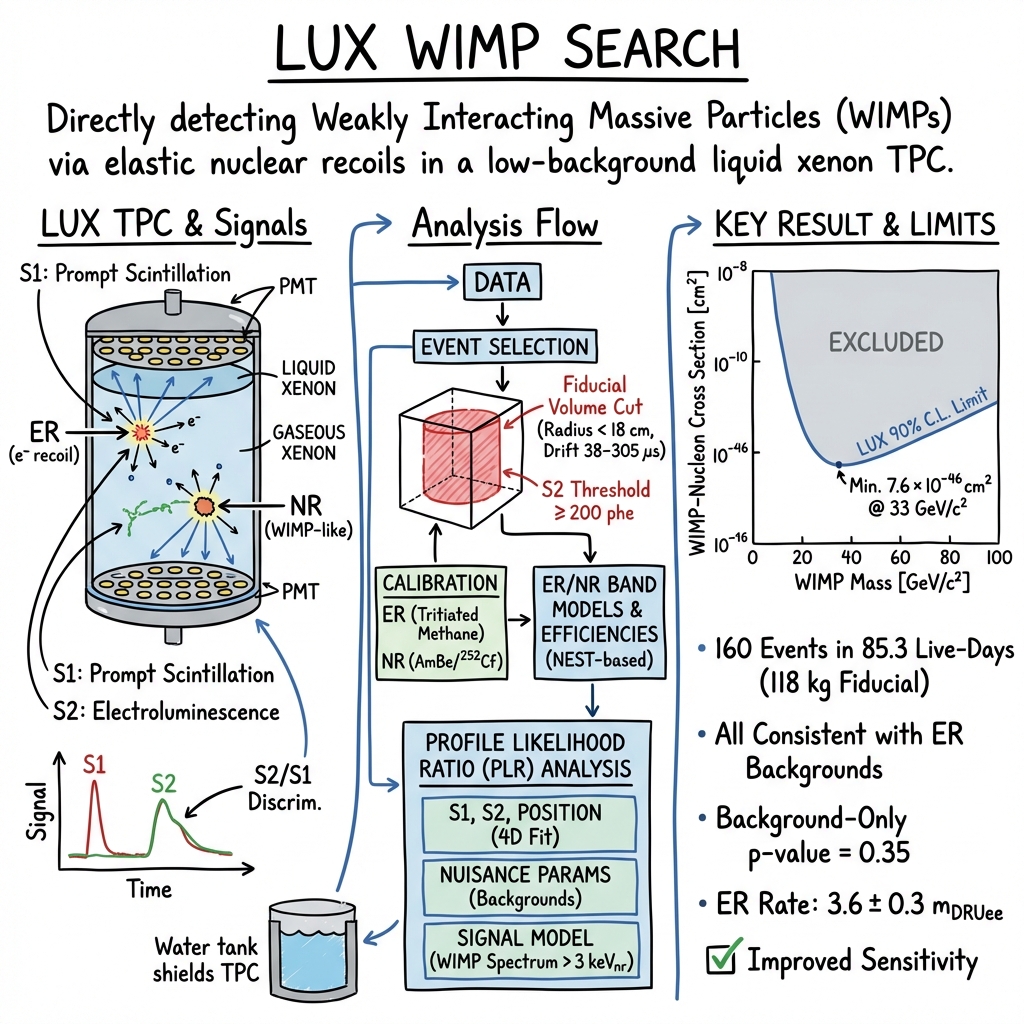
Abstract: The Large Underground Xenon (LUX) experiment, a dual-phase xenon time-projection chamber operating at the Sanford Underground Research Facility (Lead, South Dakota), was cooled and filled in February 2013. We report results of the first WIMP search dataset, taken during the period April to August 2013, presenting the analysis of 85.3 live-days of data with a fiducial volume of 118 kg. A profile-likelihood analysis technique shows our data to be consistent with the background-only hypothesis, allowing 90% confidence limits to be set on spin-independent WIMP-nucleon elastic scattering with a minimum upper limit on the cross section of $7.6 \times 10{-46}$ cm${2}$ at a WIMP mass of 33 GeV/c$2$. We find that the LUX data are in strong disagreement with low-mass WIMP signal interpretations of the results from several recent direct detection experiments.
Paper Prompts
Sign up for free to create and run prompts on this paper using GPT-5.
Top Community Prompts
Explain it Like I'm 14
Overview
This paper shares the first results from the LUX experiment, a very sensitive detector placed deep underground in South Dakota. LUX’s goal is to look for dark matter—an invisible kind of matter that makes up most of the mass in the universe but doesn’t give off light. The team watched their detector for about three months to see if dark matter particles would bump into xenon atoms inside, leaving tiny signals.
What questions was the experiment trying to answer?
- Do dark matter particles called WIMPs (Weakly Interacting Massive Particles) interact with normal matter strongly enough for us to catch them in the lab?
- If we don’t see them, how small must their interaction strength be?
- Are earlier hints from other experiments—especially for lighter WIMPs—really signs of dark matter?
How did they do it?
The detector in simple terms
LUX is a tank filled with xenon, a noble gas cooled into a liquid, with a thin layer of xenon gas on top. It sits 4,850 feet underground and inside a large water tank to block cosmic rays and other outside radiation. This quiet environment helps the team spot rare events.
Here’s what happens if a particle hits the xenon:
- A tiny flash of light happens right away in the liquid. The team calls this “S1.”
- The hit also frees a few electrons. An electric field pulls these electrons up into the gas layer, where they make a second flash of light, called “S2.”
- Super-sensitive light sensors (photomultiplier tubes) above and below the xenon see these flashes. Using S1 and S2 together, the team can tell where the event happened and what kind of hit it was.
Why two flashes? Think of S1 like the splash when a pebble drops into water, and S2 like a second splash when the pebble’s ripples push water up at the surface.
Telling real dark matter-like hits from background
Most “background” events come from normal radiation that causes electrons to move; these are called electron recoils (ER). Dark matter WIMPs are expected to bump into xenon nuclei (the centers of atoms), causing nuclear recoils (NR). ER and NR make different patterns in the ratio of S2 to S1, so the team uses that ratio to separate them.
To keep only the cleanest data:
- They analyze events that look like a single hit (one S1 followed by one S2).
- They focus on the inner “fiducial volume” (118 kg of xenon in the center), away from edges where backgrounds are higher.
- They set sensible thresholds so tiny, poorly measured events are excluded.
- They calibrated the detector by adding tiny amounts of safe radioactive materials (like tritium and krypton) and by shining neutrons from known sources into the xenon. Tritium helps map the ER background; neutrons mimic NR (dark matter-like) events.
The analysis approach, in everyday terms
They used a statistical test called a “profile likelihood.” In simple language, this compares how well the data match:
- Just background events, versus
- Background plus a possible dark matter signal.
They looked at four things together—where the event happened (radius and depth), and the sizes of S1 and S2—to see if any events looked more like dark matter than normal background.
The main dataset covered 85.3 live days of watching, using the 118 kg central xenon region.
What did they find?
- They saw 160 events in the target energy range, and all looked like normal background, not dark matter hits.
- Statistically, the data fit the “background-only” explanation well.
- Since they saw no dark matter, they set a strong “upper limit” on how often WIMPs could hit xenon. This is called the “cross section,” and it’s like the chance of collision. Their best limit was a maximum cross section of 7.6 × 10−46 cm² for a WIMP with mass 33 GeV/c² (about 35 times heavier than a proton).
- These results strongly disagree with several recent hints of low-mass WIMPs from other experiments. In other words, if low-mass WIMPs were interacting as those hints suggested, LUX should have seen them—but it did not.
Why is that important? That number (7.6 × 10−46 cm²) is extremely small, meaning if WIMPs exist, they interact even more weakly than many earlier studies thought. LUX’s low energy threshold and powerful background rejection made it the most sensitive xenon-based search of its time.
Why it matters and what’s next
Dark matter is a major missing piece in our picture of the universe. LUX’s results don’t solve the mystery yet, but they do narrow down where dark matter could be and how it might behave. By ruling out large parts of the possible “interaction strength” for WIMPs—especially at low masses—these results guide scientists toward better theories and smarter searches.
The LUX team planned longer, even more sensitive runs (around 300 live days) and technical improvements (better calibrations, lower backgrounds, and extra detectors to veto unwanted signals). Each step makes the detector more capable of either finding dark matter or tightening the limits further, helping us inch closer to answering one of science’s biggest questions: What is the universe mostly made of?
Knowledge Gaps
Knowledge Gaps, Limitations, and Open Questions
The research paper presents findings from the LUX dark matter experiment. However, several knowledge gaps, limitations, and unresolved questions remain that could guide future research:
- Background Model Refinement: The paper relies on several assumptions regarding background models, including cosmic rays and radiogenic backgrounds. Further refinement and validation of these models using independent datasets could enhance the reliability of the findings.
- Low Energy Recoil Uncertainties: There is an assumption regarding the energy threshold below which no light or charge response is assumed in the profile likelihood analysis. Future studies could refine these energy thresholds and explore their impact on results.
- Astrophysical Assumptions: The paper assumes a standard isothermal Maxwellian velocity distribution for WIMP modeling. Exploring variations in astrophysical parameters, such as the velocity distribution of dark matter, could provide deeper insights into the dark matter profile.
- NR and ER Band Separation: The study depends on the separation between nuclear recoils (NR) and electron recoils (ER) for analysis. Investigating possible improvements in separation efficiency could aid in minimizing background noise.
- Yield Measurement at Very Low Energies: The current analysis has limitations regarding direct measurements of NR yield at energies below 3 keV. Developing techniques that can lower this measurement threshold would be valuable.
- Sensitivity to Low-Mass WIMPs: Though the experiment tests low-mass WIMP hypotheses, further sensitivity improvements are needed to narrow down or refute these hypotheses convincingly.
- Impact of Systematics on Detection Efficiency: The paper provides an average shift in the limit due to variation in detection efficiency. A more in-depth study on how these systematics might variably impact results could provide better accuracy.
- Cosmogenic Activation Effects: The paper references isotopes created through cosmogenic production, such as Co. Further detailed studies on cosmogenic activation's impact on long-term detector stability and sensitivity could be beneficial.
- Long-term Stability and Calibration: The need for further engineering and calibration studies is mentioned as part of future work. Understanding how long-term stability influences results is crucial.
For future researchers, pursuing these highlighted gaps could yield a more comprehensive understanding of the results presented in the current study.
Glossary
Cosmic-Ray Muon: High-energy particles from cosmic rays that penetrate the atmosphere and reach underground locations, crucial for background assessments in experiments. "Fluxes of cosmic-ray muons, neutrons and -rays at SURF have been published elsewhere."
Cryostat: A device used to maintain low temperatures for the components of experiments that require cooling, such as liquid xenon detectors. "The LUX cryostat was filled for the first time in the underground laboratory in February~2013."
Dual-Phase Time-Projection Chamber (TPC): A detector type that uses a combination of liquids and gases to track particle interactions, especially useful for dark matter searches. "The Large Underground Xenon (LUX) experiment is a dual-phase xenon time-projection chamber operating at the Sanford Underground Research Facility."
Electron Drift Velocity: The speed at which electrons move through a medium when subjected to an electric field, important for calibrating detector responses. "An electric field of 181~V/cm was applied across the WIMP target region providing a measured average electron drift velocity of ~mm/s."
Electroluminescence: The process whereby a material emits light in response to an electric field, utilized in detectors to track ionization events. "Electrons are extracted into the gas, where they produce electroluminescence (S2)."
Fiducial Volume: The defined region within a detector that is analyzed for signals, excluding peripheral areas prone to background noise. "We report results of the first WIMP search dataset, taken during the period April to August~2013, presenting the analysis of 85.3~live-days of data with a fiducial volume of 118~kg."
Isothermal Maxwellian Velocity Distribution: A model that describes the velocity distribution of particles, often used in astrophysical simulations. "The energy spectrum of WIMP-nucleus recoils is modeled using a standard isothermal Maxwellian velocity distribution."
Material Screening: The process of assessing materials used in detectors for radiological purity and reduced background contributions. "Backgrounds from detector components were controlled through a material screening program at the Soudan Low-Background Counting Facility."
Profile-Likelihood Analysis: A statistical method for interpreting data, notably used here to ascertain limits on particle interactions. "A profile-likelihood analysis technique shows our data to be consistent with the background-only hypothesis."
Radiogenic Backgrounds: Background noise originating from natural radioactive decay processes within materials, requiring careful modeling for accurate signal detection. "Radiogenic backgrounds were extensively modeled using LUXSim."
Practical Applications
Immediate Applications
Below are actionable uses that can be deployed now, drawing on LUX’s techniques, subsystems, and analysis methods.
- Ultra–low-background materials screening and procurement workflows
- Sectors: semiconductor (reduced soft-error rates), quantum computing (fewer radiation-induced qubit errors), medical devices, space instrumentation, basic research
- Tools/products/workflows: gamma-spectroscopy assay services (e.g., SOLO/LBNL-style), cosmogenic activation control during logistics, low-alpha materials certification for packaging/encapsulation, supplier QA playbooks
- Assumptions/dependencies: access to low-background counting facilities; incremental cost/lead time acceptable; industry adoption of low-alpha standards
- Noble-gas purification to parts-per-trillion impurities
- Sectors: detector R&D (dark matter, neutrinos), semiconductor processing (high-purity process gases), spacecraft propulsion (xenon propellant QA), specialty lighting
- Tools/products/workflows: charcoal chromatographic Kr-removal skids; hot-zirconium getter trains for O2/H2O electronegatives; inline purity monitoring (e.g., electron-lifetime proxies, ATTA-based 85Kr assays)
- Assumptions/dependencies: throughput scaling to industrial flows; monitoring of trace isotopes; cost-benefit varies by sector
- Internal, uniform-volume calibrations with removable sources
- Sectors: particle and nuclear physics (LXe/LAr TPCs), nuclear safeguards/security detectors, medical imaging R&D (LXe PET)
- Tools/products/workflows: tritiated-methane β-source protocols and full getter removal; weekly 83mKr deployments for 3D gain/charge-lifetime maps; safety and regulatory SOPs
- Assumptions/dependencies: regulatory approval for tritium use; validated removal efficiency; compatible gas handling
- Neutron–gamma discrimination and 3D fiducialization for radiation detection
- Sectors: homeland security (spectroscopic portals, source search), reactor monitoring, lab radiation safety
- Tools/products/workflows: S1/S2 ratio classifiers (~99.6% ER rejection at 50% NR acceptance), mm-scale (x,y) and depth reconstruction, event topology cuts
- Assumptions/dependencies: cryogenic operation feasible for deployment environment; PMT/SiPM VUV sensitivity and reflectors (PTFE) tuned to application
- Low-light DAQ and robust digital triggering for rare-event sensing
- Sectors: astronomy/astroparticle, radiation monitoring, biomedical optical systems
- Tools/products/workflows: firmware that records >95% SPE pulses, pre/post-trigger windows, grouped-channel triggers to suppress accidentals
- Assumptions/dependencies: adaptation to SiPM arrays and non-cryogenic photodetectors; integration with existing front-ends
- Open modeling stacks for detector design and background prediction
- Sectors: medical physics (imaging/therapy planning), radiation shielding and facility design, HEP/NP experiments
- Tools/products/workflows: GEANT4-based LUXSim for end-to-end background simulations; NEST for field- and energy-dependent scintillation/ionization yields in noble media
- Assumptions/dependencies: in-house MC expertise; validation against project-specific data
- Precision cryogenics and level/pressure control in large volumes
- Sectors: cryogenic processing, superconducting quantum computing infrastructure, industrial gas handling
- Tools/products/workflows: thermal stability (ΔT < 0.2 K), pressure stability (ΔP/P < 1%), sub-mm level control via S2-width proxies; automated slow controls
- Assumptions/dependencies: transfer of methods from LXe to other cryogens; suitable sensor suites
- Radon emanation control and monitoring for ultra-clean environments
- Sectors: semiconductor fabs (alpha-induced soft errors), museums/archives, health & safety in underground facilities
- Tools/products/workflows: material-by-material emanation assays; surface treatment and storage protocols; in situ 214Pb/222Rn chain monitoring
- Assumptions/dependencies: availability of emanation measurement capacity; cost justified by reliability targets
- Water-shield and veto design patterns for low-background sites
- Sectors: reactor neutrino monitoring, underground labs, nuclear facilities
- Tools/products/workflows: scalable water-Cherenkov vetoes; shielding layout optimization using site-specific muon/neutron flux data
- Assumptions/dependencies: space and water system availability; PMT safety and maintenance
- Policy and research portfolio guidance from null-result limits
- Sectors: science policy/funding, academic program strategy
- Tools/products/workflows: use of LUX’s upper limits to reprioritize WIMP parameter space, motivate alternative DM candidates, and optimize next-gen experiment designs
- Assumptions/dependencies: consensus on astrophysical priors; coordinated roadmaps across agencies and consortia
Long-Term Applications
These opportunities require further R&D, scaling, or engineering before broad deployment.
- Discovery-grade dark matter detection and its downstream technologies
- Sectors: fundamental science (with unpredictable technological spillovers)
- Tools/products/workflows: scale-up of dual-phase LXe TPCs (e.g., LZ), improved backgrounds and thresholds, blind analyses over multi-year exposures
- Assumptions/dependencies: continued sensitivity gains; control of neutrino floor systematics; sustained funding
- Ruggedized noble-liquid detectors for fieldable neutron/gamma spectroscopy
- Sectors: homeland security, safeguards, emergency response
- Tools/products/workflows: cryocooler-integrated dual-phase modules, SiPM-based VUV readout, simplified gas systems, automated calibrations
- Assumptions/dependencies: reliability of long-term cryo operation; power and maintenance footprint acceptable; cost vs. scintillator alternatives
- Clinical and preclinical imaging with liquid-xenon detectors
- Sectors: medical imaging (PET/SPECT), radiotracer research
- Tools/products/workflows: LXe PET with high light yield and fast timing; uniform internal calibration to ensure quantitative accuracy
- Assumptions/dependencies: clinical-grade cryogenics and safety; competitive performance/cost vs. LYSO/SiPM systems
- Radiation-hard, ultra-low-background platforms for quantum and HPC systems
- Sectors: quantum computing, high-reliability computing, space electronics
- Tools/products/workflows: low-radioactivity material BOMs informed by LUX-style screening; architectural shielding; site selection and underground/underwater siting studies
- Assumptions/dependencies: quantified gains in error/decoherence rates; willingness to alter supply chains and facility design
- Standards and certification for ultra-pure noble gases (ppt 85Kr)
- Sectors: specialty gases, aerospace propulsion, research supply chains
- Tools/products/workflows: industry standards for 85Kr and electronegatives; certified purification and assay services; traceability audits
- Assumptions/dependencies: market demand for certified ultra-purity; assay throughput (e.g., ATTA) at scale
- Neutron dosimetry with event-by-event NR/ER discrimination
- Sectors: occupational safety in nuclear/accelerator facilities, radiography
- Tools/products/workflows: compact noble-liquid or high-pressure gas detectors with S1/S2-like discrimination; real-time dose mapping
- Assumptions/dependencies: miniaturization and power; regulatory approval; calibration stability
- Underground/underwater siting for radiation-sensitive infrastructures
- Sectors: data centers, quantum labs, sensor networks
- Tools/products/workflows: site selection informed by measured muon/neutron/γ fluxes; shielding retrofits (water/rock overburden, active vetoes)
- Assumptions/dependencies: TCO favorable vs. conventional siting; operational constraints manageable
- Advanced statistical pipelines for low-count rare-event monitoring
- Sectors: nonproliferation (neutrino-based safeguards), environmental radiation networks, biosurveillance analogs
- Tools/products/workflows: multivariate profile-likelihood frameworks with nuisance profiling; real-time anomaly detection with physically informed priors
- Assumptions/dependencies: validated signal and background models; integration with streaming data systems
- VUV optics and reflector materials for next-gen detectors
- Sectors: scientific instrumentation, UV sterilization, spectroscopy
- Tools/products/workflows: PTFE-based high-reflectivity VUV chambers; VUV-compatible SiPMs/PMTs and coatings
- Assumptions/dependencies: durability and cleanliness in operational environments; supply of specialized materials
- Supply-chain and handling protocols minimizing cosmogenic activation
- Sectors: space missions, low-background experiments, ultra-sensitive sensors
- Tools/products/workflows: shielded transport/storage, production scheduling to reduce activation, activation modeling tied to procurement
- Assumptions/dependencies: logistics flexibility; measurable performance benefits relative to cost
Each long-term item will benefit from continuing advances highlighted in the paper—better photon detection efficiency, lower intrinsic backgrounds (ppt-level Kr, controlled Rn), robust calibrations (tritiated methane, 83mKr), and improved simulation/analysis (LUXSim, NEST, multivariate PLR). Feasibility depends on cross-sector adoption, cost and complexity of cryogenics, regulatory frameworks (especially for radioactive sources), and demonstrated performance advantages over incumbent technologies.
Collections
Sign up for free to add this paper to one or more collections.