Measuring the superconducting coherence length in thin films using a two-coil experiment
Published 26 Mar 2014 in cond-mat.supr-con | (1403.6856v1)
Abstract: We present measurements of the superconducting coherence length ξ in thin (d < 100 Å) films of MoGe alloy and Nb using a combination of linear and nonlinear mutual inductance techniques. As the alternating current in the drive coil is increased at fixed temperature, we see a crossover from linear to nonlinear coupling to the pickup coil, consistent with the unbinding of vortex-antivortex pairs as the peak pair momentum nears \hbar\/ξ and the unbinding barrier vanishes. We compare measurements of ξ made by this mutual inductance technique to values determined from the films' upper critical fields, thereby confirming the applicability of a recent calculation of the upper limit on a vortex-free state in our experiment.
The paper introduces a two-coil experiment that probes the superconducting coherence length through nonlinear response and vortex-antivortex unbinding.
The experiments on ultrathin MoGe and Nb films correlate mutual inductance measurements with high-field Bc2 results to validate the coherence length.
The study’s methodology offers a non-invasive, high-throughput approach for accurately characterizing superconducting parameters in low-dimensional materials.
Measuring the Superconducting Coherence Length in Thin Films via Nonlinear Two-Coil Mutual Inductance
Experimental Motivation and Methodology
This work examines the superconducting coherence lengthξ in ultrathin MoGe and Nb films, leveraging a two-coil mutual inductance configuration to probe the crossover from linear to nonlinear electromagnetic response. The experimental setting consists of coaxial drive and pickup coils with the sample thin film interposed, and measurements span both the linear (low excitation) and nonlinear (high excitation) response regimes. The focus is on understanding how high-amplitude drive fields induce vortex-antivortex (V-aV) pair unbinding, leading to a transition out of the metastable Meissner state, thus enabling determination of ξ.
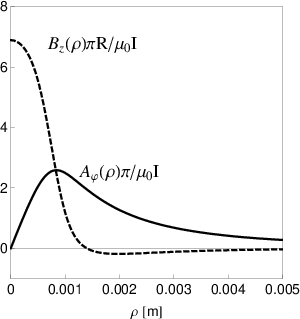
The drive coil, comprised of Nb-Ti wire, generates a controlled perpendicular magnetic field, with geometry optimized for uniformity near the film surface (Figure 1).
Figure 1: Perpendicular magnetic field and vector potential profile produced by the drive coil with respect to the film geometry.
Samples include four amorphous MoGe and four Nb films, with thicknesses well below 100 Å, ensuring that the system remains in the two-dimensional limit. Linear mutual inductance is recorded at low excitation, followed by systematic increase of the drive current at base temperature (T=1.4 K) to map the nonlinear transition. Complementary high-field resistance measurements yield Bc2, providing a traditional BCS-derived ξ reference.
Linear Regime: Superfluid Density and Penetration Depth
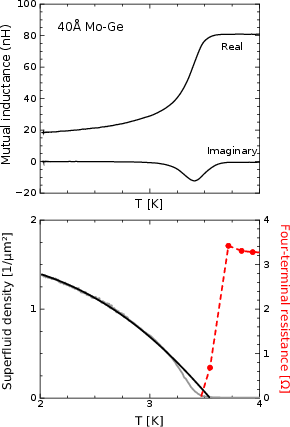
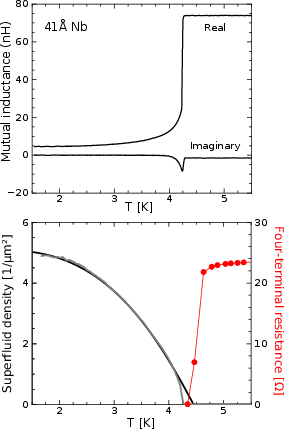
Under low field amplitudes, the mutual inductance exhibits canonical linear response. The out-of-phase voltage in the pickup coil enables extraction of the superfluid density ns and penetration depth λ through the dirty-limit BCS model. Both MoGe and Nb films exhibit superfluid density suppression at finite temperature well characterized by BCS fits, with a gap parameter ratio Δ(0)/kBTc=1.9 (Figures 2 and 3).
Figure 2: Complex mutual inductance, superfluid density, and resistance as a function of temperature for a representative MoGe film.
Figure 3: Complex mutual inductance, superfluid density, and resistance for a Nb film across the superconducting transition.
Nonlinear Response: Vortex-Antivortex Unbinding and Critical Field Determination
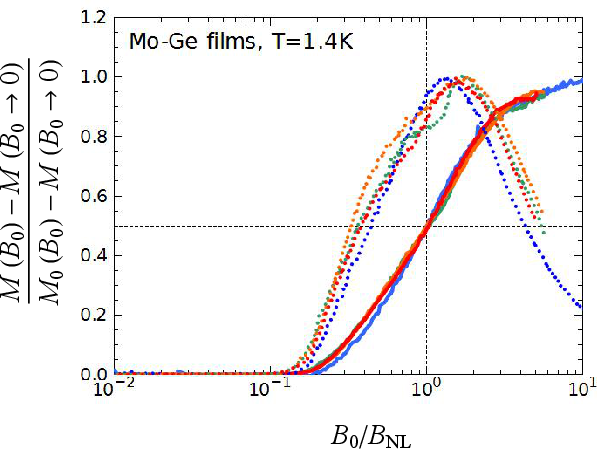
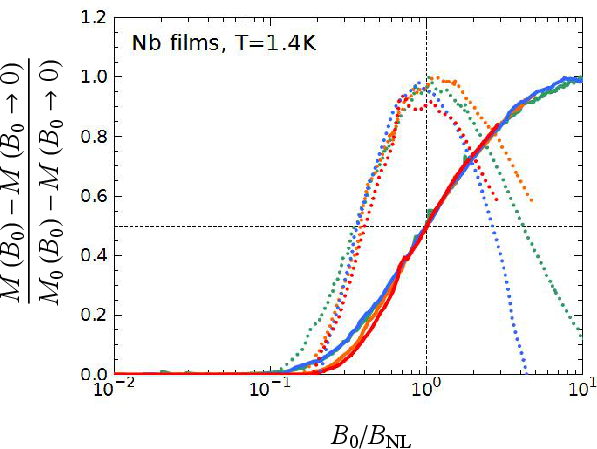
Upon increasing the drive amplitude, the mutual inductance deviates from linearity. The crossover field BNL is defined where the mutual inductance reaches half the normal-state value. This regime correlates with the collective unbinding of V-aV pairs as the screening current approaches the pair-breaking threshold (via order parameter momentum ∼ℏ/ξ). Normalized curves for all films collapse, signifying universality of the transition irrespective of disorder or pinning heterogeneity (Figure 4).
Figure 4: Scaled mutual inductance as a function of normalized drive field for all examined films, emphasizing universality of the nonlinear crossover.
Pinning-induced hysteresis in vortex dynamics is reflected in the imaginary mutual inductance, reinforcing the critical-state nature of vortex entry and dynamics.
High-Field Bc2 Measurements: Validation of the Coherence Length Scale
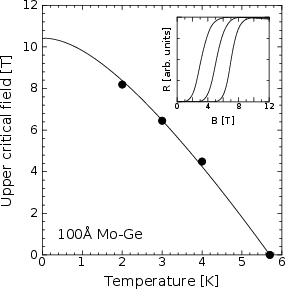
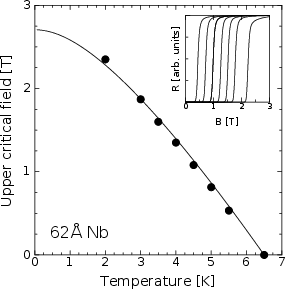
Direct resistance versus perpendicular field measurements yield Bc2(T) up to 14 T. By extrapolation using the dirty-limit Abrikosov-Gor’kov model, ξBc2 is extracted. For MoGe, ξ decreases with Tc according to ξ=ξTc=7.3K7.3K/Tc. In contrast, Nb films exhibit nearly constant ξ, as expected from the mean free path’s dependence on thickness and saturation of Tc at larger d (Figures 5 and 6).
Figure 5: Bc2(T) for a MoGe film, highlighting the dirty-limit fit and extraction of ξBc2.
Figure 6: Bc2(T) curve for a Nb film, yielding a robust and thickness-independent ξBc2.
This direct method provides a rigorous reference for evaluating the nonlinear mutual inductance approach.
Theoretical Interpretation and Model Validation
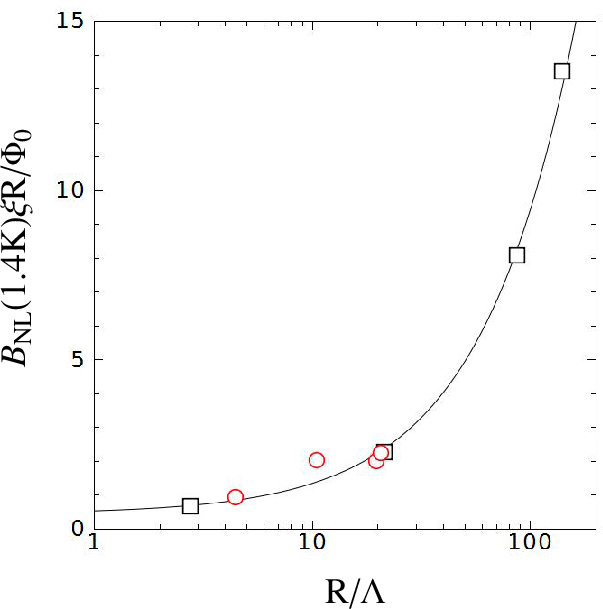
The experiments provide empirical support for the theoretical analysis by Lemberger and Ahmed, which calculates the upper field limit (B0crit) for a vortex-free ground state as a function of ξ and Λ=2λ2/d. The field BNL marking the nonlinear onset agrees with the predicted dependence: B0crit∝Φ0/(2Rξ) for long Λ and B0crit∝Φ0/(2πΛξ) for short Λ. Fitting the BNL data to these analytical expressions yields ξ values within a factor of two of the independently determined Bc2-derived lengths.
Combined data from all films, normalized to dimensionless R/Λ, are well fit by the single-ring model, with only ξ as a free parameter (Figure 7).
Figure 7: Normalized BNL versus R/Λ with theoretical fits, extracting ξ for both MoGe and Nb sample sets.
Implications and Future Directions
The demonstrated mutual inductance methodology effectively determines ξ in ultrathin films without recourse to potentially ambiguous high-field transport measurements. This is particularly valuable in complex or disordered systems where Bc2 is inaccessible, or in materials with low carrier density or pronounced quantum fluctuations. The nonlinear mutual inductance signature of V-aV unbinding is robust against material and geometric parameters, indicating general applicability.
Practically, this approach enables non-invasive and high-throughput characterization of new superconducting materials, including exotic and engineered thin-film heterostructures. Theoretically, the results reinforce the self-consistency of the Lemberger-Ahmed metastable state model and the use of two-coil methods for probing fundamental length scales in low-dimensional superconductors.
Extensions of this framework could include spectroscopic frequency studies of the nonlinear regime, mapping of spatial inhomogeneity effects, and adoption to high-Tc or topological superconducting systems where vortex dynamics and coherence length are of particular interest.
Conclusion
This study provides a comprehensive experimental protocol and analysis for determining the superconducting coherence length in ultrathin films via two-coil mutual inductance, supplemented by high-field Bc2 measurements for cross-validation. The nonlinear mutual inductance method yields ξ values quantitatively consistent with microscopic critical field predictions, and is thus a powerful, generalizable tool for probing superconducting order in the two-dimensional regime.