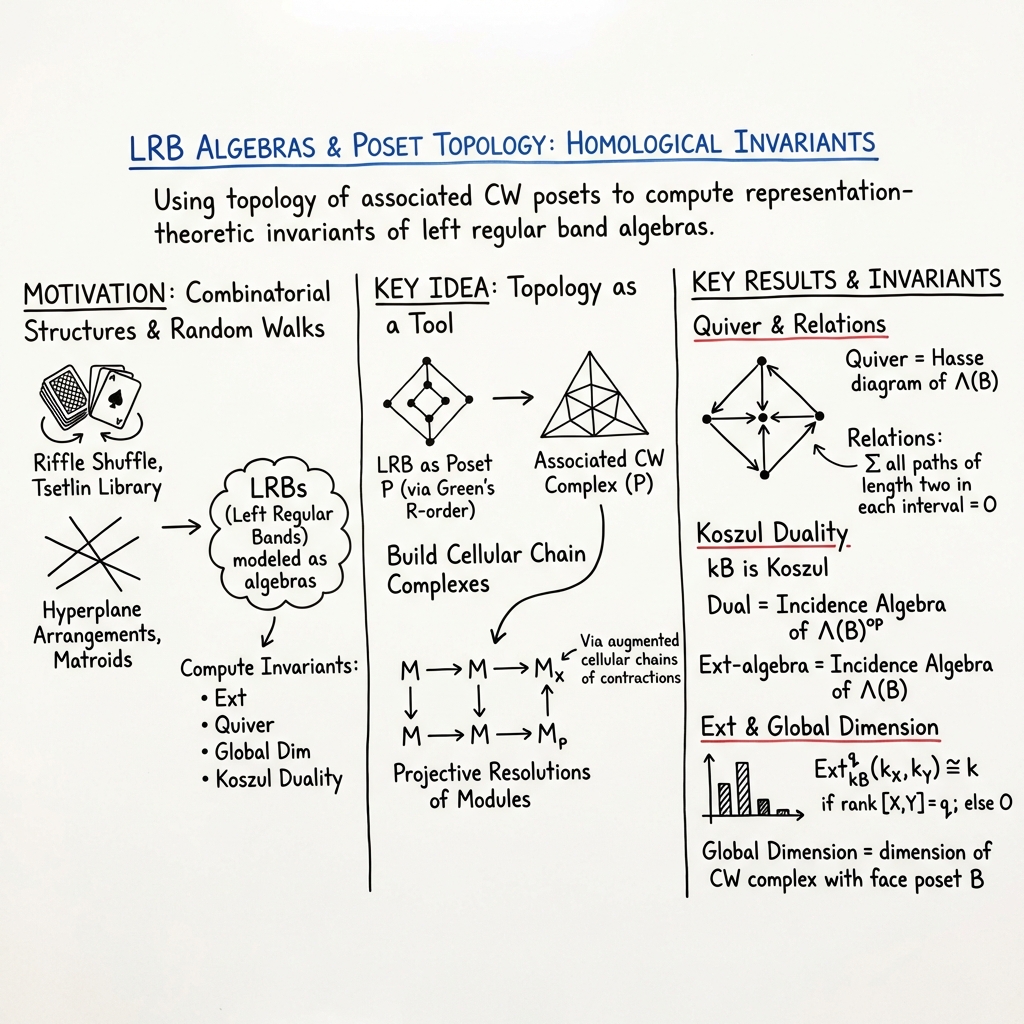
- The paper establishes explicit orthogonal idempotents and quiver presentations for connected CW left regular bands.
- It employs cellular and simplicial homology to construct minimal projective resolutions and compute Ext groups.
- Results include precise formulas for global dimension and Cartan invariants, demonstrating the Koszulity of the algebra.
Overview
The paper develops a comprehensive theory of finite left regular bands with a focus on those that are “connected CW left regular bands.” It establishes deep connections between the combinatorics of the support lattice, the topology of their associated CW complexes, and the representation theory of their semigroup algebras. In particular, after constructing complete sets of orthogonal idempotents via the support map, the paper uses cellular and simplicial homology techniques to build minimal projective resolutions for the simple modules. These resolutions, in turn, yield precise formulas for Ext groups, global dimension, and Cartan invariants of the algebra. The work further provides explicit quiver presentations and demonstrates that under natural combinatorial and topological constraints the algebra is quadratic and Koszul; its Koszul dual is isomorphic to the incidence algebra of the opposite of the support lattice.
Algebraic Structure and Idempotents
A major portion of the manuscript is devoted to constructing a set of orthogonal idempotents {ηₓ} in the semigroup algebra 𝕜B over a commutative ring 𝕜, where B is a left regular band. In this construction, each element of the support semilattice Λ(B) is represented by some idempotent eₓ (with B·eₓ = X), and then one recursively defines
ηₓ = eₓ − Σ₍Y < X₎ eₓη_Y
so that the collection {ηₓ} is orthogonal and, when B is unital, sums to the identity. This procedure – originally carried out for monoids – is extended here to arbitrary finite left regular bands by characterizing connectedness via the acyclicity of their order complexes. The radical of 𝕜B is shown to coincide with the kernel of the natural support homomorphism 𝜎 : 𝕜B → 𝕜Λ(B), and a combinatorial basis for the radical is given in terms of differences b − e₍σ(b)₎.
Schützenberger Representations and Projective Modules
In the study of 𝕜B–modules the simple modules are indexed by Λ(B) and are realized via Schützenberger representations. For each X ∈ Λ(B), the left ideal L_X = σ⁻¹(X) gives rise to the module 𝕜L_X which, via the isomorphism 𝕜B ≅ ⨁_X 𝕜L_X, provides a complete set of projective indecomposable modules. A detailed analysis shows that every such module admits the structure of a projective cover of the corresponding simple module. This decomposition underpins many subsequent homological calculations.
Quiver Presentations and Koszul Duality
Building on the idempotent decomposition, the paper shows that under a set of natural conditions (labeled (B1)–(B4))—which are verified for connected CW left regular bands—the quiver of 𝕜B is isomorphic to the Hasse diagram of the support semilattice Λ(B). Moreover, every arrow from X to Y in the quiver corresponds to a cover relation (X ≺ Y) and there is exactly one arrow whenever the interval [X, Y] is of rank 1 (or equivalently, the Ext¹-space between the corresponding simples is one‑dimensional).
A minimal system of relations is then given by, for any interval [X,Y] of length two, the relation
r₍X,Y₎ = Σ₍X < Z < Y₎ (X·Z·Y)
in the path algebra, so that 𝕜B is isomorphic to 𝕜Q⁄I with I generated by these quadratic relations. It follows that 𝕜B is a quadratic algebra and its quadratic dual is isomorphic to the incidence algebra I(Λ(B)ᵒᵖ; 𝕜). Using this presentation the paper establishes Koszulity of 𝕜B. In the Koszul setting, the minimal projective resolution of the trivial module can be obtained via the cellular chain complex of the order complex Δ(B), and the resulting cohomology determines the global dimension exactly in terms of the highest nonzero reduced cohomology of the cells arising from contracting B.
Cellular and Simplicial Homology Methods
A key technical achievement is the construction of projective resolutions for the trivial module 𝕜 over 𝕜B using augmented cellular chain complexes of CW posets on which B acts semi‑freely by cellular maps. More precisely, if B acts on an acyclic CW poset P such that every simplex has a nonempty stabilizer (and the induced action on the chain complex is compatible with the cellular structure), then the augmented chain complex C₍∎₎((P); 𝕜) → 𝕜 is a projective resolution of 𝕜. Specializing to the order complex Δ(B) (or Δ(B₍≥X₎) for a contraction) yields minimal projective resolutions, from which the Ext groups between simple modules are computed explicitly in terms of the reduced cohomology of these CW complexes.
These results recover previously known outcomes for face monoids of central and complex hyperplane arrangements while simultaneously generalizing them to other settings, such as affine oriented matroids, CAT(0) cube complexes, and COMs. In each case the topological invariants of the support lattice (or the associated CW complex) directly govern the homological dimensions and the Cartan matrix entries via Mӧbius inversion.
Enumerative Combinatorics and Cohomological Dimension
The paper also generalizes classical enumeration results in oriented matroid theory. In particular, a version of Zaslavsky’s theorem is derived: for a connected CW left regular band B with support semilattice Λ(B), the number of elements in the preimage σ⁻¹(X) is given by the alternating sum
|σ⁻¹(X)| = Σ₍Y ≥ X₎ |μ(X,Y)|,
thus expressing the flag vector of the CW complex (B) in terms of the Mӧbius function of Λ(B). This not only recovers the Las Vergnas–Zaslavsky theorem for hyperplane arrangements but also gives new enumerative formulas for CAT(0) cube complexes. Furthermore, the paper computes the global dimension of 𝕜B as the maximal n such that Hn–1(Δ(e_YB)) ≠ 0 for some Y ∈ Λ(B); as a special case, for left regular band monoids that are CW posets, the global dimension equals the dimension of the associated cell complex.
Finally, using methods from monoid cohomology and standard arguments in homological algebra, the paper shows that the cohomological dimension of a free partially commutative left regular band is exactly the Leray number of the clique complex of the defining graph. This result provides a non‑commutative interpretation of a fundamental commutative algebra invariant (the Castelnuovo–Mumford regularity).
Injective Envelopes and Applications
In addition to the projective side, the paper contains a geometric construction of injective envelopes for simple modules. For classes of left regular bands whose right ideals arise as face monoids of central arrangements (or more generally as covector monoids of oriented matroids/COMs), the approach is to identify the right projective cover via a “visual hemisphere,” derived from a generic single element extension; taking the vector space dual naturally yields the corresponding injective envelope. This construction is particularly explicit for hyperplane arrangements, and it extends to CAT(0) cube complexes and affine oriented matroids, thereby providing a uniform method for computing both projective and injective modules in these settings.
Conclusion
By blending combinatorial semigroup theory with topological techniques, the paper establishes a robust framework for analyzing the representation theory of finite left regular bands. Its main contributions include explicit quiver presentations, proofs of Koszulity, and complete descriptions of minimal projective resolutions and Cartan invariants in terms of the Mӧbius function of the support semilattice. Furthermore, the results bridge the gap between combinatorial topology (via cellular and simplicial homology) and non‑commutative algebra, leading to new insights into global dimension and cohomological invariants for important classes of algebras arising in algebraic combinatorics and discrete geometry.