- The paper establishes rigorous upper bounds on the mass anomalous dimension (γ_m) using numerical conformal bootstrap methods applied to multi-flavor QCD.
- It analyzes constraints from various flavor channels, with the most stringent bounds in the symmetric traceless sector, highlighting required fine-tuning for lattice simulations.
- Numerical results for N_f=8 indicate that γ_m must remain below 1.31 to avoid dangerously irrelevant operators, informing both lattice studies and BSM model-building.
Introduction
The paper "Bootstrap bound for conformal multi-flavor QCD on lattice" (1605.04052) employs numerical conformal bootstrap to study bounds on the mass anomalous dimension γm in four-dimensional, multi-flavor, massless QCD at a nontrivial conformal fixed point. The work generalizes and refines previous analyses by considering conformal field theories (CFTs) with SU(Nf)L×SU(Nf)R flavor symmetry, focusing on constraints relevant to lattice regularizations, particularly with Wilson or domain wall fermions, which preserve a reduced SU(Nf)V symmetry. The objective is to numerically derive upper bounds for γm compatible with the absence of dangerously irrelevant scalar operators that cannot be forbidden by the lattice symmetry, highlighting necessary fine-tuning conditions for lattice simulations to access conformal QCD fixed points.
Theoretical Context and Motivation
Determining dynamical properties, including critical indices such as γm, is central for understanding the phase diagram and infrared (IR) dynamics of gauge theories with many fermion flavors. These models are relevant both to formal CFT dynamics and to phenomenological BSM model-building (e.g., walking technicolor). The unitarity bound constrains γm<2 for four-dimensional CFTs, but more restrictive non-perturbative constraints depend on global flavor symmetry and the structure of four-fermion operators. The motivation for applying the bootstrap is to rigorously quantify these constraints without relying on (uncontrolled) analytic approximations like ladder Schwinger–Dyson equations, which only apply in specific limits.
A key focus is the identification and exclusion of relevant deformations—particularly, scalar operators in various flavor representations—which, if present, would require unnatural fine-tuning in a lattice realization of the fixed point. The analysis provides bounds not on where conformal symmetry must break, but where it can be realized on the lattice without such dangerously irrelevant operators.
Bootstrap Framework and Computational Approach
The authors implement the numerical conformal bootstrap for four-point correlators of meson-like scalar operators ΦiLiR transforming in the (Nf,Nf) of SU(Nf)L×SU(Nf)R, extracting constraints on the scaling dimensions of operators appearing in their operator product expansions (OPEs). The sum rule is decomposed according to flavor representations, notably: singlet, symmetric traceless × symmetric traceless, and anti-symmetric × anti-symmetric channels, with a specific focus on scalar operators (spin 0).
State-of-the-art semidefinite programming (SDPB) is utilized to solve the resulting systems, with computations checked up to search space dimensions Λ=17. The symmetry reduction relevant to the staggered or Wilson lattice regularizations is carefully considered to isolate which operators would genuinely pose a problem for the realization of the fixed point in a finite lattice simulation.
Numerical Results: Bounds on Operator Dimensions
For Nf=8, the bounds derived via the bootstrap are as follows:
- Singlet channel: To avoid dangerously irrelevant singlet scalar operators (not automatically forbidden by the lattice and appearing in the OPE of Φ and Φˉ), the bound ΔΦ>1.21 or γm<1.79 is required.
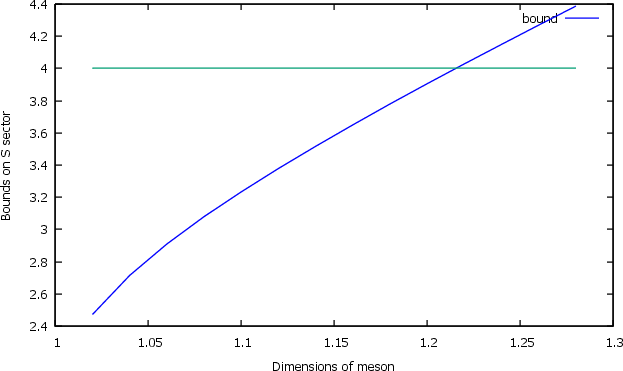
Figure 1: Bounds on the scaling dimension of operators in the singlet representation.
- Symmetric traceless × symmetric traceless channel: The strongest constraint is found here, with the bootstrap yielding ΔΦ>1.69 or γm<1.31. Operators in this channel become dangerously irrelevant (and require additional fine-tuning) when their dimension drops below four.
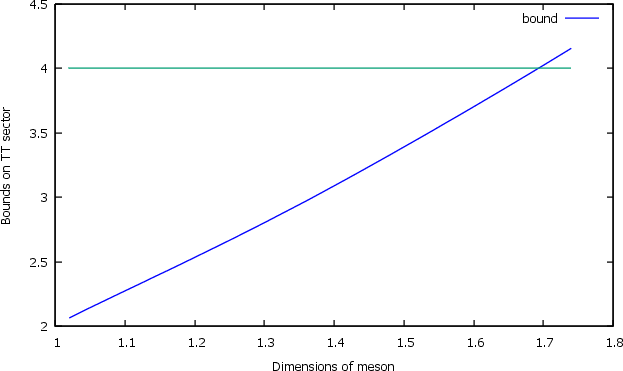
Figure 2: Bounds on the scaling dimension of operators in the symmetric traceless times symmetric traceless representation.
- Anti-symmetric × anti-symmetric channel: The bound on irrelevant operators is weaker here compared to the symmetric traceless case, and thus not the restricting constraint.
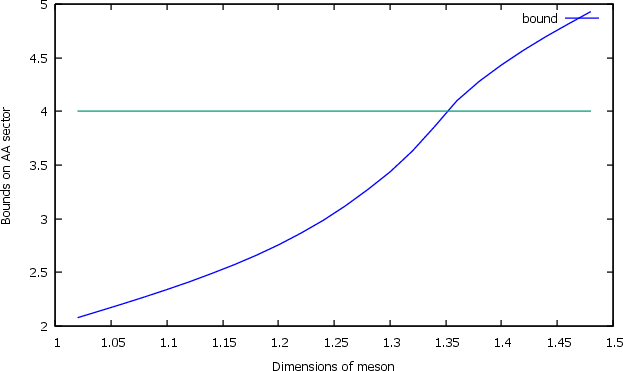
Figure 3: Bounds on the scaling dimension of operators in the anti-symmetric times anti-symmetric representation.
The bounds improve marginally with increasing search space dimension Λ, but the convergence is slow, and further improvements are unlikely to reduce the upper bound on γm below 1.2, far above the traditional strong-coupling conjecture of γm<1.
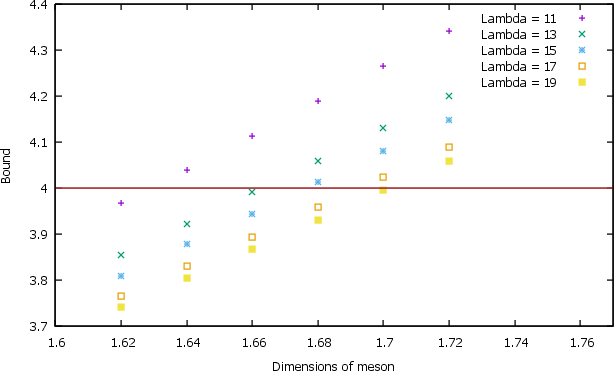
Figure 4: Change of the bounds as we increase the search space dimension Λ.
Comparison with related work in the context of staggered fermions, which preserve a smaller symmetry, indicates the bounds for Wilson/domain wall and staggered regularizations are numerically similar, with those in this paper being slightly more stringent. For larger Nf (e.g., Nf=16), the upper bound modestly tightens to γm<1.29.
Large Nf Analysis and Theoretical Implications
In the large Nf limit, the bootstrap bounds for SU(Nf)L×SU(Nf)R do not asymptote to the generalized free theory line, contrasting with the behavior observed in SO(N) models. For large Nf and spin-0 operators in the symmetric traceless × symmetric traceless channel, extrapolation to infinite search space dimension suggests a limiting scaling dimension above the unitarity threshold, e.g., ΔTT∼4.5 for ΔΦ=2, precluding the possibility of saturating the γm=1 bound in the non-supersymmetric, purely bosonic case.
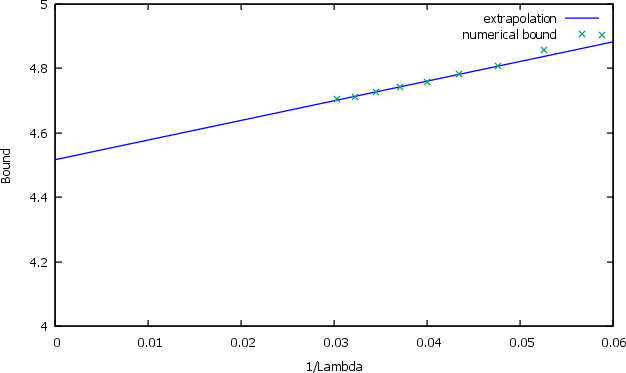
Figure 5: The asymptotic behavior of the bound on the scaling dimensions of the scalar operators in the symmetric traceless times symmetric traceless representation in SU(10000)L×SU(10000)R symmetric conformal field theories as a function of Λ−1.
Practical and Theoretical Implications
The results establish that the existence of a conformal QCD fixed point with mass anomalous dimension above γm∼1.3 would be incompatible with realization via a single-parameter tuning on regular lattices preserving only SU(Nf)V symmetry; further fine-tuning of dangerously irrelevant couplings would be unavoidable. This has direct implications for lattice simulations probing conformal windows and the phenomenological search for large anomalous dimensions in BSM scenarios.
From a theoretical standpoint, the analysis demonstrates the strength and limitations of the conformal bootstrap for vector-like gauge theories: group structure and global symmetry treatments yield meaningful, rigorous exclusion regions in theory space, but the lack of sensitivity to the specific gauge group (e.g., SU(3) vs. SU(2)) means these are necessary but not sufficient constraints for the true IR dynamics of QCD-like theories. The current approach cannot distinguish, for example, between QCD and other theories with the same global symmetry.
The observations regarding the large Nf regime emphasize that even at high flavor number, the constraints from the bootstrap are stronger than expected from naive free field behavior, reflecting the nontrivial structure of possible four-fermion operators.
Conclusion
This work provides rigorous upper bounds on the mass anomalous dimension in multi-flavor, massless QCD, relevant for lattice regularizations preserving only vector flavor symmetry. The analysis employs advanced numerical conformal bootstrap techniques, yielding γm<1.31 for Nf=8 as a necessary condition to avoid dangerously irrelevant scalar operators, generalizable to other flavor numbers. The findings delimit where lattice-accessible fixed points may exist and clarify the level of fine-tuning required, informing both non-perturbative studies of infrared conformality and phenomenological model-building. Future bootstrap studies incorporating baryonic or non-local operators could further tighten these constraints and potentially achieve greater selectivity with respect to the underlying gauge group.