Low-energy (0.7-74 keV) nuclear recoil calibration of the LUX dark matter experiment using D-D neutron scattering kinematics
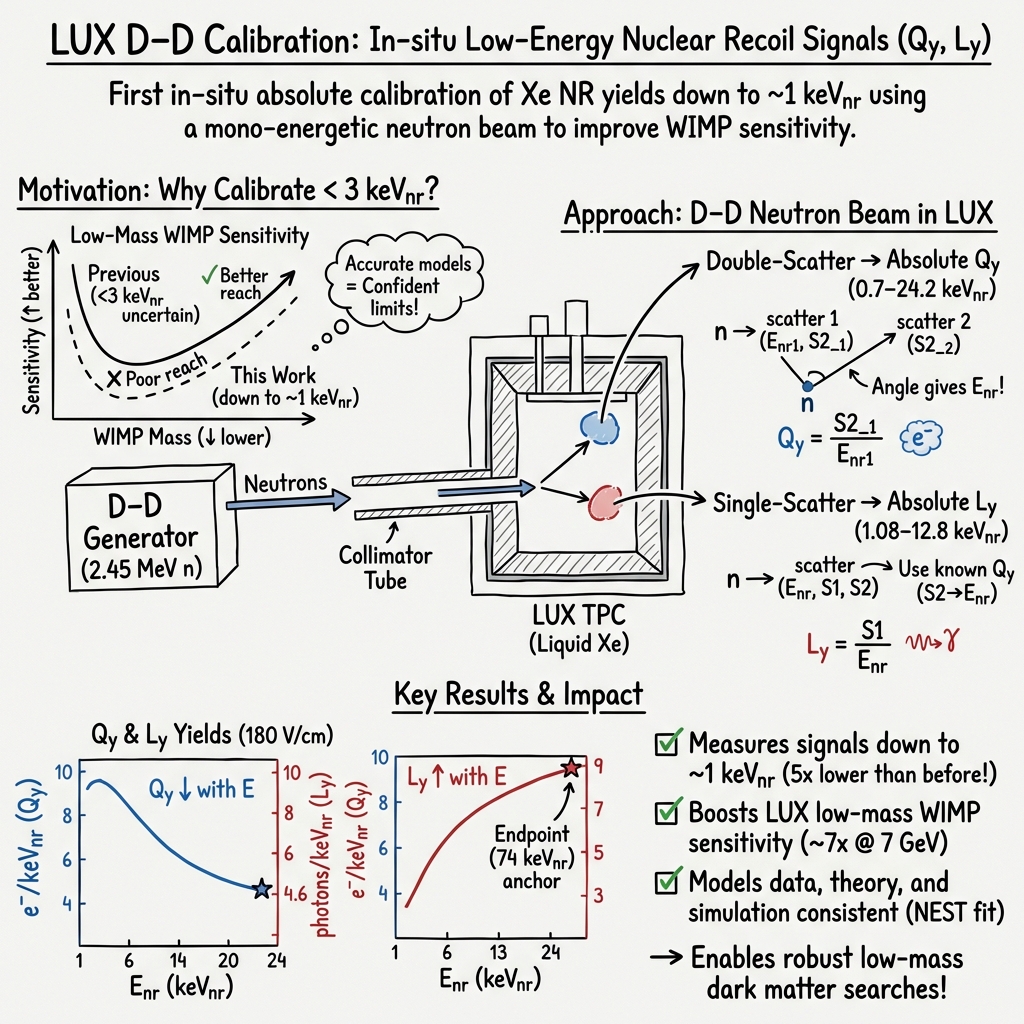
Abstract: The Large Underground Xenon (LUX) experiment is a dual-phase liquid xenon time projection chamber (TPC) operating at the Sanford Underground Research Facility in Lead, South Dakota. A calibration of nuclear recoils in liquid xenon was performed $\textit{in situ}$ in the LUX detector using a collimated beam of mono-energetic 2.45 MeV neutrons produced by a deuterium-deuterium (D-D) fusion source. The nuclear recoil energy from the first neutron scatter in the TPC was reconstructed using the measured scattering angle defined by double-scatter neutron events within the active xenon volume. We measured the absolute charge ($Q_{y}$) and light ($L_{y}$) yields at an average electric field of 180 V/cm for nuclear recoil energies spanning 0.7 to 74 keV and 1.1 to 74 keV, respectively. This calibration of the nuclear recoil signal yields will permit the further refinement of liquid xenon nuclear recoil signal models and, importantly for dark matter searches, clearly demonstrates measured ionization and scintillation signals in this medium at recoil energies down to $\mathcal{O}$(1 keV).
Paper Prompts
Sign up for free to create and run prompts on this paper using GPT-5.
Top Community Prompts
Explain it Like I'm 14
What is this paper about?
This paper explains how the LUX experiment—a giant, super-clean “camera” filled with liquid xenon deep underground—measured exactly how small “kicks” to xenon atoms show up as light and electric charge in the detector. These small kicks are the kind we expect if dark matter particles bump into xenon. The team used a special beam of neutrons to mimic those kicks and carefully calibrated the detector’s response at very low energies.
What questions were the scientists asking?
In simple terms, they wanted to know:
- When a xenon atom gets a tiny push (a nuclear recoil) with a certain energy, how much light and how much electric charge does the detector see?
- Can we measure these signals accurately all the way down to extremely small energies (around 1 thousandth of the energy used in a AA battery’s chemistry), where dark matter signals might hide?
- Can we report these measurements in “absolute” terms—actually counting the number of light photons and electrons—so other experiments and models can trust and use them?
How did they do the experiment?
The LUX detector, in simple terms
Imagine a clear tank full of liquid xenon. When a particle hits a xenon atom inside:
- It makes a tiny flash of light right away (called S1).
- It also knocks loose some electrons that drift upward in an electric field to the top, where they make a second, bigger flash in the gas above the liquid (called S2).
By recording both flashes, LUX can tell where and how big the hit was.
Making tiny “kicks” with neutrons
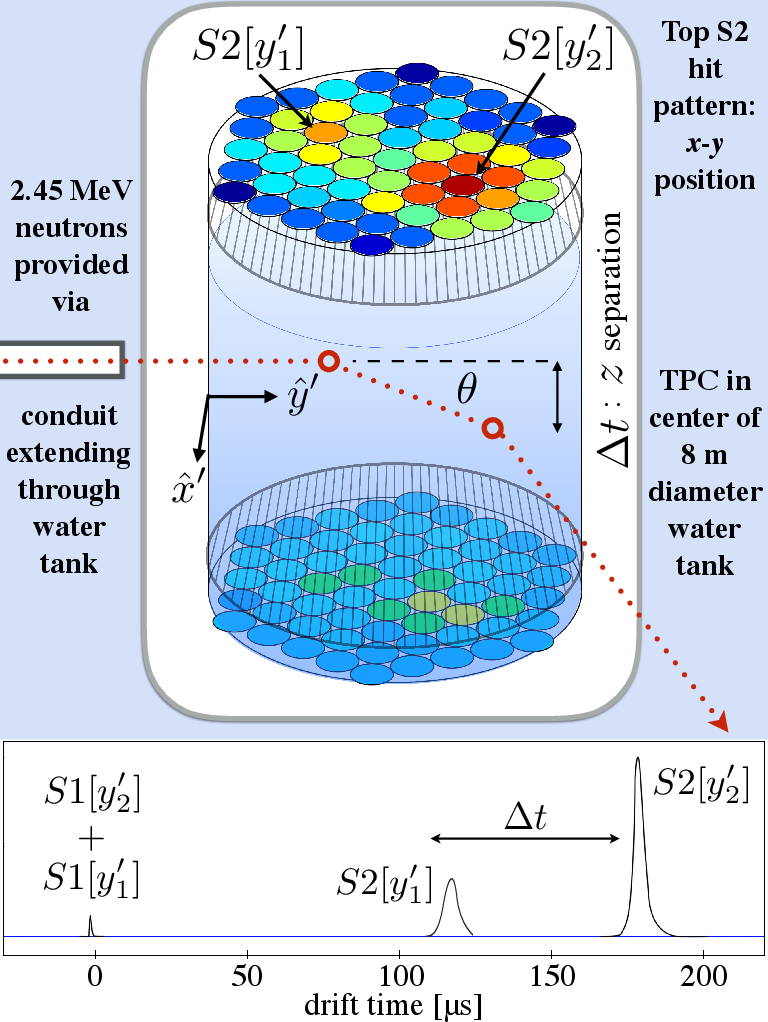
To simulate dark matter–like hits, they used a deuterium–deuterium (D–D) neutron source. It shoots out neutrons with a well-known energy (about 2.45 MeV). The team guided these neutrons through a narrow air-filled pipe into the xenon. Neutrons sometimes bounce off xenon atoms, giving them a small, measurable “kick” (recoil).
Two signals: S1 and S2
- S1 is the prompt light (photons).
- S2 is the delayed light caused by drifted electrons (so it tells you how many electrons were freed).
The team had already measured how many detector “counts” correspond to one photon and to one electron. That let them convert S1 and S2 into absolute numbers of photons and electrons.
Figuring out the recoil energy from angles (double-scatter trick)
If a neutron bounces twice inside the xenon, LUX sees two interaction points. From the 3D positions of those two points, the team can work out the angle the neutron turned. Just like billiards, the bounce angle tells you how much energy was transferred in the first hit. This lets them know the exact recoil energy without guessing.
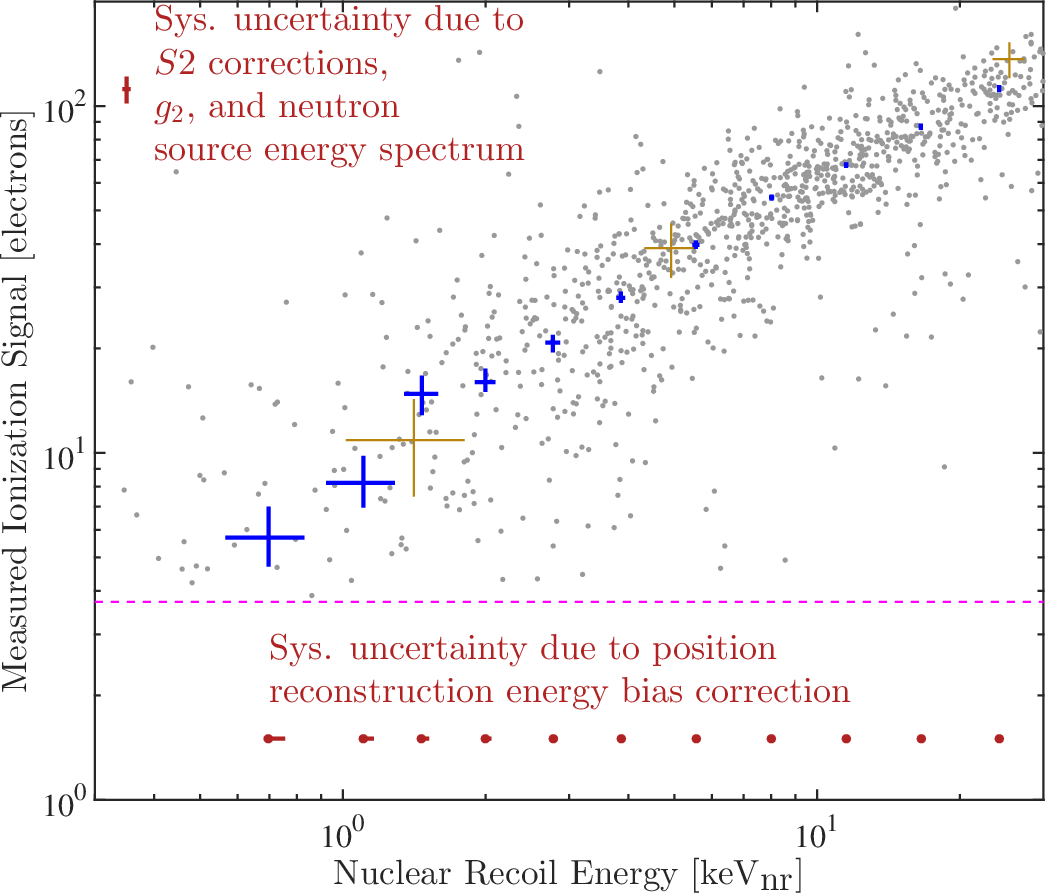
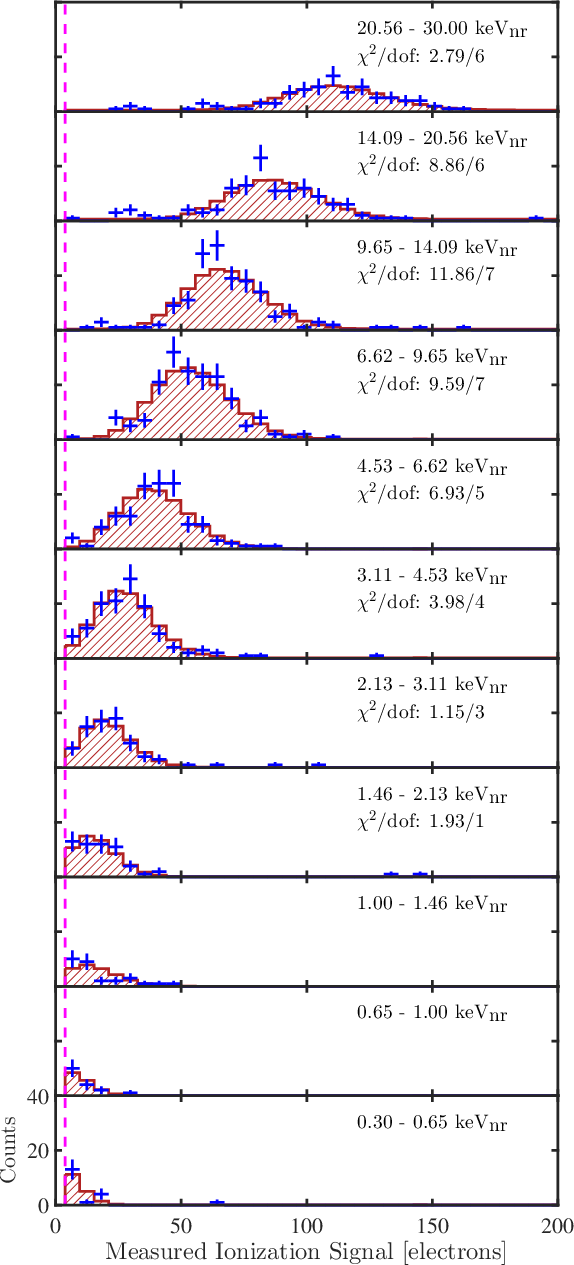
They then compared that known energy to the S2 signal from the first hit to learn the “charge yield” (how many electrons per energy). Using that, and the total S1 and S2 from single-bounce events, they also measured the “light yield” (how many photons per energy).
Making sure the measurements are trustworthy
- They set up the neutron beam to be very clean and mostly one energy, and only used events in a tight region along the beam path to keep the energy “pure.”
- They regularly calibrated the detector with a known source (krypton-83m) to correct for small changes in response across the detector and over time.
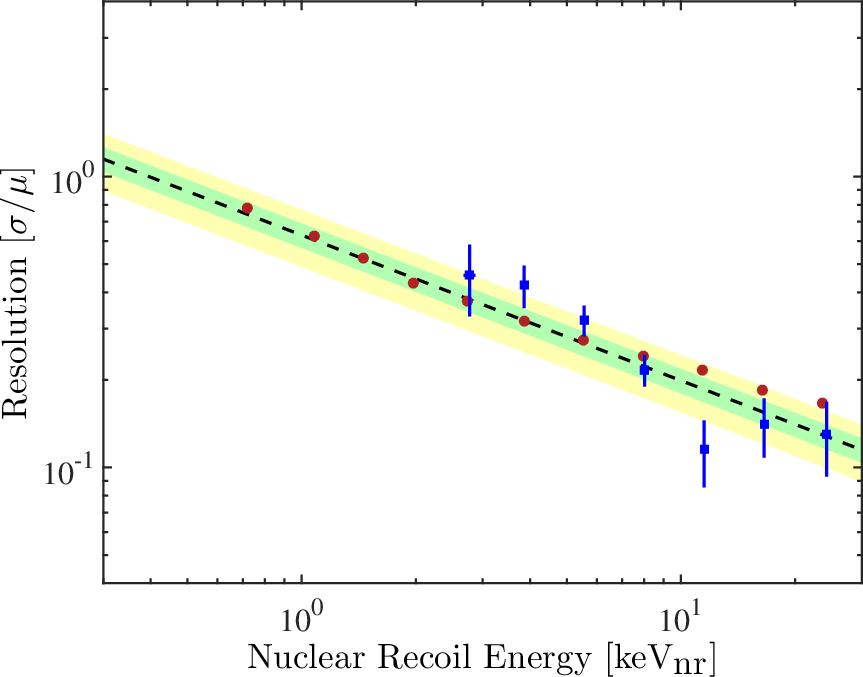
- They carefully estimated uncertainties, including how precisely they could locate each hit and a known statistical effect (Eddington bias) that can slightly skew results when sorting events by energy.
What did they find?
Here are the main results, explained plainly:
- They measured signals from extremely small nuclear recoils:
- Charge (electrons) from recoils as low as about 0.7 keV.
- Light (photons) from recoils as low as about 1.1 keV.
- They reported both light yield and charge yield in absolute units:
- “Absolute” means they directly counted how many photons and electrons were produced per unit of recoil energy, at the detector’s working electric field (about 180 V/cm). This avoids older, complicated definitions and makes the results easier to compare and use.
- They also measured yields at higher energy up to 74 keV, which is the maximum recoil energy a 2.45 MeV neutron can give xenon in a single bounce.
- Using all these data together, they updated and improved the models (called NEST models) that predict how liquid xenon should respond to nuclear recoils.
Why this matters:
- Before this work, the lowest reliable measurements using this “angle method” were only down to about 3–4 keV. LUX pushed that boundary down to around 1 keV, showing the detector really does see both light and charge at these tiny energies.
- That means LUX (and similar experiments) are more sensitive than previously proven to lighter dark matter particles, which would produce these very small recoils.
What does this mean for dark matter searches?
- Better sensitivity to low-mass dark matter: By proving that LUX can detect light and charge from very small nuclear recoils, the experiment can more confidently search for lighter dark matter particles.
- More accurate calibrations: Absolute measurements (counting real photons and electrons) reduce confusion and make results easier to share and compare across experiments.
- Stronger models for the community: The improved NEST models help scientists simulate xenon detectors more reliably, guiding the design and analysis of current and future dark matter experiments.
In short, this work is like finely tuning a very sensitive microphone to pick up whispers. By carefully calibrating how faint signals look in liquid xenon, the LUX team made it easier to hear the tiny “footsteps” that dark matter might leave behind.
Knowledge Gaps
Knowledge Gaps, Limitations, and Open Questions
The LUX experiment's efforts to calibrate nuclear recoil (NR) signals for dark matter detection leave several areas for further exploration. Here is a concise list of the knowledge gaps, limitations, and open questions identified from the paper:
- Energy Range Limitation: The study only calibrates nuclear recoils from 0.7 to 74 keV. Extending the calibration to lower or higher energies could improve the sensitivity and range of the experiment.
- Electron Lifetime Variation: The study assumes an average electron lifetime for data corrections. Understanding how electron lifetimes vary with operational conditions could refine the S2 signal correction.
- Spatial Distribution of Events: While the beam energy purity cuts are used, the exact spatial distribution and dynamics of neutron interactions within the detector remain generalized. Detailed spatial and temporal modeling could enhance understanding.
- Detector Response at Different Electric Fields: The calibration's dependency on specific electric fields (180 V/cm) implies it may not be broadly applicable without adjustments to experiments with different field strengths.
- Beam Direction Assumption: Assumes neutron beam direction is accurate within 1°; further exploration could be beneficial, as minor deviations could cause material misinterpretation of recoil energies.
- Eddington Bias: The analysis adjusts for energy bin bias (Eddington bias); however, future work could better characterize how measurement and reconstruction inaccuracies influence data interpretation.
- Detector Material Interactions: Recoil energy calculations consider only interactions with xenon, ignoring possible interactions with other materials in the detector, which could lead to systematic errors.
- Impurities Impact: The analysis doesn't deeply explore how variations in liquid xenon purity and other impurities may affect signal interpretation.
- Statistical vs. Systematic Uncertainties: A clearer distinction between dominating systematic and statistical uncertainties across different measurements would aid in targeted improvements.
- Kinematic Event Reconstruction: While used effectively, the kinematic method for determining recoil energies could be compared with alternative approaches to establish robustness and accuracy.
Each bullet point identifies areas for potential enhancement and exploration within nuclear recoil research and the broader pursuit of detecting dark matter. Addressing these gaps could significantly benefit future experiment iterations.
Practical Applications
Immediate Applications
Below are concrete, near-term uses that can be deployed with current technology and practices, directly leveraging the paper’s methods and results.
- In-situ low-energy nuclear recoil (NR) calibration for xenon dark matter TPCs (e.g., LZ, XENONnT, PandaX)
- Sector: academia (astroparticle physics), scientific instrumentation
- What to deploy: a pulsed, collimated 2.45 MeV D–D neutron source; air-filled conduit/beamline through water shielding; double-scatter kinematic reconstruction to obtain absolute NR energy; spike-counting for S1 at low energies; absolute g1/g2-based yield extraction; endpoint (74 keV) cross-check
- Expected impact: reduces NR yield systematics down to O(1 keVnr), sharpens WIMP sensitivity (especially at low mass), harmonizes yield models across collaborations
- Assumptions/dependencies: safe access to a D–D generator and site approvals; adequate event position resolution; experiment-specific electric field differences (≈180 V/cm in LUX) require field-scaling or remeasurement; sufficient statistics for double scatters
- Routine commissioning and QA workflows for dual-phase Xe TPCs
- Sector: academia/industry (detector builders, operations)
- What to deploy: scheduled D–D runs at end/beginning of data-taking; monitoring of g1, g2, electron lifetime, radial field maps; S1 spike-counting performance checks; beam energy purity cuts as a standard diagnostic
- Expected impact: early detection of drift-field non-uniformities, extraction-efficiency drifts, or light-collection degradation; reproducible low-threshold performance
- Assumptions/dependencies: stable DAQ/trigger identical to physics runs; frequent 83mKr map updates; site time allocation for calibration
- Immediate updates to NEST-based detector modeling
- Sector: software/research infrastructure
- What to deploy: integrate the paper’s simultaneous-fit NR yield models (Lindhard- and Bezrukov-based) and absolute g1/g2-constrained data; retune simulations for acceptance and background modeling
- Expected impact: improved prediction of S1/S2 distributions and NR bands down to ≲1 keVnr; better-fitted analyses and uncertainty budgets
- Assumptions/dependencies: users must revalidate analyses under their field and geometry; careful propagation of Eddington-bias corrections
- Neutron beamline design and operations in constrained shielding geometries
- Sector: academia (rare-event experiments)
- What to deploy: air-filled PVC collimation conduit suspended within large water shields; alignment methods; beam energy purity position cuts; duty-cycled pulsing to manage rates and safety
- Expected impact: enables mono-energetic NR calibration in large, deeply shielded detectors without permanent penetrations
- Assumptions/dependencies: mechanical integration with existing tanks/cryostats; radiation safety plan and interlocks; site-specific geometry adaptations
- Calibration of CEvNS and low-energy neutrino detectors using noble liquids
- Sector: neutrino physics, nuclear safeguards R&D
- What to deploy: replicate double-scatter angle method and endpoint calibration to determine absolute yields at 1–20 keVnr; update thresholds and background rejection
- Expected impact: trustworthy CEvNS signal modeling; informs detector size/threshold tradeoffs for reactor monitoring demos
- Assumptions/dependencies: noble-liquid technology stack similar to LUX (S2 gain, extraction, position resolution); careful separation of NR vs ER backgrounds
- Homeland security and SNM assay detector calibration (noble-liquid systems)
- Sector: security industry, national labs
- What to deploy: D–D-based, in-situ NR response calibration for fielded or prototype noble-liquid neutron/gamma systems; definition of alarm thresholds based on absolute NR yields
- Expected impact: improved reliability of low-energy NR response; fewer false positives/negatives in operational environments
- Assumptions/dependencies: regulatory approval to deploy D–D sources at test ranges; translation of results to detector-specific fields and optics
- Training and curriculum materials for detector physics
- Sector: education
- What to deploy: lab modules on double-scatter kinematics, spike counting, electron lifetime corrections, and Eddington-bias mitigation using public datasets and code snippets
- Expected impact: hands-on understanding of connecting kinematics, reconstruction, and yield models
- Assumptions/dependencies: availability of suitably anonymized datasets and analysis scripts
- Safety and operations templates for pulsed neutron sources underground
- Sector: operations/policy within labs and collaborations
- What to deploy: SOPs covering duty cycles, interlocks, shielding, alignment, and collimated-beam operations; exposure calculations; emergency procedures
- Expected impact: smoother approvals and safer operations for future calibrations
- Assumptions/dependencies: site-specific constraints, authority having jurisdiction requirements
Long-Term Applications
These opportunities need further R&D, scaling, standardization, or cross-domain adaptation before widescale deployment.
- Turnkey D–D calibration packages for noble-liquid TPCs
- Sector: scientific instrumentation industry
- What to develop: vendor-supplied source+collimator+positioning hardware; control software; analysis pipeline (double-scatter vertexing, Eddington-bias correction, field-map corrections)
- Expected impact: reproducible, standardized NR calibration across experiments; reduced integration burden for new detectors
- Assumptions/dependencies: heterogeneous detector geometries; variable field settings; market size and serviceability in underground labs
- Scaling to multi-ton detectors (e.g., DARWIN)
- Sector: academia/engineering
- What to develop: extended beam paths and improved reconstruction (including ML-based multi-scatter disambiguation) to maintain angle resolution; strategies to mitigate longer drift and larger field non-uniformities
- Expected impact: preserves sub-keVnr sensitivity and absolute calibration at unprecedented scale
- Assumptions/dependencies: sufficient double-scatter rates at larger dimensions; manageable computational costs; careful control of space-charge and field distortions
- Cross-media generalization (LAr, LNe dual-phase TPCs)
- Sector: neutrino and dark matter experiments
- What to develop: adapt double-scatter kinematics and absolute-yield extraction to different scintillation/emission physics; field-quenching measurements in absolute units
- Expected impact: unified, absolute NR yield baselines across media; better ER/NR discrimination models
- Assumptions/dependencies: photodetector timing, S2 yield, and recombination physics differ; requires bespoke g1/g2 calibration and spike-counting adaptations
- Reactor monitoring via CEvNS with calibrated noble liquids
- Sector: energy, safeguards policy
- What to develop: compact, calibrated TPCs for persistent, non-intrusive reactor monitoring using CEvNS; robust low-energy NR modeling grounded in D–D calibrations
- Expected impact: new tool for verification of reactor operations and potentially fuel evolution
- Assumptions/dependencies: background suppression near reactors; deployment logistics; regulatory acceptance and cost-effectiveness
- Medical neutron imaging and therapy QA
- Sector: healthcare (neutron therapy, fast-neutron imaging)
- What to develop: translate precise NR calibration concepts to detectors monitoring neutron dose distributions or imaging contrast; validate dosimetry response using calibrated D–D beams
- Expected impact: improved dose/contrast fidelity and QA in neutron-based modalities
- Assumptions/dependencies: suitability of noble-liquid or analogous detectors in clinical settings; integration with medical workflows and standards
- Shared underground neutron-beam calibration facilities
- Sector: research infrastructure/policy
- What to develop: communal, low-background D–D (and possibly D–T) beamlines serving multiple experiments; standardized NR calibration protocols and inter-comparison campaigns
- Expected impact: cross-experiment consistency; reduced duplication of infrastructure
- Assumptions/dependencies: capital investment; scheduling across experiments; site radiation safety constraints
- Algorithmic products for rare-event reconstruction and calibration
- Sector: software
- What to develop: maintained libraries for S1 spike counting, double-scatter vertexing, angle-to-energy propagation with uncertainties, Eddington-bias correction, and field non-uniformity correction
- Expected impact: lowers barrier to robust low-energy calibration; reproducibility across collaborations
- Assumptions/dependencies: dataset diversity for validation; sustained community support
- Detector design optimization frameworks using absolute low-energy yields
- Sector: R&D across academia/industry
- What to develop: simulation-driven workflows that exploit absolute NR yields to optimize field strengths, extraction grids, light collection, and materials for rare-event and security detectors
- Expected impact: cost–performance trade studies grounded in realistic low-energy response
- Assumptions/dependencies: accurate scaling of yields with field and geometry; integration with GEANT4/NEST and optical models
- Standards and test protocols for low-energy neutron response
- Sector: policy/standards (metrology, security, safeguards)
- What to develop: performance metrics and certification procedures for detectors’ response to ≈2.45 MeV neutron-induced NRs; inter-lab round-robin tests using D–D sources
- Expected impact: comparable, transparent performance claims across vendors and labs
- Assumptions/dependencies: consensus among stakeholders; adoption by standards bodies; supply and regulation of D–D sources
- Higher-energy calibration extensions (e.g., D–T at 14 MeV) and endpoint methodologies
- Sector: academia/industry
- What to develop: combine D–D low-energy calibration with D–T high-energy endpoints to cover full NR spectrum; refine endpoint-based absolute yield extraction across energies
- Expected impact: end-to-end calibration for experiments sensitive to wide NR ranges (e.g., supernova neutrinos, neutron backgrounds)
- Assumptions/dependencies: higher regulatory burden for D–T; increased shielding needs; detector survivability and backgrounds at higher energies
These applications hinge on the paper’s core innovations: in-situ, kinematically defined NR energy reconstruction via double scatters; absolute yield extraction using precisely calibrated g1/g2; demonstrable S1/S2 response to O(1 keVnr); validated beam energy purity cuts; and simultaneous yield-model fits that immediately improve NEST-based simulations.
Glossary
Dark Matter: Theoretical form of matter that does not emit, absorb, or reflect light, detectable through its gravitational influence. Example: "The detector is designed to directly detect WIMP dark matter in the local galactic halo."
Deuterium-Deuterium (D-D) Fusion: A nuclear reaction wherein two deuterium nuclei fuse to produce neutrons and helium isotopes, often used as a neutron source. Example: "A collimated beam of mono-energetic 2.45 MeV neutrons produced by a deuterium-deuterium (D-D) fusion source."
Ionization Yield: Quantity of ionization electrons produced per unit of energy deposition from nuclear recoils. Example: "Ionization yield was measured as a function of nuclear recoil energy from 0.7 to 24.2 keV."
Kinematically Defined: Describes a system where quantities like energy and momentum are determined based on motion, disregarding specific internal forces or interactions. Example: "... kinamatically-defined nuclear recoil energies."
Monte Carlo Simulation: A method using random sampling to solve problems that have probabilistic interpretation, frequently used in physics to simulate complex systems. Example: "Monte Carlo simulation studies using LUXSim/GEANT4 indicate..."
Photoelectron: An electron emitted from a material as a result of photoelectric effect when light is incident on it. Example: 'The unit "phd" differs from the traditional unit of photoelectrons (phe)...'
Scintillation: Light emission from a material excited by ionizing radiation, utilized for particle detection. Example: "Energy depositions in the liquid xenon target produce both scintillation photons and ionization electrons."
Simualtion Eddington Bias: An observational bias occurring when random errors cause more extreme values to enter the sample and affect the measurement distribution. Example: "This effect broadens the width of the measured charge distribution in a given bin."
Spin-independent WIMP-nucleon Cross-section: Describes the probability of interaction between weakly interacting massive particles (WIMPs) and nucleons, with interactions not dependent on the spins of the particles involved. Example: "The most stringent direct detection limits on the spin-independent WIMP-nucleon cross-section."
Time Projection Chamber (TPC): A type of detector that allows three-dimensional reconstruction of ionizing events by collecting charge drifted in a uniform electric field. Example: "The Large Underground Xenon (LUX) experiment is a dual-phase liquid xenon time projection chamber (TPC)."
Collections
Sign up for free to add this paper to one or more collections.