- The paper establishes a morphospace framework for consciousness that integrates autonomous, cognitive, and social complexities.
- It maps various systems onto these dimensions, contrasting human neurological measures with AI's computational prowess.
- The framework proposes design principles for engineering conscious machines and advancing research in both synthetic biology and AI.
The Morphospace of Consciousness
Introduction
The paper establishes a theoretical framework for understanding consciousness through a "morphospace" that leverages information-theoretic measures across dimensions of autonomous, cognitive, and social complexity. This framework allows for comparative analysis of biological entities, from microorganisms to humans, alongside AI systems such as deep neural networks and social robots. By extending clinical measures of consciousness to synthetic systems, the paper proposes a taxonomy that distinguishes various classes of consciousness, ultimately guiding the design principles necessary for engineering conscious machines.
Concepts of Autonomous, Cognitive, and Social Complexity
The morphospace is conceptualized using three primary axes:
- Autonomous Complexity (CAutonomous): Refers to the system's capability for self-regulated behavior, determined by arousal mechanisms in biological systems or homeostatic processes in robotics.
- Cognitive Complexity (CCognitive): Captures the system's ability to process information across tasks, analogous to computational capabilities in AI systems.
- Social Complexity (CSocial): Encompasses interactions between individuals or entities, referencing the emergence of language, culture, and social norms, indicative of an agent's social intelligence.
The paper's core contribution is the alignment of these dimensions with measures of wakefulness and awareness used clinically to assess consciousness, drawing parallels between biological and synthetic forms.
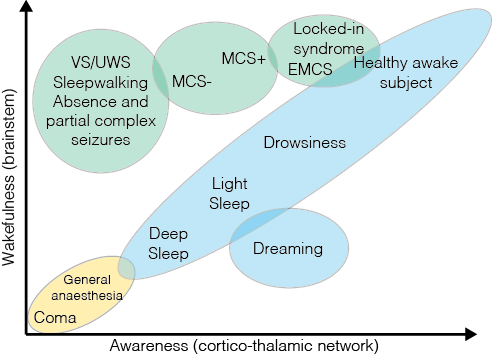
Figure 1: Clinical scales of consciousness, representing disorders on axes of awareness and wakefulness.
Application and Implications in AI and Synthetic Biology
By mapping various biological and artificial systems onto this morphospace, the research highlights differing levels of consciousness:
- Biological Systems: Humans and other higher-order organisms occupy regions of high complexity across all three dimensions.
- AI Systems: Advanced computational systems like IBM Watson and AlphaGo exhibit high cognitive complexity due to their domain-specific prowess, but typically score low on autonomous and social complexities.
- Synthetic Life: Emerging biotechnological constructs show promising autonomous complexity through reactive behaviors but lag in computational or social domains.
The paper fosters a new avenue for AI development by not only replicating biological consciousness but also exploring novel manifestations potentially achievable by future machines.
Functional Perspective of Consciousness in Robotics
The paper draws insights from cognitive robotics, positing consciousness as a solution to the "H5W problem" (How, Why, What, Where, When, and Who), which addresses an agent's interaction within social and dynamic environments. Game theory is utilized to articulate consciousness as an evolutionary strategy, emphasizing the social dimension crucial for cooperation and competition among agents. This recognizes the role of social interactions in shaping intelligent behaviors and adaptive responses observed in natural evolution.
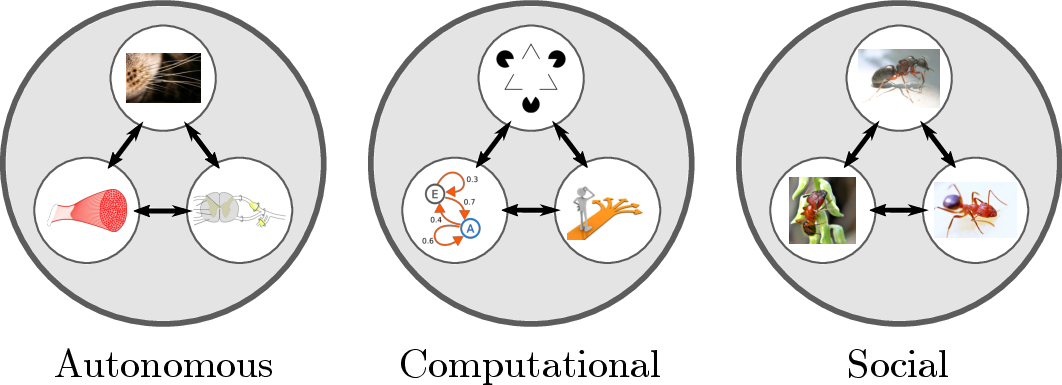
Figure 2: Schematic representation of autonomous, computational, and social complexity.
Future Directions and Developments
The morphospace framework suggests potential future developments in consciousness embodiments, including:
- Group Consciousness: Envisioning collective systems, such as swarms or social networks, manifesting distributed consciousness through emergent properties of cooperation.
- Simulated Consciousness: Exploring consciousness within virtual environments where agents interact, learn, and adapt, simulating complex social interactions.
Such perspectives encourage extending AI beyond its current computational bounds by integrating social and autonomous complexities necessary for generalized intelligent behavior. These developments underline a transformative potential for both AI and synthetic biology as they converge towards more biologically analogous systems.
Conclusion
This paper sets the stage for a unified framework merging insights from various fields to explore consciousness within artificial and biological spectra. The proposed morphospace provides a robust, quantitative tool for classifying and engineering conscious systems, paving the way for advancements in AI that parallel human-like adaptability and intelligence. As research progresses, this framework will likely illuminate new pathways and criteria for realizing the full spectrum of conscious machines.