- The paper presents a comprehensive system model that optimizes mission parameters using Goubau beam propagation and relativistic equations.
- It integrates advanced optical modeling and material analysis to balance laser power, beam duration, and sail properties, effectively reducing beamer CAPEX.
- Point designs for different cruise velocities illustrate feasibility and sensitivity to key factors like laser cost and sail material properties.
System Analysis of the Breakthrough Starshot Initiative
This paper presents a comprehensive system model developed for the Breakthrough Starshot initiative, which aims to send nanocrafts to Alpha Centauri using beamed energy propulsion. The model is designed to optimize mission parameters and evaluate the feasibility of achieving ultra-fast interstellar travel (1805.01306).
Background and Motivation
The concept of using light sails accelerated by lasers for interstellar travel dates back to the 1960s, with early work by Forward exploring metallic sails and later advancing to dielectric sails. Dielectric sails offer significantly lower absorption than metallic sails, enabling higher irradiance and acceleration, which reduces the required beam size, timescale, and overall cost. The current system model builds upon previous models by Loeb and Lubin, which used simplifying approximations like top-hat beams and manual cost minimization.
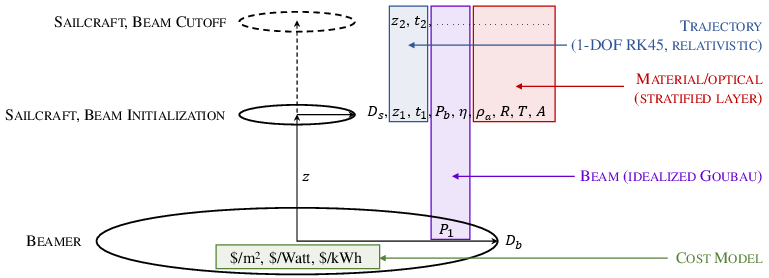
Figure 1: A high-level overview of the system model encompassing beam propagation from a ground-based beamer to a space-based sailcraft.
The system model revolves around the propagation of a beam from a ground-level beamer to a sailcraft in space (Figure 1). The model incorporates several key components:
- Goubau Beam Propagation: Unlike Gaussian or top-hat beams, Goubau beams describe near-optimal energy transfer between finite optics. The model calculates beam power transfer efficiency ηb(τ) using equations (2)-(5), where τ is a dimensionless parameter dependent on optic diameters, distance, and wavelength.
- Relativistic Equation of Motion: The equation of motion relates the power incident on the sailcraft to its acceleration, derived from momentum conservation. The derivation extends Kulkarni's approach to include a dielectric sailcraft with finite transmittance and thermal re-emission. The force on the sailcraft is given by:
Fs=cPb1+β1−β(A+2R)
where Pb is the beam power, β is the velocity, A is the absorptance, and R is the reflectance.
- Stratified Layer Optical Model: This model calculates the reflectance, transmittance, and absorptance of thin films using a characteristic matrix method. It is used to determine the optimum sail thickness for maximum acceleration per unit beam power.
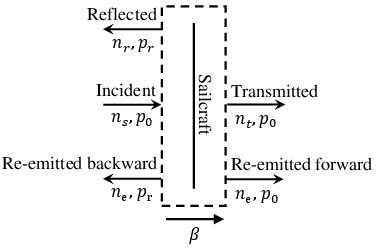
Figure 2: The control volume used for calculating photon momentum change.
Key Trade-Offs and Cost Optimization
The core challenge lies in achieving the desired cruise velocity at minimum cost. The traditional approach involves trading off beamer primary optic diameter versus power. The paper introduces the concept of trading beam duration against power and diameter to further reduce capital expenditure (CAPEX). A simplified model for beamer CAPEX is given by:
C=ka4πDb2+klP1,max+keQ0
where ka, kl, and ke are cost factors for optics, lasers, and energy storage, respectively.
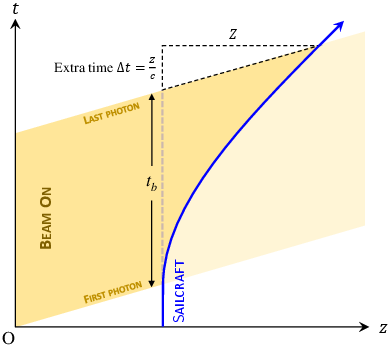
Figure 3: A spacetime diagram illustrating the relationship between beam duration and sailcraft trajectory.
Solution Procedure
The system model uses a nested optimization procedure to minimize beamer CAPEX while ensuring the sailcraft reaches its cruise velocity. The procedure involves:
- Outer iteration: Golden section search varying sailcraft diameter.
- Inner iteration: Golden section search varying beamer power.
- Bisection solver: Varying beamer diameter to match the desired cruise velocity.
- Trajectory integration: Using the RK45 algorithm to calculate sailcraft velocity and pulse energy.
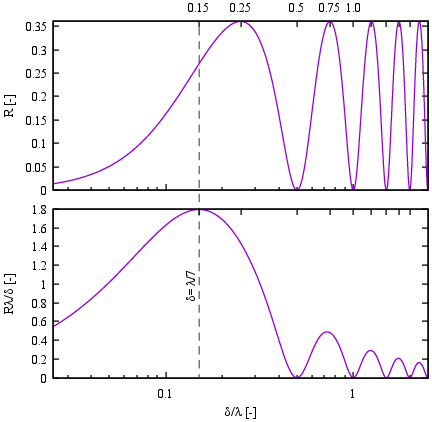
Figure 4: Plots of key performance indicators, predicted by the stratified layer model, for various dielectric film thicknesses.
Point Designs and Results
The system model is used to compute point designs for three scenarios:
- 0.2c Mission to Alpha Centauri: This design assumes advanced technology with laser costs of \SI[per-mode=symbol]{0.01}[\$]{\per\watt} and optics costs of \SI[per-mode=symbol]{500}[\$]{\per\meter\squared}. The optimized design features a 4.1 meter sail diameter and a 2.7 meter effective beamer diameter, with a total beamer CAPEX of approximately \$7 billion.
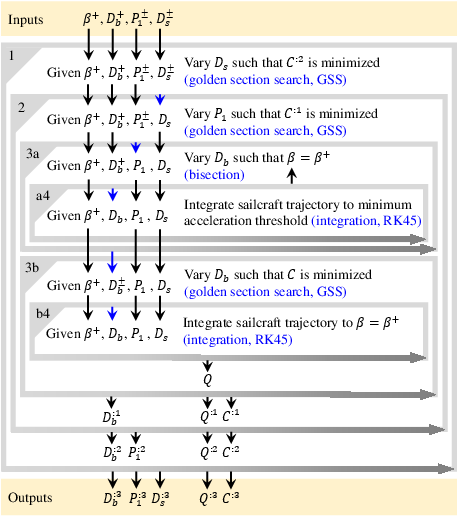
Figure 5: A visual depiction of the iterative solution procedure employed to determine the system's optimal configuration.
- 0.01c Solar System Precursor Mission: This design uses more near-term technology assumptions with laser costs of \SI[per-mode=symbol]{1}[\$]{\per\watt} and optics costs of \$10k/m\textsuperscript{2}. The optimized design has a 19 meter sail diameter and a 169 meter beamer diameter, with a beamer CAPEX of around \$4 billion.
- Ground-Based Vacuum Tunnel: This design explores the feasibility of testing sails in a vacuum tunnel. For a \SI{20}{\kilo\meter\per\second} sail speed, the model suggests a 0.4 km tunnel, 22 MW of lasers, and a 0.6 meter telescope, costing approximately \$60 million.
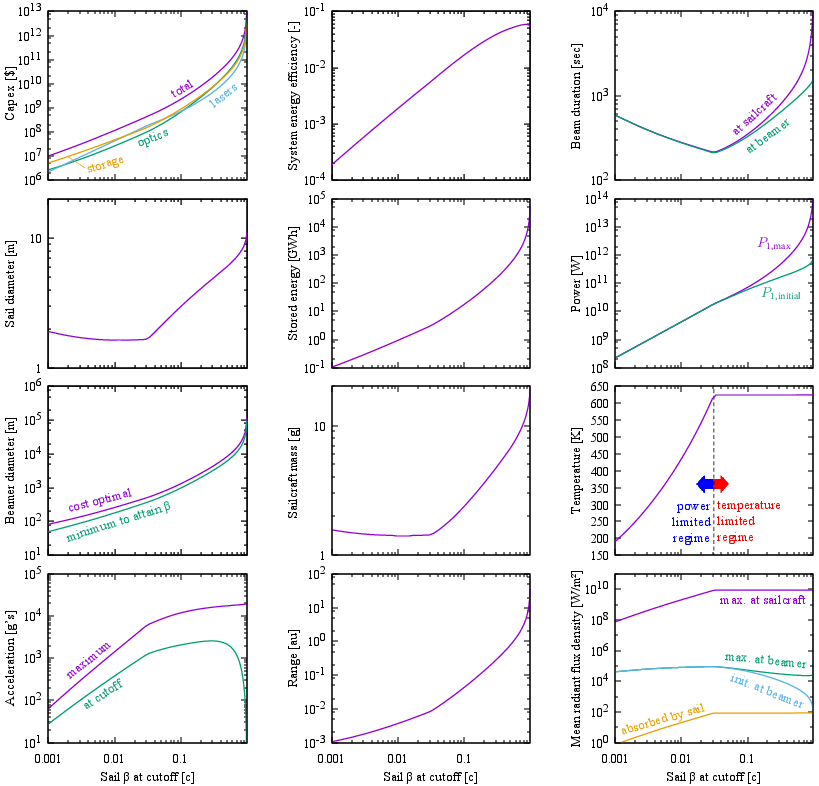
Figure 6: A plot showing the impact of varying cruise velocity on different mission parameters.
Sensitivity Analysis
The paper includes a sensitivity analysis that examines the impact of varying technology figures of merit on the overall system cost. The results show that the cost-optimized solutions are relatively resilient to changes in laser and optics costs, as the system can compensate by adjusting other parameters. However, variations in sail material properties, such as absorptance and reflectance, can have a significant impact on the beamer cost.
Conclusions
The paper presents a detailed system model for beam-driven sailcraft, incorporating Goubau beam propagation, relativistic equations of motion, and stratified layer optical modeling. The model optimizes mission parameters by trading off laser power, optics diameter, and beam duration to minimize beamer capital cost. The point designs and sensitivity analysis provide valuable insights into the feasibility and cost drivers of the Breakthrough Starshot initiative. Key findings include the importance of sail material properties, the potential for multi-lightyear pipelines of sailcraft, and the trade-offs between cruise velocity and beamer diameter. The model can be further extended to handle probabilistic inputs, incorporate domain models, and refine cost estimations.