- The paper presents a model leveraging vacuum birefringence to indirectly measure magnetic fields in black hole accretion disks.
- It employs the Kerr metric and the Poincaré formalism to simulate photon polarization changes linked to black hole spin and magnetic field configuration.
- Simulation results indicate that upcoming X-ray polarimetry missions can validate QED predictions and offer quantitative insights into magnetic field dynamics.
Probing Black Hole Magnetic Fields with Quantum Electrodynamics (QED)
Introduction
The paper "Probing Black Hole Magnetic Fields with QED" (1805.11018) explores the application of quantum electrodynamics (QED) to investigate the magnetic fields surrounding accreting black holes. By leveraging the phenomenon of vacuum birefringence, the research aims to understand and quantify the magnetic fields that are crucial for accretion processes. These fields play a significant role not only in accretion but also in the formation of relativistic jets through mechanisms like the Penrose–Blandford–Znajek process. Despite their importance, direct measurement of these fields presents a significant observational challenge.
Theoretical Framework
The concept of vacuum birefringence, a key prediction of QED, forms the theoretical backbone of this study. Although nearly imperceptible in the presence of terrestrial magnetic fields, this effect becomes relevant in the intense magnetic environments of black hole magnetospheres. Quantum electrodynamics postulates that the vacuum becomes birefringent, which means it differentiates between polarizations of light due to the presence of a magnetic field. This study posits that the polarization of X-ray emissions from the accretion disk undergoes significant alteration as these emissions traverse the magnetosphere, thus providing indirect insights into the field's strength and configuration.
Model Assumptions and Calculations
To conduct their analysis, the authors employ the Kerr metric to model the spacetime surrounding rotating black holes. The magnetic field strength along the disk’s mid-plane is assumed based on the α-model for accretion disks. The authors also implement the Poincaré formalism to examine the evolution of photon polarization through the magnetosphere. This allows them to simulate how magnetospheres with partially organized fields would depolarize X-ray emissions differently depending on their spin and the angular momentum of the photons.
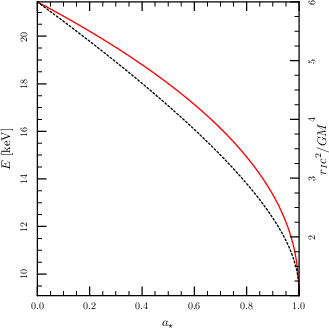
Figure 1: The plot shows, on the left y-axis, the energy at which rp=rI (solid red line). On the right y-axis, the ISCO for a black hole as a function of the spin parameter a⋆ (dashed black line).
Simulation Results
The study develops models to determine the polarization-limiting radius (PLR), which approximates where vacuum birefringence ceases to significantly alter photon polarization, using parameters like spin and magnetic field strength. Figure 1 exemplifies the relationship between photon energy, the innermost stable circular orbit (ISCO), and black hole spin, showing that QED effects are notable at different energy levels based on spin velocity.
Empirical findings demonstrate that photons with differing specific angular momenta—and thus different interactions with the accretion disk's magnetic field—experience varying degrees of depolarization. Figure 2 illustrates how vacuum birefringence affects photon polarization across different black hole spins and photon angular momenta. The solid and dashed lines represent different magnetic field configurations, highlighting the nuances in polarization behavior indicative of the disk’s magnetic structure.
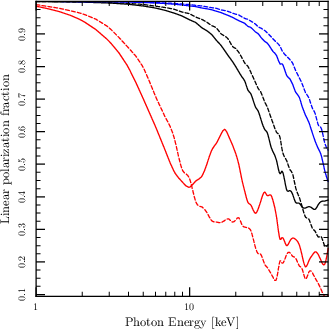
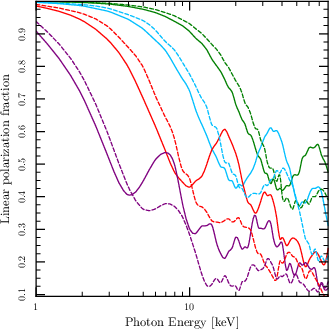
Figure 2: Final polarization fraction vs. photon energy calculated in the 2-fold (solid lines) and 1.5-fold configurations (dashed lines) for varying angular momentum photons for different spin parameters.
In addition, the paper simulates observational predictions for the X-ray polarimetry missions such as IXPE and eXTP. The observed polarization degree from these missions, when aligned with the theoretical models, could discern the magnetic field strength and its structural characteristics close to black hole event horizons.
Discussion and Implications
The simulations indicate significant potential for QED effects, specifically the influence of vacuum birefringence on polarization observables in high-energy astrophysical settings. The distinct patterns and peaks found in photon polarization spectra, especially in environments of intense magnetic fields near fast-spinning black holes, could serve as direct evidence for the structure and strength of magnetic fields in black hole systems.
The results suggest that existing and upcoming X-ray polarimetry missions are poised to test these theoretical assumptions and models. By refining the structure of the magnetic field models, researchers could leverage polarization data to extract more precise insights about magnetic fields in accreting black holes, informing both theoretical physics and astrophysical observations.
Conclusion
Overall, this study provides a comprehensive model for understanding black hole magnetic fields through QED's vacuum birefringence effect on X-ray polarization. The results hold substantial implications for future observational missions, potentially guiding more sophisticated explorations of magnetic field dynamics in black-hole accretion disks.